Parents Guide GCSE Resits: How to Help Your Teen
Parents guide GCSE resits with current 2026 dates, clear resit rules and calm, practical ways to help your teenager revise without added pressure.

Missing a GCSE grade can feel larger than the result itself. Your teenager may see a closed door, while you may feel an urgent need to find the right course, timetable and revision plan. The useful truth is quieter: a resit is another exam series, not a judgement on their ability or future.
This parents guide GCSE resits explains how the system works, the key dates for 2026-27 and how to offer practical help without turning every conversation into a progress check. For most families, the best support combines clear administration, a manageable routine and enough space for the teenager to retain ownership.
GCSE resit checklist for parents
Start with these practical steps:
- Confirm the subject, exam board, specification and tier where applicable.
- Ask the school or college whether the student has been entered for November 2026 or summer 2027.
- Check the examination centre, timetable and arrival arrangements.
- Find out whether the resit is being funded by the school or college, or whether a fee applies.
- Ask what teaching, supervised revision and access arrangements are available.
- Build a short weekly revision routine around the teenager's main course.
- Use topic practice before moving to complete past papers.
- Agree how you will discuss progress, rather than asking about revision every day.
MathsGenie's November GCSE resits guide gives students a useful overview of the autumn series. For a broader explanation of entries and retaking qualifications, read GCSE resits explained.
How the GCSE resit system works
In England, students on eligible 16-19 study programmes who have not achieved grade 4 or above in GCSE maths or English are normally required to continue studying those subjects. This requirement forms part of the government's condition of funding for schools and colleges.
That does not necessarily mean every student must sit an examination at the first possible opportunity. A college may consider attendance, engagement, prior grade and current progress before deciding whether a November entry is appropriate. Your first source of information should therefore be the exams officer, resit teacher or course leader.
The November GCSE series is principally used for mathematics and English Language. Under the current rules for qualifications regulated in England, candidates taking these GCSEs in November must have been at least 16 on 31 August of that year. Other GCSE subjects are generally retaken in the summer series.
A student who already has a grade 4 may still choose to resit when a higher grade is needed for a particular course, apprenticeship or career route. Entry and funding arrangements can differ in that situation, so ask the centre before making plans. Policies also vary outside England and between institutions.
Foundation or higher tier in maths
GCSE maths is available at foundation and higher tier. Foundation tier provides access to grades 1-5, while higher tier provides access to grades 4-9, with a limited grade 3 award possible in some circumstances. The right choice is not simply the tier with the highest available grade.
A teenager aiming for a secure grade 4 may perform better on foundation if higher-tier content has repeatedly caused difficulty. Someone who needs grade 6 for a future course will need higher tier. The school or college should make the decision using prior performance, current assessments and the student's progression goal.
Before buying resources or printing papers, confirm the board and tier. MathsGenie's GCSE maths revision hub covers AQA, Edexcel, OCR, Eduqas and other boards, with exam questions, revision materials and past papers.
Key GCSE resit dates for 2026-27
The confirmed November 2026 common timetable places English Language papers on Tuesday 3 November and Thursday 5 November. GCSE mathematics papers are on Wednesday 4 November, Friday 6 November and Monday 9 November 2026.
Students taking the November 2026 series are due to receive results on Wednesday 13 January 2027. Schools and colleges receive results electronically the previous day.
Exact paper times, components and arrangements must be checked on the candidate timetable issued by the examination centre. Do not rely only on a date copied into a family calendar. Access arrangements, examination clashes and supervised timetable variations are handled by the centre.
If the November entry deadline has passed, contact the school or college immediately rather than assuming an entry exists. Late entries may not be possible and can attract additional fees. Students not entered in November can discuss the next appropriate summer series with their centre.
For summer 2027, examination dates depend on the subject and board. Confirm the final timetable with the centre when it is issued. Working backwards from that date is much easier with MathsGenie's free revision planner.
Supporting a teen through a resit without pressure
A resit student often carries two workloads. They may be beginning A Levels, a vocational qualification or an apprenticeship while revisiting a subject associated with disappointment. A revision plan that ignores the new course is unlikely to last.
Begin by asking what kind of help would be useful. Offer a few choices: planning sessions, finding resources, providing a quiet room or leaving revision entirely between the student and teacher. Choice restores some control.
Agree one weekly check-in. Keep it brief and specific:
- What was covered this week?
- Which topic still feels uncertain?
- Is there anything practical I can arrange?
- What is the next small task?
This is more constructive than repeated questions such as, “Have you revised yet?” MathsGenie's guide to helping with GCSE maths without nagging develops this approach further.
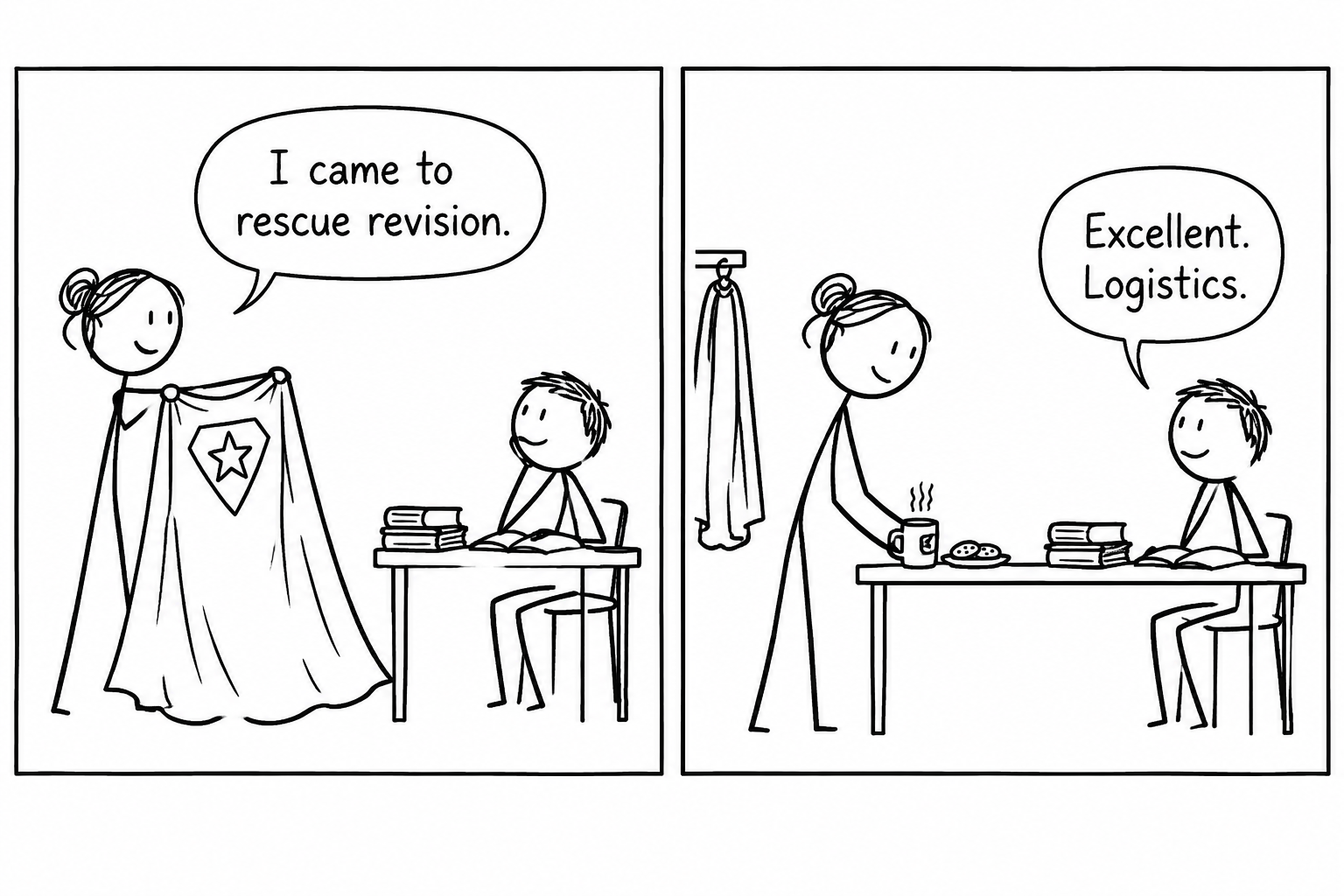 A parent discovers that quiet practical support can be more useful than arriving as a revision superhero
Practical support matters because it removes friction. Help protect a regular time, keep the calculator and stationery together, and make meals or travel one less thing to organise near the examination. These actions communicate confidence without demanding a performance report.
What effective resit revision looks like
Resit revision should not be a complete replay of Year 11. The student already has evidence showing what happened last time. The aim is to diagnose gaps, relearn specific material and practise retrieving it under examination conditions.
A sensible cycle is:
- Complete a short assessment or selected past-paper questions.
- Identify topics where marks were lost.
- Use a revision lesson or video solution to rebuild the method.
- Answer practice questions without looking at the solution.
- Mark the work and correct every error.
- Revisit the topic several days later.
At first, shorter topic sessions are often more productive than full papers. Complete papers become valuable once knowledge is reasonably secure because they develop timing, question selection and stamina. The student can use the GCSE maths revision timetable guide to create a routine that fits around college.
When full-paper practice begins, match the correct exam board and tier. For example, MathsGenie's Edexcel GCSE maths past papers include mark schemes and papers organised by series and tier. Revision lessons, practice questions, mini tests, predicted papers and video solutions can then be used to repair the weaknesses revealed by marking.
Your role is not to become the teacher. You can help by asking whether mistakes have been corrected, not whether a particular score is “good enough”. Progress may first appear as clearer working, fewer unfinished questions or better recognition of a topic. Marks often follow later.
Common mistakes parents and students should avoid
Treating the resit as an emergency
Urgency can produce an ambitious plan that collapses after a week. Several focused sessions completed consistently are more useful than a punishing timetable built around guilt.
Revising everything equally
Students often return to topics they already enjoy because success feels reassuring. A diagnostic paper or teacher assessment should decide priorities. If time is short, use the practical advice in how to catch up on GCSE revision.
Measuring every session by a grade
Grade boundaries are set for each examination series, so a raw mark should be treated as evidence, not a guaranteed grade. Look at the types of errors being made and whether corrections can be completed independently.
Using the wrong papers
A paper from the wrong board or tier can create confusion and misleading results. Check the specification code, examination board and tier on the centre's entry confirmation.
Making home feel like another classroom
A teenager needs a parent more than another examiner. Keep revision conversations within agreed boundaries. Notice effort and follow-through, while allowing the teacher and mark scheme to judge the work.
A calm route towards the next result
A GCSE resit matters, but it does not need to dominate family life. Confirm the administrative details, agree a realistic weekly routine and let evidence from practice guide the next task. That is effective GCSE resit help for parents: structure without surveillance, encouragement without false promises and practical support without taking control.
MathsGenie provides free GCSE maths revision lessons, practice questions, mini tests, past papers, mark schemes, predicted papers, video solutions and a revision planner. Start at the GCSE maths revision hub, choose the correct board and tier, and help your teenager turn the resit into a series of manageable next steps.