

GCSE Maths Revision: How Parents Can Help Without Nagging
GCSE maths revision without nagging: simple routines, past papers and calm support. Help your child practise well and feel confident for exams.
GCSE season has a particular sound. It is the quiet thud of a calculator on a desk, the soft scrape of a ruler, and the heavier noise of worry trying to turn itself into procrastination. If you are a student, you feel it in your stomach. If you are a parent, you feel it in your questions. The problem is that the questions can quickly become the enemy: “Have you revised?” “How much?” “Are you sure?” In GCSE maths revision, the line between support and nagging is thin, and it often gets crossed with the best intentions.
This post is written for UK GCSE and A Level maths students, but it is also something you can show a parent who genuinely wants to help. The goal is simple: keep the pressure low, keep the practise high, and make revision feel like progress rather than judgement.
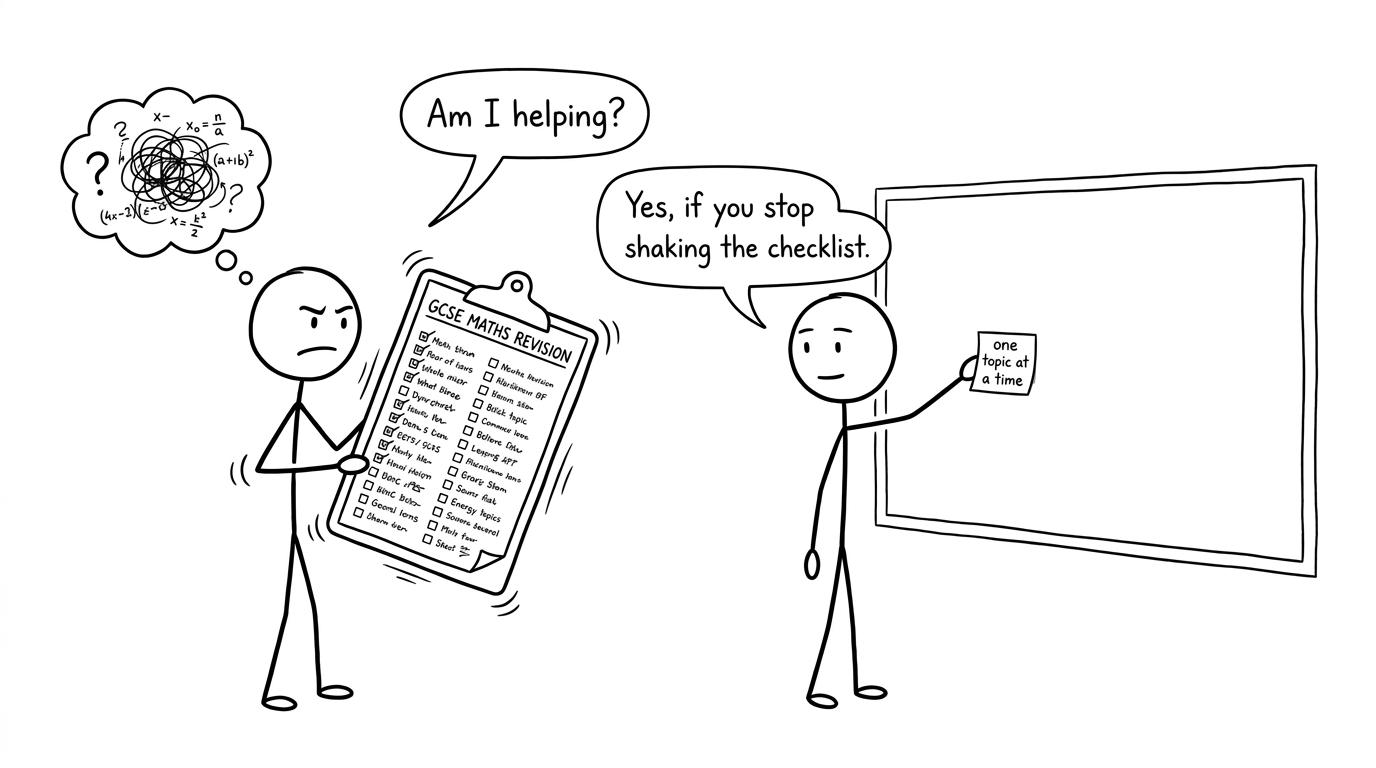 A parent shakes a giant GCSE checklist while the student moves one sticky note
A quick checklist: supportive, not stressful
If your parent asks, “What should I do then?”, here is the short answer.
- Agree one small daily routine (even 202020 to 454545 minutes counts).
- Ask for a plan, not a report.
- Make resources effortless: open the right YesGenie page, print one paper, find the mark scheme.
- Measure progress with evidence (scores, topics ticked, time spent), not with feelings.
- Use calm questions that create thinking: “Which topic is most likely to come up?” “Which mistake keeps repeating?”
- Keep the home environment stable: sleep, food, and a quiet place beat motivational speeches.
YesGenie makes this easier because it is built around small steps: revision lessons, topic questions, mini tests, past papers, predicted papers, and video solutions.
Why nagging backfires in GCSE maths revision
Nagging is not really about revision. It is about uncertainty. Parents cannot sit your exam, so they try to reduce uncertainty by asking for reassurance. Students cannot guarantee a grade on demand, so they protect themselves by avoiding the conversation. Everybody loses.
GCSE maths revision works best when you can stay with one problem long enough to learn something from it. That requires psychological safety: the sense that you are allowed to be wrong while you practise. If every revision session ends with an interrogation, your brain learns to associate maths with threat, not growth.
The alternative is quietly powerful: make revision visible in simple ways (a plan on the fridge, a past paper score trending upward, a topic list getting shorter) so parents feel reassured without needing to press you.
The “parent as project manager” approach (without the micromanaging)
A good project manager does not do the work for you. They remove friction.
Here are three roles that help GCSE students revise maths without the relationship cost.
Curator: remove the “what should I do?” decision
Decision fatigue is real. When you are tired, you will not choose the hard but useful task (past-paper practice). You will choose the easy task (scrolling, rewriting notes, reorganising pens).
A parent can help by pre-loading choices:
- Bookmark the right exam board area (Edexcel, AQA, OCR, Eduqas, WJEC). For example, use Edexcel GCSE Maths Past Papers.
- Keep a “default” quick-win resource for low-energy days, like Edexcel GCSE Maths Mini Tests.
- If you are close to exams, keep Edexcel GCSE Maths Predicted Papers ready so revision is focused.
Timekeeper: protect a small window, then leave you alone
The best revision routine is the one you can repeat without drama. Agree a time window (say, 7:007{:}007:00 to 7:457{:}457:45pm) and treat it like a sports training slot. Parents support by protecting it (less noise, fewer errands, fewer interruptions), then stepping away.
A useful phrase is: “Do you want me to remind you once, or should we just stick to the same time daily?” One reminder is support. Ten reminders is noise.
Scorekeeper: track evidence, not mood
You will have days where you feel brilliant and score badly, and days where you feel awful and improve. That is normal.
Parents can help by tracking only two things:
- what you did (one paper, one topic, one mini test)
- what you learned (one mistake to fix)
That is enough to keep GCSE maths revision grounded.
A simple GCSE maths revision routine parents can support
This routine is designed to stop arguments before they start.
Build: lessons first, then questions
If a topic is weak, start with a clear explanation and a few guided examples. YesGenie has bite-sized content built for this. A parent’s job is not to teach the maths (unless they can do it calmly and correctly). Their job is to point you towards the right resource.
Use revision pages like:
- AQA GCSE Maths Revision Guides
- A quick refresher such as BIDMAS Revision Guide
- For number fluency, Powers and Roots Revision Guide (Edexcel)
Then practise with exam-style questions using a bank such as Eduqas GCSE Maths Question Bank (the structure is similar across boards: topic-by-topic questions with solutions).
Prove: past papers with mark schemes
Past papers are the closest thing to the real GCSE experience: timing, pressure, and mark allocation.
Parents can support by printing one paper, setting a quiet hour, and making the mark scheme easy to access. You do the work; they remove the friction.
Start here: GCSE Past Papers Hub.
Sharpen: predicted papers close to exams
In the final weeks, you want breadth and exam feel without drowning. Predicted papers can help you revise efficiently because they are modelled around typical patterns and spec coverage.
Use Edexcel GCSE Maths Predicted Papers, or choose your board from Resources.
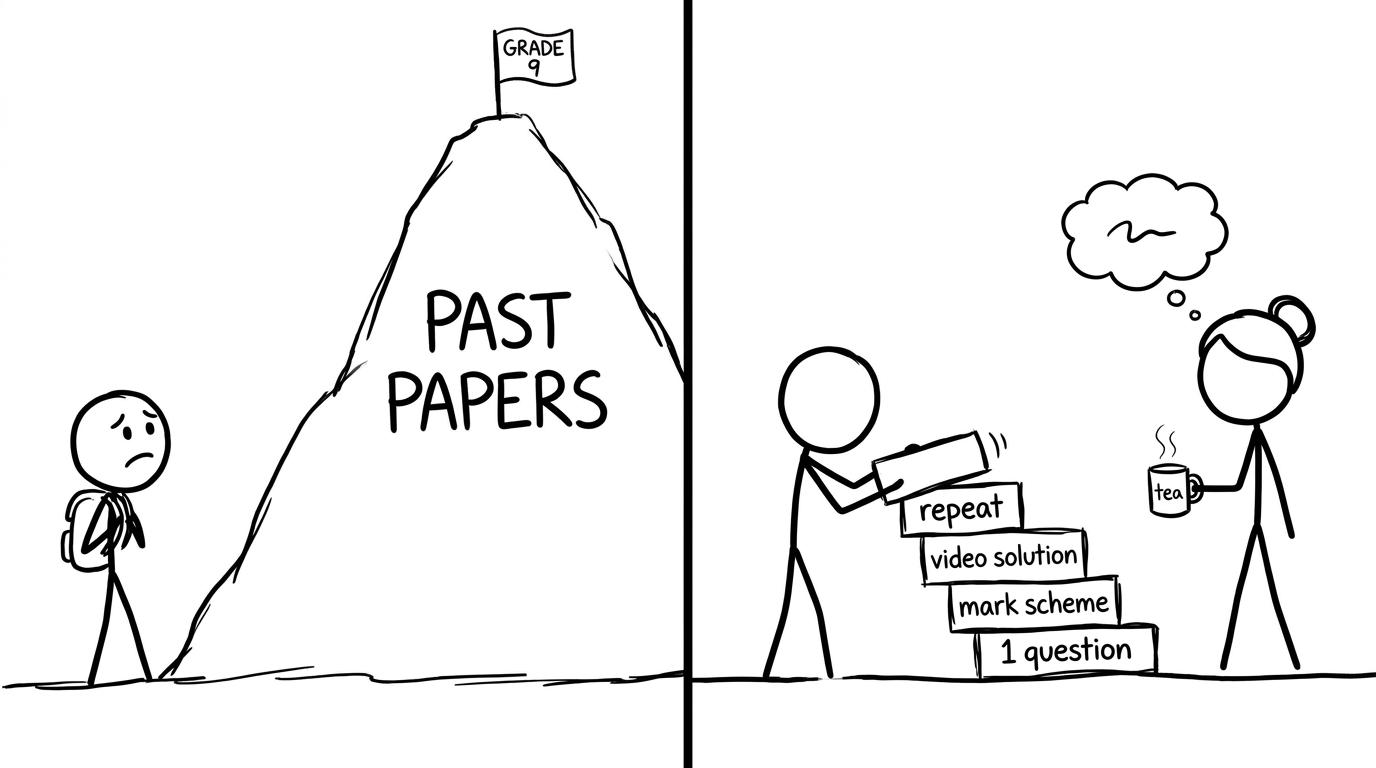 Student builds staircase of “1 question, mark scheme, video solution”
Worked examples parents can “coach” without doing the maths
A parent does not need to know the content to help you revise. They can coach the process: read carefully, set up clearly, check against the mark scheme, and correct one mistake.
Below are two GCSE-style examples. If you are a parent reading this, notice the useful questions in bold; they are process questions, not maths questions.
Example 1: Reverse percentages (common on higher tier)
Question: A jacket is reduced by 20%20\%20% and now costs £484848. What was the original price?
Let the original price be xxx.
A 20%20\%20% reduction means the new price is 80%80\%80% of the original:
0.8x=48 0.8x = 48 0.8x=48Solve:
x=480.8=60 x = \frac{48}{0.8} = 60 x=0.848=60Answer: £606060.
Parent coaching prompts:
- What does “reduced by 20%20\%20%” mean as a multiplier?
- Can you write one equation before you touch the calculator?
- Does the answer make sense (should the original be larger than £484848)?
If this topic is shaky, build it with targeted practice via topic questions and revision guides, then return to mixed past paper questions.
Example 2: Expanding and factorising a quadratic
Question: Expand and simplify (x+5)(x−3)(x+5)(x-3)(x+5)(x−3).
Multiply term-by-term:
(x+5)(x−3)=x(x−3)+5(x−3) (x+5)(x-3)=x(x-3)+5(x-3) (x+5)(x−3)=x(x−3)+5(x−3) =x2−3x+5x−15 =x^2-3x+5x-15 =x2−3x+5x−15Combine like terms:
=x2+2x−15 =x^2+2x-15 =x2+2x−15Answer: x2+2x−15x^2+2x-15x2+2x−15.
Parent coaching prompts:
- Have you used a consistent method (grid, FOIL, or distribution)?
- Have you collected like terms carefully?
- Can you quickly check by substituting a number, like x=1x=1x=1?
Quick check with x=1x=1x=1:
LHS: (1+5)(1−3)=6×(−2)=−12(1+5)(1-3)=6\times(-2)=-12(1+5)(1−3)=6×(−2)=−12
RHS: 12+2(1)−15=1+2−15=−121^2+2(1)-15=1+2-15=-1212+2(1)−15=1+2−15=−12.
The check matches, which builds confidence without extra nagging.
How to have the “revision conversation” without tension
The best conversations are short and specific. Here are scripts that work.
Swap “have you revised?” for “what’s the next step?”
- “What’s your next GCSE maths revision step today: lesson, questions, or a paper?”
- “Which topic is annoying you most right now?”
These questions assume you are capable. They invite a plan.
Ask for one piece of evidence
Evidence stops arguments. Try:
- “Show me the one question you fixed today.”
- “What did the mark scheme say you missed?”
This turns revision into a craft: make, test, improve.
Agree boundaries
A healthy boundary might be:
- You revise at your agreed time.
- Your parent checks in once, at a pre-agreed time.
- If you stick to the plan, there is no further discussion.
That is how you keep GCSE support calm.
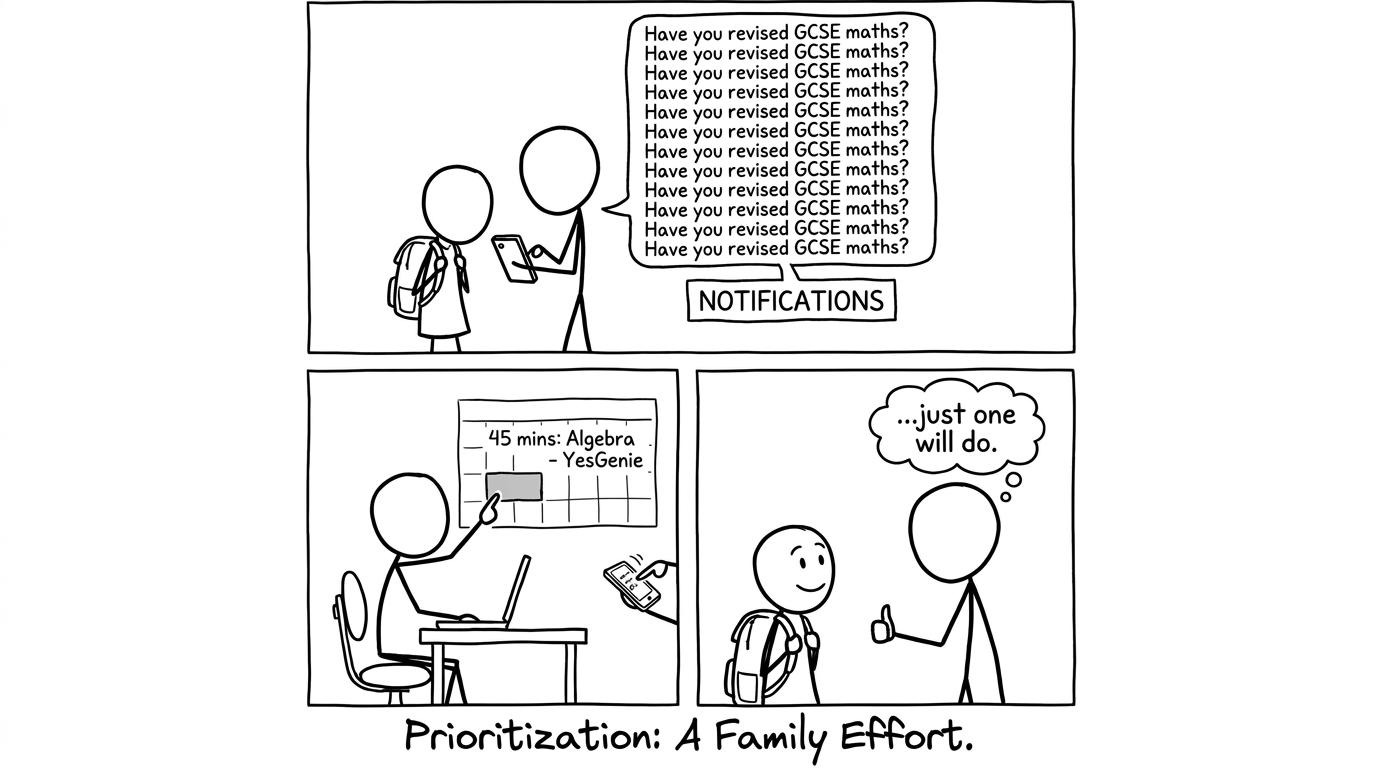 Phone notifications replaced by one calm YesGenie calendar block
Common mistakes (and how parents accidentally reinforce them)
Turning revision into “time served”
If the goal becomes “sit at the desk for two hours”, you will find ways to spend two hours without learning. Better: one mini test, one topic, one past paper section, then stop.
Over-helping on questions
When parents jump in with answers, students lose the chance to struggle productively. In GCSE maths, marks often come from method steps. If you do not practise writing those steps, you cannot earn them under pressure.
Only doing comfortable topics
Students naturally repeat what they can already do because it feels good. A parent who praises only speed and ease accidentally pushes this. Better: praise “you fixed that mistake” or “you went back to the mark scheme”.
Using “grade talk” as motivation
“You need a 7” can feel like a threat, not a target. GCSE maths revision improves faster when the focus is on inputs: papers completed, topics mastered, errors reduced.
Ignoring tier and board details
Foundation and higher tier demand different depth. Edexcel, AQA, OCR, Eduqas and WJEC have slightly different styles. Make sure you are practising the correct board resources and paper format.
Closing: the calm way to win GCSE maths
GCSE maths revision is not improved by louder reminders. It is improved by fewer decisions, clearer next steps, and the steady accumulation of small wins. Parents do not need to become maths teachers. They need to become calm builders of an environment where practise happens and mistakes are treated as information.
If you want that environment, set up your next week with YesGenie: use revision lessons to rebuild weak topics, practise with topic questions and mini tests, then prove it with past papers and predicted papers. Start with the GCSE Past Papers Hub, add the right board papers like Edexcel GCSE Maths Past Papers, and finish each session by learning from the mark scheme. Keep it simple, keep it consistent, and let GCSE progress speak for itself.










