

Online GCSE Biblical Hebrew Revision Course: Worth It?
Online GCSE Biblical Hebrew revision course guide: compare paid teaching with free resources and decide what is worth buying alongside GCSE maths revision.

The hardest revision decisions are rarely about motivation. They are about uncertainty. You know you need help, but you do not know whether paying for it will solve the right problem.
An online GCSE Biblical Hebrew revision course can be worth joining if it is closely aligned with the current Pearson Edexcel specification, gives you expert feedback and provides a structure you will genuinely follow. But a paid course is not automatically better than free resources. If you already have teacher support, understand the grammar and can mark your work accurately, official materials and disciplined independent revision may be enough.
For a GCSE student also preparing for maths exams, the real question is broader: will the course improve your Biblical Hebrew without consuming the time and energy needed for your other subjects?
The short answer: when is a paid course worth it?
A paid course is most likely to offer good value when:
- the tutor has specific experience teaching Pearson Edexcel GCSE Biblical Hebrew;
- lessons cover both language and literature rather than general Biblical Hebrew;
- you receive individual feedback on translation and written analysis;
- the course uses the correct current set texts and assessment format;
- sessions fit around school, homework and GCSE maths revision;
- you need external structure to remain consistent;
- there is a trial lesson, sample session or clear cancellation policy.
Free resources are more likely to be sufficient when:
- your school already provides knowledgeable teaching;
- you know precisely which topics need attention;
- you can use mark schemes honestly and learn from mistakes;
- you have access to the specification, sample assessment materials and suitable past questions;
- you are organised enough to revise regularly without live lessons.
The dividing line is not simply paid versus free. It is feedback and structure versus independent control.
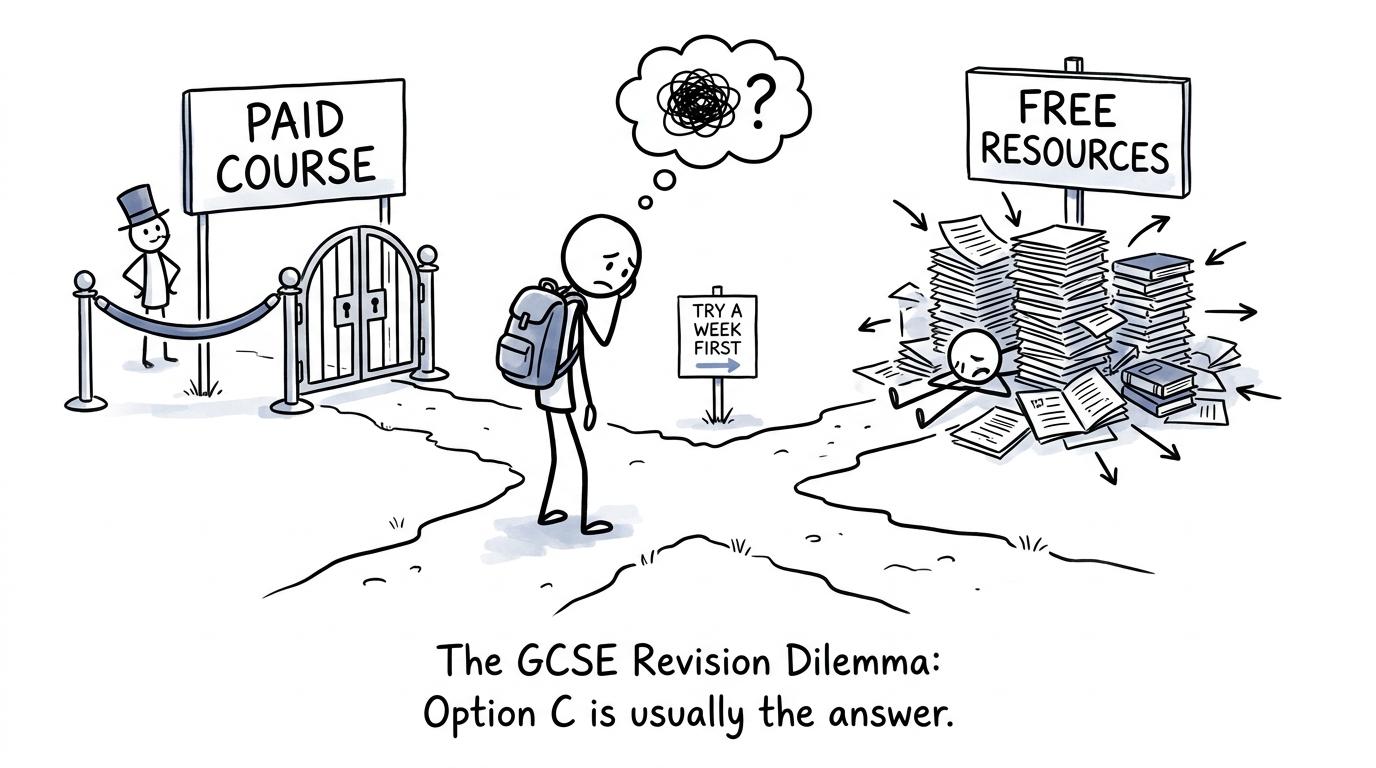 A student choosing between a paid course and free revision resources
What GCSE Biblical Hebrew actually assesses
Before paying for any course, check that it teaches the qualification you are taking. A course can be academically impressive and still be poor GCSE preparation.
Pearson currently lists Edexcel GCSE Biblical Hebrew under qualification code 1BH01BH01BH0. The published specification divides the qualification into two externally examined components, completed in the same examination series:
- Component 1: Language, worth 50%50\%50% and marked out of 100100100;
- Component 2: Literature, worth 50%50\%50% and marked out of 100100100.
The language component assesses reading and understanding unseen Biblical Hebrew passages, including comprehension and translation into English. The specification also includes an option involving either grammatical structures or translation of simple English sentences into pointed Biblical Hebrew.
The literature component assesses knowledge of the prescribed texts alongside analysis, evaluation and response. The official assessment objectives give 50%50\%50% of the qualification to language knowledge and understanding, 25%25\%25% to knowledge and understanding of literature, and 25%25\%25% to analysing, evaluating and responding to literature.
Biblical Hebrew is untiered, unlike GCSE maths, where foundation and higher tier affect the available grades and paper content. That makes specification alignment especially important: a general beginners' Hebrew class may improve reading but fail to prepare you for literary analysis, prescribed content or the wording of GCSE questions.
Set texts and administrative details can change. Confirm the live specification and prescribed texts with your teacher and Pearson before enrolling or planning revision.
Paid course versus free resources
A price tag can buy useful things. It can also buy material you could have found independently. Judge the course by what changes in your learning.
What a strong paid course can provide
Expert correction is the clearest advantage. Translation errors are not always obvious to the student who made them. A specialist can identify whether the problem came from vocabulary, morphology, syntax or an imprecise English rendering.
Accountability also matters. A fixed lesson each week creates a deadline. For students who repeatedly postpone a less familiar subject, that structure may be more valuable than another folder of notes.
Efficient diagnosis can save time. A good teacher should distinguish between a small knowledge gap and a larger misconception, then set focused practice rather than asking you to revise an entire unit.
Finally, a live group can make a relatively uncommon GCSE feel less isolated. Questions that might remain unresolved during independent revision can be discussed immediately.
What free revision can do well
Free does not mean weak. The official specification tells you what can be assessed. Sample assessment materials show the structure and style of the papers. Available past papers and mark schemes help you understand the standard expected.
Your school may also provide text notes, vocabulary lists, grammar exercises and teacher feedback. If those resources already cover the specification, a commercial course needs to add something more than polished slides.
The same principle applies in maths. MathsGenie's free GCSE maths revision hub brings together board-specific lessons, worksheets, exam questions, revision guides and papers. Students improve when they use these resources actively, attempting questions, checking solutions and returning to weak areas, not merely because the resources exist.
Free Hebrew revision can work in the same way. The essential cycle is:
- identify a specific weakness;
- review the relevant language rule or literary material;
- retrieve it without notes;
- answer an appropriate question;
- check the response against reliable guidance;
- record the correction;
- revisit it after a gap.
The limitation is feedback. A mark scheme cannot always explain why a translation sounds plausible but remains inaccurate. That is where a teacher, tutor or focused short course may justify its cost.
Questions to ask before enrolling
Do not let a countdown timer or impressive course title make the decision for you. Ask for concrete details.
Does it match Pearson Edexcel 1BH01BH01BH0?
The provider should be able to name the qualification, components and current prescribed texts. “Suitable for Biblical Hebrew learners” is not the same as “designed for this GCSE”.
Who teaches it?
Look for relevant teaching and assessment experience. A scholar may know the language deeply without knowing how GCSE responses are marked. Ideally, the tutor understands both.
Is feedback included?
Find out whether students submit translations and literature responses for individual marking. A video library with no correction is closer to a resource subscription than a taught revision course.
Can you see the timetable and workload?
Count preparation, homework and catch-up time as well as the live lesson. A course occupying one evening may create several additional hours of work.
Is there a sample or trial?
A sample lesson lets you assess pace, clarity and technical reliability. Read the terms carefully, including access length, refunds and what happens if a session is missed.
 An online course confronted by a specification-conscious mark scheme
A sensible free-first test
Before purchasing a full course, run a short independent trial. This turns an emotional decision into an evidence-based one.
For one week, complete a small language task and a small literature task using your existing school and official resources. Mark what you can, then write down every question you cannot resolve.
At the end of the week, classify the problem:
- Knowledge: you do not know vocabulary, grammar or content.
- Application: you know the rule but cannot use it in an unfamiliar passage.
- Feedback: you cannot tell whether your answer would receive credit.
- Consistency: you planned to revise but did not begin.
- Timing: you understand the material but work too slowly.
If most problems concern knowledge, free targeted resources may be enough. If feedback and application dominate, specialist teaching becomes more valuable. If consistency is the issue, a course may help but a realistic timetable could solve the problem without additional cost.
This diagnostic approach also works for maths. MathsGenie's guide to finding your weakest GCSE topics explains why evidence from questions is more useful than revising whatever feels familiar.
Balancing Biblical Hebrew with GCSE maths
Every paid course has a second cost: the revision time it displaces.
A student taking GCSE maths alongside Biblical Hebrew should protect regular maths practice, particularly because maths performance depends on repeated problem-solving rather than last-minute reading. The GCSE maths revision timetable guide can help you build a week around school and other subjects.
Use short, defined blocks. A Hebrew session might focus on vocabulary retrieval, one grammatical feature or one section of a set text. A maths session should similarly have a precise target, followed by questions and marking.
MathsGenie's one-month GCSE maths revision plan provides a practical structure when exams are approaching. If you follow OCR, the OCR GCSE maths revision hub keeps lessons, questions and papers aligned with your board. Students taking Edexcel, AQA or Eduqas should likewise choose the correct board materials from the main GCSE hub.
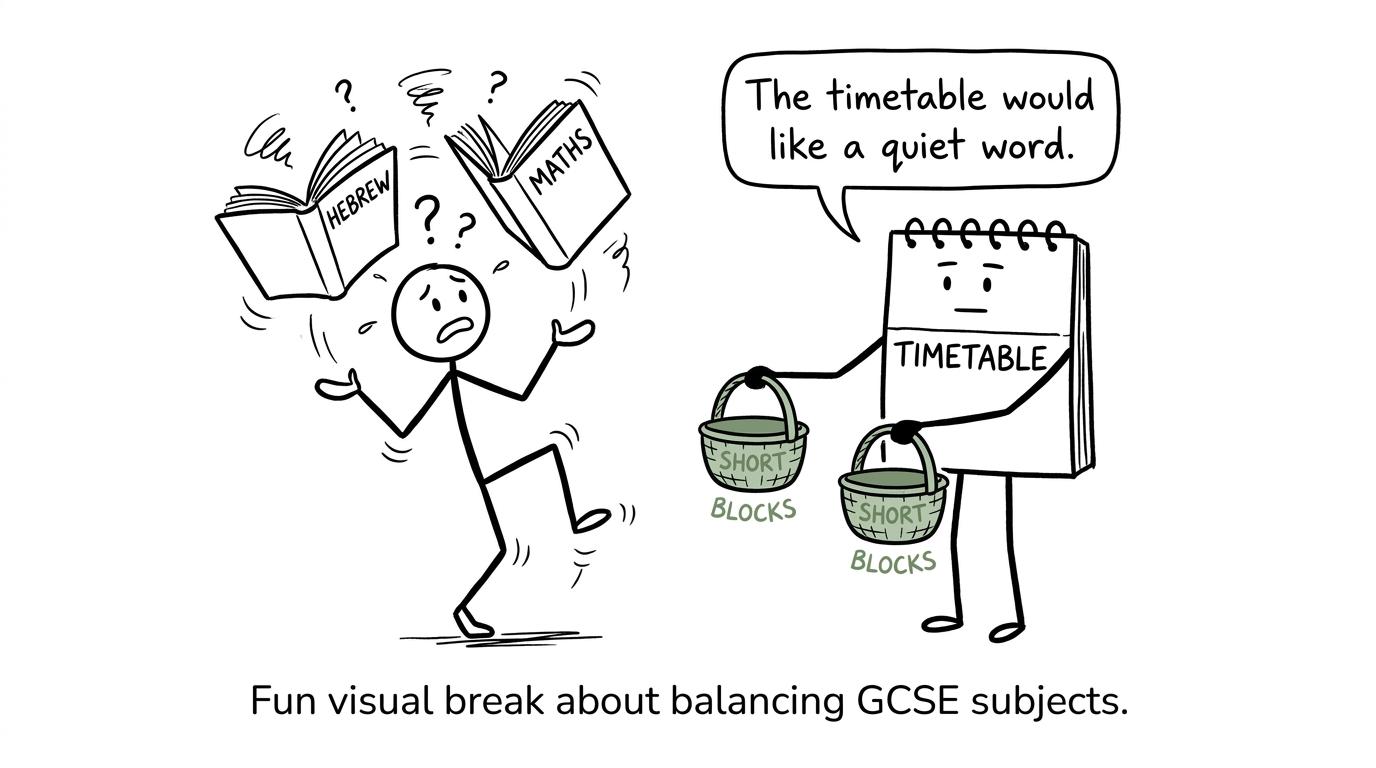 A student balancing Hebrew and maths while a timetable offers help
Common mistakes when choosing a revision course
Buying before diagnosing the problem
Students sometimes purchase a complete course when they need feedback on only one area. Identify the gap first. A few specialist lessons may be better value than a broad programme.
Confusing Biblical Hebrew with Modern Hebrew
There may be overlap in script and vocabulary, but the GCSE assesses Biblical Hebrew and prescribed literary content. A Modern Hebrew course is not a substitute for specification-focused preparation.
Assuming live teaching guarantees progress
Attendance is not the same as learning. You still need retrieval, written practice, correction and repetition between sessions.
Ignoring literature preparation
A course focused almost entirely on grammar and translation leaves half of the qualification insufficiently covered. Check how literature knowledge and analysis are taught and assessed.
Sacrificing maths paper practice
Do not allow a new course to remove all your timed maths work. Use Edexcel GCSE maths predicted papers where appropriate, but remember that predicted papers do not guarantee future exam content. They are practice tools. Combine them with revision lessons, genuine past papers and mark schemes.
Collecting resources instead of using them
Ten bookmarked websites are less valuable than one completed, marked and corrected task. If forgetting is a recurring problem, MathsGenie's guide to making GCSE maths revision stick offers a repeatable retrieval and spacing routine that can also inform language revision.
The final verdict
An online GCSE Biblical Hebrew revision course is worth paying for when it supplies something genuinely scarce: accurate specification-focused teaching, individual correction, accountability and efficient answers to difficult questions.
It is probably not worth the cost when it simply repackages general notes or recorded lessons, neglects the literature component, follows the wrong set texts or overwhelms an already crowded GCSE timetable.
Start with the specification. Test free resources for a week. Identify whether your real need is knowledge, feedback, timing or structure. Then buy only the support that closes that gap.
Meanwhile, keep your maths revision simple and active. Begin at the MathsGenie GCSE maths revision area, choose your exam board and tier, and use free revision lessons, practice questions, mini tests and video solutions to repair weak topics. Follow those with past papers, predicted papers and careful mark-scheme review. Good revision is not measured by how much you collect. It is measured by what you can do, unaided, when the paper arrives.










