

Moving Schools GCSE German: How to Stay on Track
Moving schools GCSE German advice: compare exam boards, map topic gaps, protect speaking practice and keep your wider GCSE revision calmly on track.
Changing schools halfway through a GCSE course can make familiar subjects feel suddenly unfamiliar. Your new German class may have covered different themes, used another textbook or followed a different exam board. Meanwhile, maths homework and every other deadline continue as normal.
If you are moving schools GCSE German does not have to become a lost subject. The practical answer is to identify your exact course, compare what each school has taught, protect regular speaking practice and agree a catch-up plan with your new teacher. Do that early and the change becomes a manageable list of gaps rather than a vague fear of falling behind.
Your first-week checklist
Complete these actions as soon as possible after joining the new school:
- Confirm the German exam board, specification and qualification code.
- Check whether you are entered for foundation or higher tier.
- Ask whether your tier or intended exam entry needs reviewing.
- Obtain the new school's topic sequence and vocabulary lists.
- Give your teacher a list of themes and grammar covered previously.
- Transfer useful exercise books, assessments and teacher feedback.
- Arrange a short speaking assessment or informal diagnostic.
- Confirm how and when speaking practice takes place.
- Ask who is responsible for your final exam entry.
- Protect your maths and other GCSE revision from catch-up overload.
Your official pupil record should transfer between schools, but it may not contain the detailed classroom information that a German teacher needs. Bring your own evidence where possible: marked writing, vocabulary records, speaking feedback, recent reports and a list of completed units.
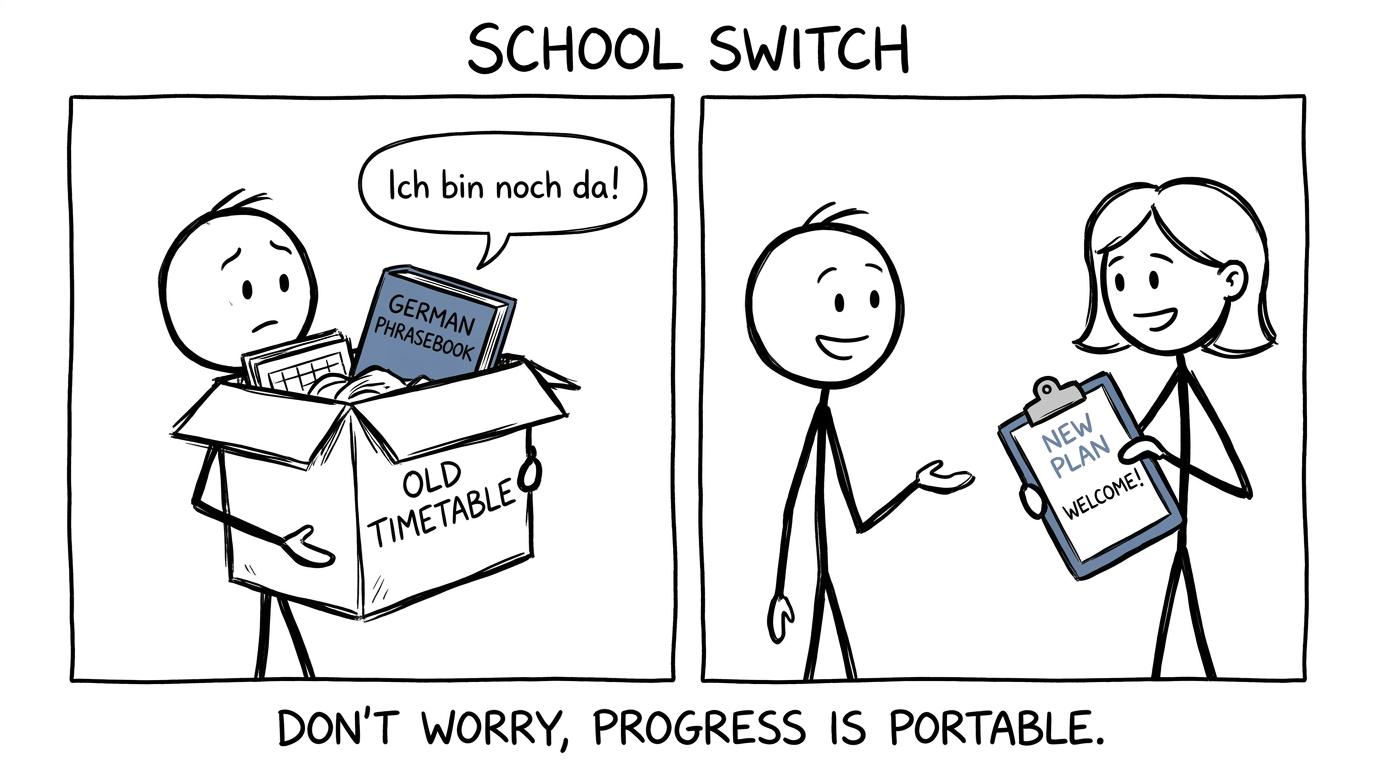 A student arriving at a new school with an old timetable while a German phrasebook remains cheerfully present
Confirm which GCSE German course you are taking
The phrase “GCSE German” can hide important differences. AQA and Pearson Edexcel, for example, publish their own specifications, vocabulary requirements and assessment materials. Schools may also teach themes in different orders.
Current GCSE German specifications are linear qualifications. Assessment takes place at the end of the course, so moving school does not normally mean that completed classroom units themselves carry marks forward. However, everything you have learnt still matters because later listening, speaking, reading and writing depend on accumulated grammar and vocabulary.
Ask your head of German or exams officer to confirm:
- the exam board and specification code;
- your examination year;
- your current tier;
- the structure of each assessment;
- the speaking assessment arrangements;
- any approved access arrangements;
- the deadline for changing an exam entry, if relevant.
Do not rely on a classmate's description or an old revision guide. Reformed GCSE German specifications began first teaching in September 2024, with first assessments in 2026. Older materials can therefore describe tasks that no longer match the course being examined. Your teacher and current specification should be the final reference.
Current courses assess listening, speaking, reading and writing. On major specifications such as AQA and Edexcel, each area contributes 25%25\%25% of the qualification. Students take foundation or higher tier, and the same tier must be used across the papers. Exact task formats still vary by board, which is why confirming the specification comes before buying resources or planning practice.
Build a curriculum gap map
Two schools can be teaching the same specification and still be in different places. One may have completed school and future-study themes while another has concentrated on travel and relationships. The sensible response is not to restart the entire course. It is to map the difference.
Create a simple document with four categories:
| Category | What to record |
|---|---|
| Secure | Topics and grammar you can use without notes |
| Familiar | Material you recognise but cannot yet use confidently |
| Missing | Content your new class has covered but you have not |
| Different | Content you studied that the new class has not reached |
Compare the following with your new teacher:
- specification themes and subtopics;
- prescribed vocabulary;
- present, past and future time frames;
- word order and subordinate clauses;
- modal verbs and common irregular verbs;
- adjective endings and cases at the level required for your tier;
- translation in both directions;
- dictation or read-aloud requirements where applicable;
- speaking task formats;
- extended-writing expectations.
A topic being “covered” is not the same as it being secure. Mark it secure only if you can understand it and produce relevant German without copying a model answer.
Prioritise transferable German
When the missing-content list looks long, begin with language that works across several themes. High-utility verbs, opinions, reasons, connectives, questions and time phrases help in speaking and writing while also supporting listening and reading.
Grammar should be prioritised in the same way. Accurate control of common verbs and word order is usually more useful than memorising an elaborate paragraph that answers only one possible prompt.
Use three levels of priority:
Essential now
This includes language currently being used in lessons, foundational grammar and anything needed for an approaching speaking assessment or mock examination.
Important next
These are specification gaps that will limit future work but are not blocking this week's lessons.
Useful later
This includes vocabulary you recognise, less common details and material that can wait until the urgent gaps are stable.
This order matters. A school move creates administrative noise, and noise encourages students to treat everything as equally urgent. It rarely is.
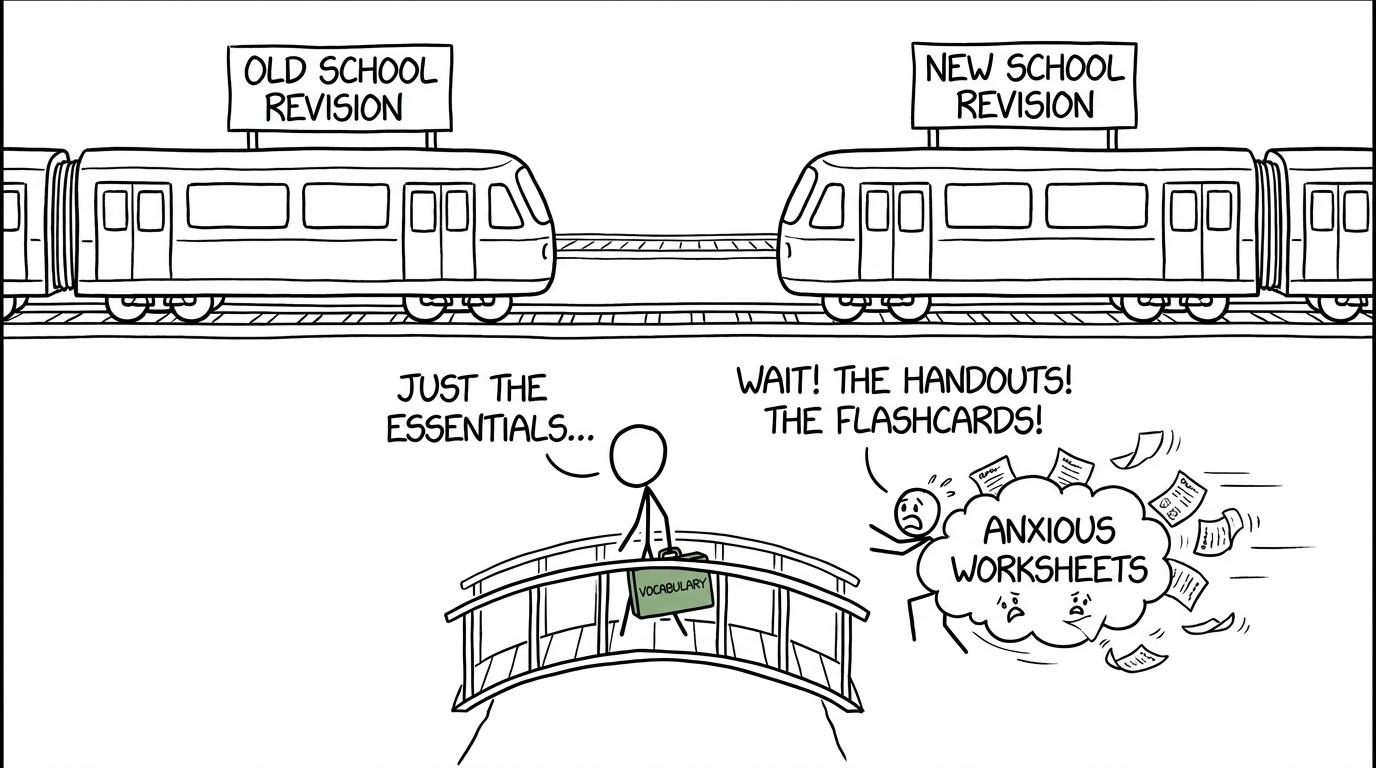 A student calmly carrying vocabulary between the old-school and new-school revision trains
Protect speaking practice immediately
Speaking is the easiest skill to neglect during a move because it depends on another person, a clear format and regular feedback. It is also difficult to rebuild through one long session near the assessment.
Ask your new teacher for a short diagnostic covering pronunciation, responses to unprepared questions and the task types used by your board. The purpose is not to produce a grade prediction on your first day. It is to reveal what kind of practice you need.
A sustainable routine could include:
- reading aloud for a few minutes several times a week;
- recording short answers and listening back;
- practising questions rather than scripts alone;
- revisiting pronunciation patterns;
- responding with brief, accurate German before adding detail;
- attending any conversation session offered by the department.
Learn flexible sentence patterns, but avoid memorising one long answer word for word. A slightly different question can make a rigid script collapse. You need language that can move.
Use a catch-up timetable that leaves room for maths
The hidden danger of changing school is not only falling behind in German. It is allowing German catch-up to consume the time reserved for maths, English and science.
Start with a weekly plan rather than an ambitious daily overhaul. The free MathsGenie revision planner can help you see your commitments in one place. Add German catch-up as defined tasks such as “learn travel vocabulary” or “practise read-aloud task”, not as the endless instruction “revise German”.
A balanced week might contain:
- two short German gap sessions;
- one speaking session;
- one review of current classwork;
- protected maths sessions based on actual weak topics;
- one catch-up buffer for work that takes longer than expected.
Keep maths revision diagnostic. The GCSE maths revision hub brings together board-specific lessons, practice questions, papers and revision tools. If your new school also uses a different maths board, read the Edexcel and AQA GCSE maths comparison rather than assuming the whole subject has changed.
Short tests are useful when time is tight. The Edexcel GCSE maths mini tests can reveal a specific weakness without occupying an entire evening. The principle transfers to German: diagnose a narrow gap, correct it and revisit it later.
Ask for specific support
“Can you help me catch up?” is understandable, but it gives a busy teacher little information. Specific requests are easier to answer:
- Which missed units should I prioritise?
- Which vocabulary list matches this specification?
- Can you check whether my previous work meets this board's writing expectations?
- May I attend an extra speaking session?
- Which assessment should I complete to show my current level?
- When will we review whether my tier is appropriate?
If you have special educational needs, a disability or existing access arrangements, speak to the SENCO and exams officer promptly. Do not assume that every arrangement will appear automatically in every classroom system. The school must check the evidence and follow the relevant awarding-body process.
If the move happens in Year 11, ask for a named review date. A plan without a review can quietly become permanent, even when it is not working.
Keep evidence of progress
Maintain one folder, digital or physical, containing:
- your specification checklist;
- vocabulary gaps;
- corrected writing;
- speaking targets;
- mock results and teacher feedback;
- deadlines and exam-entry details.
This reduces repeated conversations and makes improvement visible. It also separates a genuine knowledge gap from the temporary discomfort of learning a new teacher's routines.
Use the same approach in maths. Complete a topic or paper, mark it, record the reason for each lost mark and choose the next action. MathsGenie's guide to starting GCSE past papers explains how to move from short diagnostic work towards timed papers. If exams are close, a structured one-month GCSE maths revision plan can prevent German catch-up from pushing maths to the edge of the week.
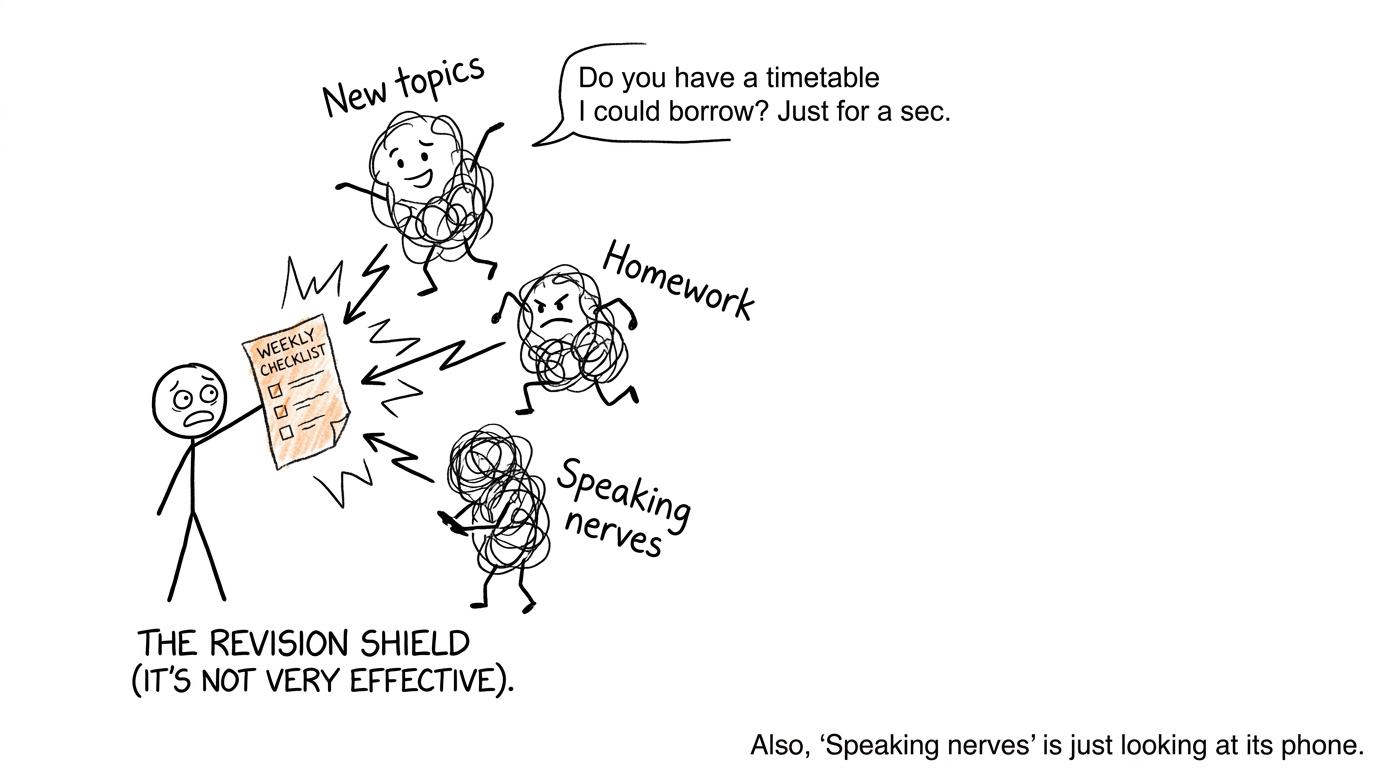 A weekly checklist defending a student from new topics, homework and speaking nerves
Common mistakes when moving schools mid-GCSE German
Assuming the exam board is the only difference
Textbook order, homework systems, speaking routines and teacher terminology may change even when the specification does not. Compare classroom coverage as well as exam-board names.
Trying to relearn everything
This wastes time and hides the real gaps. Use a diagnostic checklist, then prioritise missing foundations and current class content.
Ignoring speaking until later
Speaking confidence grows through frequent retrieval and feedback. Begin with short, regular practice during your first week.
Using outdated revision materials
Check the publication date and specification. Materials created for an outgoing course may contain different themes or assessment tasks.
Letting catch-up replace all other revision
German matters, but so do your other GCSEs. Use a timetable with clear limits. If maths needs urgent repair, the GCSE one-week maths revision plan provides a focused reset using lessons, questions and marked paper practice.
Staying silent because the move feels temporary
Teachers cannot respond to gaps they cannot see. Share your previous coverage, ask precise questions and agree when progress will be reviewed.
A school move changes the route, not the destination
Changing schools during GCSE German can leave you between two sequences: one course you partly completed and another already in motion. The answer is not frantic revision. It is accurate information, a visible gap map, regular speaking and a timetable that protects the rest of your subjects.
Start by confirming your board, tier and assessment format. Give your new teacher evidence of what you have learnt. Then close the most important gaps one at a time.
For maths, keep one dependable base throughout the transition. Use MathsGenie's free revision lessons and practice questions to rebuild individual topics, mini tests to diagnose weaknesses, mark schemes and video solutions to understand lost marks, and past papers or predicted papers when you are ready for exam conditions. A new classroom may change your timetable. It does not need to take away your direction.











