

Edexcel vs AQA Maths: What Changes for GCSE?
GCSE Edexcel vs AQA Maths explained: papers, skills, revision strategy and worked examples. Use Maths Genie lessons, practice and papers to improve.
A student opens a past paper and feels that familiar wobble: Why does this look different to the one my friend is doing? If you’re revising for GCSE Maths, it’s easy to assume Edexcel and AQA are basically the same exam with different logos. They’re not. The maths content overlaps heavily, but the feel of questions, the rhythm of marks, and the way topics are blended can change how confident you feel on the day.
This post isn’t here to fuel exam-board myths. It’s here to give you a calm, practical comparison of GCSE Edexcel vs AQA Maths, plus a revision strategy that works for both. Because in the end, the exam board is the map. Your skills are the engine.
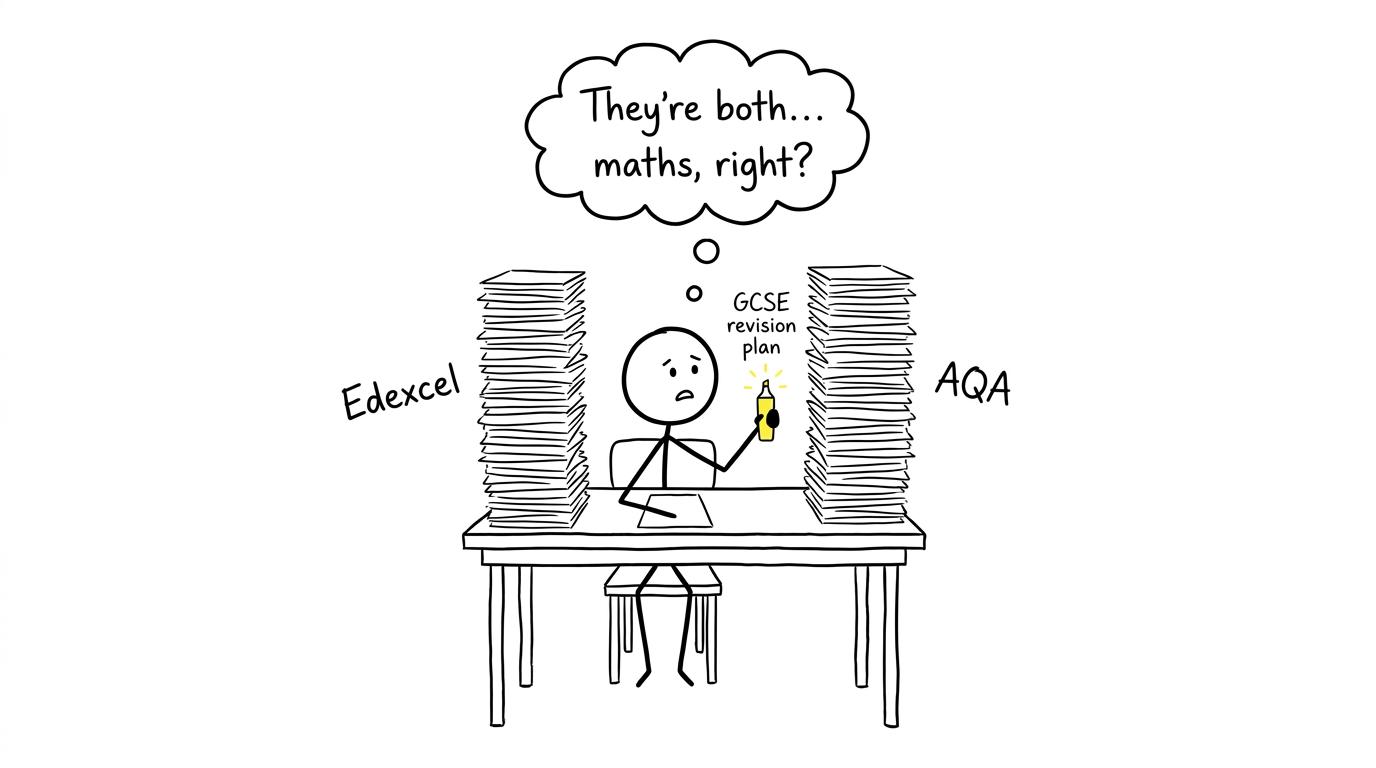 Student facing Edexcel vs AQA paper stacks
Edexcel vs AQA Maths in one honest checklist
If you remember nothing else, remember this: both exam boards assess the same big ideas, but they often reward slightly different habits.
What stays the same across exam boards
- The core GCSE Maths content: number, algebra, ratio and proportion, geometry and measures, probability, statistics.
- Foundation and higher tier structure (with grades 999 to 111 overall; foundation targets grades 111 to 555, higher targets 444 to 999).
- Multi-step problem solving and functional maths style contexts.
- The need to show working for method marks.
What tends to feel different
- Edexcel often has very familiar question styles that repeat across years, and can feel “pattern-based”.
- AQA often varies phrasing and context more, and can reward careful reading and setting up equations clearly.
- Mark schemes can differ in strictness around method presentation.
For targeted practice:
- Use AQA GCSE Maths for AQA-specific papers.
- Use GCSE Predicted Papers and resources to focus revision efficiently as exams approach.
What actually changes between Edexcel and AQA GCSE Maths?
Paper structure and calculator balance
Both exam boards typically assess across three papers, with a mixture of calculator and non-calculator. But you should still revise with your board’s papers because timing, topic distribution and style can shift your pacing.
On Maths Genie you can practise directly with:
- AQA GCSE Maths papers view to build familiarity with AQA layout.
- GCSE Edexcel predicted papers for exam-season style practice.
Question style: “same skills, different packaging”
A helpful way to think about this is that your GCSE mark isn’t just about knowing methods. It’s also about recognising which method a question is asking for.
- Edexcel questions can feel more direct: “Here’s the structure, do the method.”
- AQA questions can feel more narrative: “Here’s the situation, decide the structure.”
That’s not a rule. It’s a tendency. The safest revision plan is to master the method and practise spotting it under different wording.
Mark scheme emphasis: method marks are your best friend
In both Edexcel and AQA GCSE Maths, method marks are the difference between “I got stuck” and “I still picked up marks”. That means your working has to be legible and logically ordered.
A good habit: write one line per decision.
- Start with the equation you’re using.
- Substitute values.
- Rearrange step-by-step.
- Only then calculate.
If you want structured topic-by-topic practise before full papers, the GCSE Maths self-assessment sheet (PDF) is a simple way to identify weak areas quickly.
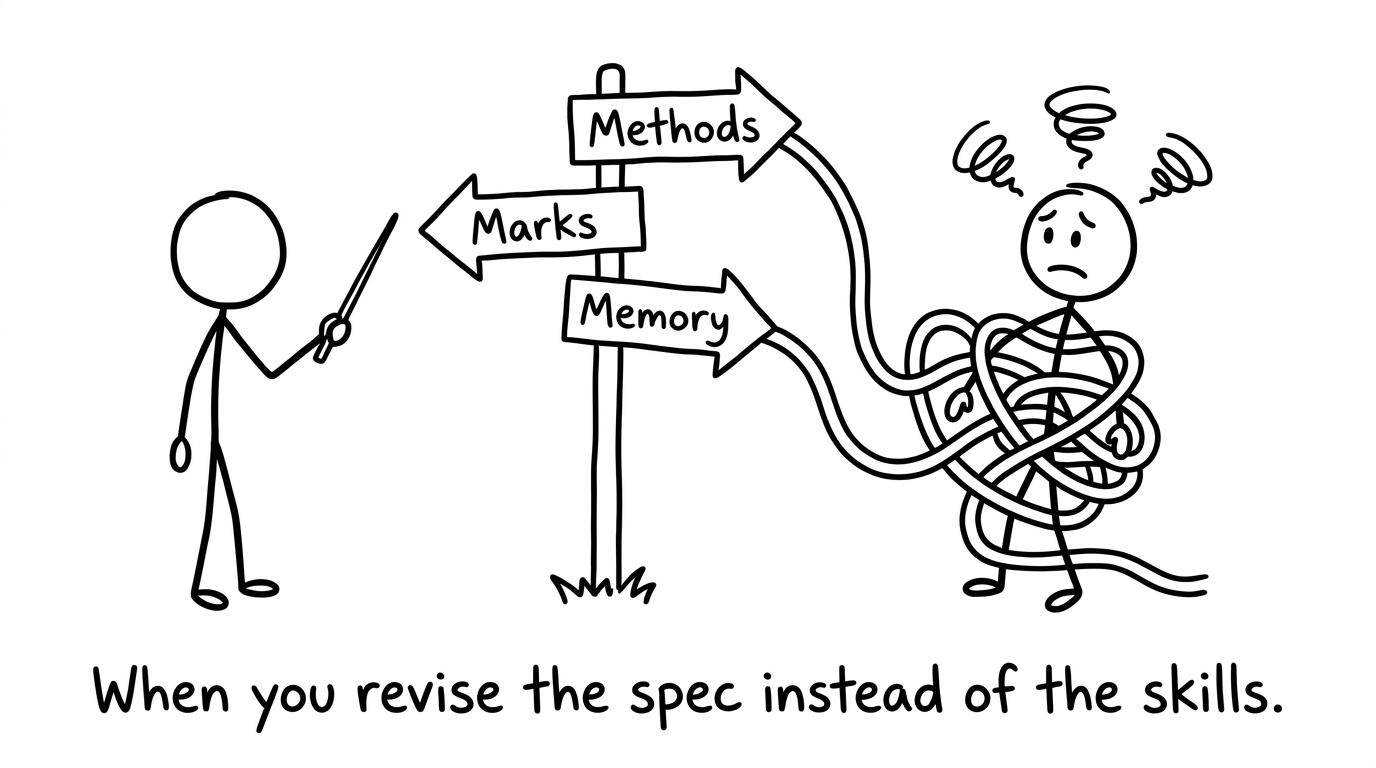 Teacher signpost: Methods vs Marks vs Memory
The revision strategy that works for Edexcel and AQA GCSE
A lot of revision stress comes from trying to memorise the spec like a shopping list. A better approach is to revise the skills that travel.
Step one: build the skill base (lessons and topic practice)
Before you grind papers, make sure the core techniques are automatic. A paper is not the best place to learn a method for the first time.
Use:
- GCSE Statistics Revision if you’re also doing GCSE Statistics alongside GCSE Maths.
- Other GCSE resources for formulae and self-testing support.
Step two: practise questions by topic, then mix them
Your brain learns methods in tidy folders. Exams test them in messy piles.
A simple loop:
- Pick a topic you’re shaky on.
- Do focused questions until the method is stable.
- Then do a mixed set (or a paper) to practise recognising it.
Step three: switch to papers early enough to learn timing
A common GCSE mistake is saving papers for “the week before”. Papers are not just assessment. They are training.
For paper practice on Maths Genie:
Worked examples: the methods don’t change, the wording does
These examples are chosen because they appear across Edexcel, AQA, OCR and Eduqas GCSE papers in many disguises.
Worked example 1: rearranging and substituting (a classic “setup” skill)
Make xxx the subject:
y=3x+5 y = 3x + 5 y=3x+5Step-by-step:
Subtract 555 from both sides:
y−5=3x y - 5 = 3x y−5=3xDivide both sides by 333:
x=y−53 x = \frac{y-5}{3} x=3y−5If y=20y=20y=20, then:
x=20−53=153=5 x = \frac{20-5}{3} = \frac{15}{3} = 5 x=320−5=315=5Why this matters for Edexcel vs AQA: Edexcel might ask directly to “make xxx the subject”. AQA might wrap it in a formula context (money, physics, conversion). The algebra is identical.
Worked example 2: linear simultaneous equations (method marks live here)
Solve:
2x+y=113x−y=4 \begin{aligned} 2x + y &= 11 \\ 3x - y &= 4 \end{aligned} 2x+y3x−y=11=4Add the equations to eliminate yyy:
(2x+y)+(3x−y)=11+4 (2x+y) + (3x-y) = 11 + 4 (2x+y)+(3x−y)=11+4 5x=15⇒x=3 5x = 15 \Rightarrow x = 3 5x=15⇒x=3Substitute into 2x+y=112x+y=112x+y=11:
2(3)+y=11⇒6+y=11⇒y=5 2(3) + y = 11 \Rightarrow 6 + y = 11 \Rightarrow y = 5 2(3)+y=11⇒6+y=11⇒y=5So the solution is (x,y)=(3,5)(x,y) = (3,5)(x,y)=(3,5).
Exam-board angle: AQA often rewards a clearly stated elimination choice (“add to eliminate yyy”). Edexcel often repeats similar structures across years. Either way, your working needs to be readable.
Worked example 3: ratio in context (where reading matters)
A recipe uses flour and sugar in the ratio 5:25:25:2. You have 350 g350\text{ g}350 g of flour. How much sugar is needed?
The ratio parts for flour are 555 parts.
One part is:
3505=70 g \frac{350}{5} = 70\text{ g} 5350=70 gSugar is 222 parts:
2×70=140 g 2 \times 70 = 140\text{ g} 2×70=140 gSo you need 140 g140\text{ g}140 g of sugar.
Why this matters for GCSE: ratio questions can be written in a clean line (Edexcel style) or embedded in a longer story (AQA style). The calm approach is the same: find one part, then scale.
Common mistakes students make with Edexcel vs AQA GCSE Maths
- Revising the wrong papers. If you’re AQA and only practise Edexcel, you’ll still improve at maths, but you may be surprised by unfamiliar phrasing and layout. Use AQA GCSE Maths papers if that’s your board.
- Treating predicted papers like magic. Predicted papers are useful for focused revision, not a guarantee. Use them alongside topic revision and past papers. Start at GCSE Predicted Papers and resources.
- Hiding your working. In GCSE Maths, you can lose method marks even if you had the right idea, simply because the examiner can’t see it.
- Ignoring non-calculator skills. Even on calculator papers, basic arithmetic and fraction sense save time and reduce errors.
- Confusing “hard” with “new”. Often a question feels difficult because it’s a familiar skill in an unfamiliar context. That’s why mixing practice matters.
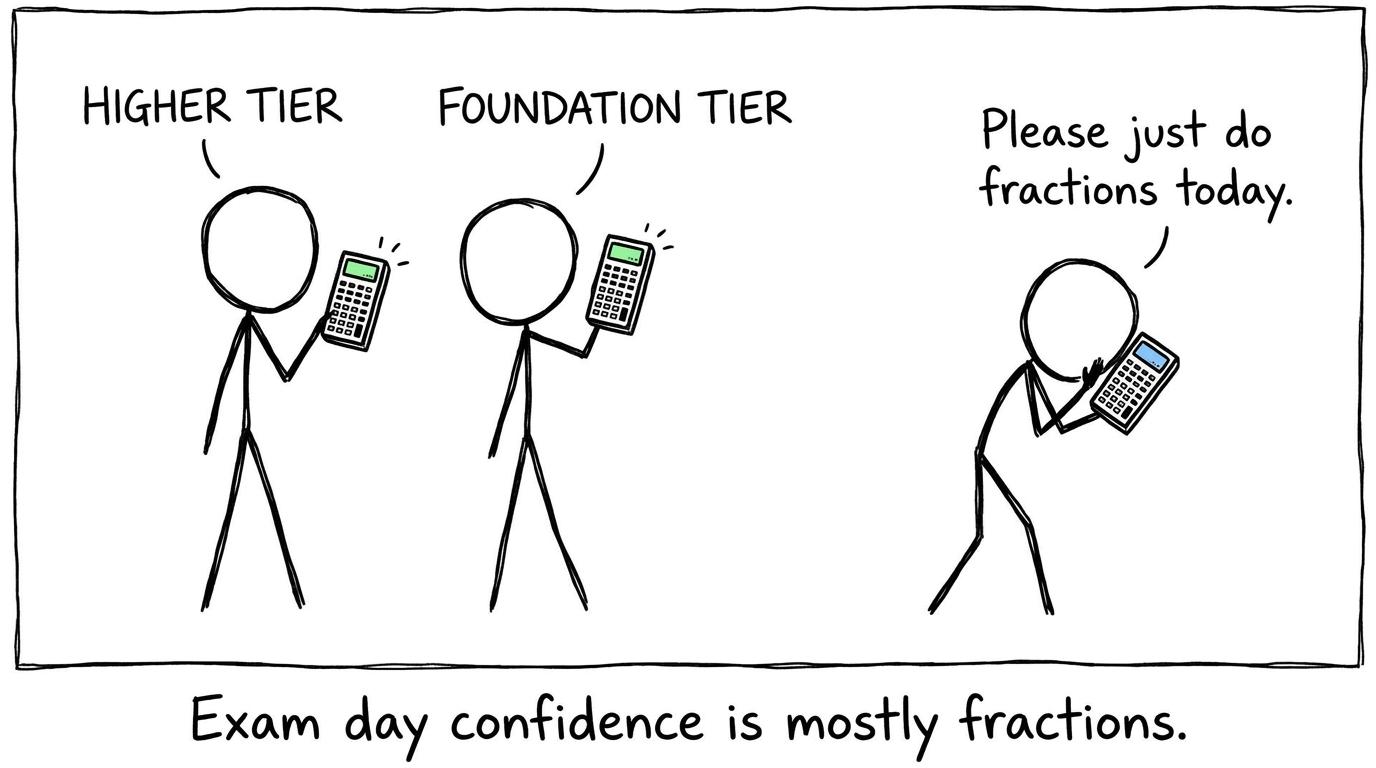 Three students with calculators, joking about fractions
Bringing it together: your GCSE grade isn’t decided by a logo
Edexcel vs AQA can feel like a big fork in the road, but for GCSE Maths it’s usually a difference in how questions are asked, not what you’re expected to know. If you master the methods, practise recognising them under different wording, and train with the right papers, you stop being surprised by the exam.
Your next steps on Maths Genie:
- Build confidence with revision lessons and topic practice.
- Use AQA GCSE Maths papers if you’re on AQA.
- Add exam-season focus using GCSE Predicted Papers and resources.
- Identify gaps quickly with the GCSE Maths self-assessment sheet (PDF).
If you treat GCSE revision like a slow, steady craft rather than a last-minute sprint, the exam board becomes background noise. And that’s the point: on the day, you want to be thinking about maths, not worrying about which brand of paper it’s printed on.










