Moving Schools GCSE Further Maths: Stay on Track
Moving schools GCSE Further Maths advice: confirm your specification, identify topic gaps and build a practical revision plan without falling behind.
Changing schools halfway through a course can make familiar maths feel strangely uncertain. Your old class may have started matrices while your new class is finishing functions. Even the qualification itself may be different. If you are moving schools GCSE Further Maths, the quickest way to stay on track is to confirm your exact specification, compare the two schools’ topic coverage and create a short catch-up plan with your new teacher.
The problem is rarely that you have suddenly become worse at maths. It is usually a problem of sequence: two schools travelling towards similar goals by different routes. Once you map those routes, the uncertainty becomes a manageable list.
Your moving-school checklist
Within your first week, aim to confirm:
- the full name and code of your Further Maths or extended maths qualification
- whether your new school will enter you for it
- which topics your old school taught
- which topics your new class has already completed
- the examination format and calculator rules
- when your next assessment or mock will take place
- whether any access arrangements need to be transferred or reconsidered
- who will help you resolve gaps in notes, homework and assessment evidence
Do not rely on phrases such as “GCSE Further Maths” alone. Schools sometimes use that label informally for different Level 222 qualifications, and their content, grading and assessment structures are not identical.
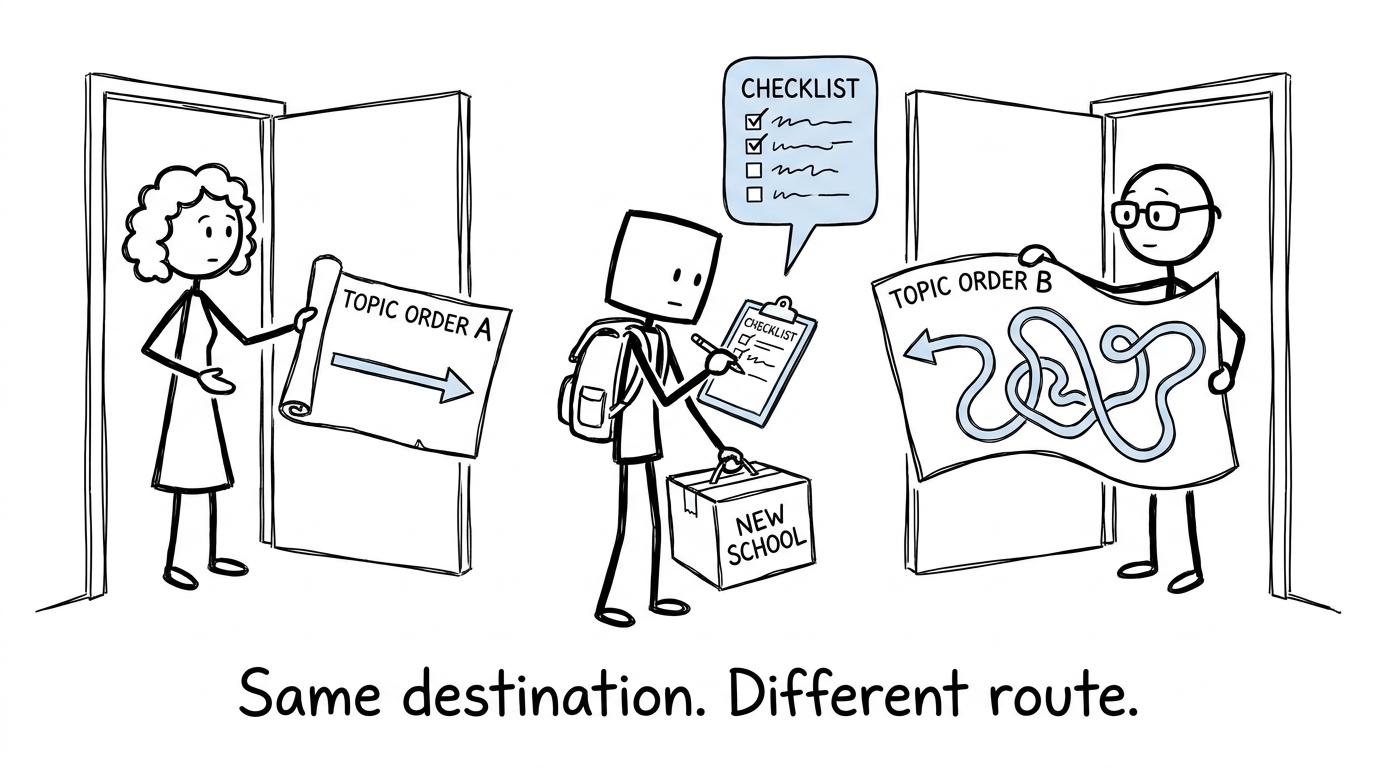 A student comparing two schools' different routes towards the same destination
Confirm the qualification before revising
This is the most important administrative step because it determines what you actually need to learn.
A school offering the AQA Level 222 Certificate in Further Mathematics may refer to it simply as Further Maths. It is an additional, untiered qualification rather than a replacement for GCSE Mathematics. Its content extends GCSE work through areas including algebra, functions, graphs, geometry, trigonometry, matrices and introductory calculus.
The AQA course has two equally weighted written papers. The first is non-calculator and the second permits a calculator. Each paper can assess content from across the specification.
Another school might use the Pearson Edexcel Level 222 Extended Mathematics Certificate. That qualification also extends Higher tier GCSE Mathematics, but it has its own content, assessment pattern and grading scale. It includes substantial algebra alongside number, ratio, geometry and probability.
That distinction matters. A student who has learnt matrices for one specification may arrive at a school following a course in which matrices are not assessed. Meanwhile, the new class may have covered probability or algebraic proof that the student has not yet met.
Ask your new maths teacher or examinations officer these questions:
- What is the awarding organisation?
- What is the specification or entry code?
- Will I definitely be entered this examination series?
- Which papers will I sit?
- Is the qualification tiered or untiered?
- Which topics have already been taught?
Keep the answers together. A single page containing your qualification, paper format and missing topics is more useful than a folder full of unfocused revision.
Build a topic handover, not a pile of notes
It is tempting to request every worksheet from both schools. That often creates volume without clarity. Instead, build a topic handover with three categories:
- Secure: you can answer exam-style questions without notes.
- Partly secure: you recognise the topic but need prompts or make recurring errors.
- Not yet taught: you have not received proper teaching on it.
Your old exercise books and online classroom records can show what was presented, but completed notes do not prove that a skill is secure. Test your understanding with questions.
Use the GCSE Maths topics by exam board and tier guide to check the underlying Higher tier knowledge supporting your additional qualification. The MathsGenie GCSE Maths revision hub also lets you locate lessons, questions and papers for the main GCSE exam boards, including Edexcel, AQA, OCR and Eduqas.
Compare topic coverage with your teacher rather than trying to reconstruct the whole course alone. The most useful handover information is specific: “I have studied composite functions but not matrices” is actionable. “We did some algebra last term” is not.
Protect your core GCSE Maths first
Further Maths is designed to extend strong GCSE knowledge. It cannot reliably compensate for gaps in the foundations beneath it.
If changing schools has disrupted both courses, prioritise the skills that support each one. These commonly include:
- manipulating algebraic expressions
- factorising and solving quadratics
- rearranging formulae
- simultaneous equations
- indices and surds
- functions and graph transformations
- coordinate geometry
- trigonometry and geometric reasoning
- proof and clear mathematical communication
This does not mean abandoning Further Maths whenever GCSE work becomes difficult. It means choosing revision that serves both courses. Improving algebraic manipulation, for example, can strengthen ordinary Higher tier questions while making advanced functions and introductory calculus more accessible.
Your GCSE tier must also be confirmed after the move. Foundation and Higher tier are GCSE Mathematics arrangements; an additional Level 222 Further Maths qualification may be untiered. Do not assume that the tier or entry discussed at your former school has automatically carried over.
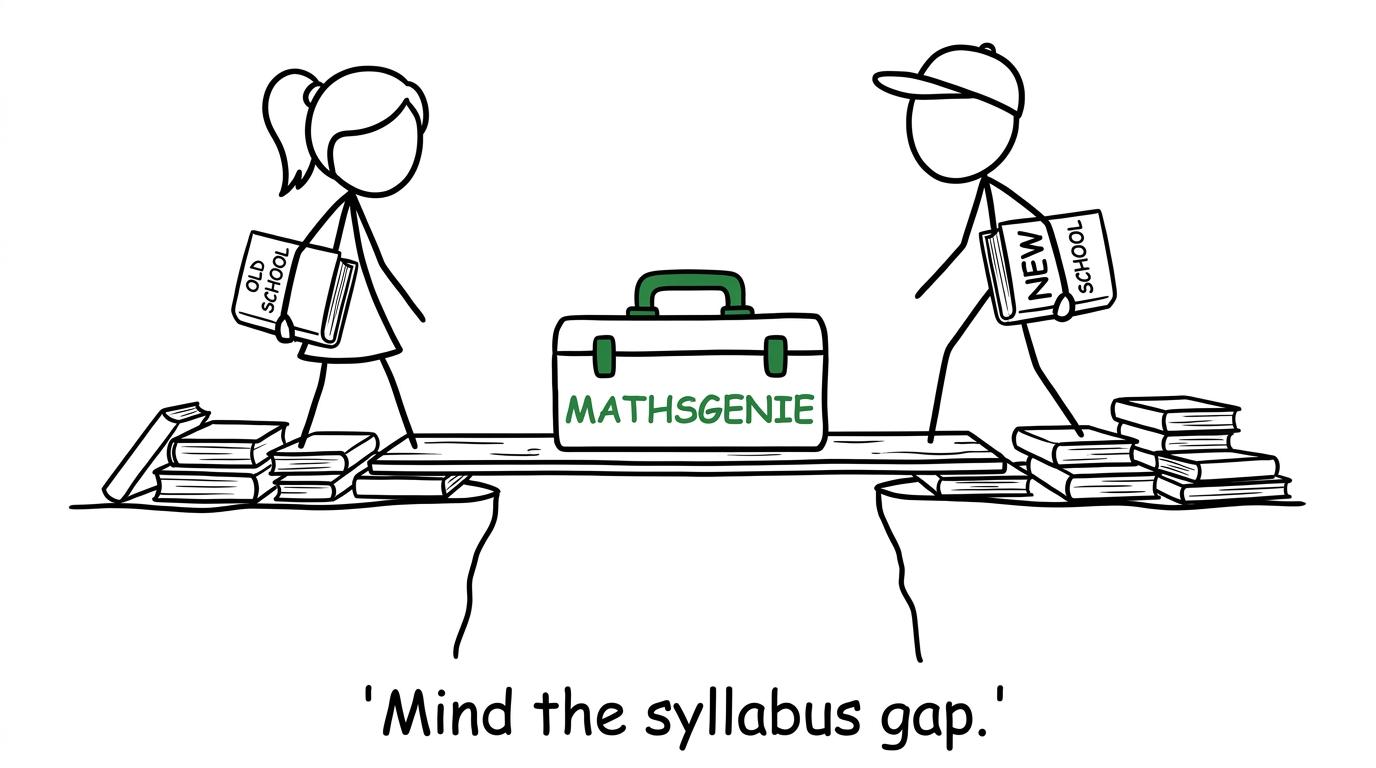 Students building a bridge between old and new schools using a MathsGenie toolbox
Create a catch-up plan that can survive a busy week
A useful plan is modest enough to repeat. Trying to recover an entire term over one weekend usually produces tiredness rather than durable understanding.
Start with three weekly sessions:
One learning session
Choose one genuinely missing topic. Use a revision lesson, make a brief method summary and check essential definitions or notation. Keep the session focused on one outcome.
One practice session
Answer questions on the same topic without copying a model solution. Mark the work immediately and record exactly what caused each lost mark: missing knowledge, an algebraic slip, unclear working or misreading.
One mixed review
Return to the new topic alongside older material. This prevents catch-up work from pushing previously secure knowledge out of sight. Short GCSE Maths mini tests can help you maintain the underlying skills without committing to a complete paper every time.
For a fuller structure, adapt the GCSE Maths revision timetable around your school week. Give missing Further Maths content its own labelled slots instead of hiding it inside a vague instruction to “revise maths”.
The most reliable revision cycle is simple:
- learn one idea
- practise it independently
- mark the work carefully
- write a specific correction
- retest the skill after a short gap
That rhythm matters more than heroic session length.
Use papers diagnostically before using them for timing
A complete Further Maths paper can feel brutal if your former school simply had not reached several topics. At first, use papers to discover gaps rather than to judge your likely grade.
The AQA GCSE Further Maths past papers collection brings together papers, official mark schemes and worked solutions where available. Check that AQA is actually your qualification before using it as your main assessment source.
During the first diagnostic paper:
- mark questions on untaught topics as coverage gaps
- distinguish those from questions you were taught but could not complete
- note where you understood the method but lost accuracy
- identify notation that differs from what your old school used
- choose no more than three priorities for the following week
Later, complete papers under the correct timing and calculator conditions. The guide to using GCSE past papers properly explains the paper, mark, repair and retest cycle. Predicted papers can provide fresh exam-style practice nearer the examination, but they should supplement specification-matched teaching and official past papers rather than replace them.
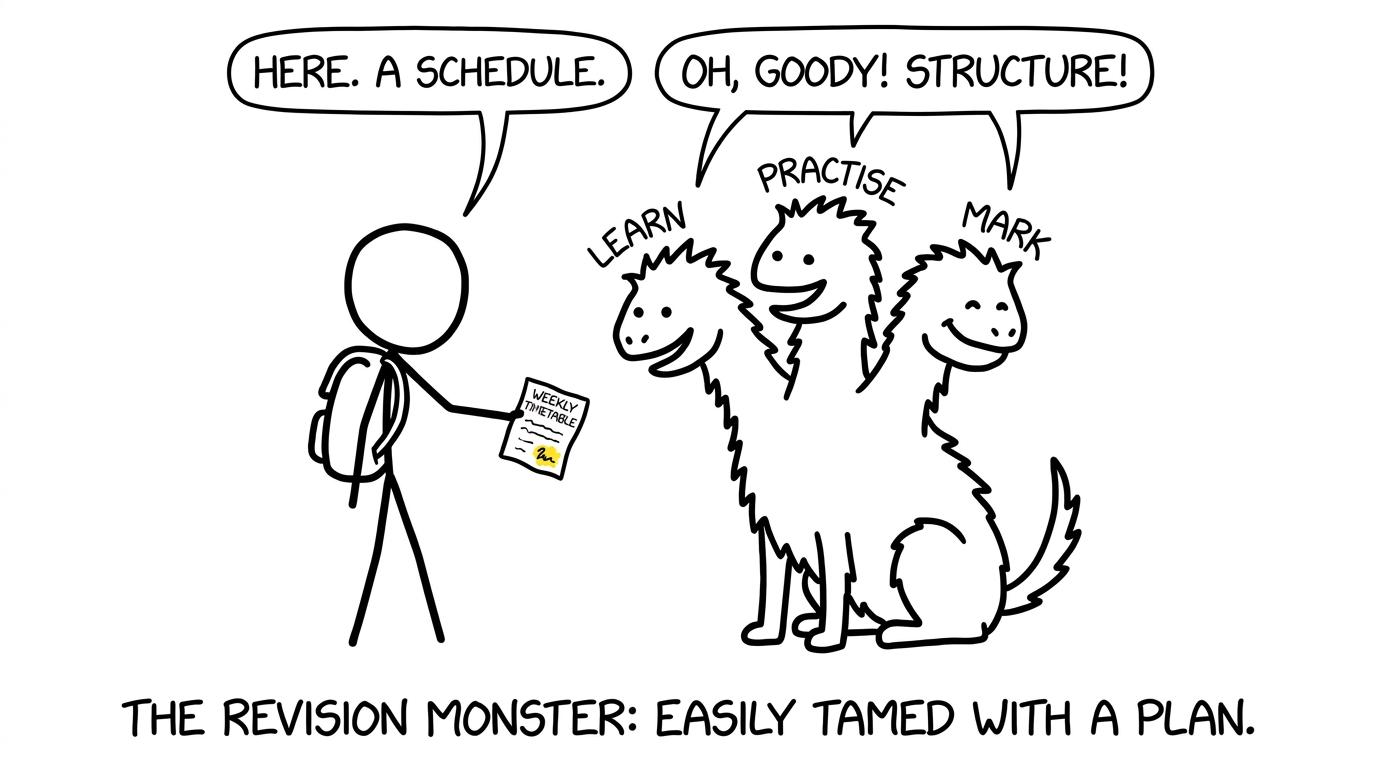 A revision monster becoming manageable when given a small weekly timetable
Speak to the people handling your examination entry
Subject knowledge is only half the transfer. Your examination arrangements must also be clear.
Ask the new school to confirm your entry rather than assuming that records have transferred automatically. If the school does not normally teach your previous qualification, it may need time to decide what support and entry arrangements are possible. Raise the issue early and involve a parent or carer if decisions remain unclear.
If you use access arrangements, contact the new school’s SENCo promptly. Under current JCQ guidance, arrangements must reflect your current need and normal way of working at the new centre. The new centre must check the evidence and process the appropriate application; it should not rely blindly on a previous approval. Ask your former school to transfer relevant evidence securely when requested.
Keep copies of useful non-confidential information such as your topic list, mock feedback and teacher comments. Examination officers and SENCos handle formal records, but your own academic handover can help teachers understand your starting point quickly.
Common mistakes when moving schools during Further Maths
Revising before identifying the specification
Similar course names can hide important differences. Confirm the awarding organisation and specification code before downloading papers or building a topic list.
Treating every unfamiliar topic as a personal weakness
Sometimes a topic is unfamiliar because it was scheduled for later at your old school. Label it “not yet taught”, arrange teaching and then assess it fairly.
Trying to catch up in teaching order
Your new class may depend on one missing topic immediately while other gaps can wait. Prioritise prerequisite knowledge and upcoming assessments, not the order of an old scheme of work.
Completing questions without marking them
Practice only becomes informative when you compare it with the mark scheme or solution. Record why marks were lost and repeat the skill later.
Neglecting ordinary GCSE Maths
The additional qualification builds on Higher tier knowledge. Keep your core GCSE preparation moving alongside the catch-up plan.
Waiting for adults to notice the mismatch
Teachers may not immediately know what your old school covered. Bring a concise topic audit and ask direct questions about entry, missed content and support.
A change of school does not have to become a permanent gap
Moving midway through GCSE Further Maths can interrupt the route, but it does not erase the progress already made. The task is to make the invisible differences visible: qualification, topic order, assessment format and support arrangements.
Start today by confirming your specification and creating three lists: secure, partly secure and not yet taught. Then use MathsGenie as your free revision base. Rebuild methods through revision lessons, strengthen them with practice questions, check your thinking with mark schemes and video solutions, and move towards mini tests, past papers and predicted papers when the foundations are ready.
For a practical weekly framework, the one-month GCSE Maths revision plan can be adapted around your Further Maths gap list. You do not need to recreate the course overnight. You need the right map, honest feedback and a routine you can keep following.