

Moving Schools GCSE Astronomy: Stay on Track
Moving schools GCSE Astronomy? Use this calm transfer checklist to protect observations, map specification gaps and keep maths revision firmly on track too.
Changing schools halfway through a GCSE can feel like arriving at a film after someone has quietly removed three scenes. The subject is familiar, but the order is not. Notes use different language. Topics you expected next have already been taught.
If you are moving schools GCSE Astronomy does not need to become a lost qualification. Your immediate priorities are to confirm that your new school can enter you for Pearson Edexcel GCSE Astronomy, transfer evidence of your observational work, compare your learning against the current specification and create a focused catch-up plan. Do those things early and the move becomes a manageable gap-mapping exercise rather than a reason to start again.
The same disruption can affect GCSE Maths. Fortunately, much of the mathematical work in astronomy, including standard form, graphs, angles, ratios and formulae, can strengthen both subjects when revision is planned carefully.
Your school-transfer checklist
During your first week, aim to confirm each of the following:
- Your exam board, specification code and intended exam series
- Whether your new school teaches and enters students for GCSE Astronomy
- Which specification topics your previous and new classes have completed
- Whether records of your aided and unaided observations can be transferred
- Who will oversee any unfinished observational work
- Where your notes, assessments and feedback will be stored
- Which astronomy calculations reveal gaps in your GCSE Maths knowledge
- When your progress will be reviewed with a teacher
Do not rely on a verbal assurance that everything will be sorted. Ask for the plan to be written down, even if it is only a short email between your teachers and examinations officer.
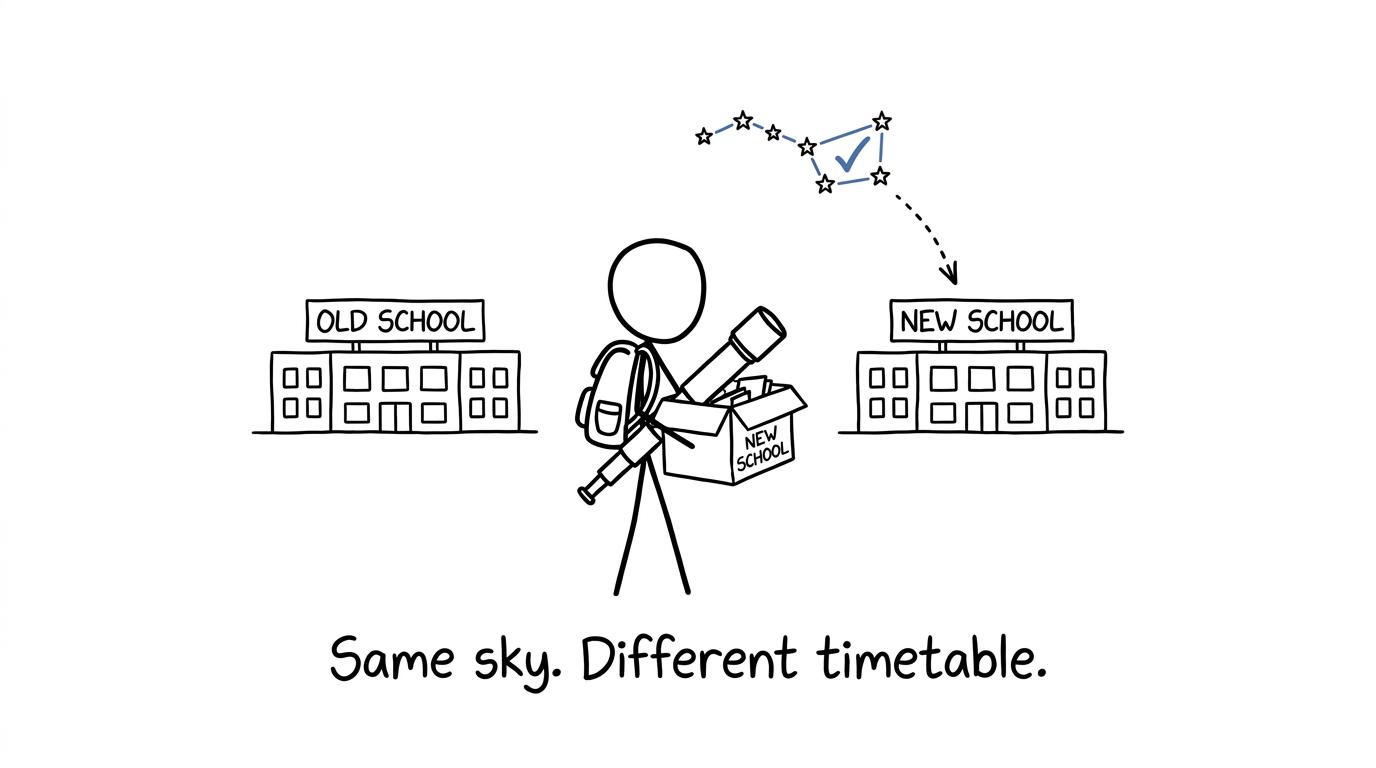 A student carrying a telescope between two schools under a checklist-shaped constellation
Confirm exactly which qualification you are taking
The current Pearson Edexcel GCSE Astronomy qualification has the specification code 1AS0. It is untiered, unlike GCSE Maths, so there is no foundation or higher paper decision. Every candidate sits the same assessment.
The qualification has two externally examined papers:
- Paper One, Naked-eye Astronomy, covers Topics One to Eight.
- Paper Two, Telescopic Astronomy, covers Topics Nine to Sixteen.
- Each paper lasts 111 hour 454545 minutes.
- Each paper is worth 100100100 marks and 50%50\%50% of the qualification.
Questions can include multiple-choice items, short answers, calculations, graphical work and extended responses. Students complete all assessment in the same May or June series.
This matters because schools do not always teach the topics in numerical order. Your old school might have completed stellar evolution while your new class is studying lunar cycles. Neither sequence is necessarily wrong. What matters is whether you will eventually cover every statement in the current specification.
Ask your new teacher for a specification checklist marked with four labels:
- secure
- partly secure
- not yet taught
- taught by the new school before you arrived
That final category is your true catch-up list. It is far more useful than revising the entire course from the beginning.
Protect your observational work immediately
Observational work is the part of a school move that deserves the fastest attention. Under the current specification, candidates must complete at least one unaided observation and one aided observation during the course. Aided work may involve equipment such as binoculars, telescopes or cameras.
The observations develop skills in planning, carrying out, analysing and evaluating astronomical work. Your centre must make the required observation statement for the relevant exam series, so your new school needs enough evidence to confirm that the requirements have been met.
If you completed observations at your previous school, ask for the transfer of:
- observation dates and locations
- the task title and method
- planning sheets
- original records or images
- teacher feedback
- analysis and evaluation
- confirmation of the equipment used
- relevant safety information
Do not assume that bringing your final write-up is sufficient. Your new teacher and examinations officer should decide whether the available records meet Pearson's current requirements. The two schools may need to communicate directly.
If evidence cannot be confirmed, ask promptly whether the observation should be repeated. Astronomy is unusually dependent on weather, visibility and seasonal opportunities. A task that is easy to schedule in autumn may be impossible to reproduce shortly before the examinations.
Never attempt a solar observation independently. Looking directly at the Sun can cause serious eye damage. Follow the approved method, risk assessment and supervision specified by your school.
 A telescope faces clouds while a student proudly evaluates the limitations
Build a gap map instead of restarting the course
A move creates two kinds of gap. The obvious one is content: material your new class has covered and you have not. The quieter one is vocabulary. Two teachers may explain the same idea using different diagrams, conventions or phrases.
Create one page for each specification topic. Record:
- what you remember without notes
- what your previous school taught
- what the new class has completed
- your most recent assessment result
- one action needed next
Keep the action precise. “Revise cosmology” is too broad. “Review evidence for an expanding universe, then answer questions on redshift” gives you somewhere to begin.
Use a simple priority rule:
priority=size of gap×urgency\text{priority}=\text{size of gap}\times\text{urgency}priority=size of gap×urgencyYou do not need to assign numerical scores. The expression is a decision-making tool. A large gap in a topic being assessed next week comes before a smaller gap scheduled for next term.
This approach also works for maths. The GCSE Maths topics by exam board and tier guide can help you compare what your old and new schools have covered under Edexcel, AQA, OCR or Eduqas. If the move has disrupted several areas, follow the best order for learning GCSE Maths topics rather than choosing sessions at random.
Use astronomy to identify your maths gaps
At least 20%20\%20% of the marks in GCSE Astronomy assess mathematical skills. That makes maths more than a supporting subject. It is part of how astronomical knowledge is tested.
Common crossover skills include:
- calculations with angles and time
- rearranging and substituting into formulae
- working with ratios and scale
- converting units
- interpreting tables and graphs
- drawing lines of best fit
- using significant figures
- handling very large and very small values in standard form
When you lose a mark on an astronomy calculation, identify the real cause. Was the astronomical idea unclear, or did the mathematical process fail? Those require different responses.
For a maths weakness, use a revision lesson and focused practice questions on MathsGenie's free GCSE Maths revision platform. For an astronomy weakness, return to the relevant specification statement, class material and astronomy exam questions. Separating the two prevents you from repeatedly reading astronomy notes when the actual problem is rearranging a formula or interpreting a graph.
Create a catch-up timetable that can survive real life
The temptation after changing school is to build an enormous timetable. It looks reassuring for an evening and then collapses under homework, travel and tiredness.
A smaller repeatable plan is better. Each week, include:
- one session for a missed astronomy topic
- one session for current classwork
- one session for observational analysis or terminology
- one short maths session based on crossover skills
- one review of errors from questions or assessments
Keep catch-up work separate from ordinary homework. Otherwise, completing tomorrow's task can create the illusion that older gaps are closing.
The GCSE Maths revision timetable guide can help you build a realistic routine around school and rest. If you are unsure which mathematical skills deserve attention first, the guide to GCSE Maths topics that regularly appear provides a useful starting point.
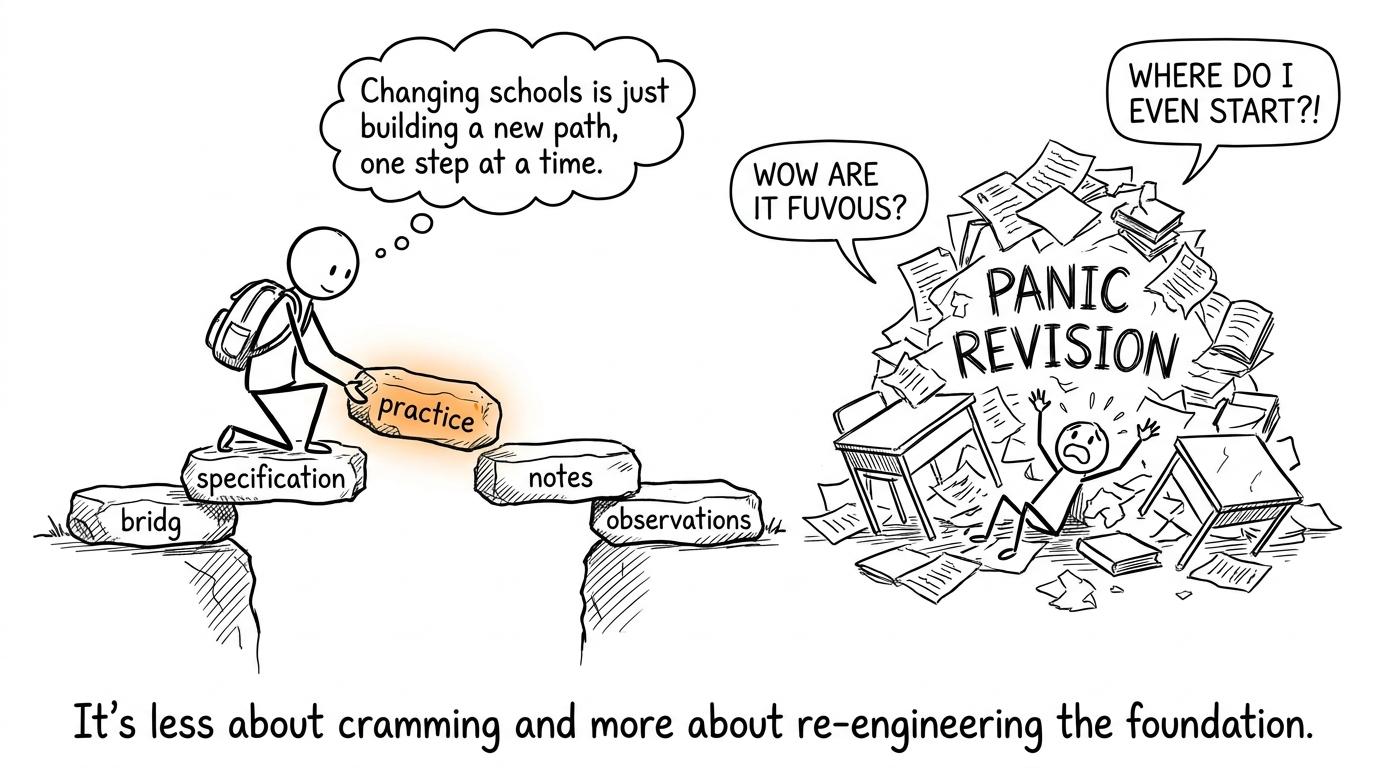 A student builds a calm bridge from specification, notes, observations and practice
Turn practice into evidence of progress
Reading can make unfamiliar notes feel familiar, but familiarity is not the same as recall. After reviewing a topic, close your materials and write down its key ideas, diagrams, vocabulary and equations from memory. Then answer questions without help.
Marking is where catch-up becomes measurable. Record whether each lost mark came from:
- missing knowledge
- weak application
- incorrect maths
- poor interpretation of data
- imprecise terminology
- an incomplete evaluation
A full paper may initially be too broad because it mixes taught and untaught content. Begin with questions on completed topics, then move towards timed papers as your coverage improves. The principles in how to use GCSE past papers properly apply across exam subjects: attempt, mark, diagnose, repair and retest.
For your parallel maths preparation, GCSE predicted papers can provide extra practice after topic gaps have been repaired. They should complement official past papers, not replace specification-led revision.
Speak to the people who can fix administrative problems
A student can organise notes and practise calculations, but only the school can confirm exam entry and complete centre processes.
Speak to:
- your astronomy teacher or subject lead
- your form tutor or head of year
- the examinations officer
- the special educational needs coordinator if you have access arrangements
- a parent or carer who can help follow up the transfer
Ask direct questions: Has my entry been confirmed? Has my observation evidence arrived? Which topics did this class finish before I joined? When will we check my catch-up progress?
If your new school does not offer GCSE Astronomy, ask the examinations officer what options are genuinely available. Do not assume that you can automatically continue as an external or private candidate. A willing centre must be able to enter you and satisfy the qualification's observational requirements.
Common mistakes after moving schools mid-course
Waiting for the new school to discover every gap
Teachers need your old topic list, notes and assessment information. Bring what you have and ask your previous school for the rest.
Revising everything equally
Some content is already secure. Use the specification to isolate missing topics and prioritise by urgency.
Ignoring observation records
Observational work cannot be treated like an ordinary missing worksheet. Confirm the evidence and centre requirements as soon as possible.
Treating every calculation error as an astronomy problem
A weak ratio, graph or standard-form skill may be the true cause. Repair it through focused maths practice.
Completing papers without analysing them
A mark alone does not tell you what to do next. Use mark schemes, write an error log and revisit the exact weakness.
Keep the qualification connected
Changing school can make learning feel divided into “before” and “after”. The specification is what reconnects those halves. It gives both schools a shared map and gives you a finite list of actions: confirm the entry, secure the observation evidence, identify omitted topics and practise the skills that cost marks.
MathsGenie can support the mathematical side of that plan for free. Start with revision lessons, move into practice questions, check your work with mark schemes and video solutions, then test your progress through mini tests, past papers and predicted papers. Use the MathsGenie GCSE learning journey to decide what comes next.
The school may have changed. The route can change too. But once the gaps are visible, they become tasks rather than mysteries and tasks can be completed.











