Make Your Own GCSE Chinese Practice Questions?
Make own GCSE Chinese practice questions effectively: turn notes into exam-style prompts, check accuracy, and pair them with reliable revision resources.
Revision notes can feel reassuring. The pages are full, important phrases are highlighted and every theme looks familiar. Then you close the book and discover that recognising an answer is not the same as producing one.
If you have searched for how to make own GCSE Chinese practice questions, the short answer is yes: writing questions can be worthwhile because it forces you to select, recall and organise what you know. However, homemade questions work best as a supplement to official exam-board materials, not as a replacement for them.
The useful part is not simply owning another pile of questions. It is thinking like an examiner long enough to notice what a good answer must contain.
The quick verdict
Making your own GCSE Chinese questions is worth the time when you:
- base them on your exam board's current specification;
- cover listening, speaking, reading and writing rather than vocabulary alone;
- write an answer or checking guide for every question;
- include topics and language you find difficult;
- return to the questions after a delay;
- compare their style with official sample and past papers;
- ask a teacher to check uncertain language, pronunciation or marking.
It is less valuable when you copy sentences directly from your notes, create only easy recall questions or spend so long designing attractive cards that little time remains for answering them.
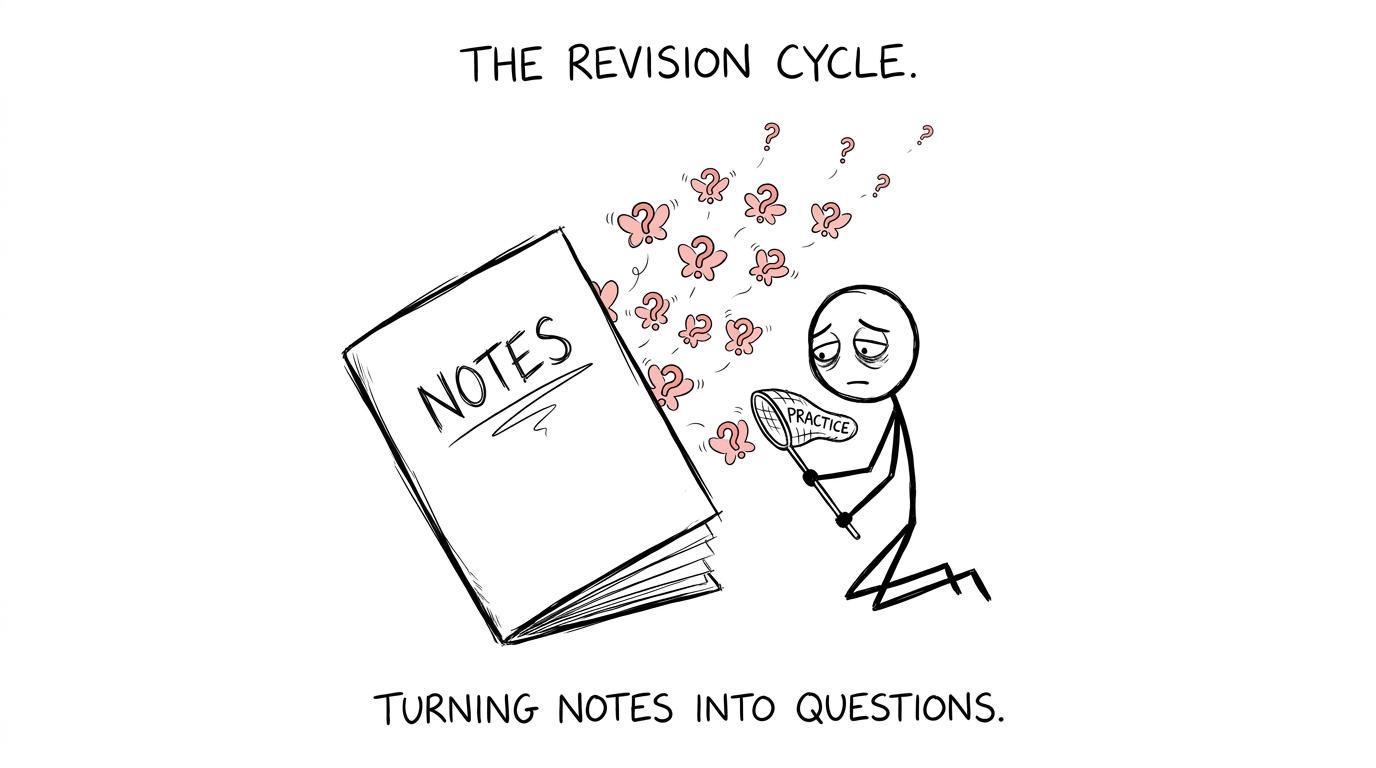 A student trying to catch practice questions escaping from an enormous revision notebook
Why writing questions can improve revision
Reading notes often creates familiarity. You see a phrase and think, "I know that." A question removes the phrase and asks whether you can retrieve it without help.
Retrieval practice is supported by a substantial body of classroom research, although the design and difficulty of the questions matter. Research specifically examining student-generated questions is more mixed: generating questions can encourage deeper processing, but answering poorly targeted homemade questions is not automatically better than using well-designed questions supplied by a teacher or exam board.
That distinction matters. Question writing has two possible benefits.
First, it makes you inspect your notes. You must decide what is important, which skill is being tested and what a complete response would require. Second, the finished questions can become retrieval practice later, provided you close your notes and answer from memory.
There is also a useful lesson here for maths revision. Copying a method can feel fluent while the page is open, but an unseen question reveals whether the method is genuinely available. MathsGenie's free GCSE and A Level maths revision follows that progression through lessons, exam questions, solutions and papers. The subject changes; the principle does not.
Start with your specification, not your highlighter
GCSE Chinese courses assess communication through listening, speaking, reading and writing. The exact themes, timings, task formats and mark allocations depend on the qualification and exam board.
For example, the current AQA GCSE Chinese (Spoken Mandarin) course has separate listening, speaking, reading and writing assessments, each contributing one quarter of the qualification. Pearson Edexcel GCSE Chinese also assesses the four skills separately and offers spoken Mandarin or Cantonese routes. Their themes and precise question structures are not identical.
Therefore, check your own specification and teacher guidance before building a question bank. Do not assume that a task copied from a different board, an International GCSE or an older specification matches your exam.
Create a simple coverage list with these headings:
- specification theme and subtopic;
- language skill;
- Foundation or Higher tier;
- question format;
- language or grammar being tested;
- date attempted;
- mistake found and next action.
This prevents a common revision problem: producing dozens of questions on comfortable topics while avoiding the areas most likely to expose a gap.
How to turn GCSE Chinese notes into practice questions
Separate each page into testable knowledge
Take one small section of notes rather than an entire theme. Identify the material that could be retrieved or applied:
- vocabulary and character recognition;
- opinions and justifications;
- time references;
- connectives and sentence structures;
- cultural or contextual information required by your course;
- details that might appear in a reading or listening passage;
- prompts suitable for speaking or extended writing.
Do not turn every line into a question. Select ideas that are important, easily confused or difficult to produce independently.
Choose the skill before writing the wording
A vocabulary card tests something different from a reading inference or a spontaneous speaking response. Label the intended skill first, then write the prompt.
For reading, you might create questions about the main message, a specific detail, an opinion, a time reference or the meaning of an unfamiliar word in context. For writing, use bullet-point prompts that require information, an opinion, a reason and more than one timeframe where this matches your course.
Speaking prompts should encourage unrehearsed responses rather than the recitation of one memorised paragraph. Listening is harder to create accurately by yourself, but you can record short passages and answer questions after a delay. Ask a teacher or proficient speaker to check pronunciation and natural phrasing before relying on those recordings.
Write the checking material immediately
Every homemade question needs an answer, acceptable alternatives or a brief checklist. Otherwise, you may repeatedly practise an error without noticing it.
For a comprehension question, record the evidence that supports the answer. For translation, note acceptable wording and any essential meaning. For an extended response, create a checklist based on the relevant mark scheme, including task completion, clarity, range and accuracy where applicable.
Keep this checking material separate from the question. The answer should not be visible while you are attempting it.
Make one deliberate change
Turning notes into questions should involve transformation rather than copying. You could change the context, switch the timeframe, require a negative response, ask for an explanation or move from recognition to production.
The change should remain within language you have been taught and the demands of your tier. Difficulty is useful only when it is valid. An obscure phrase outside the specification does not become good revision merely because it is hard.
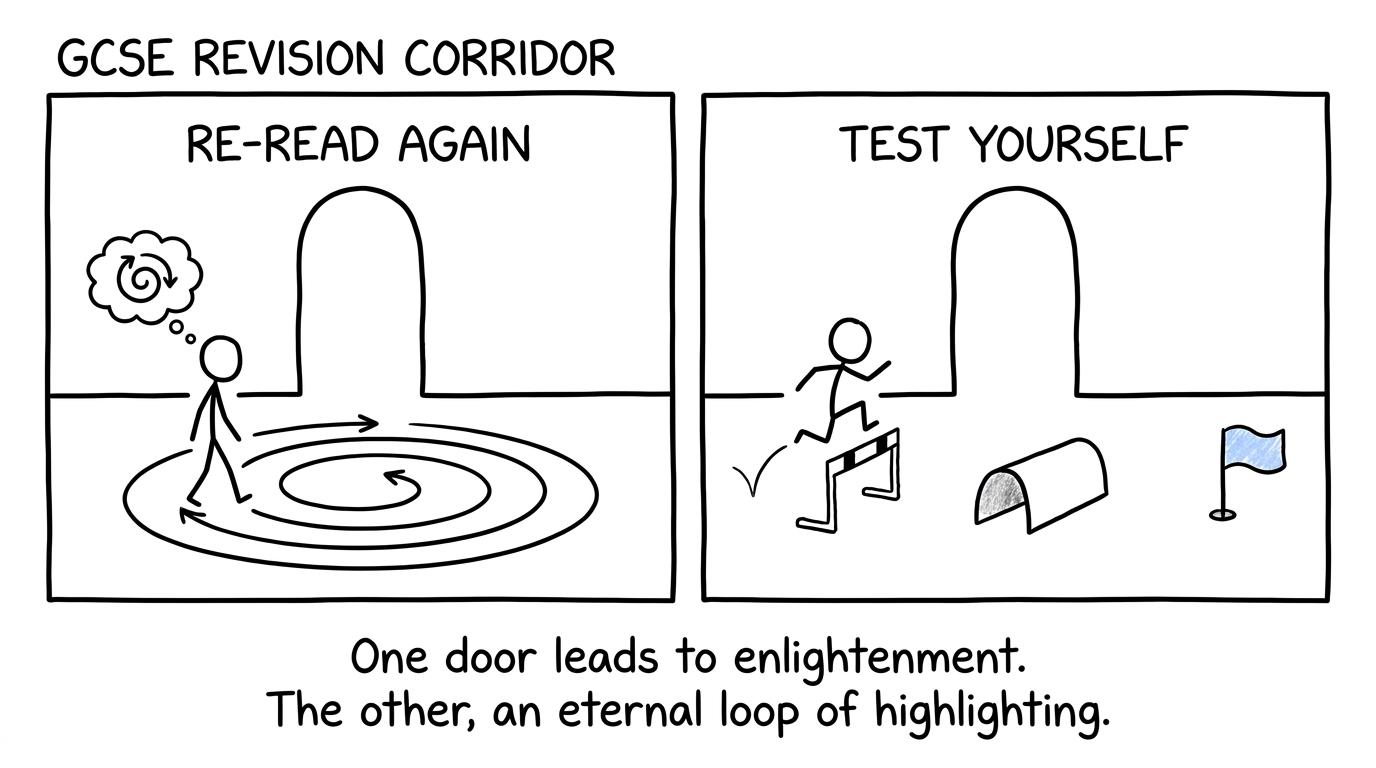 A revision student choosing between rereading in circles and testing themselves
Build questions for all four language skills
Listening questions
Use short, clearly recorded passages and test one or two features at a time. Questions can focus on gist, details, opinions, reasons or whether an event refers to the past, present or future.
Avoid testing yourself from a script you have just written. Leave a gap before listening, ask somebody else to record it or shuffle several recordings so that memory of the script does not supply the answer.
Speaking questions
Create role-play prompts, picture discussion prompts and follow-up questions that resemble your board's format. Include predictable questions for confidence and less predictable follow-ups for spontaneity.
Record your response, then listen for whether you answered the whole prompt, communicated clearly and used accurate pronunciation and tones. Teacher feedback is especially valuable because a written answer key cannot fully judge spoken communication.
Reading questions
Turn short passages from your approved course materials into questions about explicit details, implied meaning and viewpoints. Include translation into English if it appears in your assessment.
Keep the passage long enough to provide context. Isolated word matching can strengthen vocabulary, but it cannot replace reading connected language.
Writing questions
Use the task length and prompt style required by your board and tier. Your question bank should include short responses, translation into Chinese where assessed and longer tasks built around compulsory bullet points.
A useful prompt gives you enough direction to write, but not so much that it supplies the vocabulary and structure being tested.
Use homemade questions alongside trusted resources
The strongest revision system has two layers. Your own questions target personal weaknesses; official materials show how the real assessment is constructed.
This is also a sensible way to divide revision time across Chinese and maths. For maths, you can use Edexcel GCSE Maths past papers to experience authentic paper structure, then return to targeted lessons and practice questions for individual weaknesses. MathsGenie's guide to using Edexcel past papers properly explains the cycle of sitting, marking, diagnosing and reattempting.
Fresh questions have a role too. In maths, GCSE predicted topics and revision guidance can help you prioritise recurring specification skills without treating predictions as guarantees. The same caution applies to Chinese: do not guess a narrow list of themes and ignore the rest of the specification.
If time is short, use a small, well-chosen set rather than manufacturing an entire mock examination. The GCSE maths night-before revision plan offers a useful model: choose focused practice, mark it and correct a few important weaknesses instead of rushing through everything.
A reliable quality check for your questions
Before adding a question to your revision bank, ask:
- Is it based on my current specification?
- Does it test the skill named on the card?
- Is the wording clear and unambiguous?
- Is the language accurate and natural?
- Does it match my tier?
- Can I check the answer reliably?
- Is it meaningfully different from my notes?
- Does it address a weakness rather than repeat a strength?
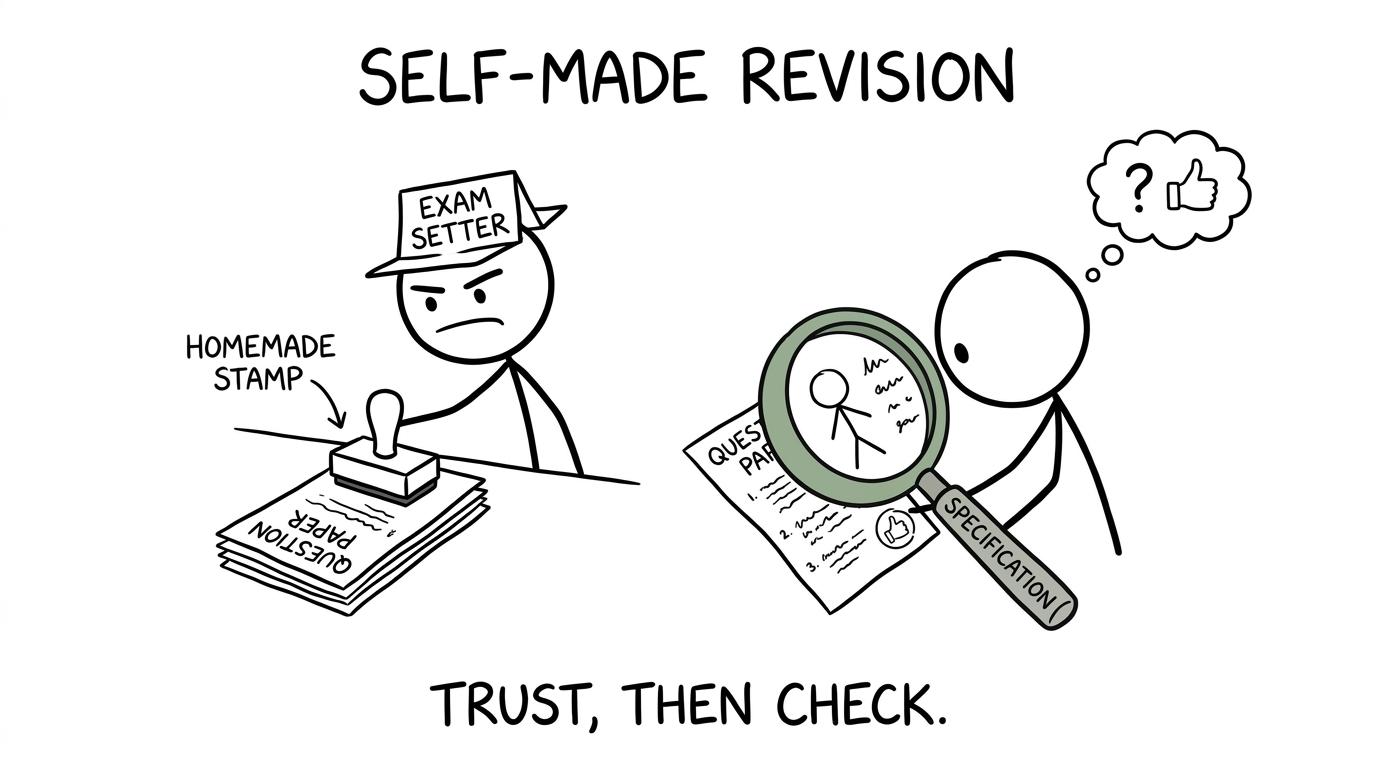 A homemade exam setter checking a question against the specification
Common mistakes when making GCSE Chinese questions
Copying notes almost word for word
This tests recognition and short-term memory. Close the notes, change the context and require yourself to produce or interpret the language.
Writing only vocabulary questions
Vocabulary matters, but GCSE Chinese also requires comprehension, communication, translation and extended responses. Build coverage across all four skills.
Making every question comfortable
Students naturally write questions about material they understand. Use mistakes from classwork, teacher feedback and marked assessments to identify better targets.
Trusting an unchecked answer key
An inaccurate translation or unnatural sentence can become more familiar each time it is repeated. Verify uncertain answers with your teacher and authoritative course materials.
Replacing official papers completely
Homemade questions cannot reliably reproduce a full exam's balance, progression and marking. Use them for targeted practice, then test yourself with official assessment materials.
Spending more time designing than answering
A plain question that you attempt twice is usually more useful than a perfect-looking card you never revisit. Maths students can see the same principle in the discussion of whether an easy-looking GCSE maths paper is really easy: familiarity matters only when it survives proper exam-style practice.
Turn question writing into a repeatable routine
Begin with one weak subtopic. Write a small mixed set, prepare the answers and have uncertain language checked. Leave the set alone, then attempt it without notes. Mark it honestly and record why each error happened.
A few days later, answer the missed questions again. Retire questions that have become effortless and replace them with prompts requiring broader vocabulary, greater spontaneity or more precise comprehension.
The aim is not to become an amateur exam board. It is to expose the distance between seeing and knowing.
When maths is also on your revision timetable, let MathsGenie remove the resource-hunting. Start with free MathsGenie revision lessons, move into practice questions and mini tests, then use past papers, predicted papers, mark schemes and video solutions to test whether the learning holds under exam conditions.
Make your own GCSE Chinese practice questions where personalisation helps. Use trusted materials where authenticity matters. In both Chinese and maths, progress begins when the notes close and you ask yourself to produce the answer.