

Easiest GCSE Maths Paper Ever? Make It Feel Easy
GCSE maths can feel like the easiest paper ever when you revise smart. Use past papers, predicted papers and mark schemes to lock in marks fast.
When someone walks out of a GCSE Maths exam saying, “That was the easiest paper ever,” it rarely means the paper was gentle. More often, it means something quieter happened weeks earlier: they made the questions feel familiar.
That’s the real secret behind an “easy” GCSE paper. Not luck. Not a friendly examiner. Just repetition done well: the same types of marks, the same methods, the same little traps that stop catching you.
The goal of this post is simple: help you make your next GCSE Maths paper feel like the easiest you’ve ever sat, whether you’re Foundation or Higher, and whether you’re with Edexcel, AQA, OCR or Eduqas.
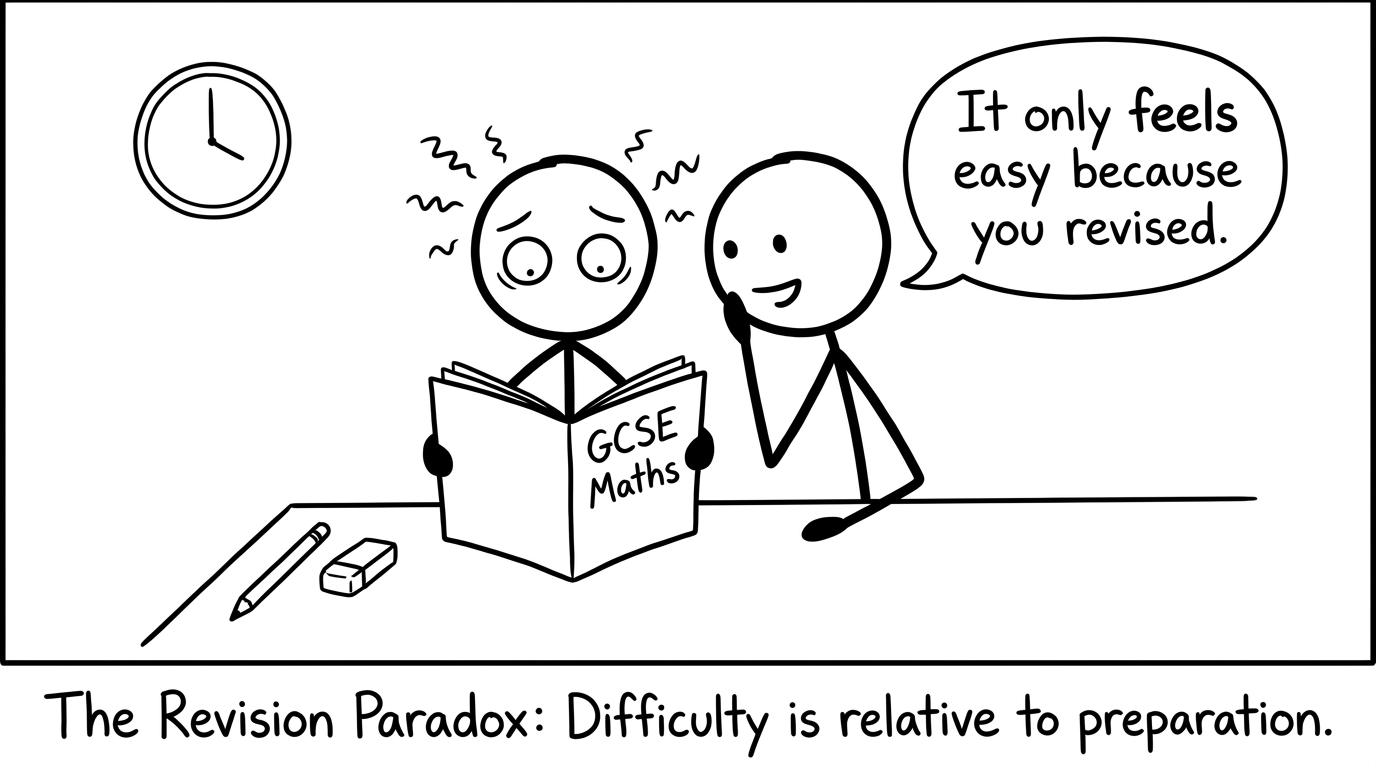 A student realises why the paper feels easy after revision
The “easiest GCSE paper” mindset (and why it works)
An exam feels easy when your brain doesn’t have to improvise. In GCSE Maths, most marks are earned from standard methods: fractions, percentages, linear graphs, angles, algebra, ratio, area, probability. The story changes. The method doesn’t.
Think of it like this: if you’ve only seen a method once, it feels like a new language on exam day. If you’ve practised it across varied questions, it feels like reading.
That’s why Maths Genie is built around doing the same skill in three layers:
- Revision lessons to learn the method
- Exam questions to see how it’s actually assessed
- Mark schemes and video solutions to correct your thinking fast
A paper becomes “easy” when you’ve already met its favourite question types in the weeks before.
Quick checklist: how to make any GCSE paper feel easier
Use this as your simple plan for the final few weeks.
Build your paper routine
- Do one timed paper each week, then two, then three (as the exam nears).
- Mark it the same day using a mark scheme.
- Rewrite any method you got wrong in a clean, correct form.
Maths Genie makes this straightforward with predicted papers and full paper sets in the resources area: GCSE Predicted Papers and Revision Resources.
Use the right papers for your board
If you’re aiming for exam realism, pick papers aligned to your specification. For example:
And if you want extra breadth, older full sets are also available:
Don’t ignore Paper 1 habits
Paper 1 (non-calculator) often rewards fluency: fractions, rearranging, exact values, simplifying. If you’re working with Edexcel, this old-but-useful hub is a strong place to gather targeted practice:
What actually makes a GCSE Maths paper “easy”?
A paper feels easy when it leans heavily on high-frequency topics. These are the “bread and butter” marks that appear across Edexcel, AQA, OCR and Eduqas.
Here are three clusters that often decide your grade:
Fractions, decimals and percentages
This is one of the most reliable areas for Foundation and Higher. It’s also where small slips cost easy marks.
A strong starting point:
Ratio and proportion
Ratio appears everywhere: recipes, best buys, sharing, scale factors.
For structured practice, Maths Genie’s schemes and topic pathways help you practise in order:
Algebra fundamentals
Most “easy” papers have early algebra marks that you can secure quickly: collecting like terms, one-step and two-step equations, substitution, straight-line graphs.
Even if you’re an A Level student revising alongside tutoring or supporting a sibling, these basics matter. They’re the roots.
Worked examples: the marks that make a paper feel easy
The point of worked examples isn’t to show off. It’s to show what an examiner can reward quickly.
Worked example 1: non-calculator percentage change
A coat costs £80. The price is reduced by 15%15\%15%. Work out the new price.
Calculate 15%15\%15% of 80:
15% of 80=0.15×80=12 15\% \text{ of } 80 = 0.15 \times 80 = 12 15% of 80=0.15×80=12Subtract the reduction:
80−12=68 80 - 12 = 68 80−12=68So the new price is £68.
Why this makes a GCSE paper feel easy: it’s two clean lines, and the method repeats across contexts (sales, population change, error intervals).
Worked example 2: ratio sharing (Foundation to Higher staple)
Share £96 in the ratio 5:35:35:3.
Total parts:
5+3=8 5+3=8 5+3=8Value of one part:
968=12 \frac{96}{8} = 12 896=12So the shares are:
5 parts=5×12=60 5 \text{ parts} = 5 \times 12 = 60 5 parts=5×12=60 3 parts=3×12=36 3 \text{ parts} = 3 \times 12 = 36 3 parts=3×12=36Answer: £60 and £36.
Why this makes a GCSE paper feel easy: it’s a method question with predictable marks. You don’t need inspiration; you need the habit.
Worked example 3: solving a linear equation (fast marks)
Solve 3(2x−1)=213(2x-1)=213(2x−1)=21.
Expand:
6x−3=21 6x - 3 = 21 6x−3=21Add 3:
6x=24 6x = 24 6x=24Divide by 6:
x=4 x = 4 x=4Why this makes a GCSE paper feel easy: the examiner is checking you can expand and invert operations in the right order.
Worked example 4: a Higher-style twist that still gives method marks
Simplify 12x2y3xy2\frac{12x^2y}{3xy^2}3xy212x2y.
Divide coefficients:
123=4 \frac{12}{3} = 4 312=4Use index laws:
x2x=x2−1=x \frac{x^2}{x} = x^{2-1} = x xx2=x2−1=x yy2=y1−2=y−1=1y \frac{y}{y^2} = y^{1-2} = y^{-1} = \frac{1}{y} y2y=y1−2=y−1=y1So:
12x2y3xy2=4×x×1y=4xy \frac{12x^2y}{3xy^2} = 4 \times x \times \frac{1}{y} = \frac{4x}{y} 3xy212x2y=4×x×y1=y4xWhy this makes a GCSE paper feel easy: even “harder” questions often have a calm, rule-based core. You can learn that core.
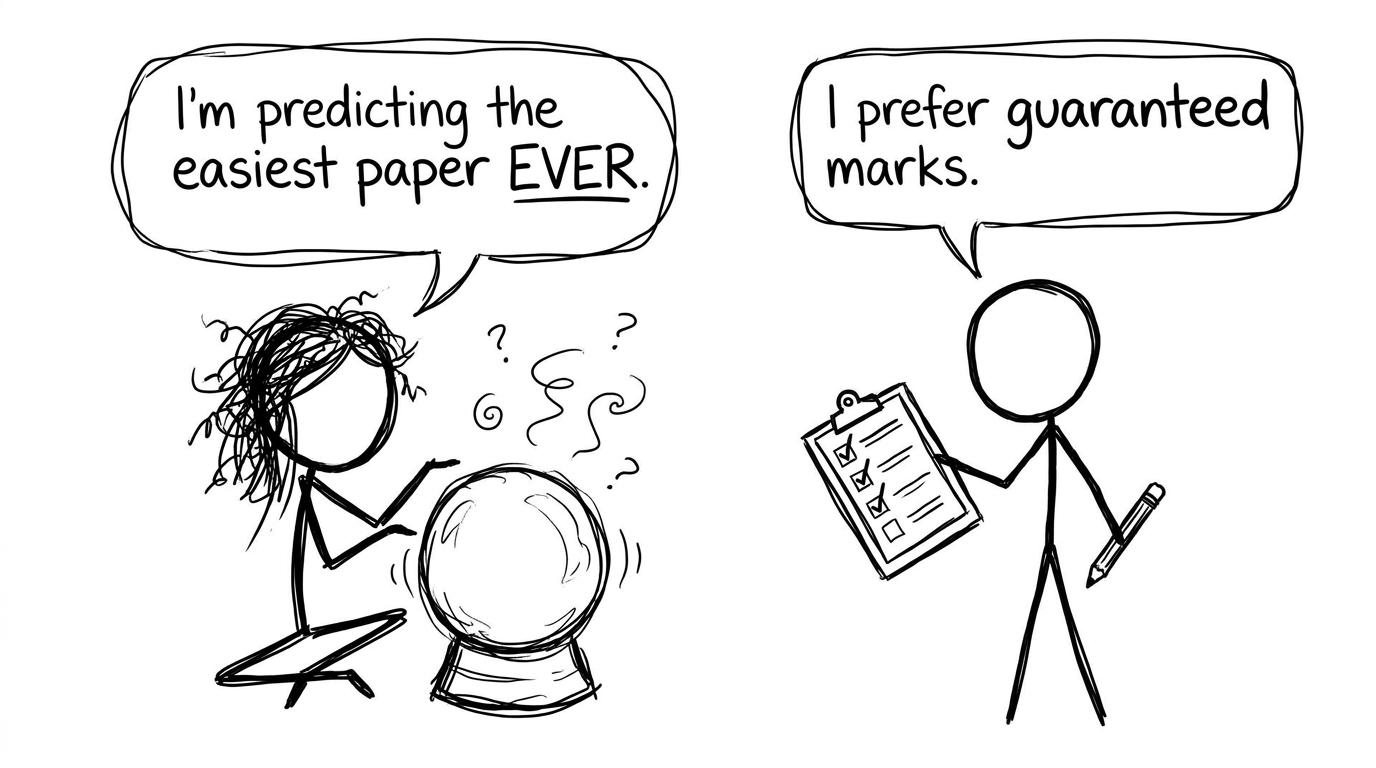 Two approaches: crystal ball vs checklist revision
How to use predicted papers without fooling yourself
Predicted papers can be brilliant for focus, but they’re not magic. They help you practise likely styles and cover gaps efficiently. They do not guarantee what will be on your GCSE paper.
The smart way to use them is:
- Sit a predicted paper under timed conditions.
- Mark it strictly.
- Identify which topics cost you marks.
- Return to revision lessons and exam questions for those topics.
You can find Maths Genie’s predicted and practice sets here:
If you want smaller chunks (great for busy weeks, or A Level students squeezing in support practice), try:
Common mistakes that stop a GCSE paper feeling “easy”
These are the mistakes that make students say “It was easy… but I dropped marks.” They’re fixable.
Rushing the first five questions
Early GCSE questions are often the most efficient marks on the paper. Losing 333 marks to a careless slip is the opposite of strategy. Slow down deliberately at the start to speed up later.
Not showing steps (especially on Foundation)
Even if you can do it in your head, the mark scheme often rewards method. If you write nothing and make one slip, there’s nothing to credit. Two lines of working can protect you.
Mixing up percentage decrease and “new equals old times”
Students frequently do 80×0.1580 \times 0.1580×0.15 and stop, forgetting the new price is 85%85\%85% of the original. A safe habit is to write either:
New=Old−Decrease \text{New} = \text{Old} - \text{Decrease} New=Old−Decreaseor
New=Old×(1−0.15) \text{New} = \text{Old} \times (1 - 0.15) New=Old×(1−0.15)Using the calculator when the method is the mark
On calculator papers, it’s tempting to type everything. But in GCSE Maths, many questions are testing structure (setting up the equation, choosing the formula, rearranging). The calculator only finishes the arithmetic.
If you’re doing A Level: why this matters (more than you think)
If you’re an A Level student, you might be reading this thinking it’s not for you. But here’s the thing: A Level fluency is built on GCSE automaticity. Algebraic manipulation, indices, rearranging, proportional reasoning; these show up again and again.
Also, plenty of A Level students tutor younger siblings or help friends. Being able to explain a GCSE method clearly is a surprising test of your own understanding.
And if you want to keep your skills sharp while revising for A Level papers, Maths Genie has dedicated A Level past paper collections too:
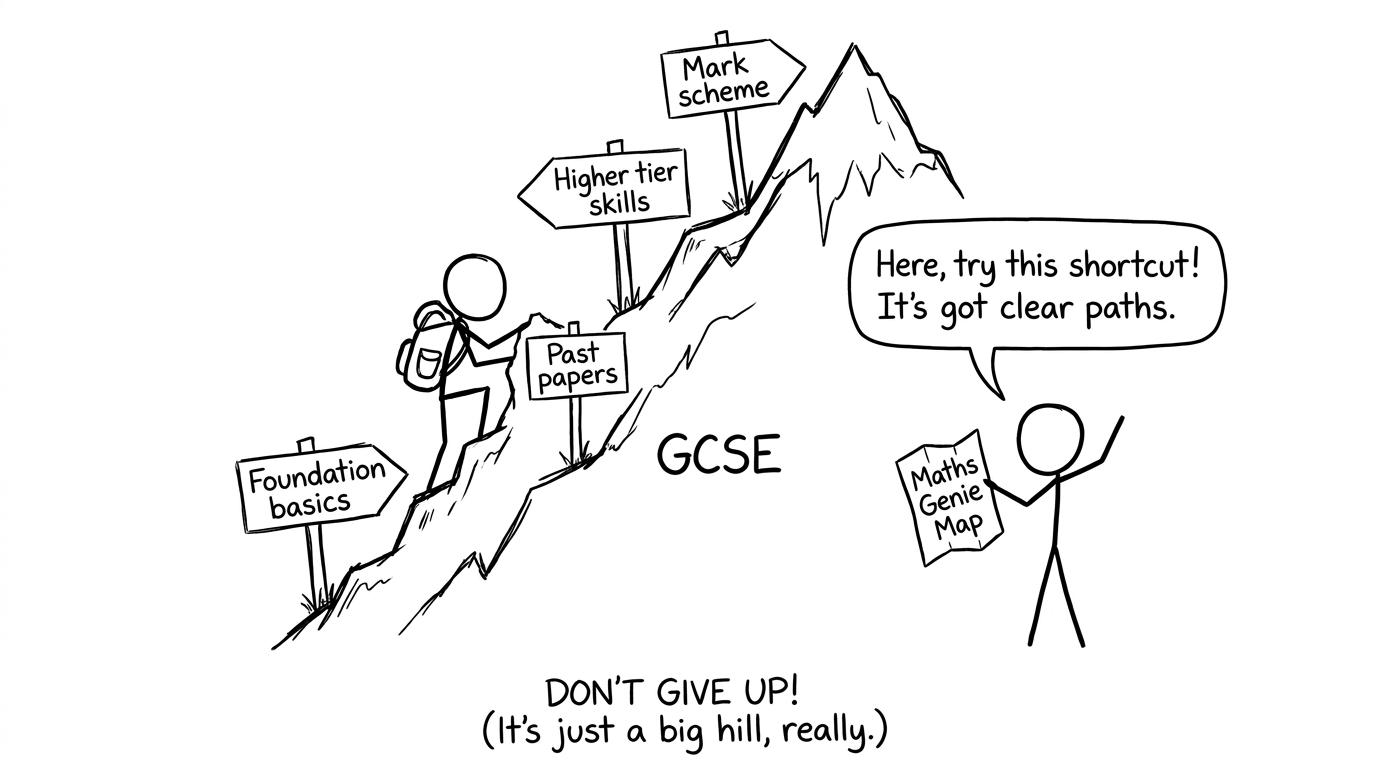 Climbing the GCSE mountain with signposts and a Maths Genie map
Bringing it together: make your next GCSE paper feel easy
The “easiest GCSE Maths paper ever” is usually the one you prepared for properly. Not perfectly. Properly. You sat papers, checked mark schemes, practised the topics that hurt, and did it again.
If you want that calm feeling when you turn the page and think, I know what this is, use Maths Genie as your routine:
- Start with revision lessons for weak topics
- Move to exam questions and mini tests
- Then sit past papers and predicted papers under timed conditions
- Use mark schemes and video solutions to correct your methods fast
Your next step: open GCSE Predicted Papers and Revision Resources, pick one paper, and commit to marking it properly. That’s how “easy” is made, one honest session at a time, until the GCSE stops feeling like a surprise.










