Is GCSE Food and Nutrition Worth It? Honest Guide
Is GCSE Food and Nutrition worth it? Explore the honest pros, cons, workload, assessment and future routes before choosing your GCSE options confidently.
Choosing GCSE options can feel oddly permanent. A subject name appears in a booklet, you tick a box, and suddenly you are imagining the next two years of your life. Food sounds practical and creative, but you may also have heard about lengthy written work, scientific investigations and stressful practical assessments.
So, is GCSE Food and Nutrition worth it? For many students, yes, particularly if you enjoy cooking, food science, nutrition and learning through practical activity. It is less suitable if you expect an easy subject with little revision or writing. GCSE Food Preparation and Nutrition combines cooking with scientific knowledge, planning, analysis and non-exam assessment, so the best choice depends on how well that mixture fits you.
The quick decision checklist
GCSE Food Preparation and Nutrition may be a good option if you:
- enjoy preparing food and want to improve your technical skills;
- are curious about nutrition, ingredients, food safety and food science;
- can plan ahead and work calmly under time pressure;
- are willing to write about, analyse and evaluate practical work;
- prefer a course combining theory with hands-on activity;
- understand that practical lessons still require revision and organisation.
Think carefully before choosing it if you dislike detailed written portfolios, rarely meet deadlines or only want the subject because it sounds easier than your other options. It is a serious GCSE graded 9-1, not simply a weekly cooking lesson.
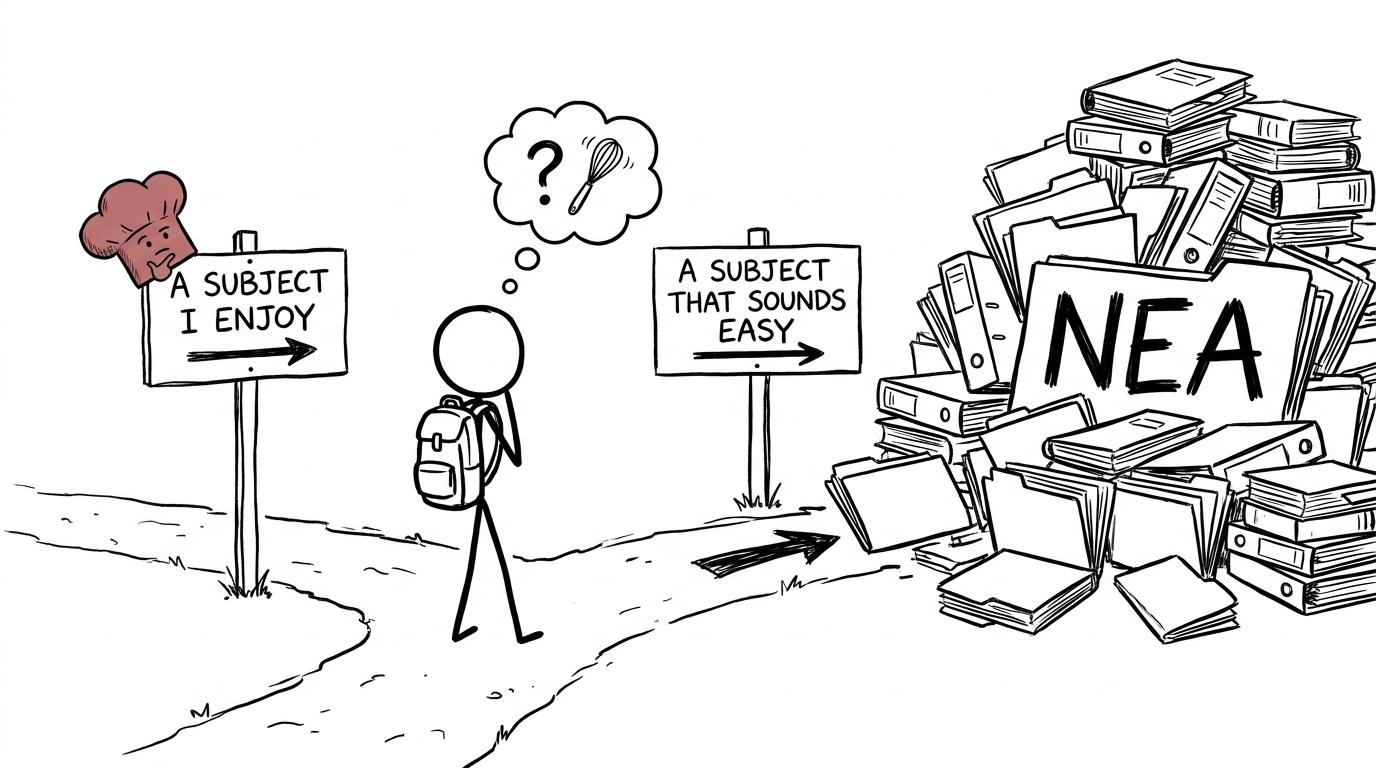 A student discovers that the apparently easy GCSE option leads towards a pile of NEA folders
What do you study in GCSE Food Preparation and Nutrition?
The exact wording and structure depend on your exam board and school. Current qualifications offered by boards including AQA, OCR and Eduqas cover broadly similar areas:
- nutrition and health;
- food science and the properties of ingredients;
- food safety and hygiene;
- food choice and influences on diet;
- food provenance and sustainability;
- preparation, cooking and presentation techniques;
- planning, analysis and evaluation.
The scientific element is easy to underestimate. You may investigate how ingredients behave during cooking, explain why a process produces a particular result, or compare the sensory qualities of products. Successful students do more than make an attractive dish: they understand what happened and can communicate that understanding precisely.
Your school may also offer a different food-related qualification, such as hospitality and catering. That is not automatically equivalent to GCSE Food Preparation and Nutrition, so check the qualification title, awarding body and assessment structure before selecting it.
How is the GCSE assessed?
For AQA, OCR and Eduqas, the broad balance is a written examination worth 50%50\%50% and non-exam assessment, usually called NEA, worth 50%50\%50%.
The examination length varies. AQA and Eduqas currently use a 111 hour 454545 minute written paper, while OCR uses a 111 hour 303030 minute paper. The detailed format can change, so confirm the specification used by your school rather than relying on a general options leaflet.
The NEA normally contains two distinct parts:
- a food investigation assessing scientific understanding;
- a food preparation task involving research, planning, practical skills, presentation and evaluation.
Across these specifications, the investigation commonly contributes 15%15\%15% of the qualification and the preparation assessment contributes 35%35\%35%. AQA's preparation task, for example, culminates in producing and presenting three dishes within a single session lasting no more than three hours. Its investigation report is expected to contain between 1,5001,5001,500 and 2,0002,0002,000 words.
Those details reveal the character of the course. Half the qualification may be completed outside the final written examination, but NEA is not free time. It is structured, authenticated work completed under controlled conditions and marked against defined criteria.
The honest advantages of taking the subject
You learn skills that remain useful
Cooking safely, planning meals, understanding nutrition and managing ingredients are useful beyond school. Unlike some knowledge that can feel distant from everyday life, food preparation appears every week.
The course can also develop independence. A successful practical requires preparation, sequencing, time management and the ability to recover when something goes wrong. Those habits transfer well to science practicals, revision and later employment.
It combines different ways of learning
Some students work best when knowledge has a visible purpose. Food science gives abstract ideas a concrete setting, while practical sessions break up a timetable dominated by written subjects.
That does not remove academic demand. Instead, it changes its form. You move between remembering facts, applying knowledge, demonstrating techniques and evaluating outcomes. If that variety keeps you engaged, it can be a strong reason to choose the course.
It can support relevant future routes
The GCSE can provide helpful background for further education, apprenticeships or careers connected with food science, hospitality, catering, product development, public health and nutrition. It can also complement subjects such as biology, chemistry, geography and business.
However, it is rarely a guaranteed entry ticket. Courses in areas such as nutrition or dietetics may place greater emphasis on later science qualifications and specific English or maths grades. Requirements vary between institutions and can change, so investigate actual post-161616 and university entry requirements before building your options around one career idea.
It uses real mathematical thinking
Food and maths overlap more than they first appear to. You may use ratio and proportion when adapting recipes, convert units, interpret nutritional data, compare costs and calculate percentages.
These skills also support GCSE maths. If number work is a weakness, MathsGenie's fractions, decimals and percentages revision guide can rebuild the foundations. The AQA GCSE Maths revision hub also provides lessons, questions and worksheets covering ratio, proportion, units and data.
The honest disadvantages
The workload is broader than cooking
A dish may take one lesson to produce, but the assessed process includes research, trials, photographs, planning, justification and evaluation. Written work can accumulate quickly if it is postponed.
The workload is not necessarily greater than every other GCSE. It is simply distributed differently. Instead of relying entirely on final examinations, you must sustain effort during the course and protect time for NEA deadlines.
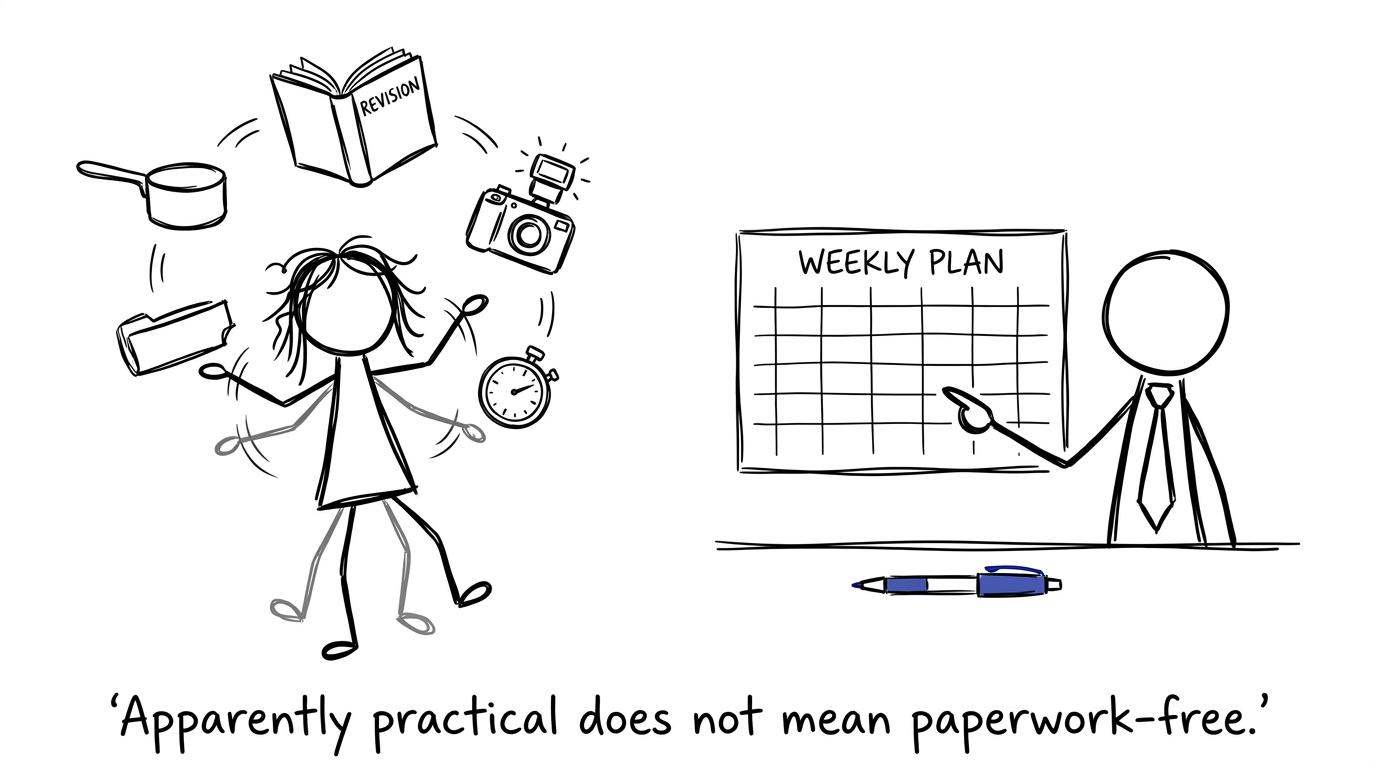 A student juggles cooking, evidence and a portfolio while learning that practical does not mean paperwork-free
Practical assessment can feel pressured
Cooking within a set period demands more than technical ability. You need an efficient order of work, clean equipment, sensible timings and contingency plans. Students who enjoy relaxed cooking at home may find assessed cooking quite different.
This pressure can improve with rehearsal. Repeating techniques, learning where time is lost and preparing an accurate time plan make the final task more manageable.
There may be practical costs or restrictions
Schools have different arrangements for ingredients, equipment and taking food home. Some provide ingredients; others ask families to supply some or all of them. Allergies, dietary requirements and access to facilities may also affect practical work.
Do not guess. Ask your school what it provides, how often ingredients are needed and what support is available. This is a local policy question, not something an exam board specification can answer for every student.
Enjoying food is not enough by itself
Watching cooking videos or enjoying baking does not necessarily mean you will enjoy explaining functional properties, memorising nutrition content or evaluating evidence. The GCSE rewards informed decision-making, not just enthusiasm for the finished product.
How much work does it actually take?
The course is normally taught across the same two-year period as your other GCSEs. The weekly lesson allocation depends on your school, but your effort is likely to include theory revision, practical preparation, technique practice and concentrated NEA work in the final year.
A manageable routine is better than occasional panic:
- review new theory soon after each lesson;
- keep terminology and food-science explanations organised;
- practise unfamiliar techniques before assessed work where permitted;
- record deadlines and ingredient requirements immediately;
- complete planning and evaluation sections when the evidence is fresh;
- keep maths revision separate rather than allowing NEA to consume it.
This last point matters. Food Preparation and Nutrition is optional, but GCSE maths remains central to many sixth-form, college, apprenticeship and employment routes. MathsGenie's one-month GCSE maths revision plan offers a realistic structure when subjects begin competing for your time.
Is it a good choice alongside GCSE maths?
Yes, provided you plan your workload. The numerical content can reinforce proportion, percentages, measures and data interpretation, but it does not replace dedicated foundation or higher-tier maths practice.
Use your crossover skills deliberately. Become comfortable checking units, reading scales and judging whether a result is sensible. Then continue with board-specific maths revision and timed questions. MathsGenie's guide to GCSE maths topics that appear regularly can help you prioritise high-value areas.
As exams approach, move from topic lessons to GCSE predicted papers, past papers, mark schemes and video solutions. The principle is the same in both subjects: knowledge becomes reliable when you apply it under realistic conditions.
Common mistakes when deciding or taking the course
Choosing it because it sounds easy
Practical does not mean undemanding. Read the course outline and assessment breakdown before making your decision.
Ignoring the written examination
Cooking ability alone cannot carry a qualification in which the written paper contributes 50%50\%50%. Theory revision should begin long before the examination season.
Leaving NEA writing until late
Delayed write-ups make evidence harder to interpret and create unnecessary pressure. Follow your teacher's permitted schedule and complete each stage promptly.
Describing rather than analysing
Saying what happened is not the same as explaining why it happened or evaluating the evidence. Precise scientific vocabulary matters.
Neglecting other core subjects
A demanding practical week can easily displace maths revision. Keep a small minimum routine, even if it is only a focused lesson followed by practice questions. Learn when to start GCSE past papers and schedule them before NEA deadlines crowd the calendar.
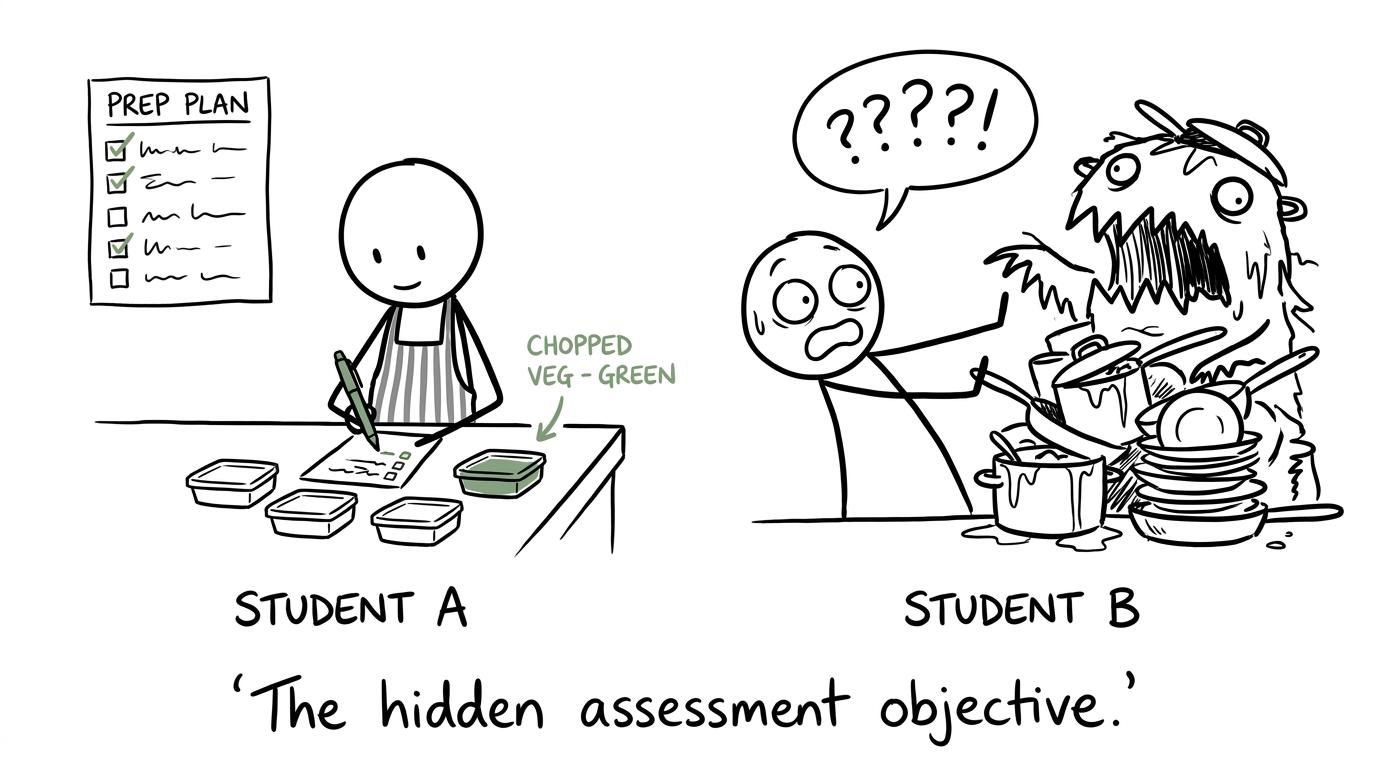 Two students discover that washing-up may be the kitchen's hidden assessment objective
The final verdict
GCSE Food Preparation and Nutrition is worth taking when its combination of cooking, science, nutrition, planning and evaluation genuinely interests you. It offers useful life skills and can support food-related progression, but it is neither an effortless option nor a requirement for every future career in the field.
Before deciding, ask to see your school's specification, sample work, ingredient policy and typical deadline calendar. Compare those facts with your interests and working habits. The best GCSE option is rarely the one with the easiest reputation. It is the one whose effort you can imagine sustaining.
Whichever subjects you choose, protect your maths progress. Build a calm weekly routine with MathsGenie's free revision lessons, practice questions, mini tests and revision planner. Then use mark schemes and video solutions to correct weaknesses before testing yourself with past papers and predicted papers. If you take Edexcel, the guide to using GCSE maths past papers properly is a practical place to begin.