

Is GCSE English Literature Worth It? Honest Guide
Is GCSE English Literature worth it? Weigh the workload, benefits, drawbacks and future options, then decide how it fits alongside maths revision.
There is a particular kind of pressure that appears when GCSE choices become real. A subject may sound interesting in Year 9, but by Year 11 it represents lessons, revision, quotations and another examination competing for your attention.
So, is GCSE English Literature worth it? For many students, yes. It develops close reading, analytical writing and the ability to build an argument from evidence. It can also support progression to A Level English Literature and other essay-based subjects. But it requires substantial reading, regular written practice and knowledge of several set texts. If you have a genuine choice, the right answer depends on your interests, future plans and overall workload, not on whether someone else calls it an “easy” or “important” GCSE.
For students preparing for maths exams as well, the real question is whether you can give Literature enough consistent attention without neglecting your core revision.
The quick decision checklist
GCSE English Literature is more likely to be worth taking if you:
- enjoy discussing why writers make particular choices;
- are willing to read plays, novels and poetry carefully;
- can practise timed analytical writing regularly;
- may want to take English Literature or another essay-based subject at A Level;
- want to strengthen your ability to explain ideas with evidence; and
- can fit the workload alongside maths, science and your other GCSEs.
Think more carefully before choosing it if you strongly dislike extended reading, already have an unusually demanding subject combination or would only take it because you assume universities require it. Entry requirements vary, but English Language is more commonly specified as the essential English GCSE. Always check the exact requirements of your preferred sixth form, college or future course.
There is another important complication: you may not actually have a free choice. English is compulsory at key stage four in England, and many schools enter students for both English Language and English Literature. School policies and qualification arrangements can differ across England, Wales and Northern Ireland, so ask your school what is compulsory before planning around an option that may not exist.
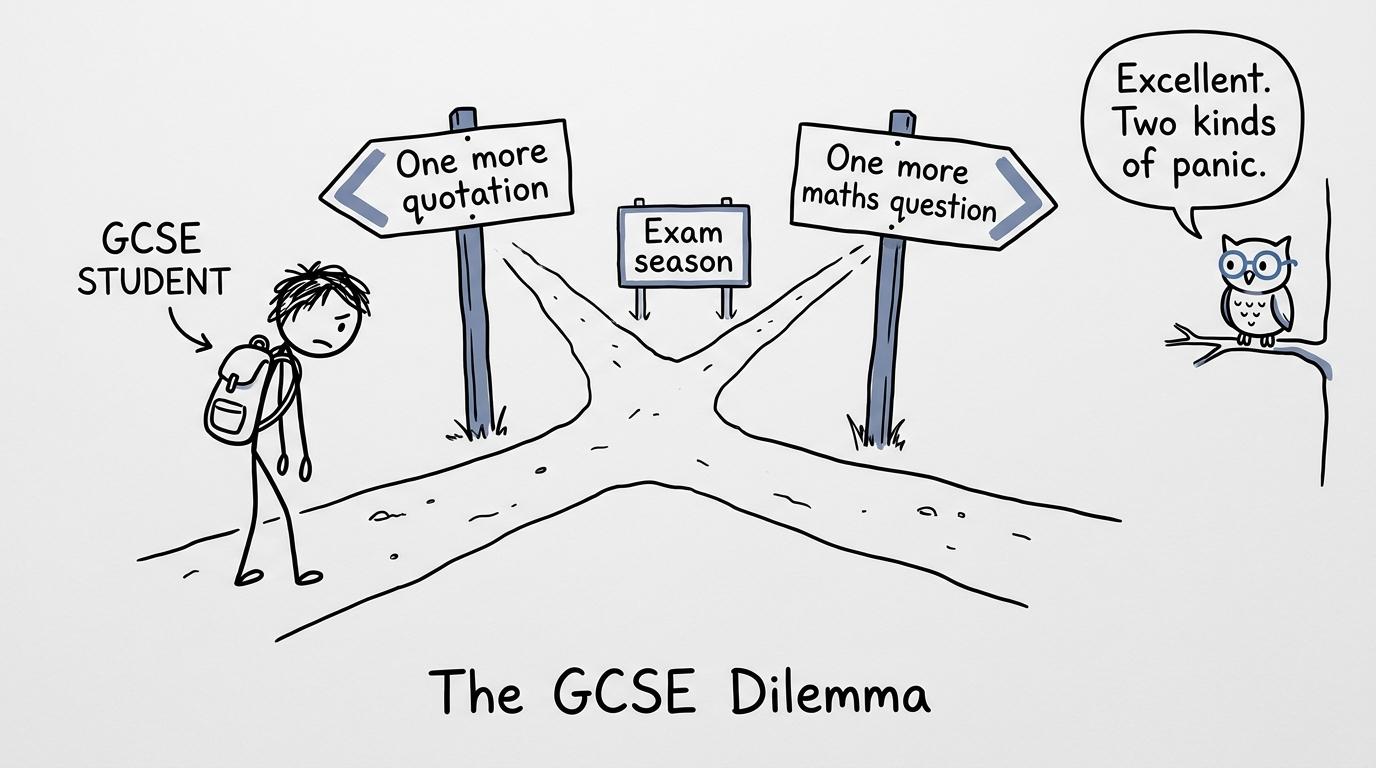 A GCSE student choosing between one more quotation and one more maths question
What GCSE English Literature actually involves
The qualification is not simply about enjoying stories. It asks you to read closely, form an interpretation and support it with appropriate textual evidence.
For GCSE specifications in England, the required content includes a Shakespeare play, a nineteenth-century novel, poetry published since 1789 and British fiction or drama from 1914 onwards. Students must also respond to unseen texts. Exact set works and paper structures depend on the exam board, whether that is AQA, Edexcel, OCR or Eduqas.
The official assessment objectives broadly reward four things:
- understanding and responding to texts;
- analysing language, form and structure;
- understanding relationships between texts and their contexts; and
- writing clearly and accurately.
Analysis carries considerable weight. Knowing the plot is therefore only the beginning. You need to explain how a writer creates meaning and why a detail matters.
Current AQA, Edexcel, OCR and Eduqas GCSE English Literature examinations are closed text or closed book, although relevant extracts or poems may be printed where the specification allows. You should confirm the precise arrangements for your board rather than assuming that every paper works in exactly the same way.
The strongest reasons to take English Literature
It teaches you to build arguments from evidence
Literature repeatedly asks you to make a claim, select evidence and explain the connection between them. That habit travels well. History, politics, law, psychology and many other subjects require students to organise ideas rather than merely list facts.
There is a quieter benefit for maths students too. A difficult GCSE maths question often hides its structure inside several sentences. Close reading helps you notice conditions, distinguish relevant information and explain reasoning precisely. Literature will not teach algebra, but it can improve the discipline with which you read and communicate.
It keeps future study options open
If you may want to take A Level English Literature, GCSE Literature is valuable preparation and can be an entry requirement. Sixth forms set their own criteria: some ask for a particular Literature grade, while others consider both English qualifications. Check individual course pages before making a decision.
For most unrelated degrees and careers, GCSE English Literature is not a universal requirement. Its value is broader. It demonstrates experience of sustained reading, analytical writing and dealing with competing interpretations.
It can make English Language easier to manage
English Language and English Literature are separate qualifications, but some skills overlap. Both reward careful reading, clear expression and purposeful analysis. Regularly explaining a novelist’s language or a playwright’s structural choices can make analytical writing feel less unfamiliar elsewhere.
That does not mean revising one automatically covers the other. Language includes its own reading and writing demands, while Literature requires detailed knowledge of set texts. The overlap is useful, not complete.
It offers a different kind of challenge
A balanced GCSE timetable is not necessarily an easy one. It is one that uses different kinds of thinking. After a sequence of calculations, interpreting a character or comparing poems can provide a genuine change of mental gear.
The reverse is also true. A focused session on GCSE maths revision can feel refreshingly definite after writing an essay. Variety can make a revision week more sustainable when it is planned rather than improvised.
The honest drawbacks
The content load is substantial
You are expected to know several complete texts, important themes, characters, structural choices and useful evidence. Poetry adds comparison, while unseen material tests whether you can apply your skills without prior preparation.
The solution is not to memorise enormous model essays. Short, adaptable quotations and secure knowledge of each text are usually more useful. Even so, this knowledge takes time to build.
Timed essays need repeated practice
Understanding a play in class is different from constructing a focused response under examination conditions. You need to interpret the question, plan efficiently, select evidence and maintain an argument while the clock is moving.
This resembles maths in one important respect: recognition is not performance. Watching someone solve a problem is not the same as solving it yourself. Reading an excellent essay is not the same as writing one. Both subjects improve through active practice followed by useful feedback.
It may compete with your weakest subjects
Time has an opportunity cost. An evening spent relearning poetry is an evening not spent repairing a gap in fractions, algebra or geometry. That is not an argument against Literature. It is an argument for making the trade-off visible.
Use a realistic GCSE maths revision timetable and place English alongside it. If the plan only works when every day goes perfectly, it is not a workable plan.
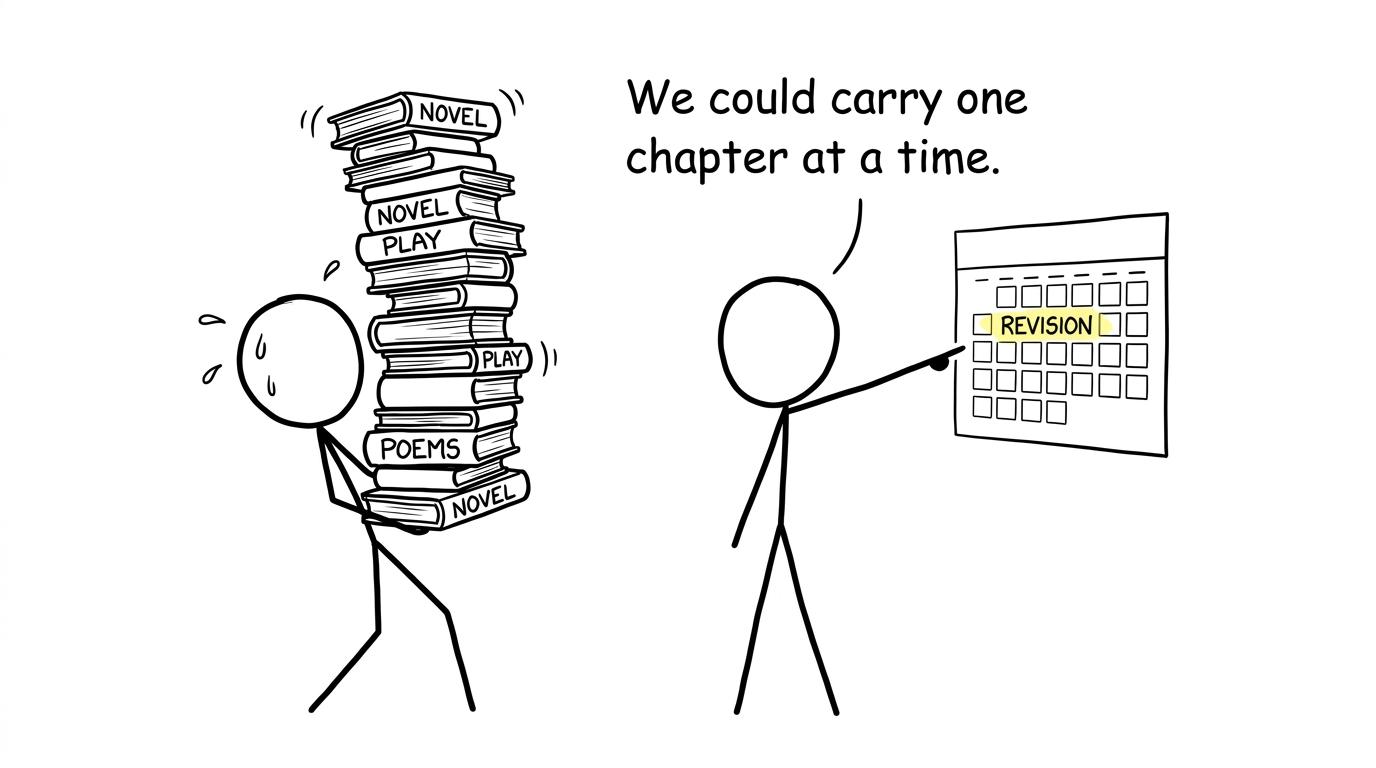 A student discovering that a revision calendar is easier to carry than every book at once
How much work does English Literature take?
The workload depends on your starting point, teaching schedule and target grade, so there is no honest universal number of hours. The more useful distinction is between continuous work and emergency work.
A manageable routine might include:
- rereading a short section of a text;
- retrieving quotations without notes;
- planning one response to a past question;
- writing one paragraph under a time limit; and
- checking your work against teacher feedback or a mark scheme.
These smaller tasks prevent every text from becoming a single giant revision job in spring. The same principle works in maths. MathsGenie’s twenty-minute maths revision routine shows how a short session can combine retrieval, exam-style practice and immediate marking.
During busy weeks, separate maintenance from improvement. Maintenance keeps familiar material available. Improvement tackles something you cannot yet do. For Literature, that could mean recalling quotations before improving an essay paragraph. For maths, it could mean reviewing formulae before repairing a weak topic with revision lessons and practice questions.
Balancing Literature with GCSE maths revision
Do not divide time equally just because the subjects are equally visible on your timetable. Allocate it according to need, examination proximity and the marks you are currently losing.
A sensible weekly rhythm is:
- short Literature retrieval on several days rather than one exhausting quotation session;
- focused maths topic practice using the correct foundation or higher material;
- one timed task for each subject;
- immediate review using feedback, solutions or mark schemes; and
- a protected catch-up block.
When maths needs attention, use GCSE past papers at the right stage of revision rather than completing full papers too early and repeatedly exposing the same gaps. MathsGenie’s GCSE predicted papers are useful later, but predicted papers should supplement topic learning and official past papers, not replace them.
The most efficient loop in either subject is simple: attempt, mark, diagnose, repair and retest. For Edexcel maths students, the guide to using GCSE maths past papers properly explains how to turn lost marks into targeted revision rather than merely recording a score.
Common mistakes when deciding
Assuming Literature is compulsory everywhere
Your school may require it, strongly recommend it or offer a different route. National curriculum requirements, school entry policies and the qualifications available are not identical questions. Ask what applies to you.
Confusing English Language with English Literature
They are separate GCSEs. Many colleges, universities and employers specifically refer to English Language or accept one of several English qualifications. Never assume that a Literature grade automatically satisfies every requirement.
Choosing it only because it “looks academic”
A subject’s reputation will not write the essays for you. Interest is not everything, but it matters when the course requires sustained engagement with multiple texts.
Underestimating closed-book preparation
You do not need to remember every line. You do need secure textual knowledge and a useful bank of concise evidence. Leaving all quotation retrieval until the final weeks creates avoidable pressure.
Letting Literature revision consume the whole timetable
Essay work can expand to fill any amount of time. Give each task a defined purpose and stopping point. Then protect your maths revision with mini tests, topic questions and timed papers rather than hoping to “fit it in later”.
So, is GCSE English Literature worth taking?
It is worth taking when you value analytical reading, are prepared for the workload and want to preserve routes into English or other essay-based subjects. It may be less worthwhile as a voluntary choice if you dislike sustained reading, have no interest in the skills it develops and need that curriculum time for a better-fitting option.
The best decision is not the one with the most impressive label. It is the one you understand clearly enough to support with consistent work.
Once your subject choice is settled, make the rest practical. Use MathsGenie’s free GCSE maths revision hub for revision lessons, practice questions, mini tests, mark schemes and video solutions. Build towards past papers and predicted papers, record the marks you lose, and let your revision planner reflect what you genuinely need next. If you later continue with maths, the Edexcel A Level Maths past papers can take the same learn, practise and review habit into sixth form.











