Is GCSE Economics Worth It? Honest Pros and Cons
Is GCSE Economics worth it? Explore the pros, cons, workload, maths content and future options so you can choose the right GCSE with confidence today.
Choosing a GCSE can feel strangely permanent. A subject occupies one box on an options form, yet it seems to carry questions about sixth form, university and work far beyond Year 111111.
So, is GCSE Economics worth it? For many students, yes, particularly if you enjoy understanding prices, businesses, government decisions and world events. It develops analytical writing, data interpretation and practical numerical skills. But it is not an automatic shortcut to A Level Economics, nor is it a purely mathematical subject. You will need to learn precise terminology, apply ideas to unfamiliar contexts and justify conclusions in writing.
The right question is not whether Economics is universally valuable. It is whether its particular mixture of ideas, numbers and argument suits you.
GCSE Economics at a glance
Use this checklist before choosing:
- Likely to suit you: you are curious about markets, money, inequality, trade or government policy.
- Skills required: clear writing, logical reasoning, percentages, averages, graphs and data interpretation.
- Assessment: expect written examinations rather than a coursework-led subject.
- Workload: regular learning of terminology, diagram practice and structured written responses.
- Progression: useful preparation for Economics, Business, Politics and related courses, but GCSE Economics is not normally a national prerequisite for A Level Economics.
- First action: check whether your school offers it, which exam board it uses and how the timetable affects your other options.
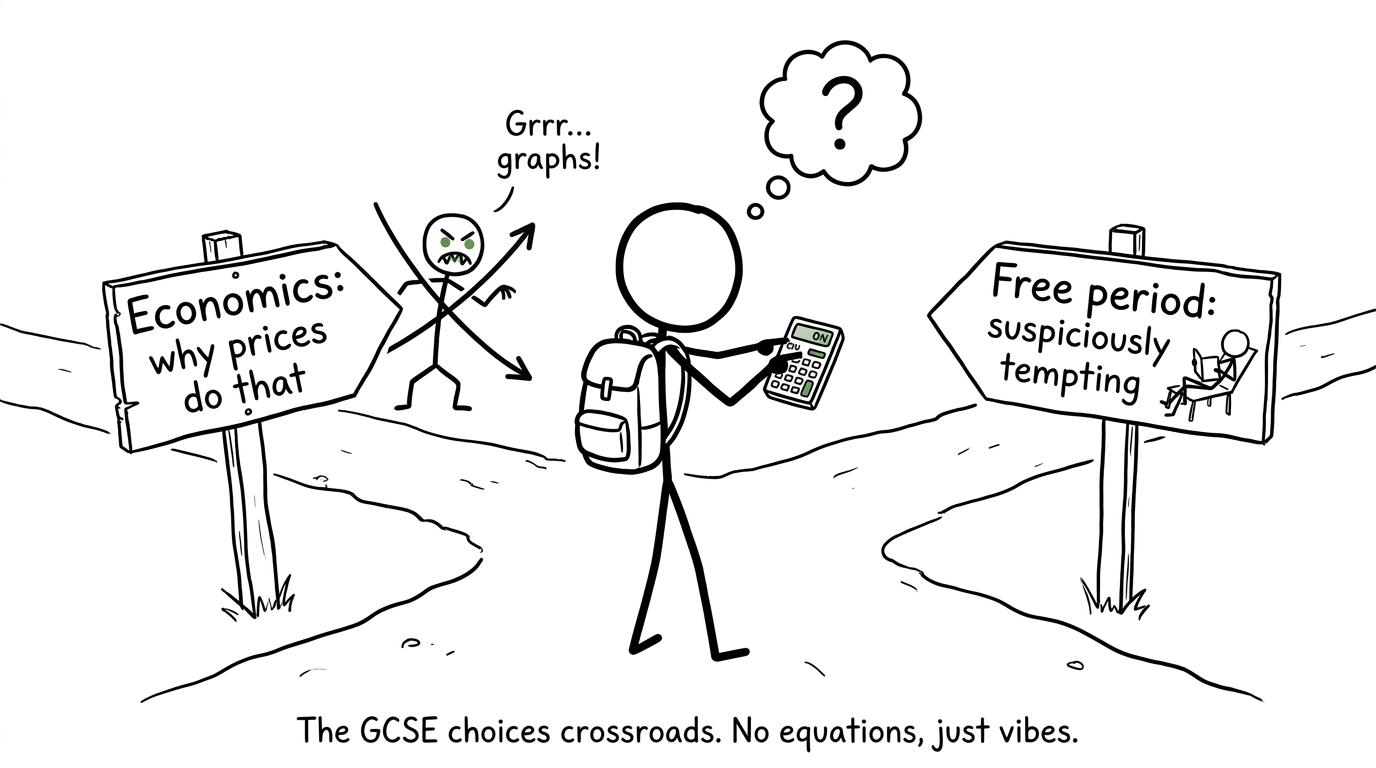 A student choosing between Economics and a suspiciously tempting free period
What do you learn in GCSE Economics?
GCSE Economics asks how people, businesses and governments make choices when resources are limited. That simple starting point leads towards demand and supply, competition, production, employment, inflation, economic growth, taxation, international trade and globalisation.
Availability varies between schools. OCR currently offers GCSE Economics under specification J205. Its course is divided into Introduction to Economics and National and International Economics, assessed through two written papers. Each lasts 111 hour 303030 minutes, carries 808080 marks and contributes 50%50\%50% of the qualification. Students answer multiple-choice, case-study, short-response and extended-response questions.
Other exam-board names may be familiar from maths, including Edexcel, AQA and Eduqas, but you should not assume that every board currently offers every subject. Ask your school for the precise specification before comparing courses.
National GCSE Economics requirements place the assessment objectives at 35%35\%35% knowledge and understanding, 35%35\%35% application, and 30%30\%30% analysis and evaluation. This tells you something important: memorising definitions is only the beginning. You must use economic ideas in context, follow chains of cause and effect, weigh competing arguments and reach supported conclusions.
The honest advantages of taking GCSE Economics
It explains decisions you already see around you
Prices rise. Interest rates change. Governments tax some activities and subsidise others. Businesses compete, merge, hire and sometimes close. Economics gives you a framework for asking why.
That can make the subject feel unusually connected to life outside school. News stories become less like disconnected events and more like decisions involving incentives, costs and trade-offs. The qualification does not tell you what political opinion to hold. It gives you tools for examining evidence and questioning simple answers.
It builds transferable reasoning
A strong Economics response often moves through a chain:
- identify the relevant concept;
- apply it to the information provided;
- explain likely consequences;
- consider who gains or loses;
- recognise limitations or alternative outcomes;
- make a justified judgement.
Those habits transfer well to subjects involving evidence and argument. They can also improve the way you approach multi-step maths problems: identify the information, choose a method, interpret the result and check whether it makes sense.
It combines written and numerical skills
Official requirements state that at least 10%10\%10% of GCSE Economics marks must assess quantitative skills in an economic context. These include percentages, percentage change, averages, totals, revenue, costs, profit, gross and net pay, graphs and economic data.
Useful relationships include:
profit=total revenue−total cost\text{profit}=\text{total revenue}-\text{total cost}profit=total revenue−total costand
percentage change=new value−original valueoriginal value×100%.\text{percentage change}=\frac{\text{new value}-\text{original value}}{\text{original value}}\times 100\%.percentage change=original valuenew value−original value×100%.The calculations are generally less advanced than higher-tier GCSE Maths topics such as trigonometry or quadratics. The challenge is interpretation: what does the figure mean for consumers, workers, businesses or government?
If these foundations need attention, use MathsGenie's GCSE Maths revision hub, percentages revision guide and percentage change revision guide.
It lets you test the subject before A Level
GCSE Economics can reveal whether you enjoy economic thinking before committing to a two-year A Level. You encounter foundational ideas and learn whether you like combining diagrams, data and extended explanations.
However, taking it does not guarantee that A Level Economics will suit you, and not taking it does not normally block you. Sixth forms set their own admissions rules, often paying close attention to Maths and English grades. Check each provider directly and read MathsGenie's GCSE Economics sixth-form grade guide for the questions worth asking.
The disadvantages you should consider
There is more writing than some students expect
The word Economics can sound heavily numerical. In reality, much of the assessment rewards explanation, application, analysis and evaluation. You may calculate a value, but you must often use it as evidence within an argument.
If you enjoy calculations but dislike explaining consequences in sentences, look closely at a sample paper before choosing. Equally, students who enjoy essays but avoid data should expect to strengthen their numerical confidence.
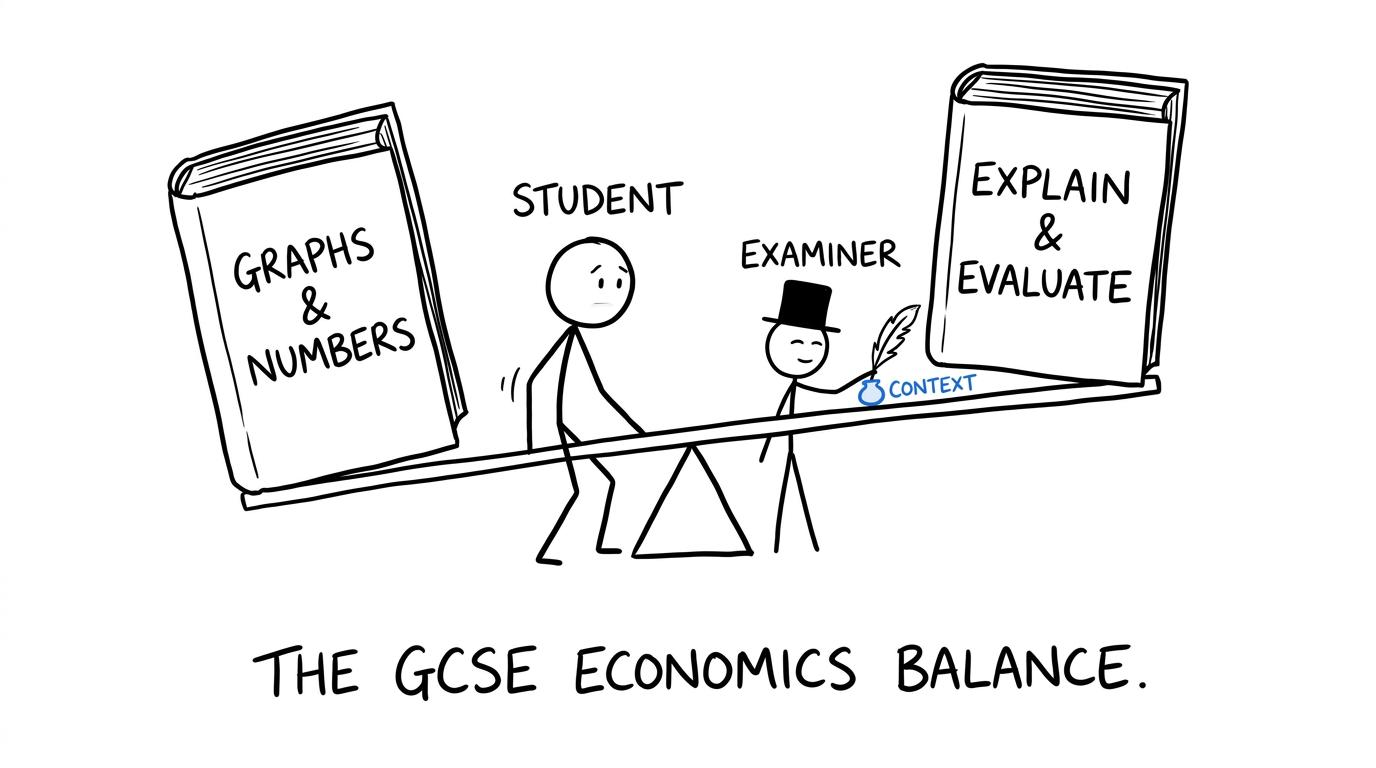 A student balancing graphs and numbers against explanation and evaluation
The vocabulary carries real weight
Demand is not simply “wanting something”. Economic growth, inflation, productivity, market failure and opportunity cost each have precise meanings. Similar-looking concepts can lead to different arguments.
This creates steady work. You need to retrieve definitions, draw and interpret diagrams, apply ideas to case studies and practise structured answers. Economics is manageable, but it is not a subject to leave untouched until the week before a mock.
Current affairs can feel demanding
You are not expected to memorise every news story. You do, however, benefit from recognising how course concepts appear in real economies. That means developing some interest in policies, trade, employment, prices and business behaviour.
If you find those questions dull even after exploring the specification, another subject may offer a better return on your time. A GCSE is easier to sustain when curiosity does some of the work.
It is not required for most future routes
GCSE Economics can be helpful, but you should not choose it only because you believe it is compulsory for an economics-related future. A Level courses commonly begin from the foundations because many schools do not offer the GCSE. Local entry rules still vary, so check them rather than relying on assumptions.
For university Economics, later mathematical preparation can become particularly important. Your decisions at A Level may therefore matter more than whether you took Economics at GCSE.
How much work does GCSE Economics actually take?
OCR lists 120120120 guided learning hours and 140140140 total qualification time for its GCSE. These figures describe the qualification's designed size, not a promise about your personal homework. Your school decides lesson allocation, while your independent revision needs depend on your starting point and target grade.
The workload is best understood as four recurring tasks:
- learning accurate economic terms;
- connecting causes to consequences;
- interpreting calculations, charts and data;
- planning and writing balanced responses under time pressure.
A short weekly routine is more effective than occasional large sessions. Review one topic, retrieve key terms without notes, answer a small set of questions and correct your response using the mark scheme. Maths students can use the same rhythm described in MathsGenie's revision timetable guide: learn, practise, mark, fix and revisit.
To strengthen the data side, the GCSE Statistics revision area provides practice with charts, averages and interpretation. These skills support Economics while also protecting marks in GCSE Maths.
Is GCSE Economics right for you?
Before deciding, score each statement honestly as yes, unsure or no:
- I want to understand how markets, businesses and governments make decisions.
- I am willing to write explanations as well as complete calculations.
- I can learn subject-specific vocabulary accurately.
- I am prepared to interpret unfamiliar case studies and data.
- The course fits my timetable without displacing a subject I value more.
- I have checked the actual specification and assessment used by my school.
Mostly yes suggests that Economics could be a strong choice. Mostly unsure means you need evidence: examine a lesson, specification and sample paper, then speak to the teacher. Mostly no does not mean you could not pass. It means the subject may demand motivation that another option would generate more naturally.
This is opportunity cost in practice. Choosing one subject means giving up another. The best choice is not the most impressive-sounding GCSE; it is the one whose benefits matter most to you.
Common mistakes when deciding
Choosing it because it sounds like Business
The subjects overlap in places, but their viewpoints differ. Business often focuses on decisions inside firms. Economics examines markets and wider national or global outcomes. Compare your school's course outlines rather than treating the names as interchangeable.
Assuming being good at maths is enough
Numerical confidence helps, but Economics also rewards contextual application and extended reasoning. The balanced skill set is closer to a calculator in one hand and a well-structured paragraph in the other.
Ignoring the exact assessment
Do not base your choice on what a friend at another school studies. Confirm the board, specification, paper structure and whether your school has any internal option requirements.
Treating future usefulness as the only criterion
A subject can be useful and still be wrong for you. Interest matters because it affects whether you will revise consistently across two years.
Judging the workload from one easy topic
Introductory ideas may feel intuitive. Later success requires precise diagrams, data interpretation and evaluation. Look at material from across the course before deciding.
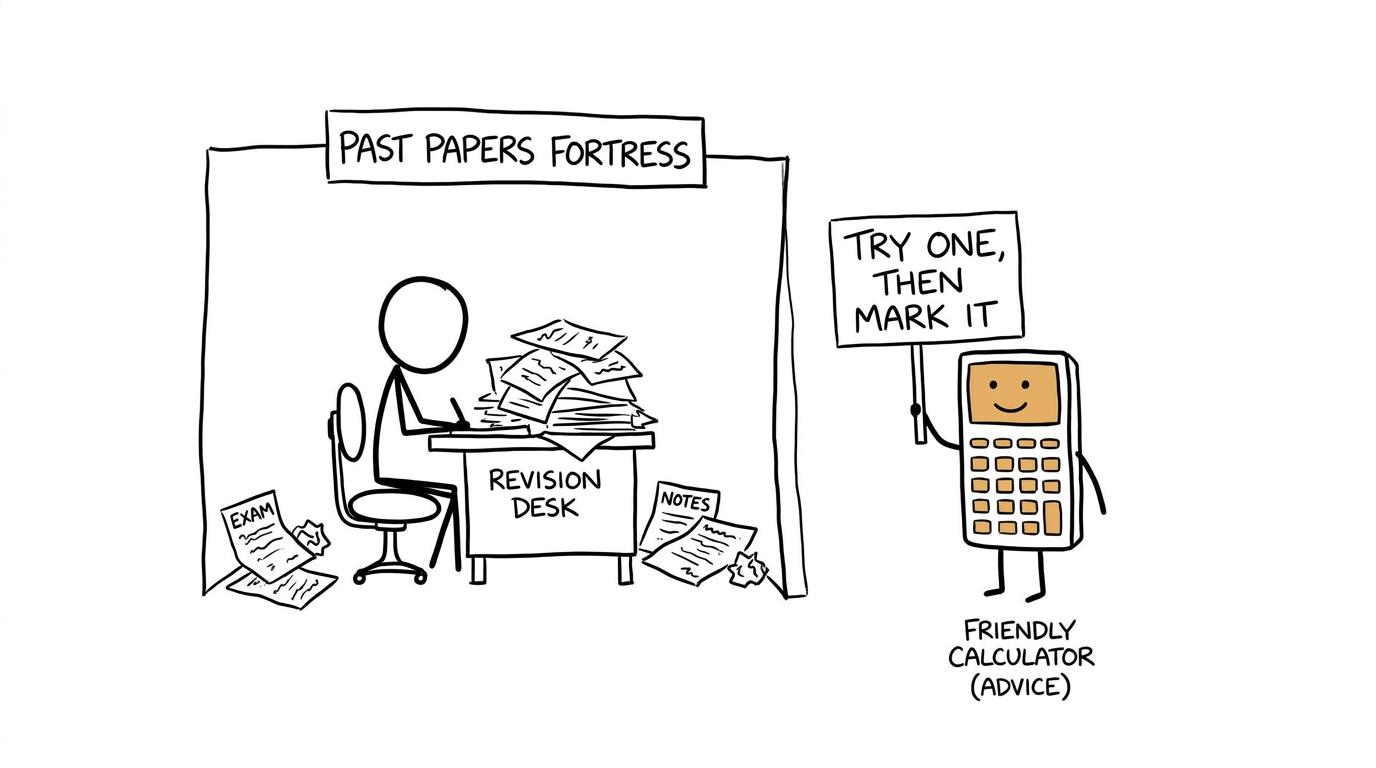 A calculator encourages a student to leave the past-paper fortress and try one paper
The verdict: is GCSE Economics worth it?
GCSE Economics is worth taking when you are genuinely curious about how choices shape markets and society, and when you are prepared for both quantitative work and structured writing. It offers useful preparation for further study and builds reasoning that travels beyond one subject.
It is less worthwhile if you are selecting it only for prestige, expect it to be mainly calculations or strongly prefer another available subject. No GCSE option creates a career by itself. What matters is the knowledge you build and the quality of thinking you practise.
Whatever you choose, keep your numerical foundations secure. Start with the free MathsGenie GCSE Maths revision journey, then use revision lessons and practice questions to repair weak topics. As exams approach, learn how to use past papers properly and add predicted papers with mark schemes and solutions. MathsGenie's mini tests, video solutions and structured revision resources turn uncertainty into a practical next step, one question, one correction and one better decision at a time.