GCSE Economics Grade: Sixth Form Guide
GCSE economics grade sixth form guide explaining typical A Level entry expectations, grade meanings and the maths skills needed for Economics.
A GCSE result can feel like a verdict. In reality, it is closer to a signpost. If you are searching for GCSE economics grade sixth form guidance, the short answer is this: a grade of 666 or above generally supports progression to A Level Economics, but your GCSE Maths and English grades may matter just as much.
There is no single national entry rule. Sixth forms and colleges set their own requirements. Some ask for grade 666 in GCSE Economics if you studied it, while others do not require the subject at all. Current entry policies commonly ask for grade 666 in Maths and English, with some selective providers asking for grade 777 in Maths.
Your quick sixth-form checklist
Before choosing A Level Economics:
- Check the exact course requirements on each provider's website.
- Look separately at GCSE Economics, Maths and English requirements.
- Confirm the general entry criteria for the sixth form or college.
- Ask what happens if you miss a required grade by one level.
- Strengthen percentages, graphs, ratios and data interpretation.
- Remember that meeting minimum grades may not guarantee a place.
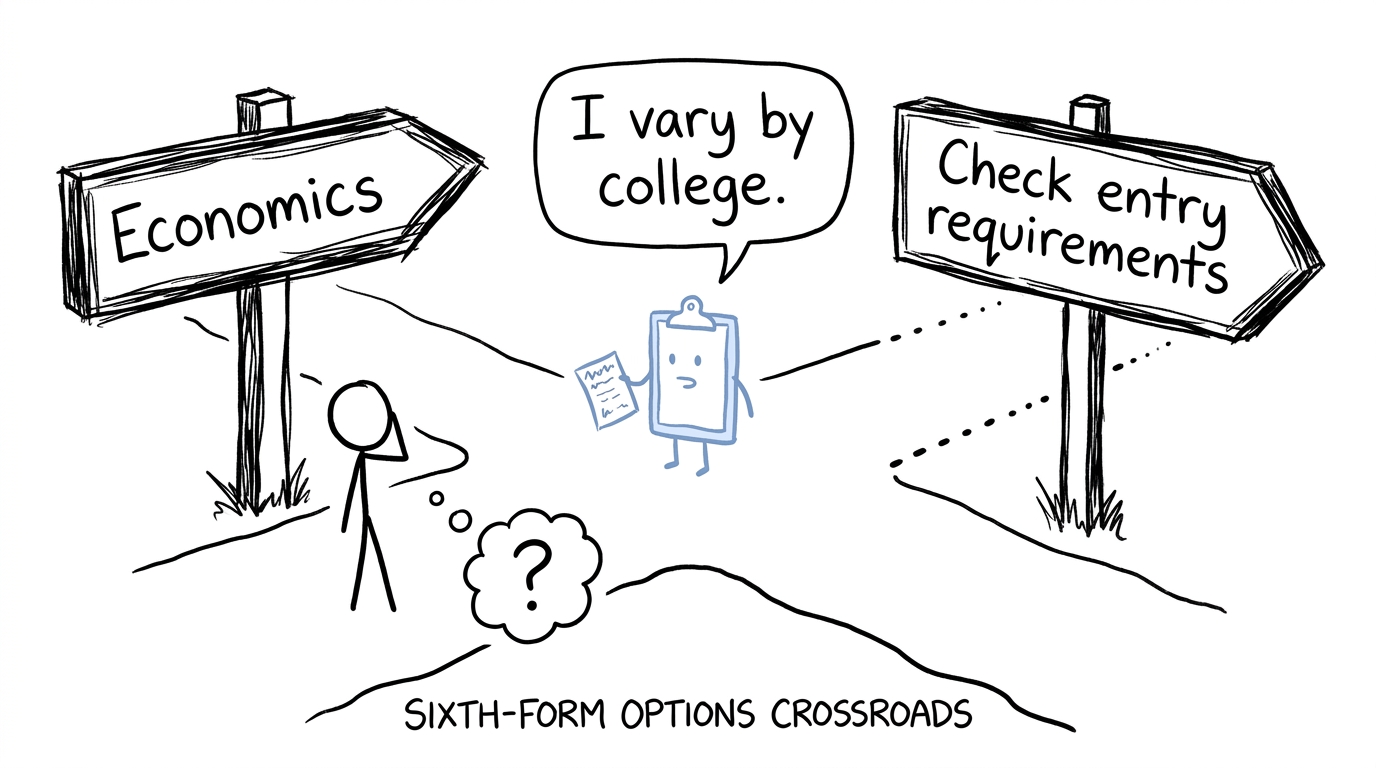 A student discovers that sixth-form entry requirements vary by college
GCSE Economics grade meaning for sixth form
The following breakdown is a guide rather than a universal admissions policy. A grade has meaning, but only your chosen provider can tell you whether it meets its rules.
| GCSE Economics grade | What it may mean for sixth form |
|---|---|
| Grade 999 | Exceptional subject knowledge and exam performance. You are likely to meet any Economics-specific requirement, subject to the provider's wider criteria. |
| Grade 888 | Very strong preparation for A Level Economics. Your next task is maintaining strong mathematical and extended-writing habits. |
| Grade 777 | Strong performance and normally above the subject requirement used by many providers. Check whether Maths and English must also be grade 666 or 777. |
| Grade 666 | Often the key threshold where GCSE Economics has been studied. It suggests secure knowledge, but every provider sets its own policy. |
| Grade 555 | A strong pass, although it may fall below a provider's subject-specific requirement. A good Maths or English grade may help, but it does not automatically replace the stated Economics requirement. |
| Grade 444 | A standard pass. Direct progression may be possible where prior Economics is not required, provided you satisfy the Maths, English and overall entry criteria. |
| Grades 111-333 | These grades are below a standard pass. Speak to the provider about alternative Level 333 routes, resits or courses with different entry requirements. |
A lower Economics grade does not necessarily close the subject forever. Official A Level subject content states that previous study of Economics should not be required, and OCR and Pearson specifications similarly indicate that prior Economics knowledge is not required. However, an individual sixth form may still set its own admissions condition when you have taken GCSE Economics.
That distinction matters: qualification rules describe who can study the course academically; admissions rules describe who a particular provider will accept.
Why GCSE Maths can influence progressing to A Level Economics
Economics is not A Level Maths in disguise, but it is not free from numbers either. National A Level Economics content requires quantitative skills to account for at least 20%20\%20% of the overall A Level marks.
You may need to interpret index numbers, calculate percentage changes, compare data and understand relationships shown by graphs. You also need to explain what the figures mean in an economic context.
This is why many providers pay close attention to GCSE Maths. A secure grade suggests that you can handle the numerical language of the course, not merely remember formulas.
Useful areas to strengthen include:
- percentages and percentage change;
- ratios and proportions;
- averages and data comparisons;
- reading scales and interpreting graphs;
- rearranging straightforward equations.
Begin with the GCSE Maths revision hub, then use the GCSE Maths question bank to identify gaps. The percentages revision guide and scatter graphs revision resources are particularly relevant to handling economic data.
Is GCSE Economics required for A Level Economics?
Usually, no. Economics is not offered at every secondary school, so A Level courses are designed to introduce their central concepts from the beginning. Exam boards including AQA, Edexcel and OCR cover microeconomics and macroeconomics, combining calculations, data response and extended written analysis.
Yet “not nationally required” does not mean “never required locally”. One college may accept students with grade 666 in Maths and English without GCSE Economics. Another may expect grade 666 in Economics if you took it. A more selective sixth form might ask for grade 777 in Maths.
Read the current admissions policy rather than relying on a friend's offer from another school or last year's prospectus.
 A student carries graph and essay skills towards A Level Economics
What to do before submitting your choices
Compare requirements carefully
Create a shortlist and record four things for each provider: its overall GCSE requirement, Economics requirement, Maths requirement and English requirement. Include any rule applying when Economics was not taken at GCSE.
Build the skills behind the grade
A grade opens the door; your habits determine what happens next. Use Edexcel GCSE Maths revision guides or select your own board from MathsGenie's GCSE hub. Learn one weak method, complete practice questions, mark them and revisit mistakes.
Use GCSE predicted papers to practise under time, but do not treat predictions as a list of guaranteed topics. Past papers and mark schemes remain the best way to understand exam standards.
Plan for results day
If you miss a requirement narrowly, speak to the sixth form directly. Do not assume that an exception will be made, but do not reject yourself before asking. Providers may consider course capacity, your complete grade profile and their published admissions rules.
Common mistakes when interpreting your grade
Treating grade 444 as an automatic A Level entry grade. It is a standard GCSE pass, but a course may set a higher subject requirement.
Looking only at GCSE Economics. Maths and English frequently appear in A Level Economics entry criteria because the course combines quantitative analysis with substantial writing.
Assuming every sixth form uses the same threshold. Entry policies vary and can change between application years.
Confusing eligibility with guaranteed admission. Meeting minimum requirements may make you eligible, but places can still depend on the provider's admissions arrangements and capacity.
Neglecting maths once GCSE exams finish. A long break from percentages and graphs can make the opening weeks harder. If you want to extend your numerical confidence, explore the A Level Maths revision hub, while remembering that A Level Maths is a separate and more advanced qualification.
Your grade is information, not identity
Your GCSE Economics grade helps a sixth form judge your current preparation. It does not measure your permanent potential, and it should not be read in isolation from Maths, English or the provider's own rules.
Check each course first. Then act on what you can control. Use MathsGenie's free revision lessons, practice questions, revision guides and video solutions to repair weak topics. Test yourself with past papers, predicted papers and mini tests, and use mark schemes to turn every mistake into a specific next step.
Start with MathsGenie's free GCSE Maths revision resources and build the numerical confidence that progressing to A Level Economics will require.