Inference GCSE English: Read Between the Lines
Inference GCSE English made clear. Learn to read between the lines, select precise evidence and write convincing answers with practical resit examples.
Inference can feel like an examiner asking you to find something that is not there. You understand every word but still wonder what hidden answer you are supposed to uncover.
The reassuring truth is that inference GCSE English questions are not tests of mind-reading. An inference is a sensible conclusion supported by clues in the text. You notice what a writer shows and explain what those details suggest. For a resit student, making that reasoning visible is a practical skill to develop.
Your inference checklist
Before writing, ask yourself:
- What does the question want me to infer?
- Which detail gives me the strongest clue?
- What does that detail suggest?
- Does my interpretation fit the context?
- Have I explained rather than repeated the quotation?
Use idea, evidence, inference: state your understanding, select a precise reference and explain the connection.
A useful test is to separate observation from interpretation. First write what the text literally shows: the character looks away, pauses or chooses a particular word. Then write what this might reveal about feeling, intention or relationship. Finally check the whole passage. If later details support the same idea, your inference becomes stronger. If they challenge it, adjust your wording rather than forcing the original thought. This habit is especially helpful when several answers seem possible, because it keeps your response anchored in evidence. In an exam, spend a moment underlining the smallest clues before drafting. Those clues often carry more meaning than a dramatic sentence that simply states what happens.
What does inference mean in GCSE English?
Explicit information is stated directly. If a text says, “Leila was angry,” her emotion is explicit.
Implicit information is suggested. Consider this original sentence:
Leila pushed the untouched plate away and answered her brother without looking up.
Pushing food away and avoiding eye contact could suggest anger, discomfort or unhappiness. The writer leaves the reader to interpret her behaviour.
GCSE English Language assessment objectives require students to identify and interpret explicit and implicit information and ideas. Question formats vary between exam boards, so check your specification. The GCSE English Language revision hub provides a starting point for finding your board.
Inference can concern feelings, relationships, atmosphere or a writer's attitude. It also supports comparison, language analysis and evaluation.
Reading between the lines in English
Look for clues in actions, dialogue, body language, setting and repeated details. Ask what a person avoids doing as well as what they do.
One clue may permit several interpretations. A character checking the clock could be bored, late or curious. Repeated checking, foot-tapping and glances towards the door make impatience or anxiety more convincing. Context turns a guess into an inference.
Choose the interpretation that explains the details without contradicting the passage. You do not need an unusual answer; you need a defensible one.
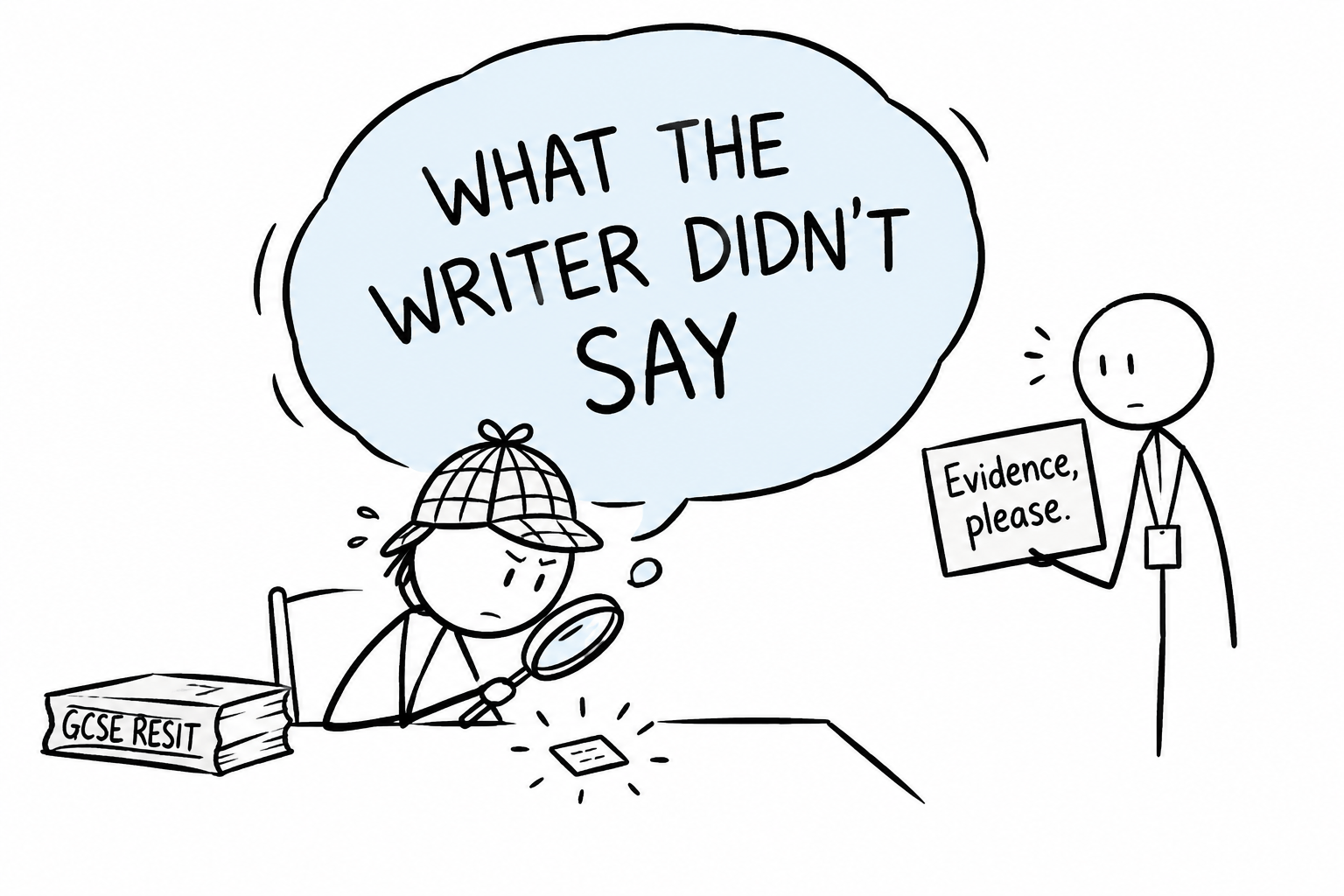 A GCSE inference detective searching for textual clues while an examiner requests evidence
How to answer inference questions
Make a focused point
Answer the exact question. If it asks about a relationship, focus on how people interact rather than an unrelated description of the setting.
Openings such as “This suggests that…” or “The character appears…” can help, but the interpretation that follows matters most.
Select precise evidence
Choose a short quotation that supports your point. A long quotation can bury the clue you want to discuss.
The AQA explicit information guide helps distinguish retrieving a stated fact from interpreting a clue. Follow the requirements of your particular question when deciding whether to quote or paraphrase.
Explain the connection
Writing that Arun is nervous because he “folded the ticket twice” leaves the reasoning incomplete. Explain that the repetitive action suggests restlessness and difficulty settling while he waits.
That explanation shows how the evidence supports your interpretation instead of expecting the examiner to supply the connection.
Original extracts with model answers
Inferring feelings
Original extract:
Rosa stood outside the office with her application pressed flat against her chest. When the door opened, she smiled too quickly and asked whether she was early.
Question: What can you infer about Rosa's feelings?
Model answer:
Rosa appears anxious. Holding the application against her chest suggests that she seeks reassurance, while smiling “too quickly” implies forced confidence. Asking whether she is early suggests concern about making the right impression.
The answer combines details without claiming that Rosa knows she will fail, which the extract does not establish.
Inferring a relationship
Original extract:
“You kept it,” Malik said, turning the faded postcard over in his hands.
His father shrugged. “It was taking up space.”
Neither mentioned the date written across the top.
Model answer:
Their relationship appears emotionally restrained. Keeping the postcard suggests that their shared past matters, despite the father's dismissive explanation. Their silence about the date implies a significant memory they find difficult to discuss.
Here, the contradiction between words and actions supports the inference.
Comparing inferences
When connecting two sources, establish a similarity or difference and support both sides. Avoid two disconnected descriptions.
The comparative inference revision guide supports evidence selection. The critical reading and comparison guide develops the wider comparison skill.
Inference and language analysis
Inference explains what a detail suggests. Language analysis examines how the writer's choices create meaning or effects.
In the original sentence “The street swallowed the last of the daylight,” you might infer a threatening atmosphere. Analysing “swallowed” takes the explanation further by exploring how the street becomes a consuming force.
Use the language analysis revision guide to practise that distinction, and the evaluation revision guide to develop judgements about a text's effects.
Common inference mistakes
Guessing without evidence: Ask which exact detail supports your idea. If you cannot identify one, reconsider it.
Repeating instead of interpreting: Saying Rosa holds an application retrieves information. Explaining what her grip suggests interprets it.
Making extreme claims: Words such as “appears” and “suggests” keep conclusions proportionate to the evidence.
Listing quotations: One detail explained clearly is more useful than several unexplained quotations.
Ignoring specified lines: Use the section named in the question. The reading question structure guide helps turn instructions into clear actions.
A practical resit revision routine
Choose a short unfamiliar paragraph. Identify one explicit fact, write one inference supported by evidence, then explain the connection. Check your reasoning against an available mark scheme or worked solution.
Next, practise using AQA English Language past papers, or select your own board's papers. Review whether your answer addresses the question and makes every inference traceable to the text.
A resit is a chance to make your reasoning clearer. Begin with MathsGenie's revision resources and one short extract today: find the clue, make the inference and explain why it fits.