What you'll learn
- What Paper 1 Question 4 is really asking you to do.
- How to decide how far you agree with a statement about the text.
- How to evaluate the writer’s methods, not just analyse them.
- How to build clear, supported AO4 paragraphs.
Where Question 4 fits
AQA GCSE English Language Paper 1 lasts 1 hour 45 minutes and is worth 80 marks, which is 50% of the GCSE. Section A is Reading Fiction and is worth 40 marks. Question 4 is the final reading question, worth 20 marks, so it needs a developed response.
Every question is compulsory. Paper 1 Question 4 usually asks you to focus on a specified part of the source, then respond to a viewpoint such as “A student said…”
The skill being assessed is AO4: you evaluate texts critically and support your ideas with textual references. “Critically” does not mean negatively — it means thoughtfully, with a clear judgement.
Evaluation
Evaluation means making a reasoned judgement about how far a viewpoint is convincing, then proving that judgement with references to the text and comments on the writer’s methods.
What the question is really asking
Question 4 is not just asking, “What techniques can you find?” It is asking:
Is this statement a fair and convincing way to read the text? How does the writer make it seem that way?
A typical wording might ask you to respond to a statement about a character, setting, mood, relationship, event, or turning point. You must decide whether you:
- agree with the statement
- partly agree with the statement
- challenge the statement, if the text supports a different reading
Answer the opinion, not just the topic
The question gives you a viewpoint. Your job is to judge that viewpoint, then prove your judgement using the writer’s choices.
Turning a statement into a judgement
Suppose the statement is: “The writer makes the character seem trapped and powerless.”
- Identify the precise claim: the statement is not just about “the character”; it claims the character seems trapped and powerless.
- Match your stance to the evidence: if most details show restriction, fear, or lack of control, you might largely agree; if some details show resistance or courage, you might partly agree.
- Turn that stance into a judgement: “I largely agree that the writer presents the character as trapped, although there are brief moments that suggest they may be beginning to resist.”
The “how far” scale
“To what extent do you agree?” means “How far along the agreement scale are you?”
You do not need to force disagreement. AQA often gives you a statement that is clearly supportable. However, the best answers are usually more precise than “I agree”. Try language like:
- I completely agree if the whole section strongly supports the statement.
- I largely agree if the statement is mostly true, with small complications.
- I partly agree if the statement is true in some ways but incomplete.
- I disagree only if you can prove a different interpretation from the text.
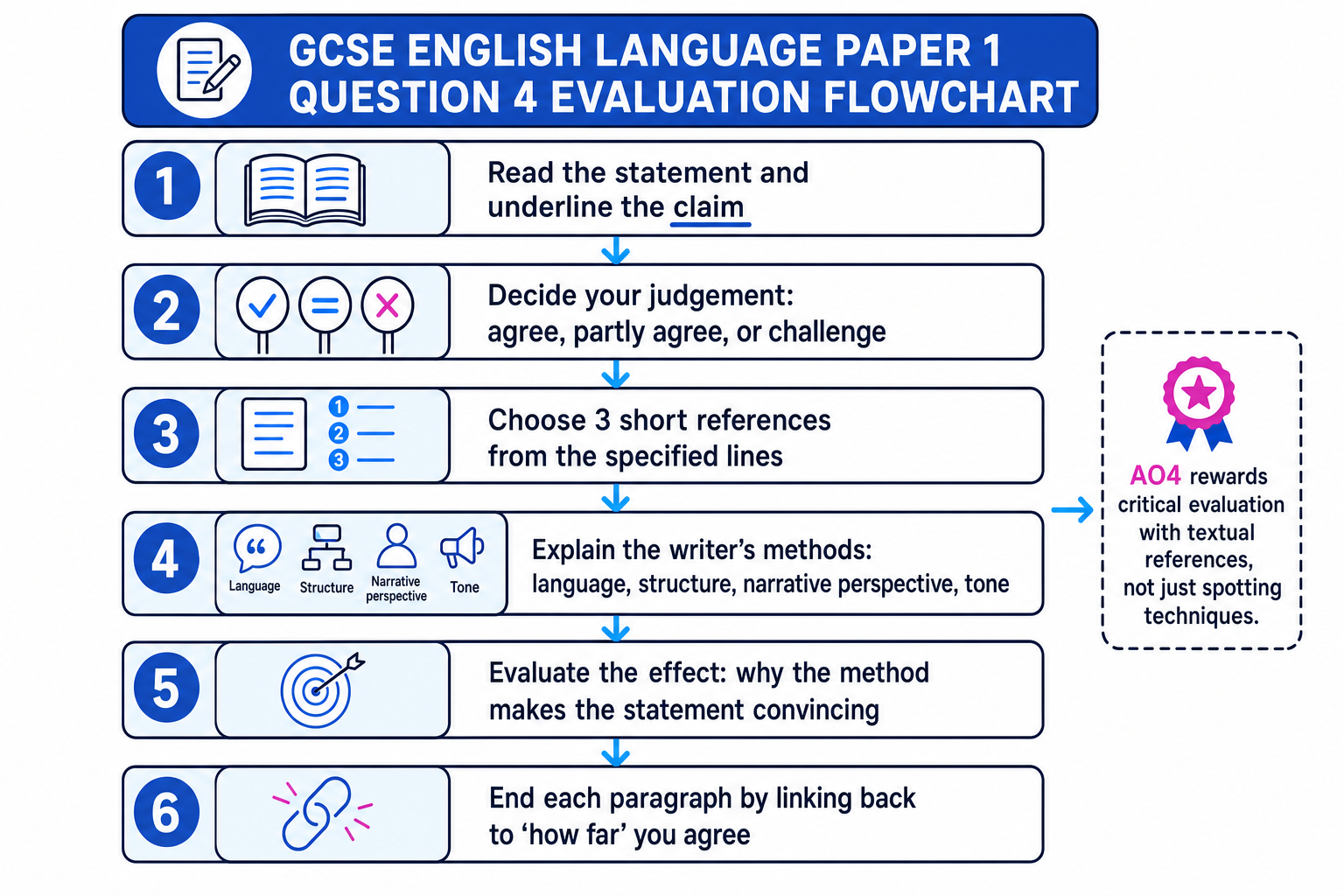
A useful process is: read the statement, decide your judgement, select references, evaluate methods, then keep linking back to “how far” you agree.
Using references properly
A textual reference is a short quotation or precise detail from the source. In Question 4, you need references because AO4 rewards evaluation with support.
Use short quotations rather than copying whole sentences. A single powerful word or phrase can be enough if you explain it well. You can also refer to structural moments, such as a sudden shift in focus or a change in pace, as long as you are precise.
Using the wrong part of the source
If the question says “Focus this part of your answer on lines…” then stay inside that section. Evidence from outside the specified lines may not be rewarded securely.
Evaluating the writer’s methods
A writer’s method is a deliberate choice that shapes meaning. It could be a language choice, a structural choice, or a narrative choice.
Writer’s methods
Writer’s methods include vocabulary, imagery, dialogue, sentence length, paragraphing, order of events, shifts in focus, contrast, narrative perspective, and tone.
Here are some useful terms:
- Vocabulary means the writer’s word choices.
- Imagery means descriptive language that creates pictures, feelings, or associations in the reader’s mind.
- Dialogue means speech between characters.
- Sentence length means how short, long, simple, or complex sentences are.
- Paragraphing means how the text is divided into sections.
- Shift in focus means the writer moves attention from one thing to another.
- Contrast means two different ideas, images, or moods are placed together.
- Narrative perspective means the viewpoint the story is told from, such as first person or third person.
- Tone means the attitude or mood created by the writing.
Precise description beats shaky terminology
If you are unsure of a technique name, describe the choice accurately. “The repeated references to darkness” is stronger than wrongly calling something a metaphor.
Analysis vs evaluation
This is the most important difference.
Analysis explains how a writer’s choice creates meaning or effect.
Evaluation judges how successfully that choice supports the statement.
| Analysis-only response | Evaluative response |
|---|---|
| “The word suggests the character is afraid.” | “This makes the statement convincing because the word presents fear as overwhelming, so the character does seem powerless.” |
| “The short sentence creates tension.” | “The short sentence is effective because it abruptly slows the moment, making the danger feel unavoidable.” |
| “The writer uses contrast.” | “The contrast complicates the statement because it shows the character is not only frightened but also quietly determined.” |
Upgrading analysis into evaluation
- Start with the method and meaning: “The writer’s use of [method] suggests [idea].”
- Add a judgement word: “This is effective / convincing / powerful / unsettling / only partly convincing because…”
- Link back to the statement: “This supports the statement to a great extent because…”
- Add nuance if needed: “However, this is complicated by [another detail], which suggests…”
Building a strong paragraph
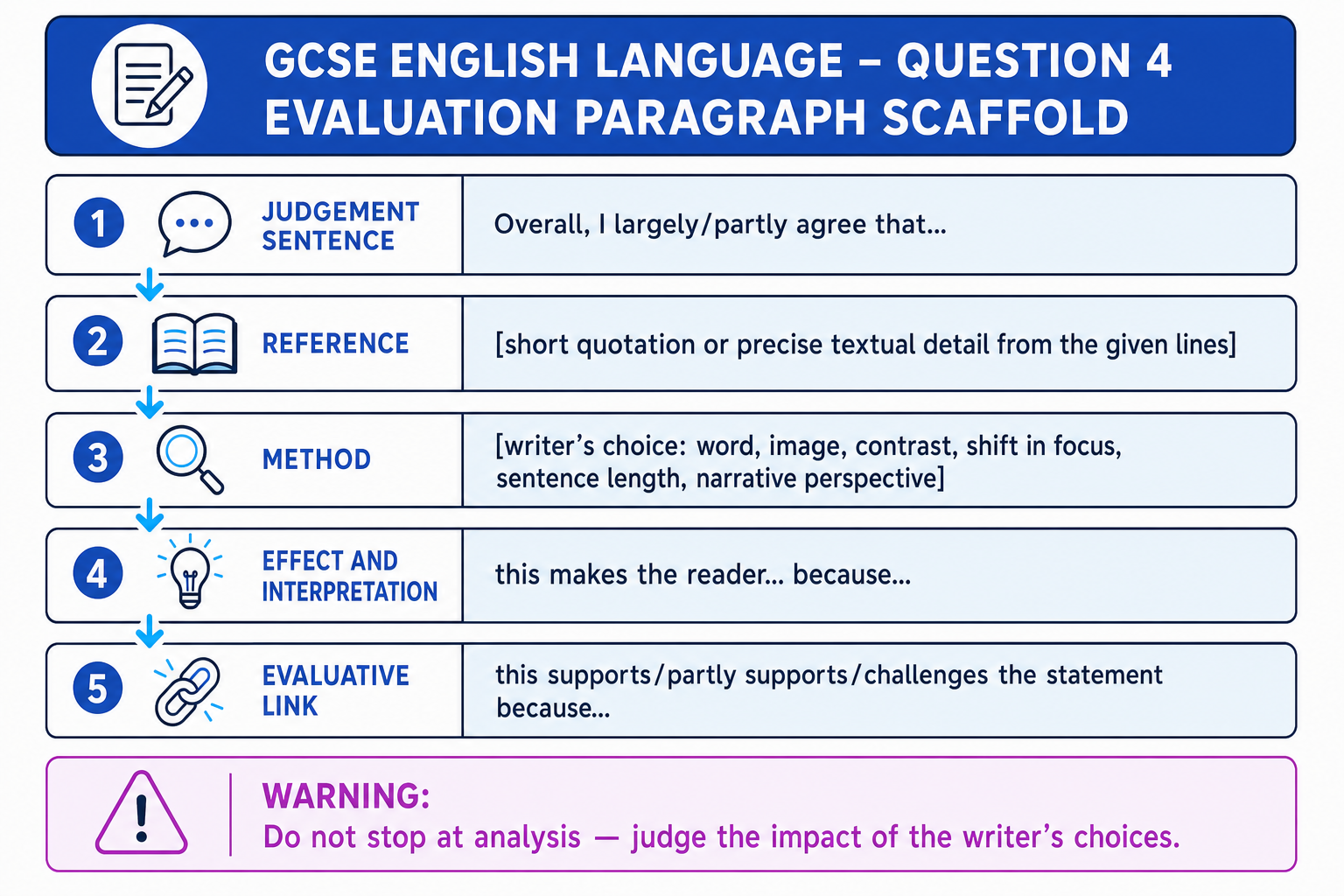
A clear Question 4 paragraph usually has five parts:
- Judgement — say how far you agree with the statement.
- Reference — use a short quote or precise detail.
- Method — identify or describe the writer’s choice.
- Effect — explain what the reader thinks, feels, notices, or questions.
- Evaluative link — judge how far this supports the statement.
Building an evaluation paragraph
- Choose one part of the statement to focus on, such as danger, sympathy, confusion, or powerlessness.
- Select one short reference from the specified lines that directly supports or complicates that idea.
- Attach a method to it: for example, a word choice, image, contrast, shift in focus, or sentence pattern.
- Explain the effect on the reader: “This leads the reader to…”, “This creates the impression that…”, or “This makes the moment feel…”
- Finish with an evaluative link: “Therefore, I agree to a great extent because the writer makes [idea from statement] feel convincing and sustained.”
What a whole answer should look like
For a 20-mark response, aim for three developed paragraphs. If you write four shorter but focused paragraphs, that can also work. Quality matters more than quantity.
A sensible structure is:
- Opening judgement: one sentence saying how far you agree overall.
- Paragraph 1: strongest evidence supporting the statement.
- Paragraph 2: another method, perhaps structural or narrative.
- Paragraph 3: a more nuanced point — either deeper support or a complication.
- Final sentence: a brief overall judgement if you have time.
You can follow the order of the extract, especially if the writer builds tension, reveals information gradually, or changes the reader’s view of a character.
Useful evaluative phrases
Try to sound like you are weighing up the statement, not just listing techniques.
Useful phrases include:
- This makes the statement convincing because…
- To a great extent, the writer presents…
- This is particularly effective because…
- The writer positions the reader to feel…
- This detail complicates the statement because…
- Although the statement is mostly convincing, this moment suggests…
- Overall, the evidence strongly supports the view that…
“Positions the reader” means the writer guides the reader towards a particular reaction or judgement.
Feature spotting
Do not write a paragraph that only says, “The writer uses a simile, an adjective and a short sentence.” Techniques do not earn marks by themselves; they matter because of what they reveal and how they support your judgement.
Timing
Because Question 4 is worth 20 marks, it deserves a good chunk of the reading time. A rough guide is 20–25 minutes.
Spend a few minutes planning. Underline the key words in the statement, choose your stance, and mark three or four useful references in the specified section. Planning saves time because you will not drift into retelling the story.
In the exam
- Underline the key claim in the statement and check the exact line focus.
- Decide your judgement: agree, largely agree, partly agree, or challenge.
- Choose three or four precise references from the specified section.
- In each paragraph, analyse a method and then evaluate how far it supports the statement.
- Keep linking back to the wording of the statement so your answer stays focused.
Check yourself
- Can you explain the difference between analysing a method and evaluating a statement?
- Do your paragraphs clearly say how far you agree, rather than just saying “I agree”?
- Are your references short, precise, and taken from the correct part of the source?
