What you'll learn
- What Paper 2 Question 2 is really testing.
- How to move from surface details to deeper inferences.
- How to compare ideas across Source A and Source B without drifting into language analysis.
- How to build a clear, concise comparison paragraph for an 8-mark answer.
Where Question 2 fits
Paper 2 is AQA English Language’s non-fiction reading and writing paper. It lasts 1 hour 45 minutes, is worth 80 marks, and makes up 50% of your GCSE English Language grade.
Section A is the reading section. You answer questions on two unseen non-fiction sources. Question 2 is usually worth 8 marks and focuses on AO1: selecting information, interpreting meaning, and synthesising details from both texts.
In simple terms: Question 2 asks you to compare what you can understand or infer from both sources.
The big idea
Question 2 is not just “find a detail from each source”. It asks you to use details from both texts to make a focused comparison about what is suggested.
What “comparative inference” means
Let’s break the phrase down slowly.
Inference
An inference is a sensible idea you work out from evidence in the text. It is not directly stated, but it is strongly suggested.
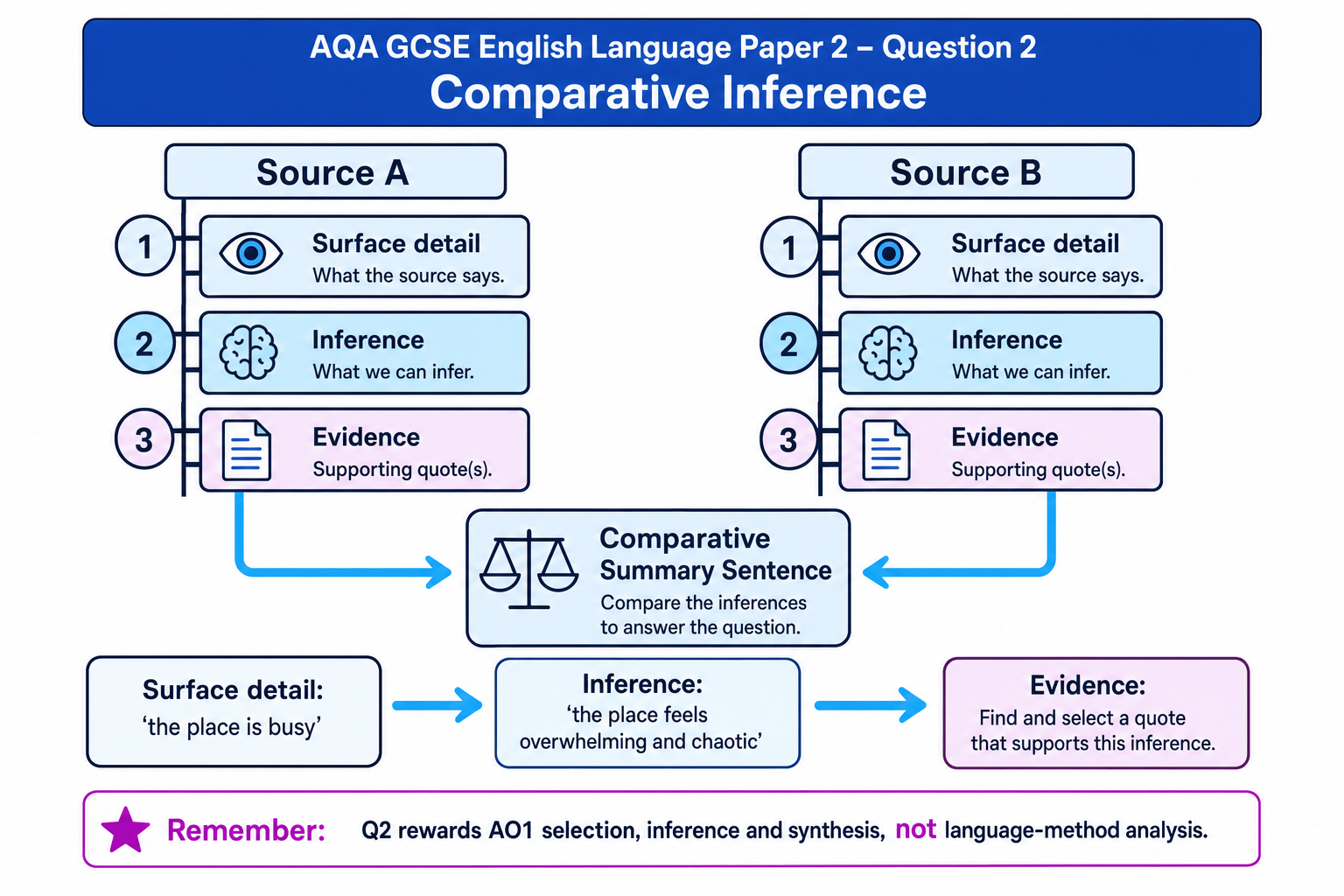
For example, if a source says a street is packed with people, full of noise, and difficult to move through, the surface detail is that it is busy. A stronger inference is that the place feels overwhelming, chaotic, or stressful.
Comparative inference
A comparative inference is when you work out what each source suggests, then compare those ideas. You might compare a similarity, a difference, or both, depending on the question.
The diagram below shows the movement you need to make: from detail, to inference, to a joined-up comparison.
Surface detail vs deeper inference
A surface detail is what the text literally says. It is the first layer of meaning.
An inference is what that detail suggests. It is the second layer of meaning.
Here is the important difference:
- Surface detail: “Source A says the place is busy.”
- Stronger inference: “Source A suggests the place is overwhelming and chaotic.”
The second version is better because it explains the impression created by the detail.
Moving from detail to inference
-
Start with a surface detail, such as a place being described as crowded, noisy, or full of movement.
-
Ask what that detail suggests about the experience. Crowds and noise might suggest pressure, confusion, excitement, danger, or lack of control.
-
Choose the inference that best matches the question focus. If the question asks about the people’s experiences, “overwhelming and chaotic” is more useful than simply “busy”.
-
Turn it into a clear sentence: Source A suggests that the experience is overwhelming and chaotic, rather than merely busy.
Staying on the surface
A weak answer often says, “Source A says it is busy, but Source B says it is quiet.” That is comparison, but it is very basic. Push one level deeper: what do those details suggest about mood, experience, attitude, or conditions?
What “synthesis” means in Question 2
Synthesis
Synthesis means combining information from both texts to create one joined-up understanding. In Question 2, this usually means linking Source A and Source B in the same sentence or paragraph.
Synthesis is more than writing one paragraph about Source A and then one paragraph about Source B. You need to bring the sources together.
A non-synthesised answer sounds like this:
- Source A shows the place is busy.
- Source B shows the place is quiet.
A synthesised answer sounds like this:
- Source A presents the place as overwhelming and chaotic, whereas Source B presents it as calm and controlled.
The second version is stronger because it compares the ideas, not just the details.
What the examiner rewards
For Question 2, the examiner is looking for:
- relevant ideas from both sources
- clear understanding of the question focus
- sensible inferences from details
- brief, well-chosen references or quotations
- comparison or synthesis across the sources
You do not need to analyse language methods in detail here. That is more important in Paper 2 Question 3, which focuses on AO2, and Paper 2 Question 4, which focuses on comparing writers’ perspectives and methods through AO3.
Keep the job of Question 2 clear
Think: ideas and meanings, not methods and terminology. You can quote a word or phrase, but you do not need to write about similes, metaphors, sentence lengths, or punctuation unless it directly helps your inference.
A simple method for answering Question 2
Use this process every time.
1. Identify the focus of the question
Question 2 will usually ask you to summarise differences or similarities about a specific focus, such as:
- the people’s experiences
- the places being described
- the conditions in each source
- the attitudes towards an event
- the difficulties faced by people
The focus matters because it controls what evidence is relevant.
2. Find one useful detail from each source
Choose details that clearly connect to the focus. You do not need long quotations. Short references are usually better.
A useful detail might be:
- a short quotation
- a specific image or description
- a clear fact from the source
- a moment that reveals how someone feels
3. Infer from each detail
For each source, ask:
- What does this suggest?
- What impression does it create?
- What does it reveal about the person, place, situation, or attitude?
Try to use precise words. Instead of “good” or “bad”, aim for words like:
- overwhelming
- peaceful
- threatening
- exciting
- isolated
- confident
- vulnerable
- restricted
- chaotic
- privileged
4. Compare the inferences
Use comparison words to connect the two sources:
- whereas
- while
- however
- in contrast
- similarly
- both
- unlike
- compared with
Your comparison should focus on meaning, not just content.
Building a paired comparison
-
Suppose your note for Source A is: crowds, noise, movement. A sensible inference is that the experience feels overwhelming or chaotic.
-
Suppose your note for Source B is: space, quiet, stillness. A sensible inference is that the experience feels calmer or more controlled.
-
Now compare the inferences, not just the details: Source A suggests a chaotic and overwhelming experience, whereas Source B suggests a calmer and more controlled one.
-
Add brief evidence from each source using your own chosen quotations or references: This is shown through [short detail from Source A], while Source B refers to [short detail from Source B].
How to structure a strong answer
For an 8-mark Question 2 answer, you usually want about two developed comparative points. That might be two short paragraphs.
A helpful structure is:
- Comparative point about Source A and Source B.
- Evidence from Source A.
- Inference from Source A.
- Evidence from Source B.
- Inference from Source B.
- Link back to the comparison.
Here is a transferable sentence frame:
Source A suggests that [inference about focus], whereas Source B suggests that [different inference about focus]. In Source A, [brief evidence] implies [meaning], while in Source B, [brief evidence] suggests [meaning].
A slightly more developed version:
Both sources present [shared focus], but they create very different impressions. Source A suggests that [experience/place/person] is [precise inference], shown by [brief evidence]. By contrast, Source B presents it as [precise inference], as [brief evidence] suggests [meaning].
Use the sentence frame as scaffolding, not as a script. Your answer must respond to the exact question and the actual sources in front of you.
How to avoid accidentally answering Question 3 or Question 4
Question 2 is often misunderstood because it involves two sources, so students sometimes write like they are answering Question 4. But Question 4 is the bigger comparison question. It asks about writers’ viewpoints and methods.
Question 2 is narrower. It wants a summary comparison based on inference.
Over-analysing methods
Do not spend your 8-mark answer writing, “The writer uses a metaphor to…” or “The adjective creates imagery…” unless it helps you make a quick inference. In Question 2, the examiner mainly rewards what you understand and how well you connect both sources.
What a concise answer might sound like
Here is a model shape using placeholders rather than invented source quotations:
Source A presents the experience as [precise inference], whereas Source B presents it as [contrasting inference]. In Source A, the detail about [brief reference] suggests that [deeper meaning]. However, in Source B, the detail about [brief reference] implies that [deeper meaning]. This makes Source A seem [summary word], while Source B seems [summary word].
Notice what this does:
- it compares both sources directly
- it includes details from both
- it makes inferences
- it stays focused on the question
- it avoids long language analysis
Choosing better inference words
Precise vocabulary helps you sound confident. Here are some useful upgrades:
| Basic word | Stronger inference words |
|---|---|
| busy | chaotic, overwhelming, crowded, intense |
| quiet | peaceful, isolated, controlled, lifeless |
| hard | demanding, exhausting, oppressive, challenging |
| happy | joyful, relieved, optimistic, content |
| sad | distressed, disappointed, lonely, hopeless |
| scary | threatening, dangerous, unsettling, intimidating |
| strange | unfamiliar, disorientating, unusual, alien |
Do not choose impressive words just for the sake of it. The word must fit the evidence.
Do not force a contrast
If the question asks for differences, look for differences. If it asks for similarities, look for similarities. If the sources partly overlap, you can write a balanced comparison: both suggest difficulty, but Source A makes it seem physically exhausting, while Source B makes it seem emotionally stressful.
How much should you write?
Because Question 2 is worth 8 marks, you do not need a long essay. Aim for roughly 8–10 minutes.
A strong answer might be:
- two comparative paragraphs, or
- one longer paragraph with two clear comparisons
Quality matters more than quantity. A short answer with precise inferences and evidence from both sources can score well.
In the exam
-
Read the question focus carefully and underline what you are comparing, such as experiences, places, attitudes, or conditions.
-
For each source, choose one or two details that let you infer something deeper than the surface meaning.
-
Write paired comparisons using words like whereas, while, similarly, or in contrast, and keep your focus on AO1 understanding rather than language analysis.
Check yourself
- Can you explain the difference between a surface detail and an inference?
- Can you turn “the place is busy” into a deeper idea about atmosphere or experience?
- Can you write one sentence that compares an inference from Source A with an inference from Source B?
