What you'll learn
- What AQA Paper 2 Question 3 is asking you to do.
- How to spot useful language methods without turning your answer into a feature list.
- How to connect words and techniques to the writer’s viewpoint and the reader’s response.
- How to build a clear analysis paragraph for 12 marks.
Where Question 3 fits
AQA GCSE English Language Paper 2 is 1 hour 45 minutes long, worth 80 marks and 50% of the GCSE. Section A is reading non-fiction; Section B is writing. Every question is compulsory.
Question 3 in Paper 2 is the language analysis question. It is worth 12 marks and usually asks you to focus on one source and often on a specific section of that source.
AO2
AO2 is the assessment objective for analysing how writers use language and structure. In Paper 2 Question 3, the focus is language: words, phrases, language features, techniques and sentence forms.
A typical question might begin: “How does the writer use language to…” This means you are not just explaining what the writer says. You are explaining how the writer’s choices shape meaning.
The big idea
Question 3 rewards analysis, not technique-spotting. The examiner wants to see you connect a writer’s language choices to their viewpoint and the effect on the reader.
What “language” means in this question
Language means the writer’s choices at word, phrase and sentence level. This includes the vocabulary they choose, the images they create, the tone they build, and the techniques they use to influence the reader.
A method is a deliberate choice made by the writer. For example, using a rhetorical question is a method; choosing the word “cruel” instead of “bad” is also a method.
A viewpoint is the writer’s attitude, opinion or perspective. In non-fiction, the writer might seem angry, amused, shocked, sympathetic, critical, nostalgic or admiring.
A reader effect is what the language encourages the reader to think, feel or notice.
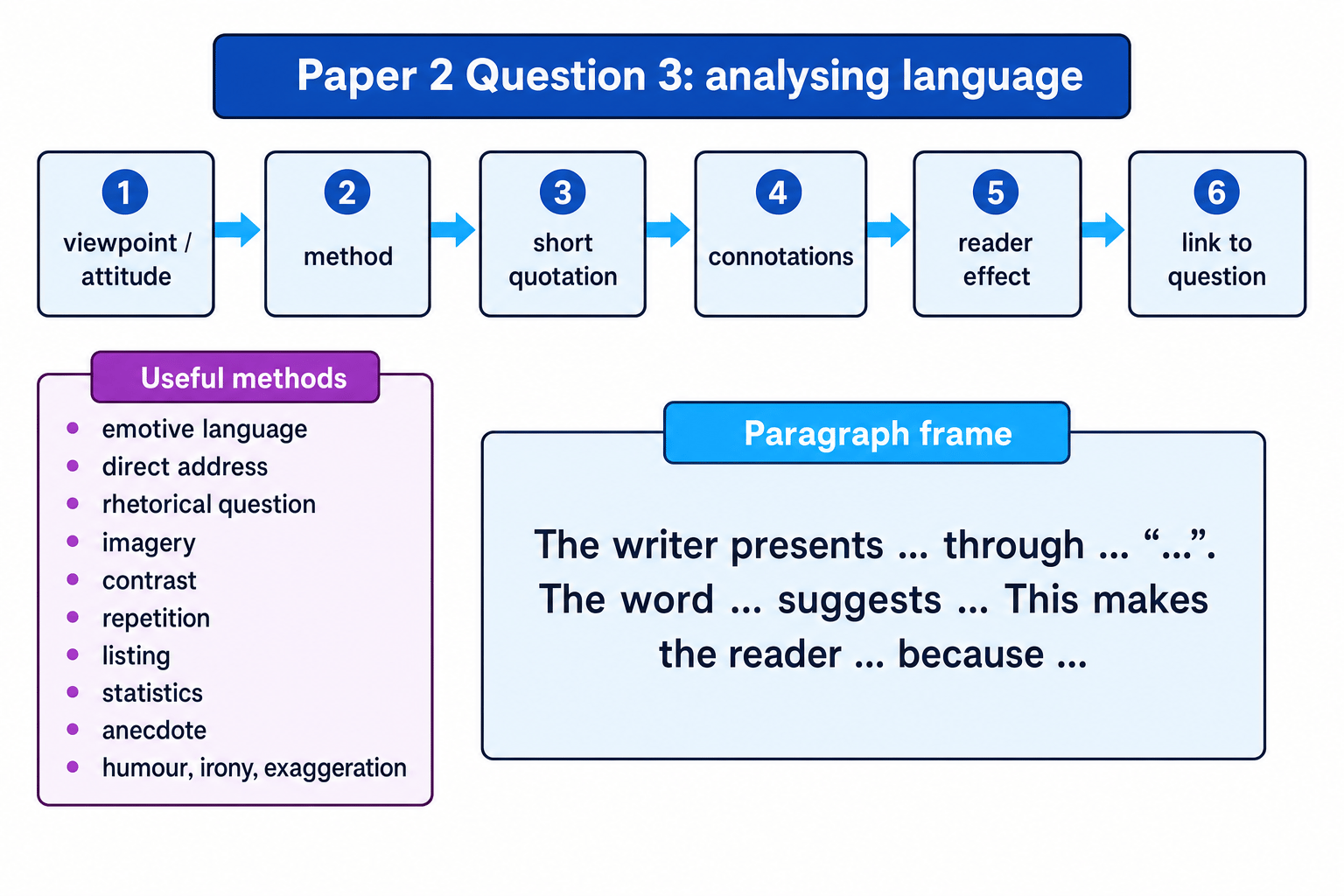
Use this simple chain when planning your answer: viewpoint, method, quotation, connotations, reader effect, link to the question.
Connotation
A connotation is an idea, feeling or association suggested by a word beyond its literal meaning. For example, “home” literally means a place where someone lives, but it can connote warmth, safety and belonging.
Moving from method to meaning
- Start with the method: if a writer uses direct address, they speak straight to the reader using words such as “you” or “we”.
- Add the relationship it creates: “you” can make the reader feel personally involved rather than safely outside the issue.
- Link to the writer’s viewpoint: this can make the writer’s warning, criticism or appeal feel urgent because the reader is being pulled into the argument.
- Shape it into analysis: “The direct address involves the reader personally, making the writer’s concern feel immediate rather than distant.”
The language methods you need to know
You do not need to use every technique in one answer. The best answers choose the methods that help explain the writer’s attitude most clearly.
| Method | What it means | How it can work |
|---|---|---|
| Word choice | The writer’s precise vocabulary. A noun names a person, place or thing; a verb shows an action or state; an adjective describes a noun; an adverb adds detail to a verb, adjective or whole sentence. | Zoom in on one powerful word and explore its connotations. |
| Emotive language | Words chosen to create strong feelings. | Can make the reader feel pity, anger, fear, guilt, excitement or admiration. |
| Rhetorical question | A question asked for effect rather than because the writer expects an answer. | Can challenge the reader, create doubt, or make the writer’s point seem obvious. |
| Direct address | Speaking straight to the reader, often using the pronoun “you”. A pronoun is a word that stands in for a noun. | Can involve, accuse, persuade or include the reader. |
| Statistics | Numerical facts or figures. | Can make an argument seem precise, factual, shocking or large-scale. |
| Anecdote | A short personal story or example. | Can make an issue feel human, believable and emotionally engaging. |
| Humour | Language designed to amuse. | Can make the writer seem likeable, mock a target, or make criticism more memorable. |
| Irony | Language that highlights a gap between expectation and reality, sometimes by saying the opposite of what is really meant. | Can expose stupidity, hypocrisy or unfairness. |
| Exaggeration | Making something seem bigger, worse or more extreme than it literally is. | Can create comedy, drama, outrage or emphasis. |
| Contrast | Placing different ideas, images or experiences side by side. | Can make differences seem sharper and reveal what the writer values or criticises. |
| Listing | A series of words, phrases or details. | Can create a sense of quantity, speed, pressure, variety or being overwhelmed. |
| Repetition | Deliberately repeating a word, phrase or idea. | Can emphasise a message, build rhythm, or show obsession or urgency. |
| Imagery | Descriptive language that creates a mental picture or sensory impression. | Can make an idea vivid and help the reader imagine it emotionally. |
Pick the richest method
If you can only say “this makes it stand out”, choose a different quotation. A strong quotation lets you discuss attitude, connotations and reader response.
Word choice: the easiest way to go deeper
Word choice is often the safest route into strong analysis because you can zoom in closely. Instead of writing about a whole long quotation, choose one or two key words inside it.
A useful pattern is:
The writer uses the word “…” which suggests… This creates the impression that… As a result, the reader…
Try to avoid vague phrases like “positive” and “negative” on their own. Be more precise: is the tone bitter, admiring, anxious, mocking, nostalgic, frustrated, affectionate or disgusted?
Zooming in on a key word
- Choose the word that carries the strongest attitude, not necessarily the longest quotation.
- Ask what the word makes the subject seem like: dangerous, fragile, ridiculous, impressive, trapped, chaotic, innocent or powerful.
- Link that impression to the writer’s viewpoint: if the word makes something seem “fragile”, the writer may be presenting it as precious and easily damaged.
- Explain the reader effect: the reader may feel protective, concerned or more willing to agree with the writer’s criticism.
Techniques only matter when they create meaning
It is not enough to write: “The writer uses a rhetorical question.” That only identifies a method. You need to explain why that method matters.
A better sentence might be:
“The rhetorical question challenges the reader to reflect on their own responsibility, making the writer’s criticism feel harder to ignore.”
Notice that this sentence links the technique to:
- the reader’s position
- the writer’s attitude
- the purpose of the language choice
Feature spotting
Do not write a paragraph that only names techniques: “There is a rhetorical question, emotive language and repetition.” This sounds like a checklist. Always explain what each choice suggests and why it affects the reader.
Statistics, anecdotes and tone
Some Paper 2 sources are persuasive, argumentative, descriptive or reflective. That means the writer may use methods that feel more like rhetoric than poetry.
Statistics can make a point seem factual and authoritative. However, you should still analyse their effect. A statistic might shock the reader, make a problem seem widespread, or create a sense of scale.
Anecdotes can make an issue feel personal. Instead of staying abstract, the writer gives the reader a small human story to respond to.
Tone means the writer’s attitude as it comes across through language. Tone is not one method by itself; it is built by several choices working together.
Useful tone words include:
- critical
- humorous
- sarcastic
- sympathetic
- angry
- reflective
- admiring
- urgent
- dismissive
Building a paragraph
A strong Question 3 paragraph usually has four parts:
- Point: answer the question by naming what the writer presents.
- Evidence: include a short quotation from the correct source and lines.
- Method and analysis: identify a useful language method or word choice and explore connotations.
- Effect and link: explain how this shapes the reader’s response and links to the writer’s viewpoint.
A flexible frame is:
The writer presents [subject] as [idea/attitude] through [method]. In the phrase “[short quotation]”, the word “[key word]” suggests [connotations]. This makes the reader [response] because [link to viewpoint/question].
Short quotations are better
For Question 3, a short quotation with one powerful word is usually better than copying a whole sentence. It gives you space to analyse rather than retell.
What to avoid
Do not compare the two sources in Question 3. Comparison belongs mainly to Question 4 in Paper 2.
Do not write about the whole structure of the text, such as “at the beginning” or “at the end”, unless you are clearly discussing a language choice in the specified section.
Do not say “This makes the reader want to read on” unless the question is specifically about suspense or curiosity. It is usually too vague for Paper 2 language analysis.
Stay inside the question
If the question tells you to refer to one source or to specific lines, stay there. Evidence from outside the named section is unlikely to be rewarded.
In the exam
- Read the wording carefully and underline what the question asks the writer is presenting.
- Select three short quotations from the correct source or section; choose ones with strong connotations or clear methods.
- Write two or three developed paragraphs, linking each method to the writer’s viewpoint and a specific reader effect.
Check yourself
- Can you explain the difference between spotting a method and analysing its effect?
- Can you zoom in on one key word and explain its connotations?
- Can you link each paragraph back to the writer’s viewpoint?
