What you'll learn
- What explicit information means in AQA GCSE English Language.
- How to scan the correct line range for directly stated facts.
- How to answer simple retrieval and “true statements” questions.
- How to avoid distractors, guesses, and answers from the wrong part of the extract.
Where Question 1 fits
You are in Paper 1 Section A: Reading Fiction. AQA English Language Paper 1 lasts 1 hour 45 minutes and is worth 80 marks, which is 50% of the GCSE. Section A is the reading section, and every question is compulsory.
Question 1 is usually worth 4 marks, so it should be a quick, accurate start. It mainly links to AO1, which rewards you for identifying and interpreting information and ideas. In this question, the focus is the most direct part of AO1: finding what is clearly stated.
Explicit information
Explicit information is information the writer states directly in the text. You do not need to work it out from clues; the words on the page tell you.
Explicit vs implicit information
A key skill is knowing the difference between explicit and implicit information.
Implicit information is suggested rather than directly stated. An inference is a conclusion you work out from clues in the text.
For Question 1, you should usually avoid inference. You are not being asked to analyse language, explain effects, or explore hidden meanings. You are being asked to retrieve facts.
The main rule
For Question 1, ask: “Does the text actually say this in the correct lines?” If the answer is “I can work it out,” it is probably not safe enough.
Separating explicit information from inference
Imagine your scan notes from the correct lines contain these direct details: the gate is locked, the narrator is outside it, and someone is approaching.
- “The gate is locked” is safe because it matches a detail directly stated in the line range.
- “The narrator is trapped” is not safe because a locked gate might suggest difficulty, but “trapped” has not been directly stated.
- “Someone is approaching” is safe because it is a direct action, not a guessed feeling, motive, or consequence.
The line range matters
A line range is the specific part of the extract the question tells you to use, such as lines 1–6 or lines 8–15.
In Question 1, the line range is not decoration. It is a boundary. If a detail is true elsewhere in the extract but not in the specified lines, it should not be used.
Using the whole source
A common mistake is choosing an answer that is true in the extract but comes from outside the line range. For Question 1, wrong lines = unsafe answer, even if the detail is accurate later.
Scanning: the right kind of reading
Scanning means moving quickly through a short section to find specific information. It is different from reading slowly for deep meaning.
For Question 1, you are usually scanning for:
- names
- places
- objects
- actions
- times
- directly stated feelings
- clear descriptions
You are not scanning for symbolism, themes, methods, or deeper interpretations.
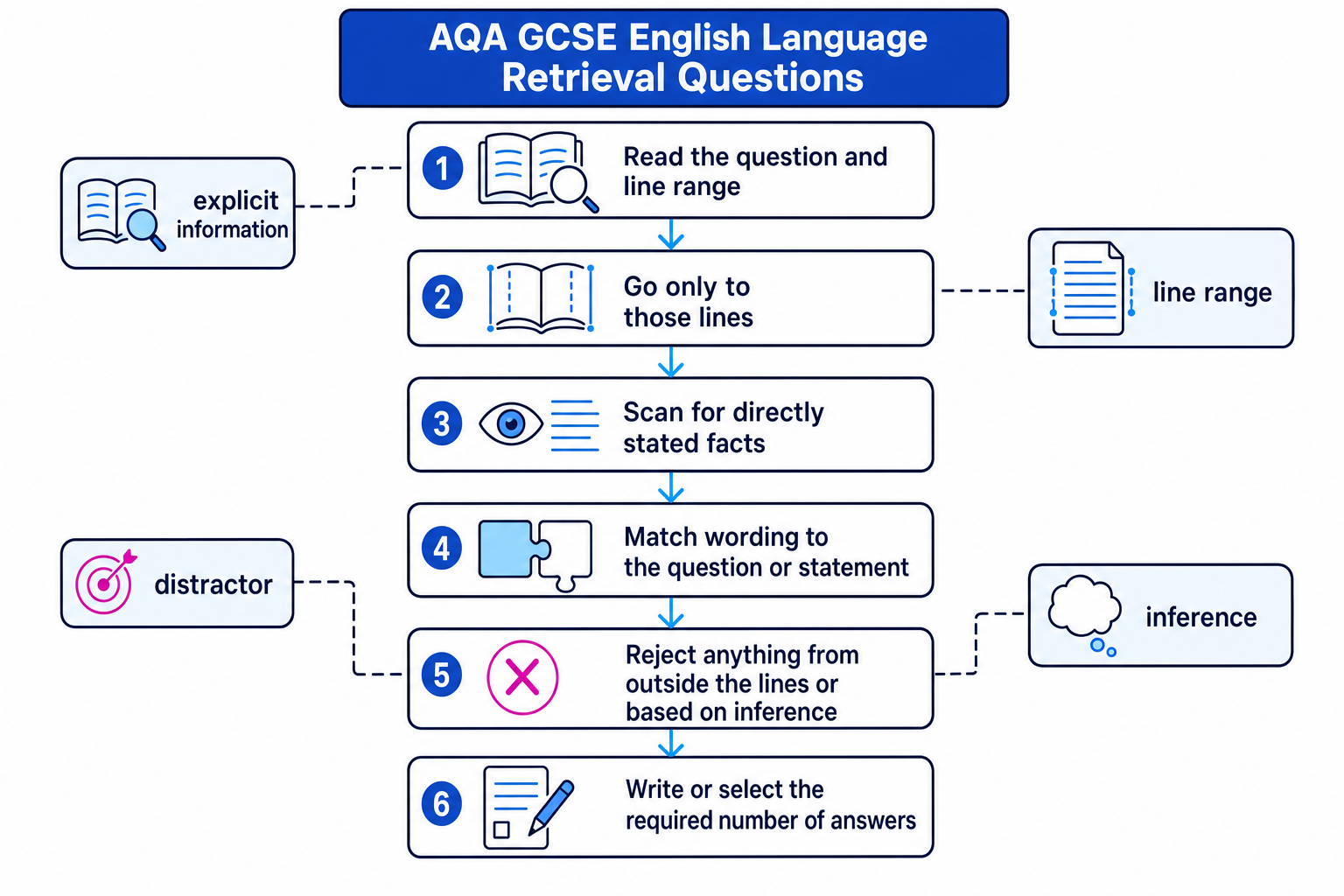
The diagram below shows the safe route through a retrieval question.
What simple retrieval looks like
In Paper 1, Question 1 often asks you to list four things from a specific part of the source.
This means you can write short answers. You do not need a paragraph. You do not need to analyse. You do not need to name techniques.
A good answer might be:
- one short quotation
- one accurate paraphrase
- one clear fact from the lines
A paraphrase is when you put the same information into your own words without changing the meaning.
One mark per clear detail
Aim for one separate detail per line. If the question asks for four things, give four clear pieces of information rather than one long sentence that the examiner has to untangle.
Turning scanned details into four answers
Suppose your scan of the correct lines gives you several direct details about a place: it is dark, there is an open window, glass is broken, smoke can be smelled, and the narrator feels nervous.
- Compare each detail with the question focus. If the question asks for things about the place, the darkness, window, glass, and smoke all fit.
- Test the feeling separately. “The narrator feels nervous” may be true, but it is about the narrator rather than the place, so it is less suitable for this question focus.
- Choose four direct place details and keep them separate: the place is dark; the window is open; there is broken glass; there is a smell of smoke.
“True statements” questions
Some practice tasks use a true statements format. A statement is a claim that can be judged true or false.
You may be given several options and asked to select the ones that are true. This checks the same retrieval skill: can you match a claim to what is directly stated in the correct lines?
Do not choose a statement just because it sounds sensible. Choose it only if the line range supports it directly.
Distractor
A distractor is a wrong answer designed to look tempting. It may use words from the text, but change a detail, go beyond the line range, or add an inference.
Selecting true statements
Imagine your scan notes from the correct lines say: the narrator is outside a locked gate, it is early morning, a woman arrives, and the narrator recognises the woman’s voice.
Options include:
- A. The narrator is outside a gate.
- B. The narrator is trapped inside a building.
- C. The gate is locked.
- D. The woman is angry.
- E. It is early morning.
- F. The narrator recognises the woman’s voice.
- G. The narrator has met the woman before.
- Match exact direct details first: A is true because the narrator is outside a gate, and C is true because the gate is locked.
- Accept details that keep the same meaning: E is true because “early morning” is directly in the scan notes, and F is true because recognising the voice is directly stated.
- Reject changed-location distractors: B is false because “outside a locked gate” is not the same as “trapped inside a building.”
- Reject added emotion or backstory: D and G might be possible guesses, but anger and a previous meeting are not directly stated.
Avoiding inference in Question 1
Inference is important in English Language, but not every question wants it. Later reading questions may ask you to analyse, evaluate, or compare. Question 1 is more basic and more precise.
Watch out for answers that include words like:
- probably
- must
- clearly feels
- wants to
- because
- symbolises
- suggests
These often signal that you are moving beyond retrieval into interpretation.
Feelings can still be explicit
Do not reject all feelings automatically. If the text directly states that a character is frightened, angry, tired, or excited, that feeling can be explicit information. The problem is when you guess the feeling from clues.
Common distractor types
Distractors usually work in predictable ways.
1. Right idea, wrong line
The detail appears somewhere else in the extract, but not in the lines you were told to use.
2. Nearly true, but changed
The option swaps a detail: the wrong person, place, object, time, or action.
For example, if the lines say a character hears a noise, a distractor might say the character sees something. Those are not the same.
3. Inferred rather than stated
The option may be a reasonable guess, but the text does not directly say it.
4. Too extreme
Words like “always,” “never,” “terrified,” “furious,” or “completely” can make a statement too strong unless the text directly supports that exact idea.
How much should you write?
For a “list four things” question, short answers are fine. You can use bullet points if the answer booklet allows, or write each answer on a new line.
You do not need to write:
- “This shows…”
- “The writer uses…”
- “This makes the reader feel…”
- a full PEE paragraph
Those are useful for other questions, especially AO2 analysis, but not here.
Keep the job small
Question 1 is designed to be a confidence-builder. Be accurate, stay inside the lines, collect the marks, and move on.
In the exam
- Read the question focus and the line range before choosing any answers.
- Scan only the specified lines and mark direct facts that match the question.
- For true-statement tasks, test each option against the exact wording of the lines.
- Reject answers that are inferred, exaggerated, changed, or from outside the line range.
- Give the required number of answers and avoid adding analysis.
Check yourself
- Can you explain the difference between explicit information and inference?
- Why is the line range so important in Question 1?
- What are two ways a distractor answer might trick you?
