

How to Get Grade 9 GCSE Biology: Habits That Work
How to get grade 9 GCSE Biology with active recall, practical knowledge, maths skills, past-paper analysis and a calm, repeatable revision plan.
Many students revise Biology by reading everything twice and hoping familiarity will become exam performance. It rarely does. If you searched how to get grade 9 GCSE Biology, the useful answer is simpler: learn directly from your specification, retrieve knowledge without notes, answer unfamiliar questions, master practical and maths skills, and use mark schemes to remove repeated errors.
A grade 999 is not secured by memorising the most pages. It comes from converting accurate knowledge into precise answers under pressure. That means changing the way you revise, not merely increasing the hours.
The grade 9 Biology revision checklist
Build your revision around these habits:
- Use the specification as a checklist rather than revising from memory.
- Test yourself before looking at notes.
- Connect processes instead of learning isolated facts.
- Know each required or core practical as an investigation.
- Practise data, graphs, percentages, units and standard form.
- Answer exam questions in unfamiliar contexts.
- Mark strictly and record why each mark was lost.
- Revisit mistakes after a delay.
- Complete timed papers before the examination.
The habits are straightforward. Their power comes from repeating them when it would be easier to reread a comfortable topic.
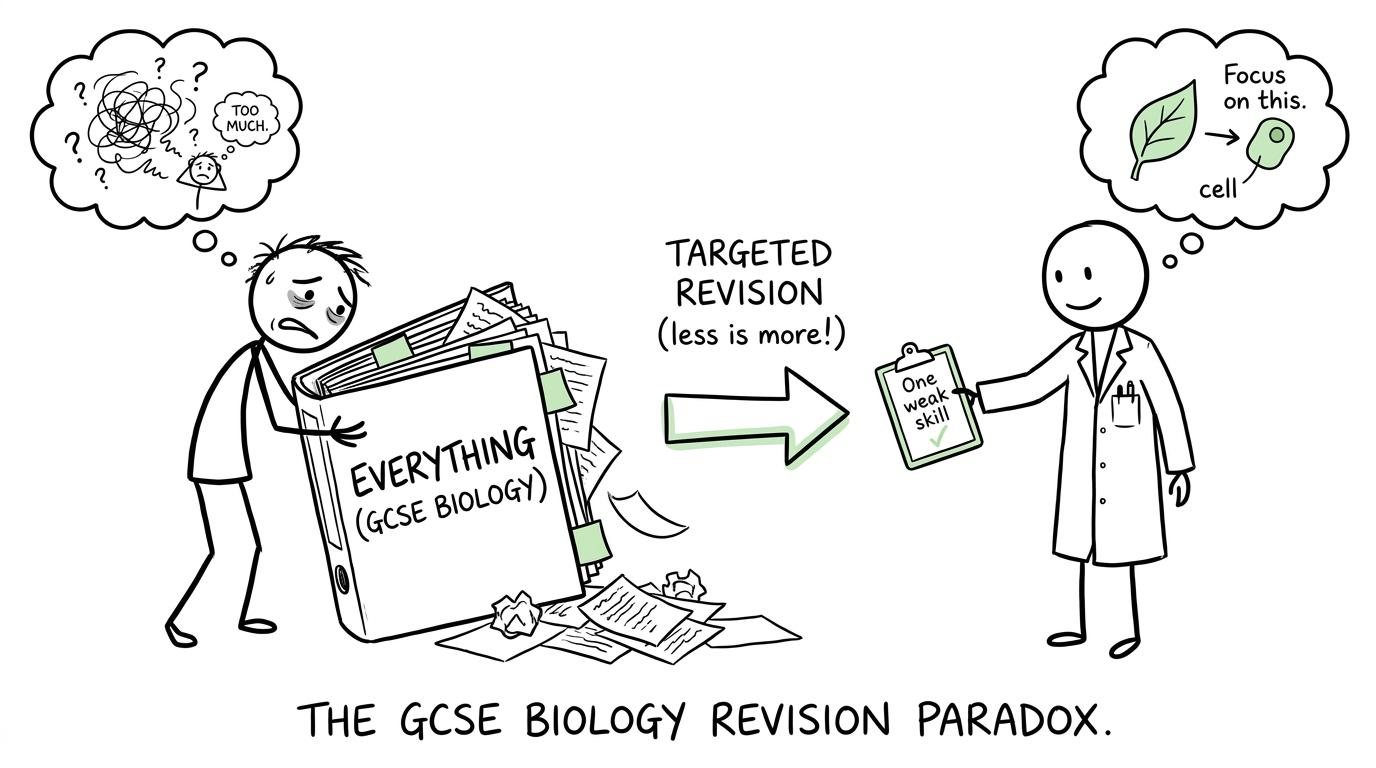 A student choosing one weak skill instead of revising everything
Understand what a grade 9 Biology paper tests
Official GCSE Biology specifications assess more than factual recall. Across the awarding organisations, the assessment objectives are broadly weighted at approximately 40%40\%40% for knowledge and understanding, 40%40\%40% for application, and 20%20\%20% for analysis and evaluation.
That balance explains why knowing a textbook can still leave a student below the top grade. A large part of the examination asks you to apply familiar biology to unfamiliar organisms, experiments or data.
AQA, Pearson Edexcel, OCR and Eduqas organise topics and practical requirements differently, so begin with the specification for your board. Check whether you study separate Biology or Combined Science and confirm your tier. A grade 999 requires higher-tier entry where papers are tiered.
Do not revise towards a guessed grade boundary. Boundaries are set for each examination series after the papers have been marked, so there is no permanent percentage that guarantees a grade 999. Instead, aim to make every available mark accessible.
Replace rereading with active retrieval
Rereading feels productive because each sentence becomes recognisable. Recognition, however, is not the same as being able to produce an explanation with no prompt.
Close the book and try one of these tasks:
- Write everything you can recall about one process for three minutes.
- Draw and label a system from memory, then check it.
- Explain a process aloud using correct biological vocabulary.
- Turn each specification statement into a question.
- Answer flashcards in both directions, such as structure to function and function to structure.
Correct the attempt immediately, but do not erase the evidence. Missing steps tell you what to retrieve next time.
Strong retrieval prompts should demand relationships. Instead of asking only for the definition of diffusion, ask how surface area, concentration gradient and diffusion distance affect the rate. Instead of listing the organs of the digestive system, explain how their structures work together.
Revisit a topic after increasing gaps. A practical pattern is the next day, several days later and then the following week. The exact timetable matters less than forcing yourself to recall the idea again after it has begun to fade.
Learn Biology as connected processes
Top-grade questions often cross topic boundaries. Exercise can connect respiration, gas exchange, circulation, temperature control and recovery. Plant growth can connect photosynthesis, mineral uptake, transport and environmental factors.
Build process chains using cause-and-effect language:
- identify the initial change;
- state the biological mechanism;
- explain its immediate consequence;
- connect that consequence to the final outcome.
Words such as “therefore” are useful only when the link is scientifically valid. Precision matters. “The organism gets more energy” is usually weaker than identifying respiration, energy transfer and the cellular process that requires it.
Create one-page connection maps, but make them from memory first. A polished diagram copied from a guide tests handwriting. A rough diagram reconstructed from memory tests Biology.
Treat practicals as examinable systems
Required and core practicals are not a separate list to memorise on the final weekend. Written papers can assess methods, variables, apparatus, safety, data handling, conclusions and improvements. They can also place familiar investigative skills into a new context.
For every practical named by your exam board, be able to identify:
- the independent, dependent and control variables;
- the apparatus and why it is suitable;
- the sequence of essential steps;
- how measurements are taken accurately;
- relevant hazards and proportionate risk controls;
- why repeats are used;
- how results should be processed or displayed;
- limitations and specific improvements.
Avoid memorising one giant paragraph. Break the investigation into decisions. If the question changes the organism or factor, you can then adapt your understanding instead of trying to force a remembered script into the wrong context.
An improvement must address an identified weakness. “Use better equipment” is vague. A stronger response names the measurement problem, selects suitable apparatus and explains how it improves accuracy, precision or control.
Secure the maths hiding inside Biology
Biology papers regularly assess ratios, percentages, means, rates, graph interpretation, sampling, probability, area, unit conversion and standard form. Official specifications also require students to translate between numerical and graphical information.
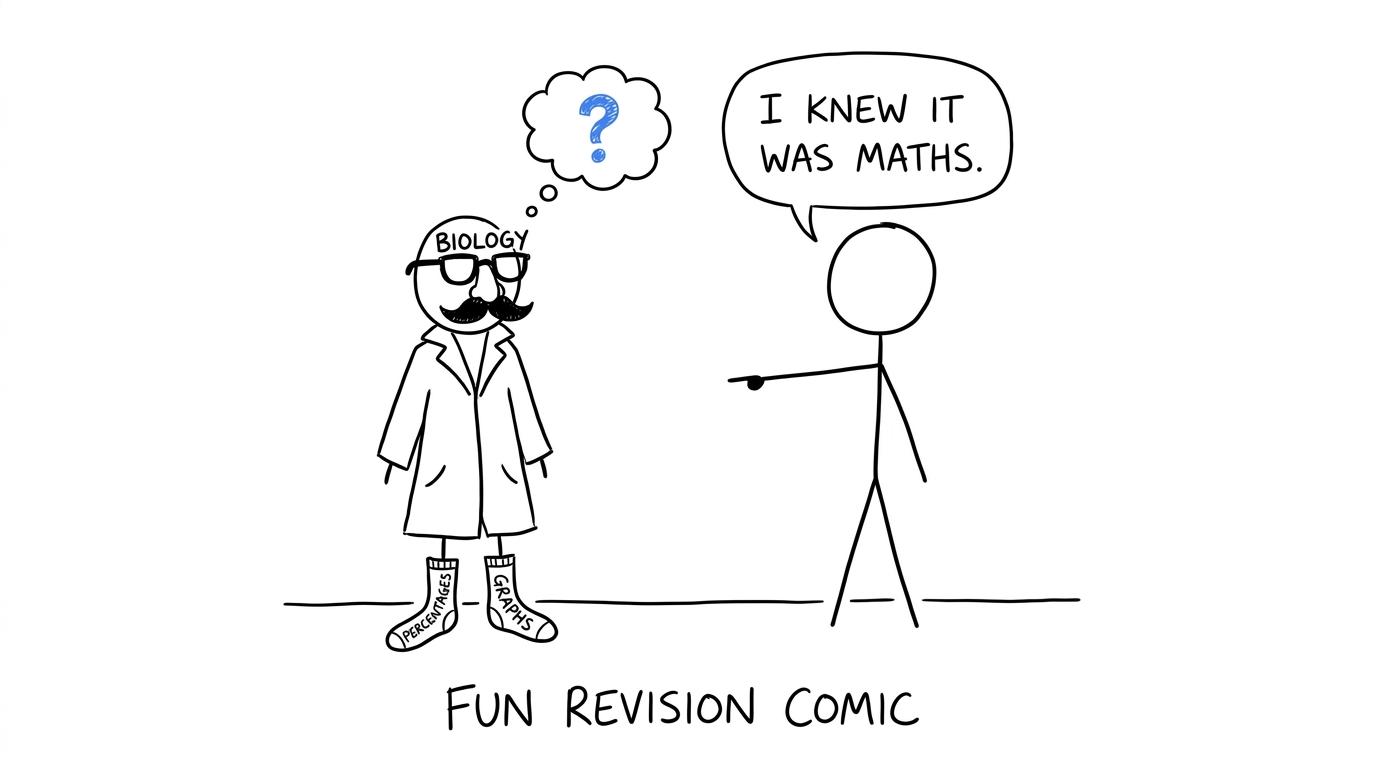 A Biology question accidentally revealing its maths disguise
The underlying methods are often familiar from GCSE maths. Key relationships include:
magnification=image sizereal size\text{magnification}=\frac{\text{image size}}{\text{real size}}magnification=real sizeimage size percentage change=new value−original valueoriginal value×100\text{percentage change}=\frac{\text{new value}-\text{original value}}{\text{original value}}\times 100percentage change=original valuenew value−original value×100 mean=sum of valuesnumber of values\text{mean}=\frac{\text{sum of values}}{\text{number of values}}mean=number of valuessum of valuesBefore calculating, convert measurements into compatible units. Write the relationship, substitute carefully, retain enough calculator accuracy and then give an appropriate final answer with units. If the question specifies significant figures, follow that instruction.
Use MathsGenie’s free standard form revision lesson when cell sizes or populations become awkward. The scatter graphs revision guide supports correlation and lines of best fit, while the accompanying scatter graph practice questions help turn that knowledge into reliable exam technique.
For a broader diagnosis, use the method in Find Your Weakest GCSE Topics. A lost Biology calculation mark may reveal a small maths gap that can be repaired quickly.
Turn mark schemes into feedback
A past paper is not merely a test. It is an instrument that shows where your revision system fails.
Start with topic questions while content is still being taught. Move to timed sections once most topics are familiar, then complete full papers under realistic conditions. Use papers for your exact qualification rather than assuming that every board assesses content in the same order.
After marking, classify each lost mark:
- Knowledge: the fact or process was missing.
- Application: you knew the idea but did not connect it to the context.
- Command word: you described when the question asked you to explain or evaluate.
- Practical skill: variables, controls or improvements were unclear.
- Maths: formula, units, graph reading or arithmetic failed.
- Communication: the response was vague, contradictory or incomplete.
Then write one action. “Revise ecology” is too broad. “Practise conclusions that quote ecological data and identify anomalies” can change the next answer.
Maths students can use exactly the same cycle through GCSE mini tests and the guide to using GCSE past papers properly: attempt, mark, fix and retest. MathsGenie’s mark schemes and video solutions help you see whether a lost mark came from understanding or execution.
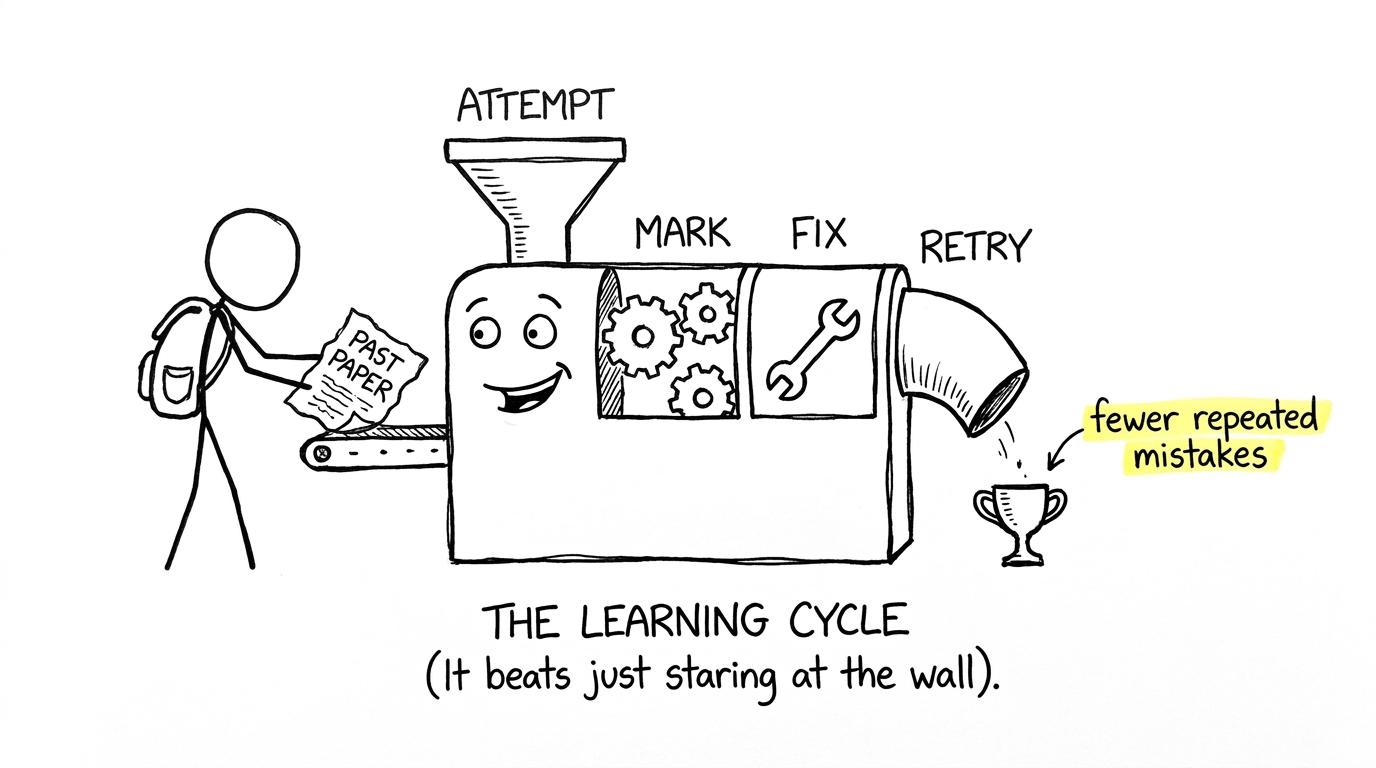 A friendly revision machine turning marked papers into fewer repeated mistakes
Write answers with examiner-level precision
Read the command word and the number of marks before writing. “State” needs a concise fact. “Describe” asks for what happens or what the data shows. “Explain” needs linked scientific reasons. “Evaluate” requires evidence on both sides and a justified judgement.
For data questions, use values from the table or graph when they strengthen the answer. Include units and compare like with like. Do not claim that correlation proves causation, and do not describe every number when the question asks for an overall trend.
For extended responses, spend a short moment planning the logical order. Accurate points linked coherently are more valuable than a long introduction. Check that pronouns such as “it” have an unmistakable meaning and that every sentence addresses the question.
A weekly routine that can move you towards grade 9
A sustainable week might contain:
- two retrieval sessions on recently taught Biology;
- one session connecting older topics;
- one practical-skills session;
- one targeted maths and data session;
- one timed exam-question session;
- one short review of the error log.
Each session should produce evidence: an answered question, corrected recall sheet, practical plan or retest score. Time alone is a poor measure of revision. What matters is what you can now retrieve or apply that you could not do before.
During busy exam weeks, follow a smaller routine rather than abandoning the system. The Biology and maths exam-week checklist shows how to balance recall, questions and recovery without attempting to relearn the course overnight.
Common mistakes that hold students below grade 9
Revising favourite topics repeatedly
Comfort creates the impression of progress. Let marked questions decide what deserves your next session.
Memorising mark-scheme phrases without understanding
Keywords cannot rescue an answer if the biological relationship is wrong. Learn why each phrase earns the mark and when it applies.
Ignoring practical details
Knowing the conclusion is not enough. Learn variables, measurements, controls, risks, graphs and evaluation.
Dropping units or rounding too early
Keep units visible, convert before substituting and avoid premature rounding. Check whether the scale of the answer is biologically sensible.
Completing papers without revisiting errors
A paper identifies weaknesses; correction changes them. Redo missed questions without notes and retest the same skill later.
Treating predicted content as a guarantee
Predictions should add realistic practice, not narrow your Biology coverage. Your specification remains the complete revision checklist. The same principle applies when using MathsGenie’s predicted papers for maths.
Make grade 9 preparation a repeatable process
The leap towards a grade 999 is usually quieter than students expect. It is one vague explanation rewritten precisely, one unit conversion secured, one practical understood properly and one repeated mistake finally removed.
Start with your Biology specification and one timed diagnostic set. Identify the largest leak, repair it and return to a different question that tests the same skill. Then repeat.
For the quantitative side of science and your maths examinations, make MathsGenie your free revision base. Use revision lessons to rebuild methods, practice questions and mini tests to secure them, then past papers, predicted papers, mark schemes and video solutions to perform under pressure. Add each task to your revision planner so that good intentions become a routine you can actually follow.










