GCSE Exam Week Checklist (Biology + Maths Calm Plan)
GCSE exam week checklist for Biology (and Maths): what to do each day, avoid panic cramming, and use YesGenie past papers and predicted papers.
When GCSE exam week arrives, it rarely feels like a neat timetable. It feels like walking into school with two pens, a half-charged calculator, and a brain that keeps replaying the words “six-mark question” at inconvenient moments. Biology revision can suddenly take over your whole head: enzymes, osmosis, disease, inheritance. And yet, in the middle of it all, you still have maths to sit, and maths quietly demands something different: calm, method, and practise.
This GCSE checklist is designed for that exact week. Not the perfect week you planned in March: the real one where you’re tired, time-poor, and trying to keep grades 9-1 within reach. It’s a Biology-first checklist, but written for students who are revising maths too, because in GCSE season you don’t get to revise subjects one at a time.
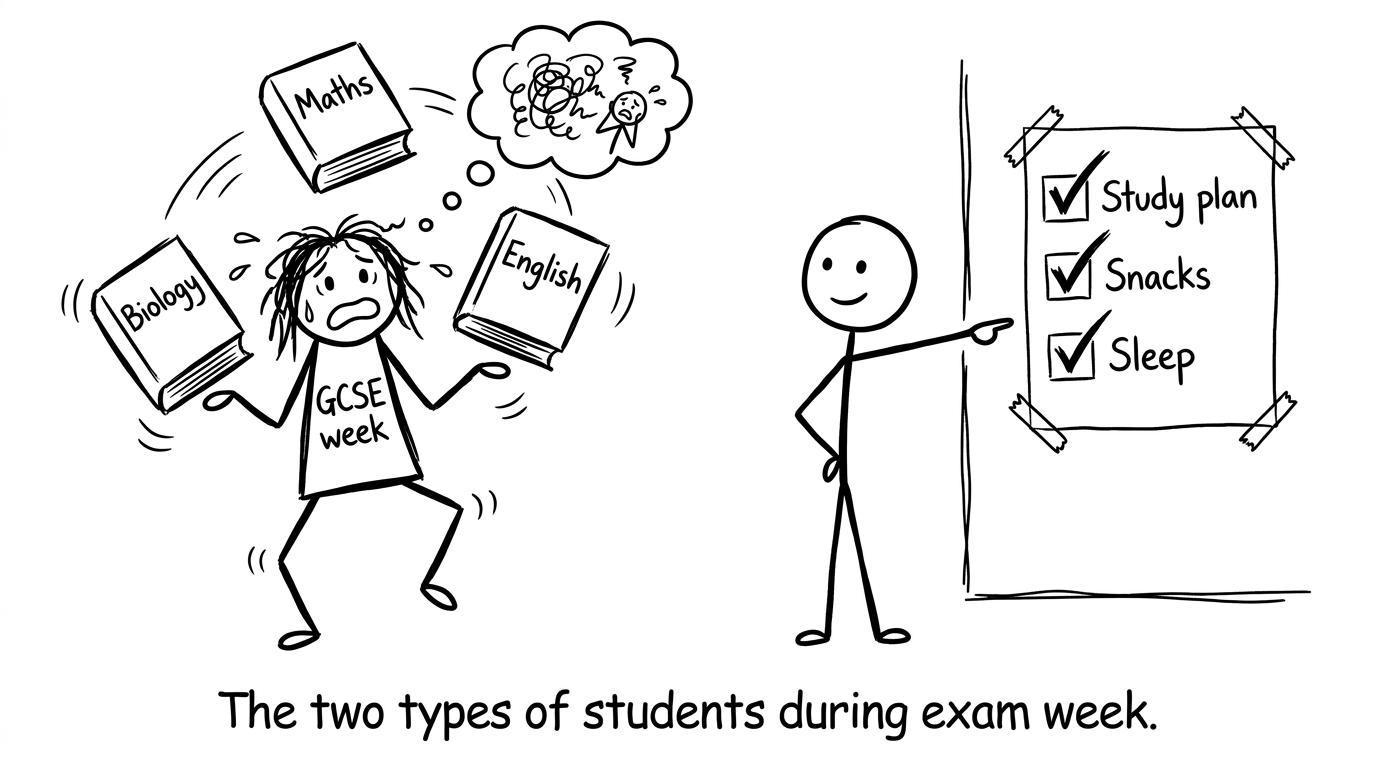 A student juggling exam week with a checklist
The simple GCSE exam week checklist (printable in your head)
Use this as your daily GCSE routine. You can do it whether you’re AQA, Edexcel, OCR or Eduqas, and whether you’re on maths foundation or higher tier.
Night before (20 minutes)
- Pack your bag: pens, pencil, ruler, calculator, protractor (if you have maths soon), clear bottle.
- Check the start time, room, seat, and whether it’s calculator/non-calculator.
- Pick one Biology focus area and one maths focus area. Keep it small.
- Set out a realistic morning plan: wake, breakfast, short recap.
Morning of the exam (15-30 minutes)
- Do a light recall session, not a full relearn.
- For Biology: read a single page of key processes and required practicals.
- For maths: do 3-5 short questions to warm up, then stop.
After the exam (30-60 minutes)
- Don’t do a post-mortem with five friends comparing answers.
- Write down what felt hard while it’s fresh (topics, not exact questions).
- Do a short reset: food, water, walk, shower.
- Then do one focused session for the next exam.
The hidden truth about GCSE Biology week (and why maths helps)
Biology often feels like “knowing things”. Maths feels like “doing things”. In GCSE exam week, “knowing things” is fragile because stress blurs recall. That’s why a small amount of maths practice can act like an anchor: you get quick wins, you see method still works, and your confidence has something solid to stand on.
If you need a clean starting point for your maths routine, keep these pages open all week:
YesGenie is built for this week: fast topic refreshers, then exam-style practice with mark schemes and video solutions.
What to revise for GCSE Biology without burning out
In GCSE Biology, the temptation is to make revision “bigger” when you feel behind. The better move is to make it “sharper”. Your goal in exam week isn’t to become a biologist. It’s to collect marks.
The Biology triage method
Pick one from each list per day:
High-yield knowledge
- Key processes (photosynthesis, respiration, homeostasis)
- Required practicals (method + variables + graph + evaluation)
- Core definitions (pathogen, immunity, diffusion, transpiration)
High-yield exam skills
- Interpreting graphs and tables
- Six-mark “explain” answers (structure matters)
- Calculations with units and significant figures
And here’s the important crossover: those Biology calculations are often just GCSE maths in disguise.
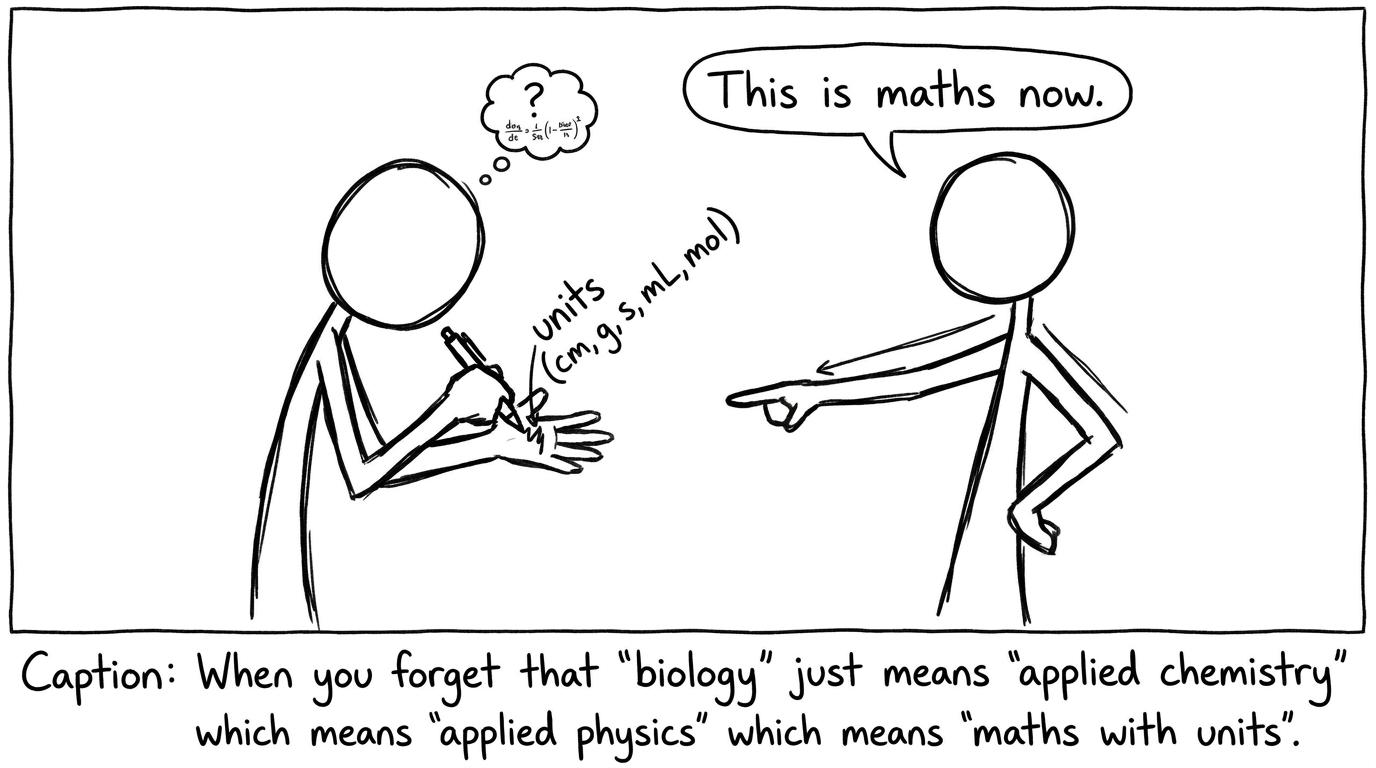 Biology units turning into maths
The maths you’ll meet inside GCSE Biology (with worked examples)
Even if your next paper is Biology, your grades 9-1 outcome can still be nudged by how cleanly you handle the maths-heavy questions: rates, percentages, averages, standard form, units.
Worked example: percentage decrease (common in Biology)
A patient’s heart rate falls from 808080 bpm to 686868 bpm after treatment. Find the percentage decrease.
Percentage decrease is:
decreaseoriginal×100 \frac{\text{decrease}}{\text{original}}\times 100 originaldecrease×100Decrease =80−68=12=80-68=12=80−68=12.
So:
1280×100=0.15×100=15 \frac{12}{80}\times 100 = 0.15\times 100 = 15 8012×100=0.15×100=15The percentage decrease is 15%15\%15%.
If percentage change is a weak spot, practise it directly in your maths time; it’s quick to improve and shows up everywhere in GCSE science.
Worked example: mean from a frequency table (biology data)
A student measures breathing rate in a class:
- 121212 breaths/min: frequency 333
- 141414 breaths/min: frequency 555
- 161616 breaths/min: frequency 222
Mean breathing rate:
Total frequency =3+5+2=10=3+5+2=10=3+5+2=10.
Total of x×fx\times fx×f:
12×3+14×5+16×2=36+70+32=138 12\times 3 + 14\times 5 + 16\times 2 = 36 + 70 + 32 = 138 12×3+14×5+16×2=36+70+32=138Mean:
13810=13.8 \frac{138}{10}=13.8 10138=13.8Mean breathing rate is 13.813.813.8 breaths per minute.
If you want extra practice on data-style questions, build the habit of doing a short stats recap in your GCSE maths slot.
Worked example: standard form (science-friendly)
A bacterium has a mass of 0.000000450.000000450.00000045 g. Write this in standard form.
Move the decimal so the number is between 111 and 101010:
0.00000045=4.5×10⁻⁷ 0.00000045 = 4.5 \times 10^{-7} 0.00000045=4.5×10⁻⁷Because the decimal moved 777 places to the right, the power is −7-7−7.
Standard form is one of those GCSE topics where two days of focused practice can change your accuracy massively.
A realistic GCSE exam week timetable (when you have Biology and maths)
This is not a fantasy schedule. It’s built for tired brains.
If you have an exam tomorrow
- 40 minutes: Biology recall (one topic + one practical)
- 25 minutes: maths questions on one skill (percentages, ratio, graphs)
- 10 minutes: mark and log mistakes
If you have two exams close together
- Make your second session exam-technique-based.
- For maths: do one paper section, then mark it.
- For Biology: practise one six-mark answer plan and one graph interpretation.
Use YesGenie’s exam resources to keep your practice realistic:
- Edexcel GCSE Maths Predicted Papers
- Resources (Predicted Papers, Mini Tests, 45-minute papers)
- November 2020 Paper 2 - Video Solutions
How to use past papers properly in GCSE week
Past papers aren’t just “more questions”. In GCSE week, they are a diagnostic tool.
The two-pass method
Pass 1 (timed, calm): Do a chunk, not necessarily a whole paper. Aim for steady work, not speed.
Pass 2 (marking, ruthless): Use the mark scheme and video solutions. Write a one-line reason for each lost mark.
Your lost marks usually fall into four buckets:
- Didn’t know the topic
- Knew the topic but forgot a step
- Misread the question
- Arithmetic or calculator slip
Only the first bucket needs “learning”. The other three are solved by GCSE exam habits.
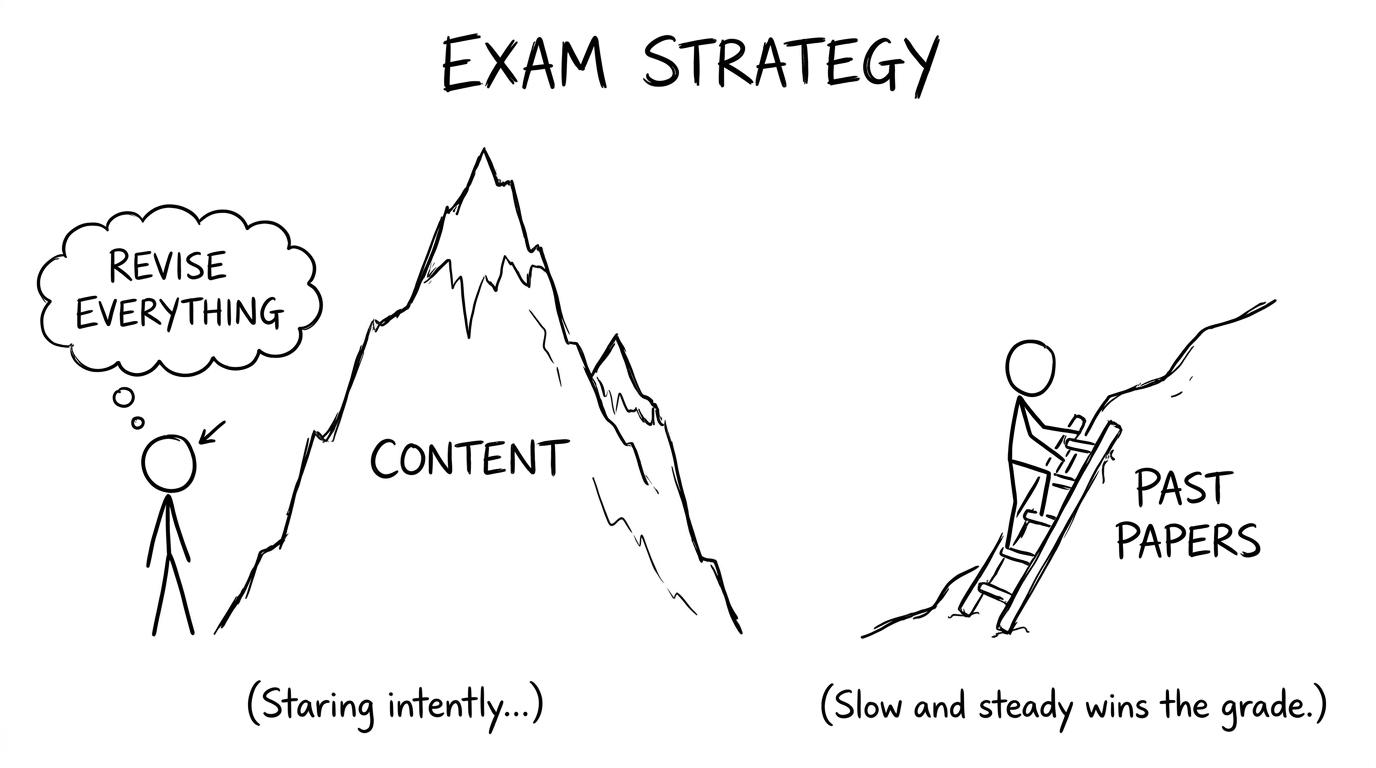 Climbing the content mountain with past papers
Common mistakes in GCSE exam week (and the fixes)
Turning revision into scrolling
If your “break” becomes 45 minutes, your brain learns the wrong rhythm. Put breaks on a timer. Even in GCSE week, you’re allowed rest, but it has to be deliberate.
Rewriting notes instead of retrieving
Pretty notes feel productive because your pen moves. Retrieval is what gets marks: closed-book definitions, blurting, flashcards, and answering exam questions.
Doing full papers when you’re exhausted
A full paper done badly teaches panic. A half-paper done well teaches method. Use 45-minute blocks (or even 25 minutes) and keep quality high.
Ignoring maths because Biology feels urgent
Biology feels loud. Maths is quiet until it isn’t. A short daily maths routine protects your GCSE grade and improves confidence across subjects.
Not learning from mark schemes
A mark scheme is not a judgement; it’s a map. In GCSE week, you’re not trying to be clever. You’re trying to match what earns marks.
A calm ending to GCSE week (and a practical next step)
By the end of GCSE exam week, most students don’t need more motivation. They need fewer decisions. A simple checklist, repeated daily, is often what keeps revision steady when your brain wants to sprint and crash.
If you want that steadiness, use YesGenie as your default: start with a quick lesson or revision guide refresh, then move straight into exam-style practice. Build your confidence with GCSE Past papers, sharpen technique with Edexcel GCSE Maths Predicted Papers, and keep your weak spots under control using Edexcel GCSE Maths Revision Guides. In GCSE season, the students who improve fastest aren’t the ones who do the most; they’re the ones who practise the right things, mark carefully, and return tomorrow.