How to Get Grade 8 GCSE Music: Habits That Work
How to get grade 8 GCSE Music with practical habits for performance, composition and appraisal, plus a focused weekly revision plan that builds marks.
A GCSE Music grade can feel unusually personal. You are not only recalling facts; you are performing, composing and explaining what you hear. When one part feels uncertain, it can seem as though the entire qualification is slipping away.
The practical answer to how to get grade 8 GCSE Music is to treat those three skills separately, then connect them through a consistent revision system. Practise music you can perform accurately and expressively, develop compositions against the marking criteria, and complete regular listening questions using precise musical vocabulary. Grade 8 usually comes from fewer repeated mistakes, not occasional flashes of brilliance.
Your Grade 8 GCSE Music checklist
Start with this overview:
- Confirm your exam board and current specification.
- Read the assessment criteria for performing, composing and appraising.
- Ask your teacher for your current marks and specific improvement targets.
- Choose performance pieces that are challenging but secure.
- Improve compositions through planned, audible changes.
- Practise unfamiliar listening as well as memorising set works.
- Use musical vocabulary to describe exactly what you hear.
- Complete timed questions and study the mark scheme.
- Keep an error log and revisit recurring weaknesses.
- Protect regular practice time rather than relying on long, irregular sessions.
AQA, Edexcel, OCR and Eduqas organise their content differently, so your own specification must remain the final authority. Across the main GCSE Music specifications, however, performing and composing commonly contribute 30%30\%30% each, while listening and appraising contributes 40%40\%40%. That balance matters: neglecting the written paper because performance feels more enjoyable leaves a large part of the qualification exposed.
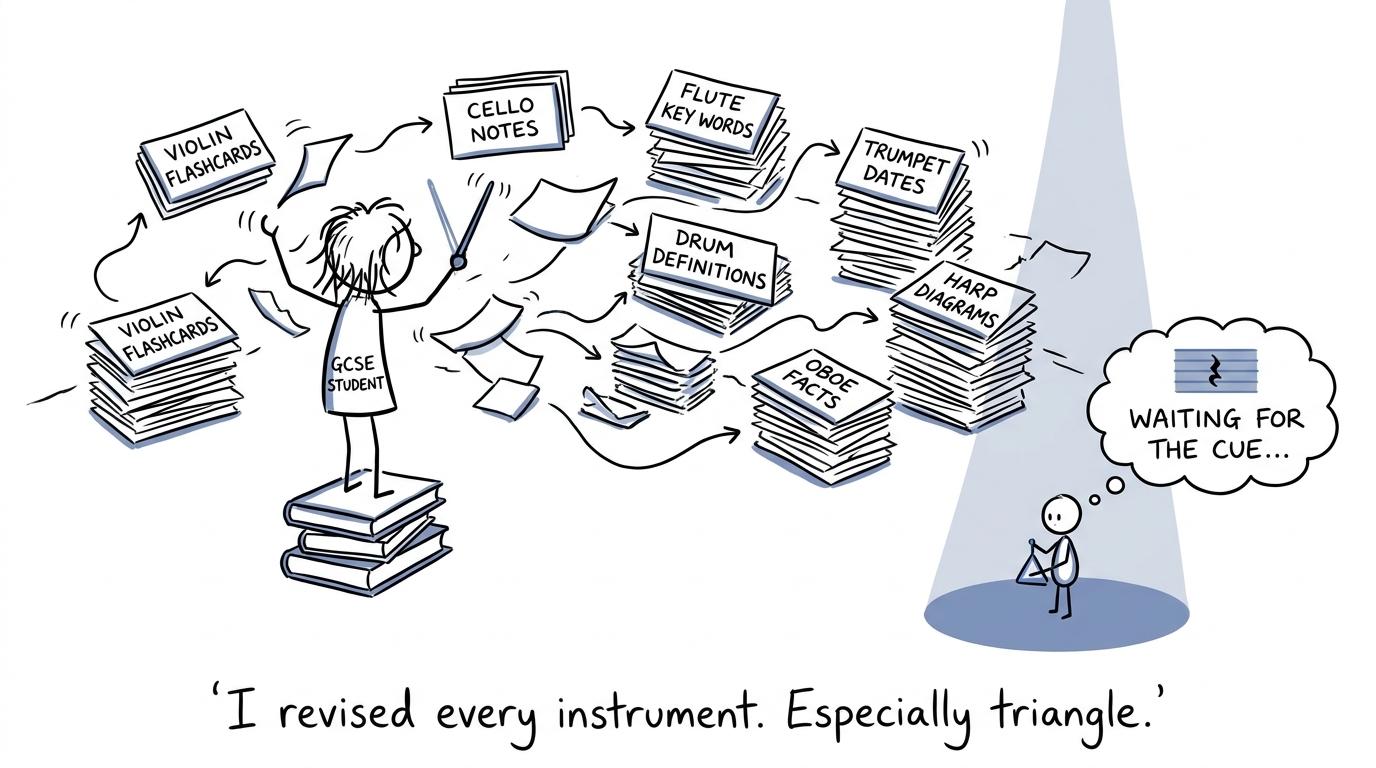 A student conducting an orchestra of revision flashcards
Know what Grade 8 performance actually requires
Grade 8 is not simply a high total. It represents consistently strong evidence across the assessment objectives. In broad terms, exam boards reward technical control, fluency, expression and interpretation in performance; coherent development and control in composition; and accurate knowledge, analysis and evaluation in appraisal.
That distinction changes how you revise. Playing a piece repeatedly from beginning to end may feel productive, but it often rehearses the same errors. A stronger routine isolates difficult passages, slows them down, checks pitch and rhythm, then reconnects them to the whole performance.
Choose security before impressive difficulty
An ambitious piece is useful only if you can control it. Examiner and moderator reports repeatedly warn that excessively difficult repertoire can lead to hesitations, inaccuracies and weak expression. A slightly more manageable piece, performed fluently and musically, may provide stronger evidence against the criteria.
Discuss repertoire with your teacher before committing. Check that it meets your board's rules, suits your current technique and gives you opportunities to demonstrate phrasing, articulation, dynamics and interpretation.
Record yourself regularly. Listening back reveals uneven tempo, unclear entries and rushed transitions that may disappear while you are concentrating on playing. After each recording, choose no more than three improvements. Specific targets such as “stabilise the tempo before the final section” are more useful than “practise more”.
For ensemble work, rehearse musical communication as well as your own part. You need to respond to balance, timing and the other performers rather than behaving like several soloists who happen to start together.
Turn composition into a deliberate process
A composition rarely becomes sophisticated because more layers have been added. Stronger work usually grows from a clear initial idea that is varied, contrasted and developed with control.
Before editing, listen to the whole piece without stopping. Mark where your attention drops, where a section arrives without preparation, or where repetition stops serving a purpose. Then decide what musical change is needed. Possibilities include rhythmic variation, melodic extension, textural contrast, harmonic movement, instrumentation, modulation or a change in register.
The important word is purpose. Software can produce instant patterns, but examiners assess your musical decisions. Over-reliance on repeated chord loops, preset accompaniment or copied-and-pasted material can leave a composition sounding static. Every major section should contribute to the intended style, mood or structure.
Use the assessment grid as an editing tool rather than reading it only at submission. Ask:
- Are the ideas memorable and relevant to the brief?
- Do they develop rather than merely repeat?
- Is the harmony coherent?
- Does the structure sustain interest?
- Are instrumental ranges and techniques realistic?
- Does the submitted score, lead sheet or annotation represent the recording accurately?
Save dated versions and keep secure backups. Also check your board's authentication, recording, timing and documentation requirements with your teacher. Administrative details do not improve the music, but missing or inaccurate evidence can create avoidable problems.
Make listening revision active
Listening is where many students confuse familiarity with knowledge. Hearing a set work repeatedly may make it recognisable, yet recognition alone does not produce a precise answer.
Active listening has an output. After an extract, you should identify a feature, support it with something audible and, where required, explain its effect or relationship to the style. Replace vague words such as “dramatic”, “fast” or “nice” with terminology connected to melody, articulation, harmony, tonality, texture, rhythm, metre, dynamics, sonority, structure and instrumentation.
Create short listening drills rather than waiting until you have time for a complete paper. One session might focus only on texture; another on instrumental timbre or changes over time. This trains your attention to move deliberately.
Examiners also distinguish between learned facts and evidence from the extract. Context matters, but it must answer the question being asked. If the music contradicts the paragraph you memorised, write about the music.
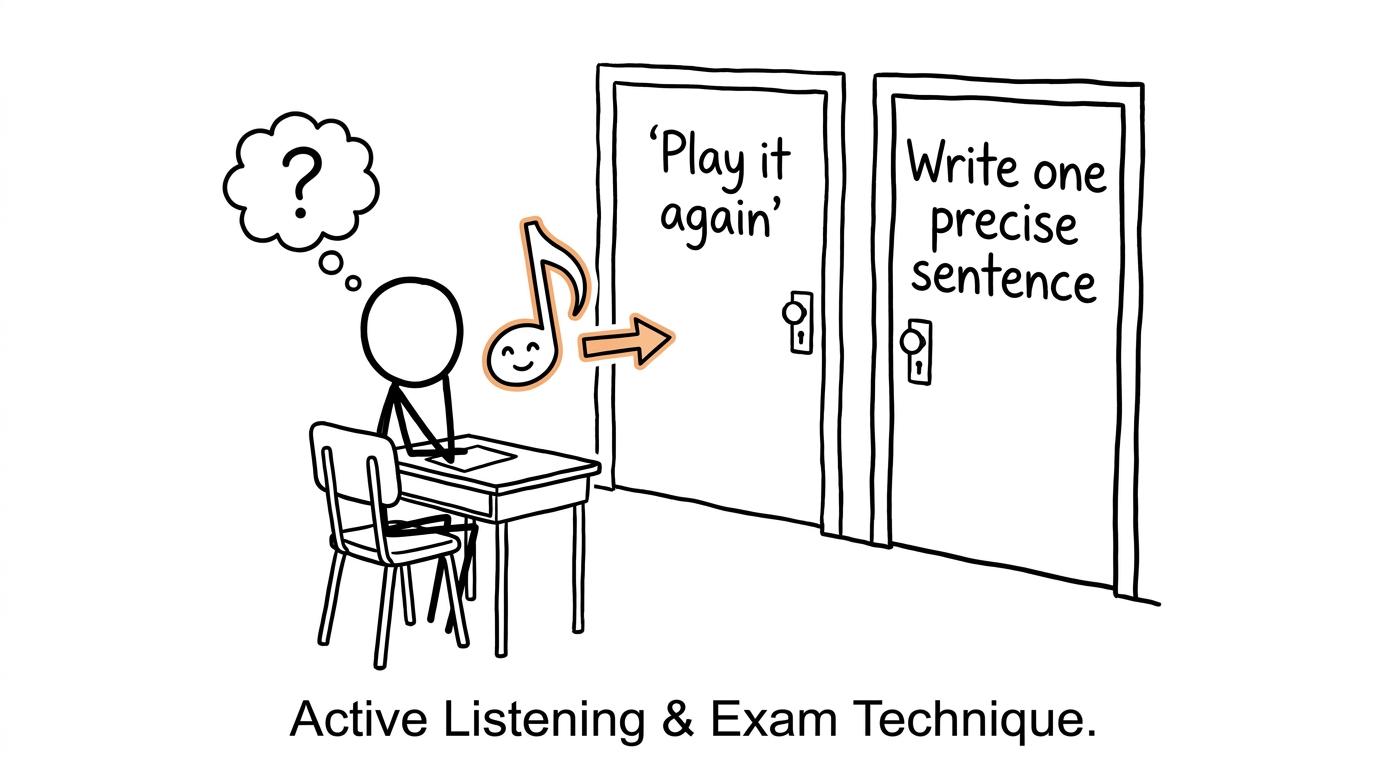 A student choosing between passive listening and one precise sentence
Use set works without memorising essays
Set-work revision should give you a flexible map, not a script. Organise each work under your specification's musical elements, then connect features to context, purpose and effect.
Flashcards are useful for factual recall, but they should be followed by retrieval from actual extracts. Listen from an unpredictable starting point and identify where you are, what is happening and which terminology best describes it. This prevents your knowledge from depending on hearing the opening first.
For extended responses, plan briefly before writing. Select the strongest relevant features, organise them logically and compare directly when comparison is required. Clear, concise analysis is usually safer than a long list of disconnected observations.
Build a weekly routine that survives busy days
The best plan is rarely the most impressive one. It is the one you can still follow during a demanding school week.
A balanced Music routine might include:
- two focused performance sessions targeting difficult passages;
- one recorded run-through followed by reflection;
- two short composition sessions with one defined editing goal each;
- three brief listening or terminology drills;
- one timed exam question followed by marking and correction.
Space those activities across the week. Frequent retrieval and deliberate practice are more useful than saving everything for one long weekend session.
If you are balancing Music with GCSE Maths, reduce the number of decisions you need to make. The GCSE Maths revision hub brings lessons, exam questions and papers together, while the GCSE one-month revision plan provides a structure you can adapt across subjects.
The same learn-practise-mark-fix cycle works in both. In Music, you identify an aural or technical weakness and rehearse it. In maths, you can use GCSE Maths mini tests to diagnose a gap, revisit the relevant lesson and test it again.
Let feedback change the next attempt
Feedback has little value when it is merely read. Its value appears in the next version.
Keep a simple log with three headings: what happened, why it happened and what you will do next. Your entries might concern an insecure transition, an undeveloped musical idea, confused terminology or an answer that ignored the command word.
Then schedule the correction. “Improve composition” is not an action. “Rewrite the transition into the contrasting section and review it with my teacher on Friday” is.
Use mark schemes to learn the level of precision expected. When revising maths alongside Music, the same habit applies to Edexcel GCSE Maths past papers: complete, mark, diagnose and reattempt. The guide to using GCSE past papers properly explains how to turn a score into a useful next step.
Common mistakes that hold students below Grade 8
Treating the grade boundary as a permanent target
Grade boundaries can change between exam series. Do not build your plan around an assumed fixed mark. Use current information from your exam board and teacher, then aim to create a margin across every component.
Rehearsing without diagnosing
Playing from beginning to end feels satisfying, but difficult bars need isolated attention. Slow practice, accurate repetition and recorded review are more purposeful.
Choosing repertoire that is too difficult
Difficulty cannot compensate for breakdowns, weak intonation or limited expression. Choose music that lets you demonstrate control.
Adding to a composition instead of developing it
More instruments and loops do not automatically create sophistication. Development should transform or extend ideas while preserving coherence.
Writing vague listening answers
Answers such as “the music becomes powerful” need audible evidence. Name the feature precisely and connect it to what changes.
Revising only the set works
Unfamiliar listening tests whether you can apply knowledge, not merely recall notes. Include unseen extracts in your routine.
Ignoring command words
Identify, describe, explain, compare and evaluate require different responses. Underline the command word before answering.
Completing papers without correcting them
Practice does not end when time runs out. Review the mark scheme, classify each lost mark and reattempt the question. For maths preparation, predicted GCSE Maths papers and guidance on when to start past papers can help you apply this cycle without abandoning your Music schedule.
Make consistency your advantage
Getting a Grade 8 in GCSE Music is less about being effortlessly talented than making strong decisions repeatedly. Choose controllable repertoire. Edit compositions with purpose. Listen actively. Use precise language. Turn feedback into a visible change.
Start today with one small audit: write down your current performance, composition and appraisal marks, then choose the weakest recurring issue in each component. Those three issues become the centre of your next week.
MathsGenie can keep the maths side of your timetable organised while you do this. Use the GCSE Maths topics by exam board and tier to identify what you need, then combine free revision lessons, practice questions, mark schemes, video solutions, mini tests, past papers and predicted papers. A clear system protects your time, and gives both Music and Maths the deliberate practice they deserve.