

How to Get Grade 7 GCSE Latin: Revision Plan
Learn how to get grade 7 GCSE Latin through active recall, accurate translation, set-text analysis, past-paper practice and a focused revision plan.
A Latin paper can create a peculiar kind of doubt. You recognise most of the vocabulary, understand the story and still watch the sentence fall apart when you try to translate it. The problem is rarely effort alone. It is usually the way that effort is organised.
If you are searching for how to get grade 7 GCSE Latin, the practical answer is this: learn vocabulary through active recall, parse before translating, revise set texts as evidence rather than stories, practise under timed conditions and keep a precise record of lost marks. A grade 777 is built by turning knowledge into reliable exam performance.
This guide focuses on the habits and revision changes that tend to make that shift possible, particularly if you are balancing Latin with GCSE maths and other demanding subjects.
Your grade 7 Latin checklist
A productive revision plan should include:
- confirmation of your exam board, components and current prescribed material;
- short, frequent vocabulary retrieval rather than occasional long sessions;
- regular practice identifying verbs, subjects, cases and clauses;
- unseen translation completed without notes;
- detailed knowledge of set texts, themes and literary techniques;
- timed questions marked against official mark schemes;
- an error log showing exactly why each mark was lost;
- repeated practice on weaknesses until performance changes.
The principle is similar to effective maths revision. You diagnose a specific weakness, repair it and test it again. MathsGenie's guide to finding your weakest GCSE topics explains how to make that process evidence-led rather than dependent on confidence.
Know what your GCSE Latin course assesses
Before creating a timetable, check the current specification and prescribed material for your examination year. Set texts and cultural topics can change between assessment cycles, so an old revision guide may contain excellent notes for the wrong material.
GCSE Latin is commonly taken through OCR or Eduqas. There is no foundation or higher tier in GCSE Latin.
For OCR GCSE Latin J282, Language is compulsory and contributes 50%50\%50% of the qualification. Students also take two optional components, each worth 25%25\%25%, selected from prose literature, verse literature and Literature and Culture routes.
For Eduqas GCSE Latin, Component 1 Language contributes 50%50\%50%. Component 2, Latin Literature and Sources, contributes 30%30\%30%, while the remaining 20%20\%20% comes from either Latin Literature Narratives or Roman Civilisation.
These structures matter because half of the qualification comes from language in either specification. Vocabulary and grammar cannot be treated as a short topic to finish before moving on. They need to remain in your weekly routine.
Grade boundaries are not fixed percentages. They may move between exam series because papers vary in difficulty, and the final grade is awarded across the qualification rather than separately for each component. Use previous boundaries as context, not as a promise. Your safer target is to create a margin above the historical boundary in timed practice.
Replace rereading with active recall
Rereading vocabulary feels smooth because the answer is always visible. Recognition, however, is not the same as recall. In the examination, the word appears without its meaning beside it.
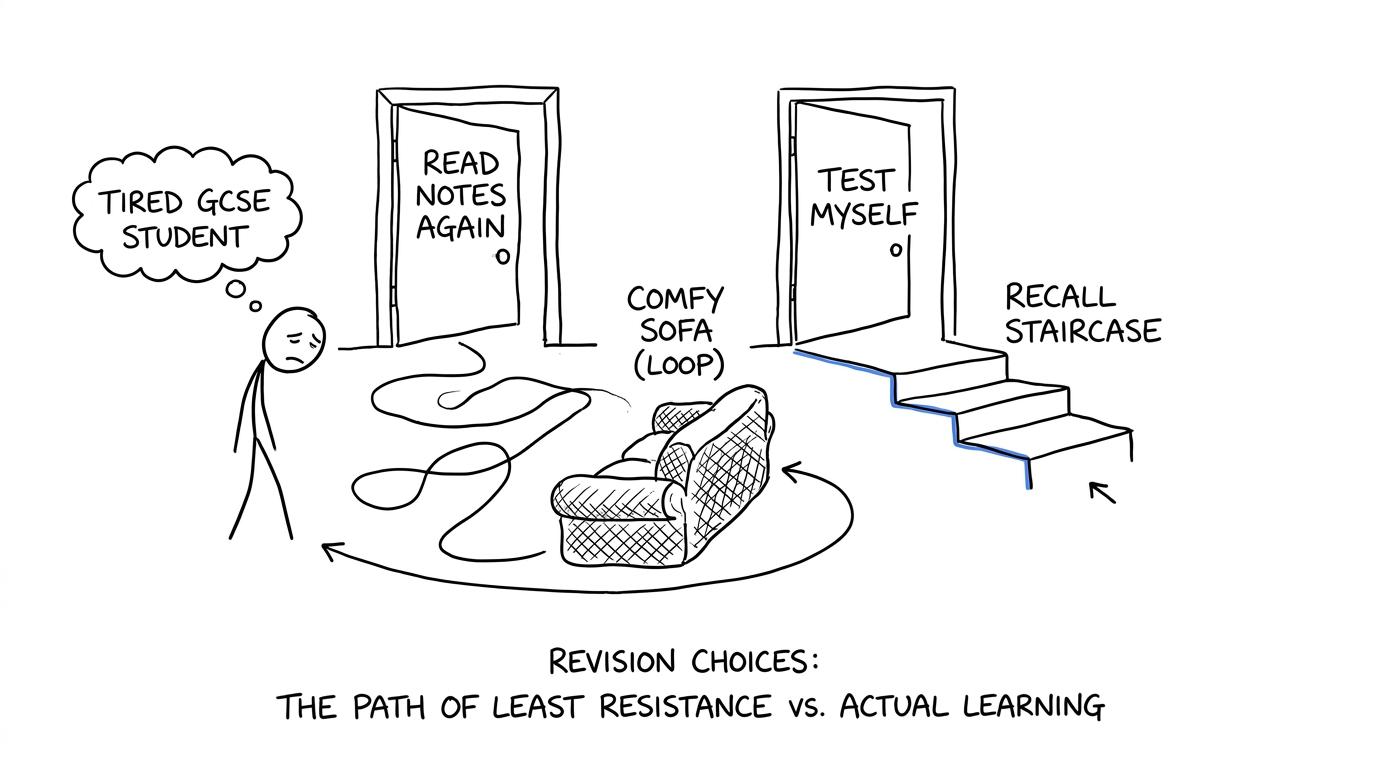 A student choosing between comfortable rereading and the staircase of active recall
Use small groups of vocabulary and test both directions. Seeing a Latin word and recalling its English meaning supports comprehension and translation. Starting with the English meaning and retrieving the Latin word makes your knowledge more flexible, especially if your course includes translation into Latin.
Do not give every word equal attention. Divide vocabulary into three groups:
- secure words recalled quickly and accurately;
- hesitant words that take too long;
- unknown or repeatedly confused words.
Most of your time should go to the final two groups. Revisit difficult vocabulary after a gap rather than repeating it several times in one sitting. A word recalled tomorrow is more useful than one repeated five times in the same minute.
This can fit into a busy timetable. The structure in MathsGenie's 20-minute GCSE revision routine transfers well to Latin: retrieve vocabulary, complete a short exam task, mark it and choose the next weakness.
Parse the Latin before producing polished English
Students often begin translating from the first word and move mechanically from left to right. English usually rewards that instinct. Latin often does not.
Before writing a translation, locate the main verb. Identify its person, number, tense and voice. Then look for the subject, objects and words whose endings show that they belong together. Mark clause boundaries and notice conjunctions, participles, infinitives or subordinate constructions.
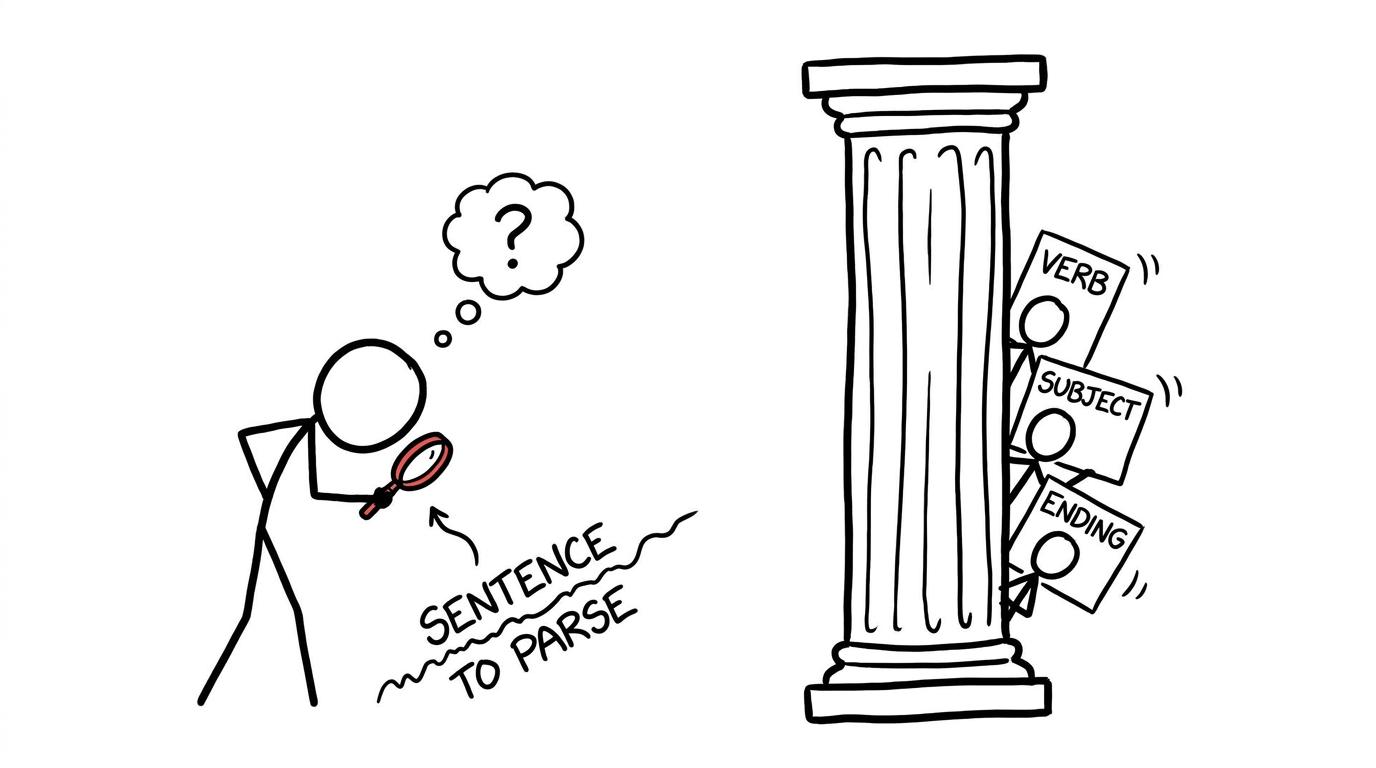 A Latin student acting as a detective while grammatical clues try to hide
The order should be:
- establish the grammatical structure;
- create a literal meaning that accounts for every word;
- turn that meaning into natural, accurate English;
- check that no negative, tense, subject or clause has disappeared.
This habit prevents one early guess from distorting an entire sentence. When you cannot complete a translation, write down what you can establish. Partial understanding may still secure marks in comprehension or analysis, while a blank answer cannot.
Build an error list by category: vocabulary, case ending, verb ending, tense, agreement, clause recognition or English expression. “Bad at translation” is too vague to revise. “I miss pluperfect verbs” gives you a next action.
Make unseen translation a regular event
A grade 777 student does not need every unseen passage to feel easy. They need a dependable process when it feels difficult.
Complete short unseen passages frequently, initially without a time limit but always without vocabulary notes unless the task provides them. Accuracy comes before speed. Once your parsing routine is stable, introduce timed sections and eventually complete full papers under the correct conditions.
Mark immediately using the official mark scheme where available. Do not simply count the marks. For each error, ask:
- Did I know the vocabulary?
- Did I recognise the grammatical form?
- Did I understand the structure but express it inaccurately?
- Did time pressure cause the mistake?
- Would the same error happen again tomorrow?
Then retranslate the troublesome sentence after a delay, without looking at your correction. This is the same feedback loop described in MathsGenie's guide to using GCSE past papers properly: attempt, mark, diagnose, repair and reattempt.
Revise literature for analysis, not just recognition
Knowing what happens in a set text is necessary, but it does not automatically produce a strong analytical answer. Examiners reward accurate references, understanding of context and explanation of how the writer creates an effect.
Organise each prescribed text around four layers:
- meaning: what happens in the passage;
- language: significant words, images and literary techniques;
- effect: what those choices suggest or make the audience notice;
- theme and context: how the extract connects to the wider work or Roman world.
Practise retrieving these layers without your notes. A useful prompt is to write a passage title and list everything you can remember in two minutes. Then compare your list with your materials and add what was missing in another colour.
For longer responses, plan around the exact wording of the question. Each paragraph should make a relevant claim, support it with precise textual evidence and explain its effect. Technique spotting alone is weak analysis. Naming repetition or vivid language earns little unless you explain why it matters in that moment.
Use past papers to learn the examiner's language
Past papers are not merely final tests. They teach you how commands differ, how much detail questions require and how marks are allocated.
Use official papers from your own exam board and prioritise material matching your current prescription. Older language papers can still provide useful unseen practice, but literature questions based on a previous set text will not test your prescribed content directly.
Start with individual questions. Then complete a component under timed conditions. Mark strictly and record:
| Lost-mark pattern | Revision response |
|---|---|
| Vocabulary not recalled | Add the word to spaced retrieval |
| Ending misidentified | Drill that form and reparse the sentence |
| Translation too loose | Account for every Latin word before polishing |
| Literary point unsupported | Attach precise evidence to each claim |
| Answer unfinished | Practise timed plans and shorter paragraphs |
If you also study GCSE maths, use the GCSE Maths revision hub and Edexcel GCSE Maths past papers to apply the same disciplined paper routine across subjects. The content changes; the value of honest marking does not.
Build a weekly revision system
A sustainable week is better than an heroic Sunday followed by six days of avoidance. A balanced plan might include:
- vocabulary retrieval on four or five short sessions;
- two grammar or parsing sessions;
- one unseen translation;
- one literature retrieval or analytical response;
- one timed exam section followed by marking;
- one brief review of the error log.
Keep sessions narrow. “Revise Latin” creates too many choices. “Recall imperfect and pluperfect endings, then parse five verbs” creates a finish line.
When time is limited, use shorter tests rather than abandoning practice altogether. MathsGenie's GCSE maths mini tests demonstrate the value of compact, focused assessment, while its guide to self-studying GCSE subjects effectively offers a useful learn / practise / mark / fix structure.
Common mistakes that keep students below grade 7
Memorising translations without understanding the Latin
A memorised English version may help with content, but it is fragile when the examination isolates an extract or asks about specific Latin. Connect each section of translation to its vocabulary, grammar and literary choices.
Treating vocabulary as finished
Vocabulary fades when retrieval stops. Keep difficult words in circulation throughout the course, including the final weeks.
Writing analysis without precise evidence
General statements about excitement, sadness or tension need support. Refer accurately to the relevant Latin and explain what the language achieves.
Ignoring the mark scheme after counting the score
A total mark tells you where you are. The mark scheme and examiner feedback help explain why. Record recurring patterns rather than filing the paper away.
Spending too long on one translation sentence
One stubborn clause can consume time needed elsewhere. Mark it, move forward and return later with fresh attention.
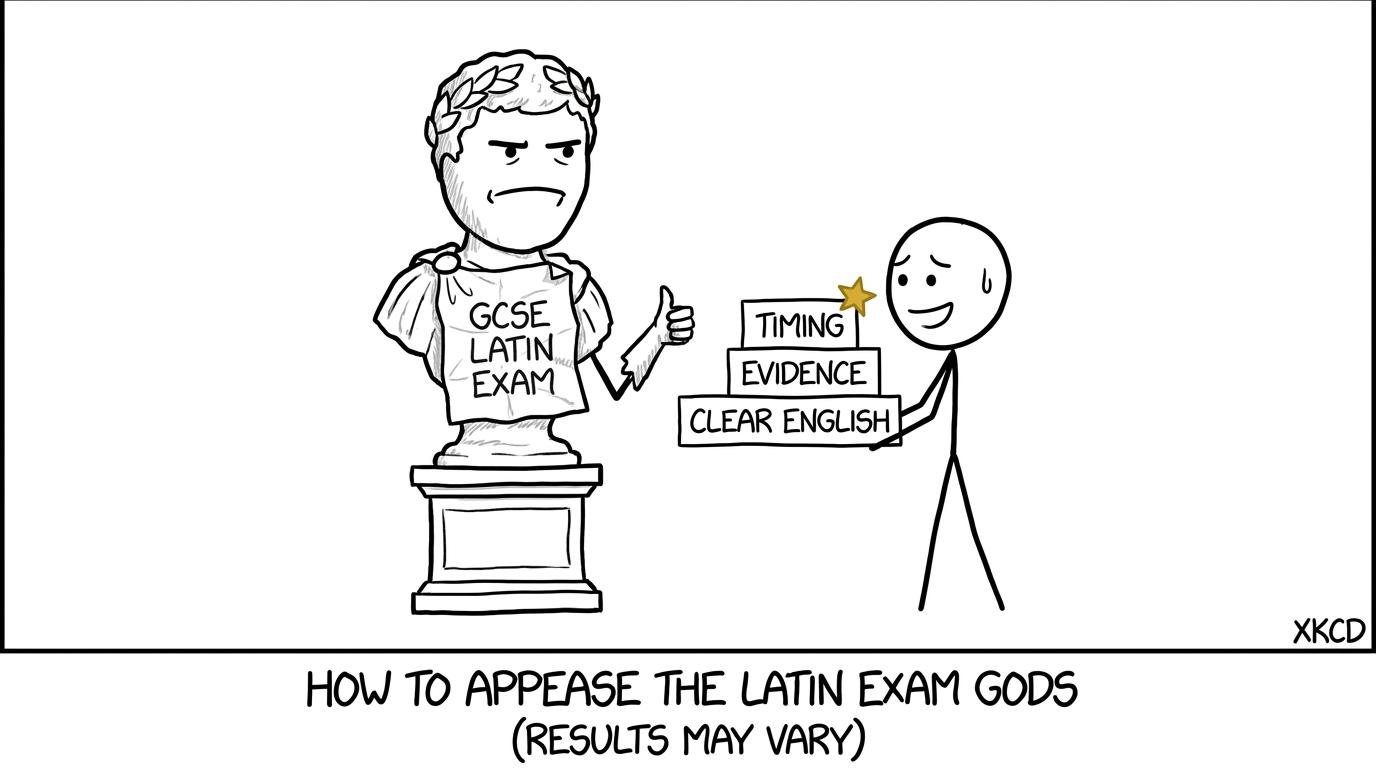 A Roman statue reluctantly approving a student's exam-technique toolkit
Turn the target into repeatable actions
A grade 777 becomes less mysterious when it is translated into behaviours: vocabulary recalled without prompts, sentences parsed before translation, evidence attached to literary claims and mistakes revisited until they disappear.
Begin with one diagnostic paper or timed section this week. Mark it carefully, identify the three largest sources of lost marks and build your next seven days around them. Check that all Latin materials match your current OCR or Eduqas specification and examination year.
For the maths side of your revision, make MathsGenie your free home base. Use revision lessons and practice questions to repair individual skills, mini tests to check recall, then past papers, predicted papers, mark schemes and video solutions to build exam performance. Different subjects reward different knowledge, but progress often follows the same quiet loop: attempt, notice, correct and return.











