How to Get Grade 6 GCSE English Language
How to get grade 6 GCSE English Language: improve reading, controlled writing, timing and feedback habits with a focused revision routine.
You can understand an English extract, write a reasonable story and still find your marks stuck below the grade you want. That is frustrating because the problem rarely feels as visible as a wrong answer in maths.
The practical answer to how to get grade 6 GCSE English Language is to make your performance more consistent: answer the precise question, analyse the writer's choices, support interpretations with evidence, organise writing deliberately and protect technical accuracy. Then practise those skills under timed conditions and use mark schemes or teacher feedback to repair specific weaknesses.
A Grade 6 does not require every paragraph to sound extraordinary. It requires enough clear, developed work across both reading and writing. Think less about producing a masterpiece and more about building a reliable system.
Your Grade 6 checklist
Use this checklist to identify what should change in your revision:
- Confirm your exam board and exact specification.
- Learn what each question assesses rather than memorising one paragraph formula.
- Practise reading and writing, because both contribute substantially to the qualification.
- Replace vague comments with precise analysis of words, structure and effects.
- Plan extended writing briefly before beginning.
- Reserve time to check spelling, punctuation and sentence control.
- Complete short timed tasks regularly, then build towards full papers.
- Mark every attempt and record one or two changes for next time.
- Reattempt weak question types instead of endlessly starting new papers.
This is similar to effective maths revision. The productive cycle is attempt, mark, diagnose, repair and retest. Maths students can explore that process in MathsGenie's guide to using GCSE past papers properly.
Understand what a Grade 6 actually demands
GCSE English Language is untiered. Unlike GCSE maths, there is no foundation or higher paper, so every student taking the same specification sits the same assessments.
AQA, Pearson Edexcel, OCR and Eduqas arrange their papers differently. Their timings, question sequences and writing tasks are not interchangeable. However, they use the nationally defined assessment objectives covering:
- identifying and interpreting information;
- analysing language and structure;
- comparing ideas and perspectives;
- evaluating texts;
- communicating effectively for purpose and audience;
- vocabulary, sentence structure, spelling and punctuation.
Across GCSE English Language specifications, reading contributes 50%50\%50% of the qualification and writing contributes 50%50\%50%. AO5, covering communication and organisation, contributes 30%30\%30%, while AO6, covering vocabulary, sentence structures, spelling and punctuation, contributes 20%20\%20%.
That creates an important revision lesson. Writing is not an optional strength to develop after reading has been mastered. It represents half of the written qualification, and technical accuracy alone represents one fifth of it.
The Spoken Language endorsement is reported separately and does not contribute to the final grades 999 to 111.
Grade boundaries are set after the papers have been marked and can change each year to reflect differences in paper difficulty. Do not build your plan around one historic mark target. Use previous boundaries for context, not prediction. MathsGenie's GCSE English Language grade boundaries history explains why the threshold moves.
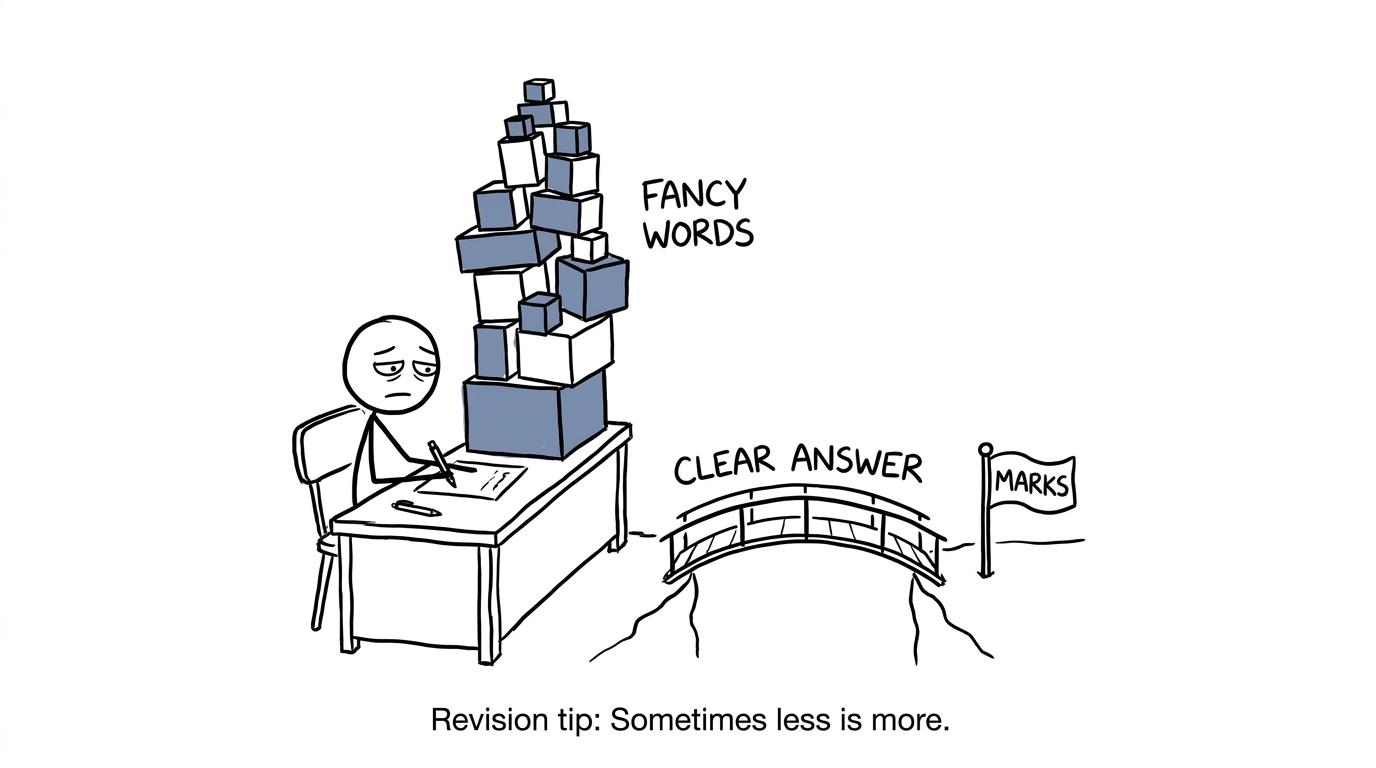 A clear answer reaches the marks while a tower of fancy words wobbles
Turn each question into a specific skill
One reason English revision becomes vague is that students write “practise Paper 1” on a timetable. That task is too large to reveal what needs improving.
Break the paper into measurable skills instead:
| Broad problem | Precise revision target |
|---|---|
| Reading answers lack depth | Explain how a selected detail supports one interpretation |
| Analysis becomes feature spotting | Connect a deliberate choice to meaning and reader response |
| Comparison feels repetitive | Compare both the viewpoints and how they are conveyed |
| Evaluation is uncertain | Make a clear judgement and test it against evidence |
| Creative writing loses direction | Plan an opening, development, shift and ending |
| Transactional writing sounds generic | Match form, tone and register to audience and purpose |
| Accuracy falls under pressure | Proofread sentence boundaries, punctuation and common spellings |
This approach will feel familiar if you revise maths by topic rather than rereading an entire textbook. The MathsGenie method for finding weak GCSE topics can be adapted to English: use a timed task, identify lost marks, name the underlying skill and retest it later.
Build stronger reading responses
A Grade 6 reading response usually needs to move beyond identification. Naming a metaphor, short sentence or adjective is only the beginning. The examiner is interested in what the choice suggests, how it shapes meaning and why it is effective in that part of the text.
Read the question before collecting evidence
Underline the focus and command word. A question asking about language is not the same as one asking you to evaluate a statement or compare perspectives. If you answer a nearby question rather than the actual one, polished writing will not recover all the available marks.
Before drafting, decide:
- which assessment objective is being tested;
- which lines or source sections you must use;
- whether you need language, structure, comparison or evaluation;
- how much the question is worth on your specification.
Choose evidence for usefulness, not length
A short quotation often gives you more control. Choose evidence containing a word, image or structural decision that you can genuinely explore. Avoid copying several lines and then making one general observation.
Your explanation should develop a chain of reasoning: the writer makes a particular choice; that choice creates or reinforces meaning; the meaning affects the reader's understanding of the character, situation or viewpoint.
Alternative interpretations can add depth, but only when they are plausible and rooted in the text. Two unsupported guesses are weaker than one carefully developed idea.
Compare throughout
For comparison questions, do not write everything about one text and then everything about the other unless your exam board's guidance strongly supports that structure. Keep the relationship visible. Compare attitudes, methods and effects, using connective language that expresses similarity, difference or qualification.
Make writing controlled before making it ambitious
Students sometimes chase sophisticated vocabulary because it looks like the clearest route upwards. Yet an unusual word used inaccurately can weaken meaning. Controlled writing is usually more valuable: clear paragraphs, purposeful details, varied but secure sentences and a tone suited to the task.
Plan for shape
Spend a short, controlled period deciding where the writing is going. For imaginative writing, plan a manageable sequence rather than an overcrowded plot. For transactional or viewpoint writing, establish your central position, audience, form and progression of ideas.
A useful plan records:
- the intended effect or argument;
- the order of paragraphs;
- one structural shift;
- the final impression you want to leave.
Planning reduces the risk of a strong opening followed by an unfinished or repetitive response.
Practise accuracy separately
Do not wait for full essays to improve punctuation. Take one paragraph and check sentence boundaries, verb agreement, apostrophes and commonly misspelt words. Then rewrite it accurately.
Vary sentence length because it serves meaning, not because a checklist demands it. The same applies to punctuation. A semicolon used correctly may help; five ambitious punctuation marks used randomly will not.
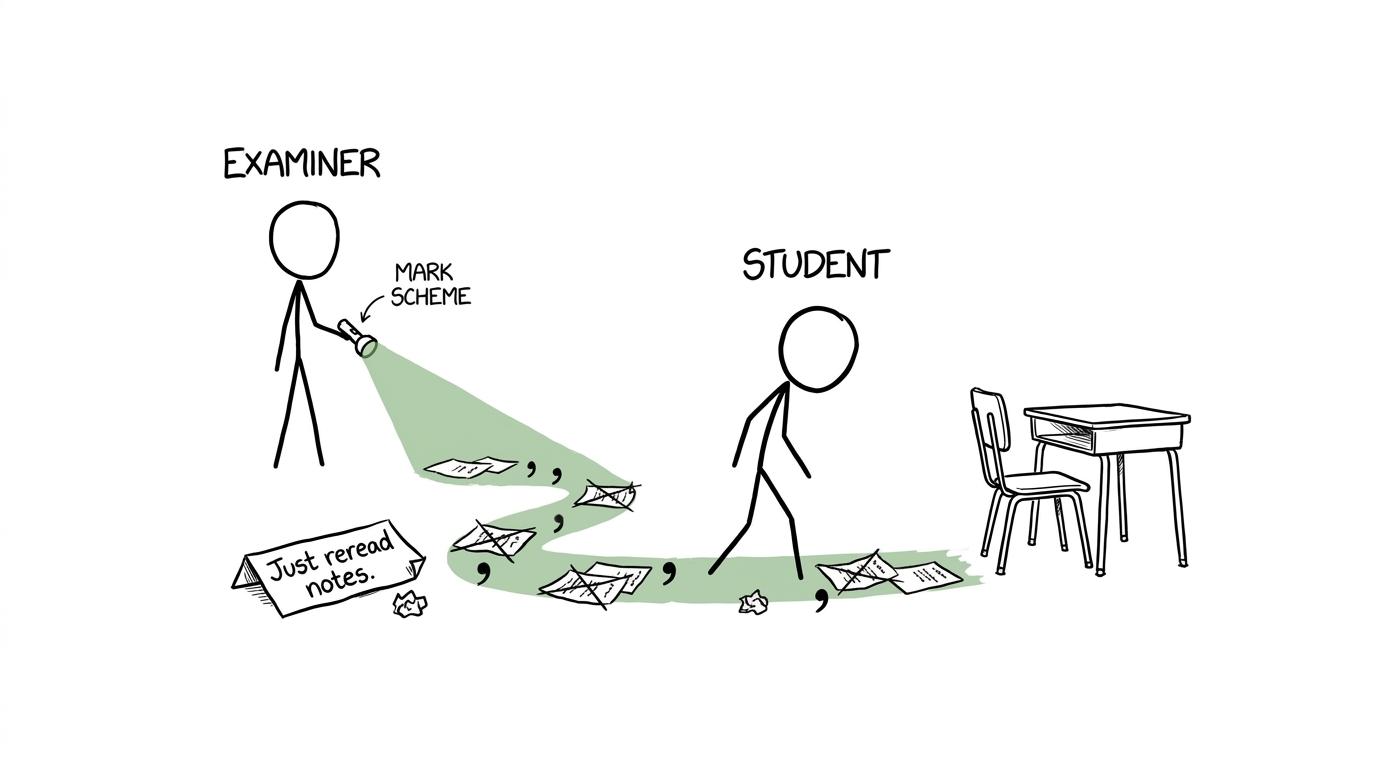 An examiner's mark scheme lights a trail of corrections while rereading notes is left behind
Use feedback like evidence
Completing work creates evidence. Improvement happens when you act on it.
After a teacher-marked response or practice paper, avoid copying the total mark and moving on. Create a compact error log with four headings:
- question or task;
- reason marks were limited;
- specific repair action;
- date to retest.
A comment such as “develop analysis” is not yet an action. Turn it into something observable: select a shorter quotation, explore one word in detail and connect the effect to the question's focus.
Study the level descriptors and mark scheme, but do not use them as a phrase bank. Their purpose is to show the qualities being rewarded. Annotated exemplars supplied by your exam board or school can help you see how those qualities appear in a complete response.
The discipline is identical to marking maths. MathsGenie's guide to redoing GCSE past papers explains why correction and delayed reattempts matter more than immediately repeating remembered answers.
Create a revision routine you can sustain
A productive English session does not need to consume an evening. A repeatable routine could include:
- brief retrieval of the question requirements;
- one timed reading paragraph or writing section;
- checking against the mark scheme or teacher guidance;
- rewriting the weakest part;
- scheduling a later reattempt.
Start with individual questions. Add longer sections when your method becomes dependable, then complete whole papers under the timing specified by your exam board. AQA papers, for example, are structured differently from OCR and Eduqas papers, so always use materials matching your qualification.
The MathsGenie revision planner can help protect time for maths alongside English. You can also adapt the rhythm in the GCSE twenty-minute revision routine: recall, attempt, mark and record the next action.
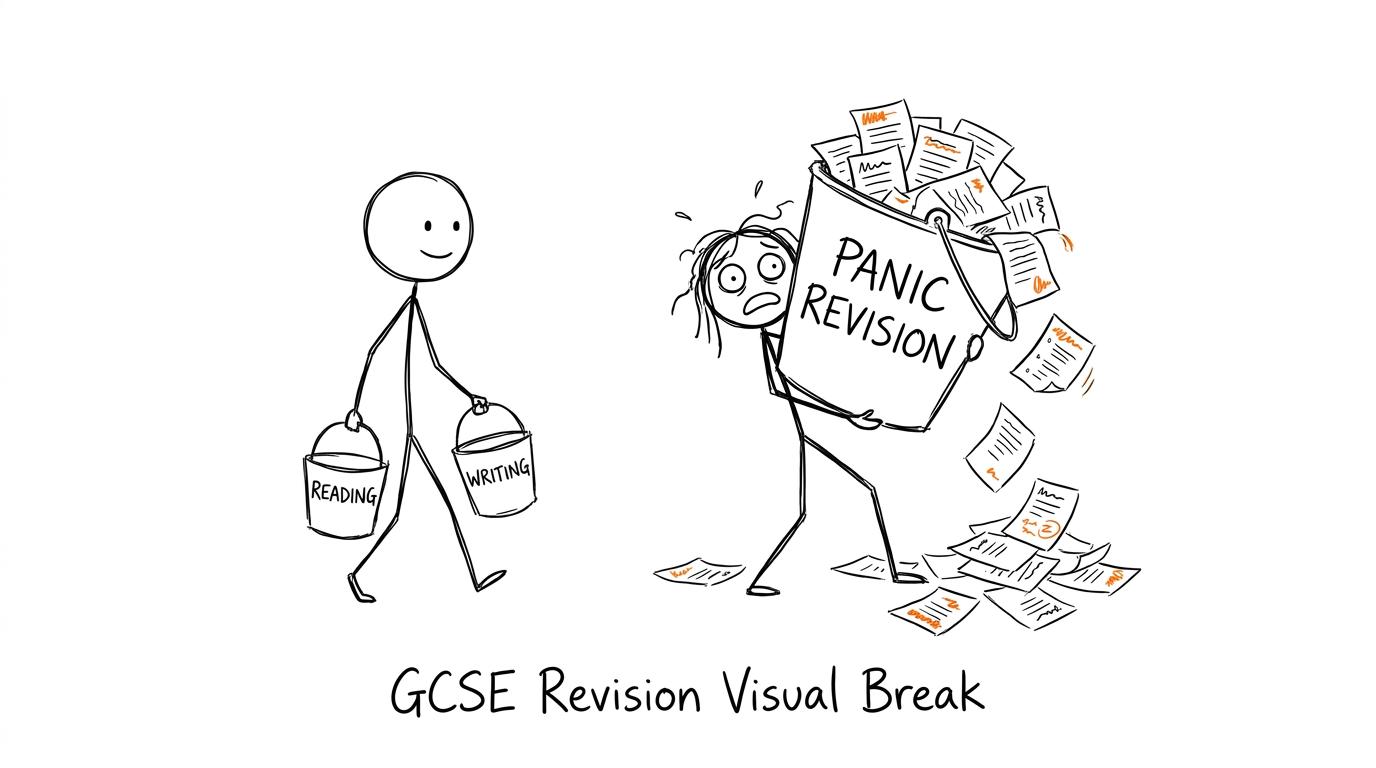 One student balances reading and writing while another spills a bucket of panic revision
Common mistakes that keep students below Grade 6
Memorising one answer structure for every question
Paragraph frames can provide early support, but rigidly forcing every response into the same shape can obscure the question. Learn what each assessment objective requires and adapt your structure accordingly.
Listing techniques without analysing them
Feature spotting does not explain meaning. Select fewer details and develop their significance more carefully.
Writing about the reader in vague terms
Claims that a technique “makes the reader want to read on” rarely say enough. Explain what the reader understands, suspects, questions or feels, and connect that response to precise evidence.
Ignoring technical accuracy
Spelling, punctuation and sentence control are directly assessed in writing. Leave time to proofread, beginning with sentence boundaries and the mistakes you make most often.
Practising only favourite tasks
A student who enjoys creative writing may avoid comparison; another may complete reading questions while neglecting extended writing. Your revision should follow lost marks, not preference.
Treating a completed paper as finished revision
An unmarked paper is evidence you have not used. Mark it, diagnose the weakness, repair it and reattempt the relevant skill.
Make Grade 6 the result of a system
A Grade 6 is rarely unlocked by one brilliant phrase. It is more often the result of dozens of small improvements: reading the question accurately, selecting better evidence, developing one interpretation, planning before writing and checking the punctuation you commonly miss.
Keep your English practice aligned with your own exam board, and use teacher feedback, official papers and mark schemes to judge progress. Then protect your maths preparation with the same evidence-led habits.
Start from the MathsGenie GCSE maths revision hub, organise your week with the revision planner and use free revision lessons, practice questions, mini tests, past papers, mark schemes and video solutions to fix your mathematical gaps. Nearer the exams, add GCSE predicted papers as a final rehearsal rather than a replacement for official papers.
Clear practice creates clear feedback. Clear feedback creates the next useful action. That is how a target grade gradually becomes a repeatable standard.