GCSE English Language Grade Boundaries History
GCSE English Language grade boundaries history explained with AQA data from 2017 to 2025, pandemic context and practical advice for using past papers.
A mark that earns a grade 777 one summer may earn a different grade the next. That can feel arbitrary, especially when you are using old papers to judge your progress. Yet the GCSE English Language grade boundaries history tells a more reassuring story: boundaries move so that changes in paper difficulty do not unfairly change the standard required for a grade.
The table below tracks AQA GCSE English Language from 2017 to 2025. It shows genuine movement, a clear pandemic-era interruption and an important lesson: past boundaries are useful reference points, but they cannot predict your next result.
What the figures cover
Before reading the trend, keep this checklist in mind:
- The data covers AQA English Language specification 870087008700 in the June series.
- The qualification has a maximum of 160160160 marks across two papers.
- The figures are the minimum raw marks required for grades 999, 777, 555 and 444.
- There were no normal summer examinations or summer grade boundaries in 2020 and 2021.
- English Language is not divided into foundation and higher tier.
- Boundaries from Edexcel, OCR, Eduqas and WJEC are not directly comparable because their assessments differ.
Students can check their specification through the GCSE English Language revision hub or go directly to AQA GCSE English Language revision.
Past GCSE English Language grade boundaries by year
| June series | Maximum mark | Grade 999 | Grade 777 | Grade 555 | Grade 444 | Context |
|---|---|---|---|---|---|---|
| 2017 | 160160160 | 123123123 | 104104104 | 828282 | 727272 | First award of the reformed qualification |
| 2018 | 160160160 | 128128128 | 108108108 | 868686 | 767676 | Boundaries rose across the selected grades |
| 2019 | 160160160 | 127127127 | 108108108 | 868686 | 767676 | Broadly stable compared with 2018 |
| 2020 | N/A | N/A | N/A | N/A | N/A | Summer examinations cancelled |
| 2021 | N/A | N/A | N/A | N/A | N/A | Summer examinations cancelled |
| 2022 | 160160160 | 119119119 | 100100100 | 808080 | 707070 | Transitional pandemic-recovery grading |
| 2023 | 160160160 | 121121121 | 102102102 | 818181 | 717171 | Return towards pre-pandemic grading standards |
| 2024 | 160160160 | 121121121 | 102102102 | 828282 | 737373 | Normal grading arrangements continued |
| 2025 | 160160160 | 119119119 | 100100100 | 828282 | 737373 | Latest completed summer series available |
These are subject-level boundaries, not notional boundaries for an individual paper. AQA determines the final grade from the combined total across both papers.
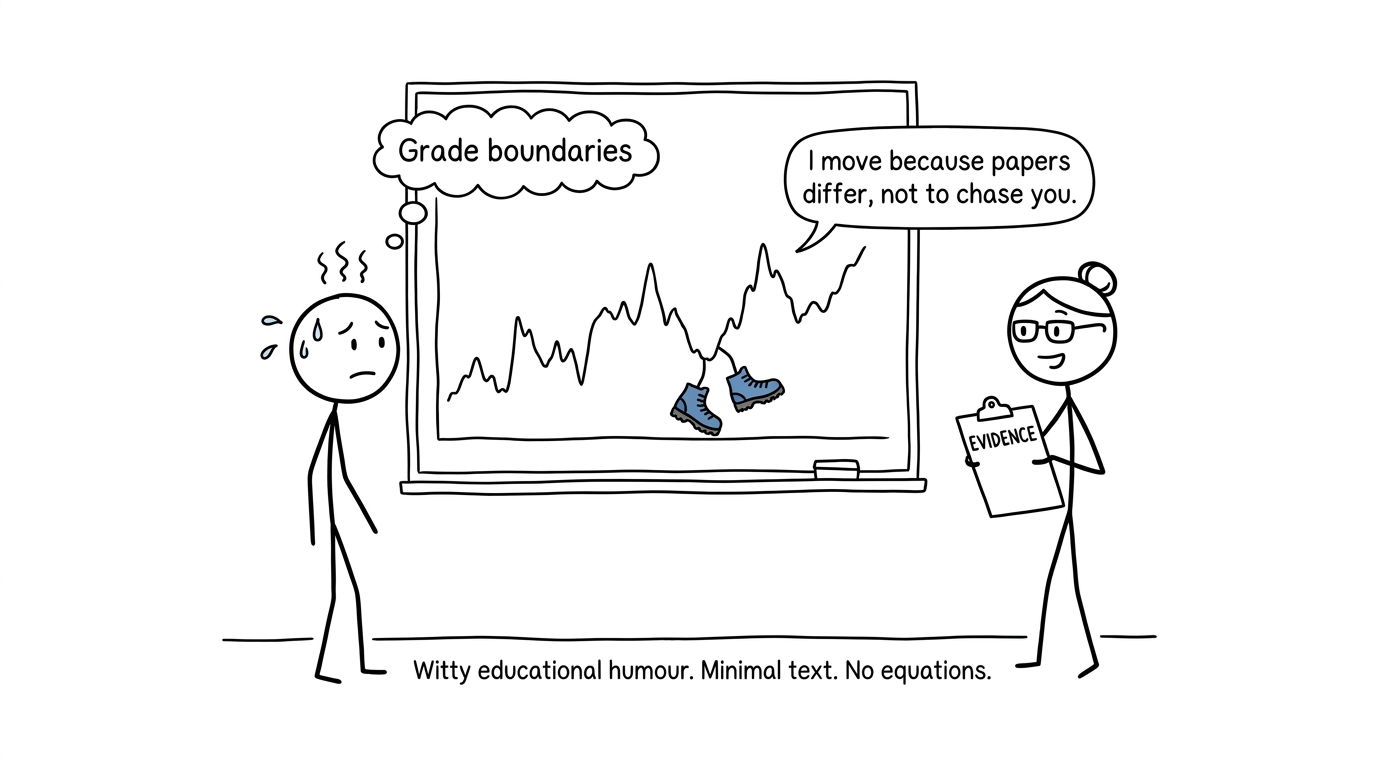 A moving grade-boundary line explains that papers differ
What the year-by-year trend actually shows
The early years established the new standard
The reformed grades 999 to 111 were first awarded for English Language in 2017. A grade 444 required 727272 marks, while a grade 999 required 123123123.
In 2018, those thresholds rose to 767676 and 128128128. That does not prove the subject became harder or that examiners suddenly demanded more. A higher raw boundary often indicates that students found the paper more accessible. The boundary compensates for that accessibility.
The 2019 figures were almost identical to 2018: grade 999 fell by one mark, while grades 777, 555 and 444 remained unchanged. Of all the years in the table, 2018 and 2019 provide the clearest picture of pre-pandemic stability.
The pandemic created a break in the sequence
There were no normal summer GCSE examinations in 2020 or 2021, so no equivalent summer raw-mark boundaries exist. Grades were awarded through exceptional assessment arrangements instead.
Examinations returned in 2022, but grading was deliberately transitional. Ofqual described the approach as a midpoint between the standards represented by 2019 results and the more generous outcomes of 2021. This helps explain why the 2022 boundaries should not be treated as an ordinary benchmark for current mock grades.
Normal grading returned from 2023
In 2023, grading returned towards the pre-pandemic standard, with protection for students during the transition. Normal arrangements continued in 2024.
Interestingly, the boundaries did not simply climb back to their 2019 values. The grade 777 boundary was 102102102 in both 2023 and 2024, compared with 108108108 in 2019. This is the central lesson of GCSE English Language grade boundary trends: maintaining a comparable grading standard does not require identical raw boundaries. Each paper has its own level of demand.
In 2025, the grade 999 and grade 777 thresholds each fell by two marks, while grades 555 and 444 stayed unchanged. That is movement, but not evidence of a permanently easier or harder qualification.
Why boundaries change
Grade boundaries are set after students have taken the examinations and the work has been marked. Senior examiners consider statistical evidence, the demand of the papers and the quality of students' responses around key thresholds.
The principle is simple. If one paper is more demanding, a lower raw mark may represent the same quality of performance. If another is more accessible, the equivalent boundary may be higher.
This is familiar to maths students: two papers can share a specification without producing the same distribution of marks. Boundaries are the adjustment mechanism, not a target announced in advance.
You can see the complete AQA figures on MathsGenie's AQA English Language grade boundaries page.
How to use historical boundaries sensibly
Use a boundary to interpret an old paper only after completing that exact paper under timed conditions. Then apply the boundary from its own examination series.
A stronger revision routine is:
- Complete one of the AQA GCSE English Language past papers without checking the mark scheme.
- Mark it carefully and record where marks were lost.
- Compare your total with that paper's published boundary.
- Identify whether the problem was timing, evidence selection, analysis or writing control.
- Rewrite one weaker response and repeat the skill on another paper.
MathsGenie's guide to using AQA English Language past papers properly explains how to turn each attempt into specific improvements.
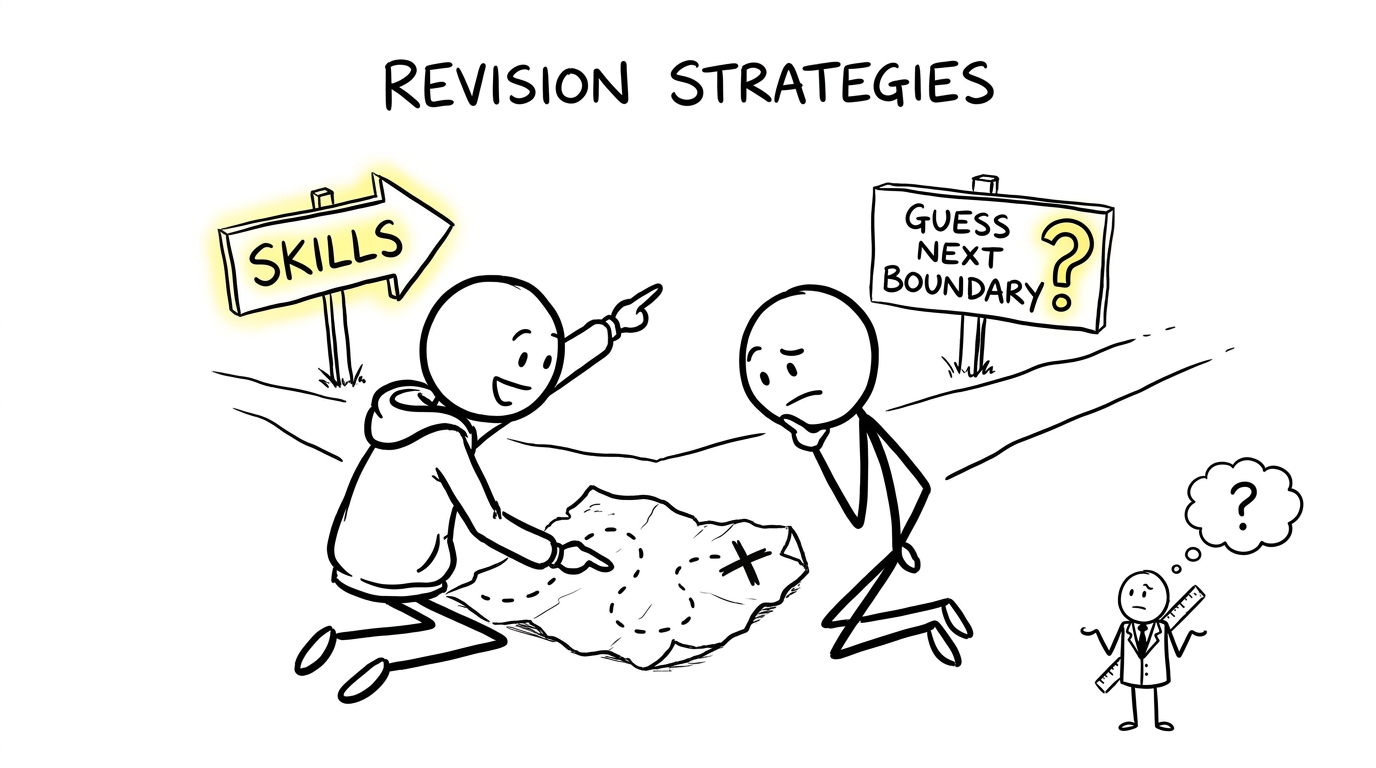 Students follow a skills map instead of guessing the next boundary
Comparing different exam boards
Do not compare AQA raw marks directly with another board. Start from the correct course page, such as Edexcel GCSE English Language revision, OCR GCSE English Language revision or WJEC GCSE English Language revision.
The same warning applies when choosing papers. Use Edexcel English Language past papers only if they match your specification. Similar grade labels do not make the papers interchangeable.
Common mistakes when analysing grade boundaries
Predicting the next boundary from a trend. Boundaries cannot be confirmed until the paper has been sat and reviewed.
Treating 2022 as an ordinary year. Its grading arrangements were transitional, so it is less suitable for predicting a current mock grade.
Adding notional paper boundaries. Component boundaries are illustrative. Your qualification grade comes from the overall subject total.
Comparing boards by raw mark. Different specifications, paper structures and maximum marks make this unreliable.
Revising only to scrape a boundary. A few marks of variation can change the outcome. Build a safety margin by improving repeatable reading and writing skills.
Turn the history into better revision
Past GCSE English Language grade boundaries explain what happened; they do not decide what will happen next. Their best use is to add context to a completed paper, not to create a supposedly safe target before the examination.
Start with MathsGenie's free English Language revision lessons, then practise with the correct board's past papers, mark schemes, practice questions and mini tests. Keep your wider exam preparation moving through the GCSE Maths revision hub, where past papers, predicted papers and focused revision resources can turn the same calm process into more marks.