

How Stressful Is GCSE Astronomy? An Honest Guide
How stressful is GCSE Astronomy? Compare its workload, maths and exams with other GCSEs, then build a calmer, practical revision plan for success.
A subject can sound fascinating in September and feel enormous by spring. GCSE Astronomy often creates that contrast: the ideas are exciting, but the vocabulary, calculations and observational skills can accumulate quietly.
So, how stressful is GCSE Astronomy compared with other GCSEs? The honest answer is that it tends to feel more stressful than an average option subject, particularly when it is taught after school or with limited lesson time. Students commonly describe it as interesting but content-heavy. It is not automatically harder than GCSE Physics, Chemistry, History, Computer Science or a modern foreign language, but it can sit in a similar upper band of perceived difficulty.
The important word is perceived. Stress depends on your teaching time, confidence with maths, access to resources and interest in the subject. GCSE Astronomy is demanding, but its demands are identifiable, and therefore manageable.
GCSE Astronomy stress: the short answer
Here is the practical verdict:
- Expect a substantial amount of scientific vocabulary and detailed content.
- Be ready to connect ideas rather than memorise isolated facts.
- Mathematical skills account for at least 20%20\%20% of the written assessment.
- Observational skills account for at least 15%15\%15% of the written papers.
- You must complete at least one unaided and one aided observation.
- Both examinations last 111 hour 454545 minutes and are worth 100100100 marks.
- Every candidate sits the same untiered papers.
For a student who enjoys space, handles calculations confidently and receives regular teaching, the course may feel moderately stressful. For someone learning it through a lunchtime club, independent revision or compressed lessons, it can feel considerably harder.
Where does GCSE Astronomy rank against other GCSEs?
There is no reliable, current league table that can tell every student which GCSE is most stressful. Stress is not an assessment objective, and exam results alone cannot measure it. Entry groups also differ: students choosing Astronomy may be particularly interested in science, may take it as an additional GCSE, or may learn it outside the normal timetable.
Historical analysis has sometimes placed Astronomy among more severely graded GCSE subjects, but older findings relate to previous specifications and grading systems. They should not be treated as a current ranking for the grades 999 to 111 qualification.
Informal student reports offer a more useful, though still imperfect, picture. Recurring comments describe GCSE Astronomy as:
- enjoyable but unexpectedly content-heavy;
- difficult when taught for only one lesson or club session each week;
- challenging because familiar science is mixed with unfamiliar terminology;
- dependent on accurate diagrams, calculations and written explanations;
- harder to revise when resources and teacher support are limited.
Taken together, those reports place Astronomy roughly in the upper-middle to high-stress group of GCSE options. It often feels more demanding than students expect from a niche optional subject. However, claims that it is definitively the hardest GCSE are not supported by robust current evidence.
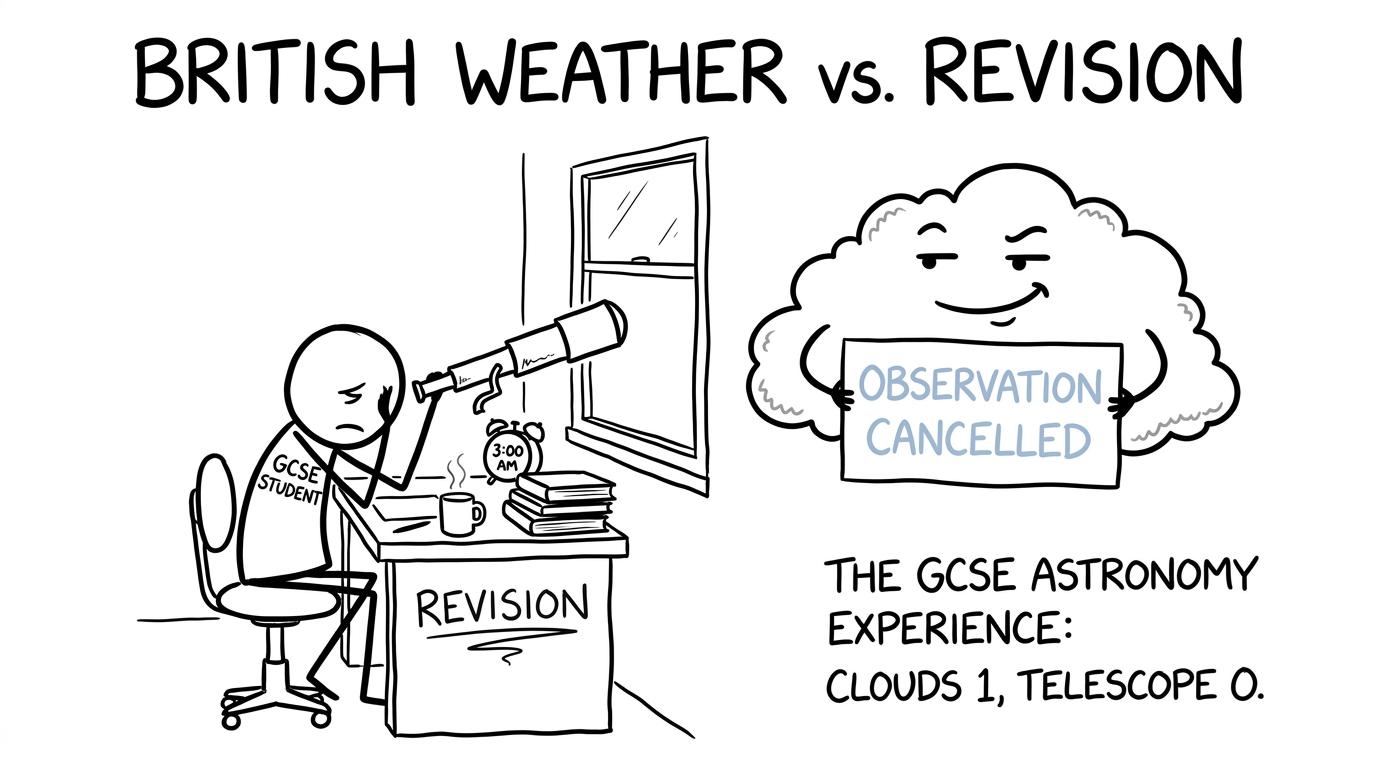 A student discovers that British weather has joined the astronomy course
Why GCSE Astronomy can feel stressful
The course is broad
The current Pearson Edexcel GCSE Astronomy specification contains 161616 topics. Paper 1 covers naked-eye astronomy, including the Earth, Moon, time, celestial observation, early models and planetary motion. Paper 2 moves into telescopic astronomy, including the Sun, planetary systems, starlight, stellar evolution, galaxies and cosmology.
That breadth creates a particular kind of pressure. You are not merely learning names of planets. You must move between physical models, observational methods, data, diagrams and explanations of events occurring across very different scales.
A sensible response is to organise the content into small topic clusters. The same principle works in maths: the GCSE maths topics checklist by exam board and tier is useful because it turns a large specification into visible, manageable sections.
The maths is applied rather than decorative
At least 20%20\%20% of GCSE Astronomy marks assess mathematical skills. These may involve standard form, ratios, unit conversions, significant figures, graphs, logarithms, rearranging formulae and interpreting large or small quantities.
The astronomical equations and key data are provided in the examination, so the main challenge is not recalling every formula. It is recognising which relationship applies, substituting correctly and managing units without losing the physical meaning.
For example, astronomical quantities are commonly written in the form
a×10n, a \times 10^n, a×10n,where
1≤a<10. 1 \leq a < 10. 1≤a<10.That is why strengthening standard form skills can reduce stress in both Astronomy and GCSE Maths. A calculation becomes less intimidating when the number format already feels familiar.
Observation is a real part of the course
Candidates must undertake at least one unaided and one aided astronomical observation. The final GCSE grade comes from written examinations rather than a separate coursework mark, but knowledge of observational design, analysis and evaluation is examined.
This can feel unusual. You may need to consider accuracy, reliability, light pollution, weather conditions and ways to improve an observation. The night sky also refuses to follow a school timetable. Clouds arrive. Equipment behaves badly. An object may not be visible when expected.
The answer is not to leave observations until the end. Record dates, conditions, equipment, decisions and limitations as you work. Treat the observation as a process you must understand, not simply an activity you must complete.
The qualification is untiered
Unlike GCSE Maths and the GCSE sciences, Astronomy has no foundation and higher tier. Every candidate takes the same papers. Pearson describes the papers as ramped, meaning questions generally become more demanding as each section develops, but advanced material cannot be avoided through tier entry.
That may raise anxiety, although it also simplifies preparation: there is only one specification and one standard of examination to understand.
How Astronomy compares with common GCSE subjects
Compared with GCSE Physics, Astronomy contains familiar themes such as forces, light and energy, but places them in less familiar contexts and adds specialised observational knowledge. Students strong in Physics may find the overlap helpful, yet Astronomy still requires separate revision.
Compared with GCSE Maths, there is less continuous mathematical content, but calculations are embedded inside scientific situations. The difficulty is often deciding what the question means before performing the calculation. Building broad GCSE skills through free MathsGenie revision can make that stage much calmer.
Compared with History or Biology, Astronomy can produce a similar feeling of content volume. The difference is that factual recall must often be combined with mathematical or graphical interpretation.
Compared with Computer Science, both subjects can feel stressful when classroom time is limited and questions demand precise language. In each case, knowing the idea informally is not always enough; you must express it in a form that earns marks.
Compared with art, drama or design subjects, Astronomy has less ongoing practical production, but greater pressure from two final written papers. Which structure feels better is personal. Some students prefer linear examinations; others find them more stressful than coursework spread across the year.
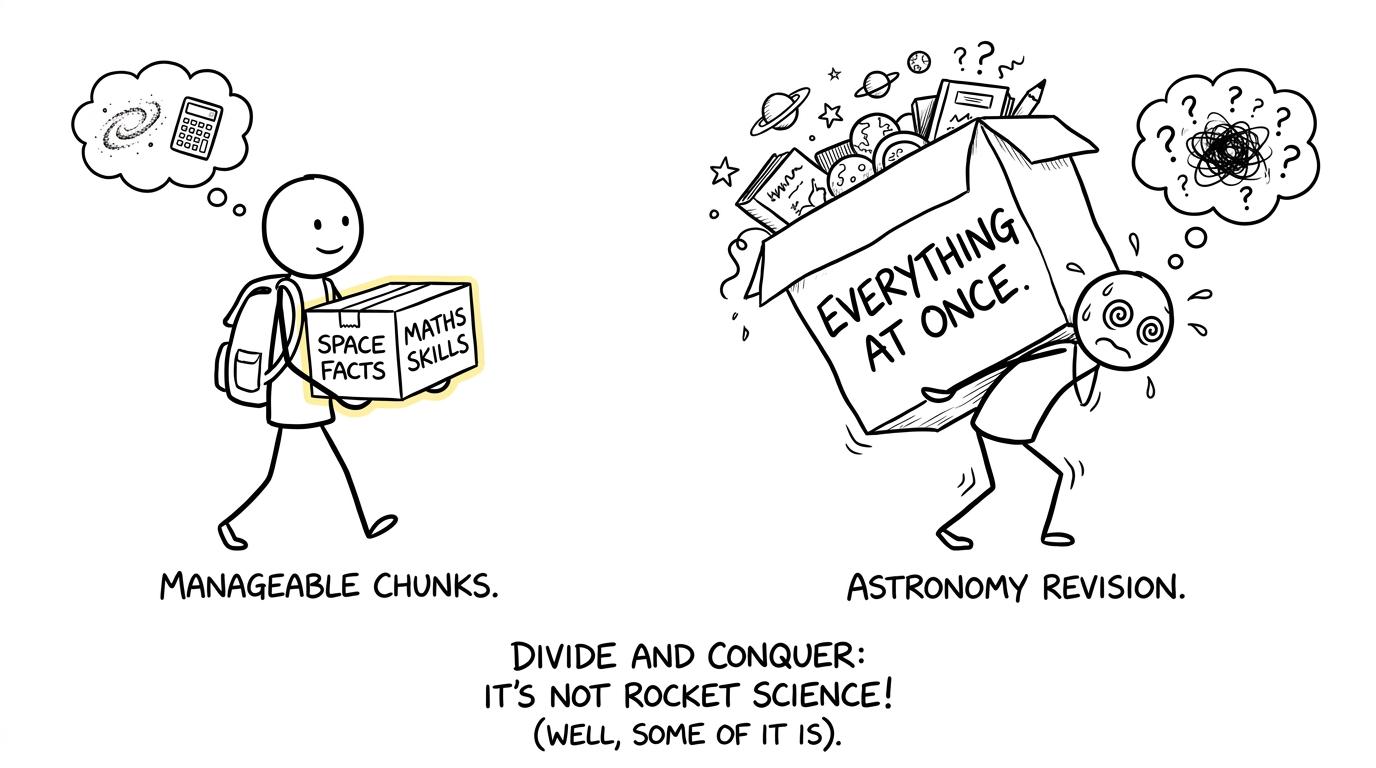 One student carries revision in small boxes while another chooses everything at once
How to make GCSE Astronomy less stressful
Separate knowledge from skills
Create two revision lists. One should contain astronomy knowledge, such as lunar features, stellar evolution and cosmological models. The other should contain transferable skills, such as graphs, units, standard form, formula rearrangement and evaluation.
This prevents the common feeling that every weakness belongs to one enormous subject. If the problem is algebra, fix the algebra. If it is terminology, use retrieval practice. Different problems need different tools.
Use short, repeatable sessions
A calm revision session might contain:
- 101010 minutes of factual retrieval;
- 202020 minutes on one specification section;
- 202020 minutes of questions;
- 101010 minutes marking and correcting errors.
The exact timings matter less than the cycle: retrieve, practise, mark and return. Maths students can adapt the structure in the GCSE one-month revision plan or use the shorter one-week revision plan when exams are close.
Practise under time before the real exams
Each Astronomy paper lasts 105105105 minutes for 100100100 marks. That does not mean every mark deserves exactly the same time, but it does show why pace matters. Extended responses, diagrams and unfamiliar data can absorb time quickly.
Start with individual questions, then timed sections, and finally complete papers. The guidance on when to start GCSE past papers explains why paper practice should begin while there is still time to repair the weaknesses it reveals.
 A friendly exam-paper alien explains that its questions are not entirely mysterious
Common GCSE Astronomy revision mistakes
Assuming enthusiasm will replace revision
Liking space is a powerful advantage, but fascination does not automatically produce precise exam answers. Learn the specification language and practise applying it.
Revising only facts
Written papers include calculations, graphs, observational evaluation and extended responses. Reading notes may improve recognition without improving performance. Questions and mark schemes reveal whether you can use what you know.
Ignoring the maths until late
Students sometimes treat calculations as a small corner of the qualification. At least 20%20\%20% of the assessment is mathematical, and quantitative skills may also support data interpretation elsewhere. Use revision lessons and practice questions to make standard form, graphs, ratios and formulae routine.
Treating the formula sheet as a solution sheet
Being given an equation does not tell you when to use it, how to rearrange it or which units are required. Practise using supplied information rather than merely reading it.
Doing full papers without correcting them
A paper is useful only when its mistakes change your next revision session. Mark it, classify each error and revisit the relevant skill. MathsGenie's GCSE predicted papers can provide fresh mathematical practice once topic gaps have been addressed, while the night-before GCSE maths plan offers a calmer alternative to last-minute cramming.
The final verdict
GCSE Astronomy is often more stressful than students initially expect. Its broad content, applied maths, observational requirements and untiered examinations place it towards the more demanding end of optional GCSEs in informal student reports. But that is not the same as saying it will be unbearable, or that it is harder for every student than Physics, History, Computer Science or a language.
Stress grows when work remains vague. It shrinks when the next task is clear.
Begin by separating astronomy knowledge from mathematical skills. Then use MathsGenie as your free maths revision base: rebuild methods through revision lessons, answer practice questions, check mark schemes and video solutions, and test your progress with mini tests, past papers and predicted papers. A large course becomes manageable in the same way the night sky becomes readable: one recognised pattern at a time.











