

Higher Tier GCSE Biology Sixth Form Requirements
Higher tier GCSE Biology sixth form rules vary. Learn when Higher is required, if Foundation grade 5 is enough, and how maths affects A Level entry.
The difficult part of choosing a GCSE tier is that the decision feels immediate, while its consequences seem far away. If you are searching for higher tier GCSE Biology sixth form requirements, the short answer is this: Higher tier is not a universal national requirement for entering sixth form, but it is often necessary if you want to study A Level Biology.
Individual schools and colleges set their own entry rules. Many ask for grade 666 or 777 in separate GCSE Biology, or comparable grades in Combined Science. Since Foundation tier is capped at grade 555, even an excellent Foundation result may fall below that course requirement. A few providers may accept grade 555, consider other evidence or offer a different science route, but you must check the current policy of your intended sixth form.
The quick decision checklist
Before agreeing to a tier or choosing sixth-form subjects, check:
- whether you study separate GCSE Biology or Combined Science;
- whether your school uses AQA, Edexcel, OCR or Eduqas;
- the highest grade available on your proposed tier;
- the Biology or Combined Science grade required by each sixth form;
- whether a specific GCSE Maths grade is also required;
- whether Higher tier is stated explicitly, rather than merely implied by the required grade;
- what alternative courses are available if your final result is below the threshold.
The important distinction is between eligibility and readiness. The published grade decides whether you can enrol. Your understanding of Biology, Chemistry and maths helps decide whether you will cope once the course begins.
Is Higher tier GCSE Biology actually required?
There is no single national admissions rule saying every A Level Biology student must have taken Higher tier GCSE Biology. Exam boards provide qualifications; sixth forms and colleges decide their own course-entry criteria.
That creates three common situations.
The sixth form explicitly requires Higher tier
Some providers state that applicants must have sat Higher tier science papers. In that case, a Foundation grade 555 does not meet the written condition, even though it is the strongest Foundation result.
This requirement may apply to separate Biology, Combined Science or both. Read the exact wording because a policy can distinguish between students taking three separate sciences and those taking the double-award Combined Science qualification.
The required grade makes Higher tier necessary
Many entry policies do not mention tier at all. Instead, they ask for grade 666 or 777 in Biology, or grades such as 666-666 or 777-777 in Combined Science.
Foundation Biology awards grades 111 to 555, while Higher targets grades 444 to 999, with a narrow allowed grade 333 below the grade 444 boundary. Therefore, a requirement of grade 666 automatically makes Higher tier necessary, even if the prospectus never uses the word “Higher”.
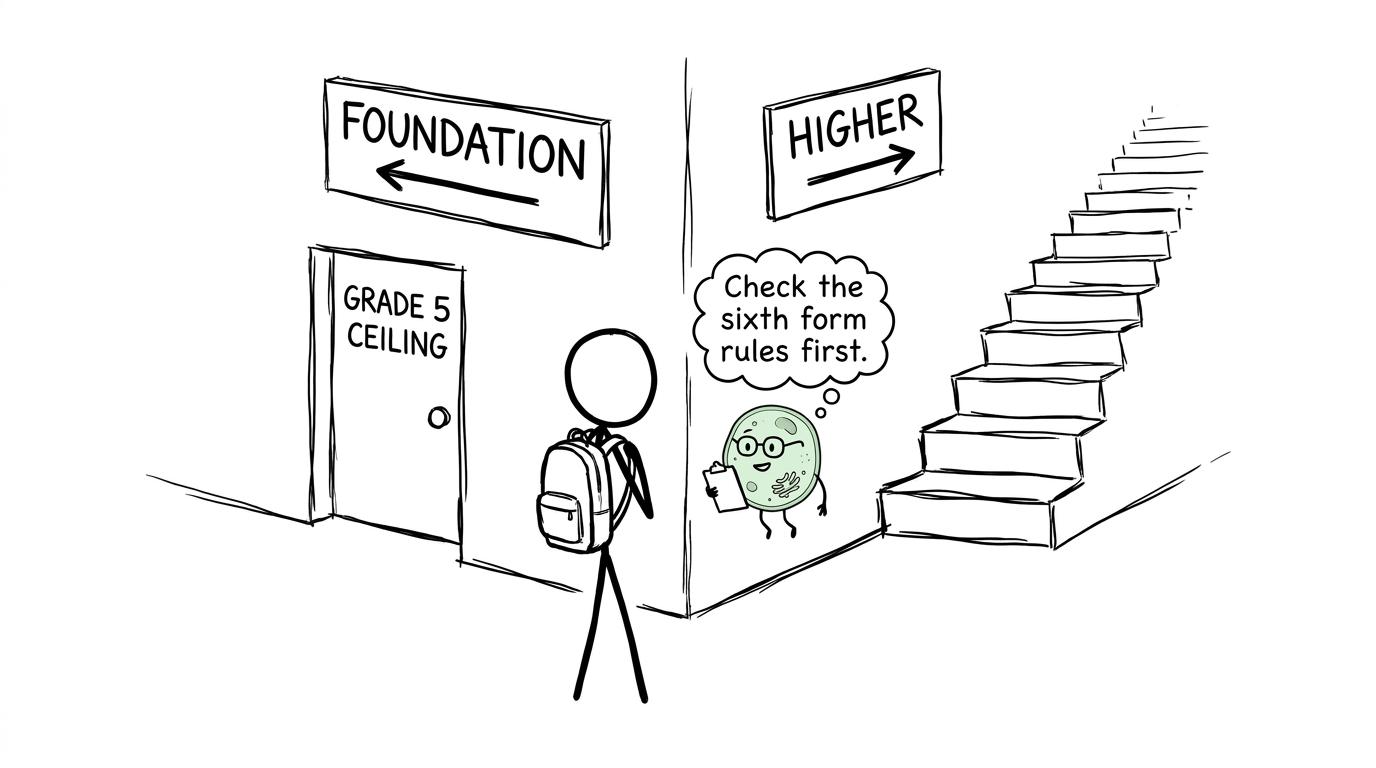 A student choosing between Foundation and Higher Biology routes
The provider accepts grade 555 or considers applicants individually
A strong Foundation grade can be enough where the published minimum is grade 555. It may also support entry to a general sixth-form programme, an applied science qualification or another Level 333 route.
Some admissions teams consider teacher recommendations, wider GCSE results, available places or exceptional circumstances. That is discretion, not a guarantee. Ask before applying and obtain the answer in writing where possible.
Is a strong Foundation grade enough for A Level Biology?
Sometimes, but not commonly where the stated Biology requirement is grade 666 or above.
A Foundation grade 555 is a valid grade 555. The certificate does not normally display the tier, and grades achieved across tiers are designed to represent comparable standards where the grade ranges overlap. The problem is not that a Foundation grade 555 is somehow “worth less”. The problem is the ceiling: it cannot become the grade 666 or 777 requested by many A Level Biology courses.
Current published entry policies vary considerably. In sampled policies for recent entry, some providers ask for grade 666 in separate Biology or 666-666 in Combined Science, while more selective courses ask for grade 777 or 777-777. Maths requirements commonly appear alongside the science requirement and can also vary.
That means you should never rely on a friend's offer from another school. Use the prospectus for your intended year of entry, then contact admissions if anything is unclear. MathsGenie's guide to choosing an A Level after GCSE Biology provides further context for comparing routes.
Separate Biology and Combined Science are not the same entry route
Students taking separate sciences receive individual GCSE grades for Biology, Chemistry and Physics. A sixth form can therefore ask directly for a particular Biology grade and may also require a result in another science.
Combined Science is worth two GCSEs and produces two equal or adjacent grades, such as 666-666 or 777-666. Marks across the science papers contribute to the overall qualification result. You do not ordinarily receive a standalone GCSE Biology grade from Combined Science.
An admissions policy might consequently say:
- grade 666 in separate GCSE Biology plus another science requirement; or
- grade 666-666 in Combined Science;
- alongside grade 555 or 666 in GCSE Maths.
Do not translate one condition into the other yourself. Ask the provider how its rule applies to your qualification and exam board.
Why GCSE Maths matters for sixth-form Biology
Biology can look like a subject built mainly from cells, ecosystems and genetics. Yet A Level assessment also expects quantitative thinking.
Across A Level Biology specifications, at least 10%10\%10% of assessment marks require mathematical skills at Level 222 or above. That standard is broadly associated with Higher tier GCSE Mathematics. Relevant skills include ratios, percentages, standard form, units, means, uncertainty, graphs, probability and rearranging equations.
This does not mean that A Level Maths is universally required for A Level Biology. It means that secure GCSE maths makes the scientific work more manageable. A student may understand an investigation perfectly but still lose marks through an incorrect scale, unit conversion or percentage calculation.
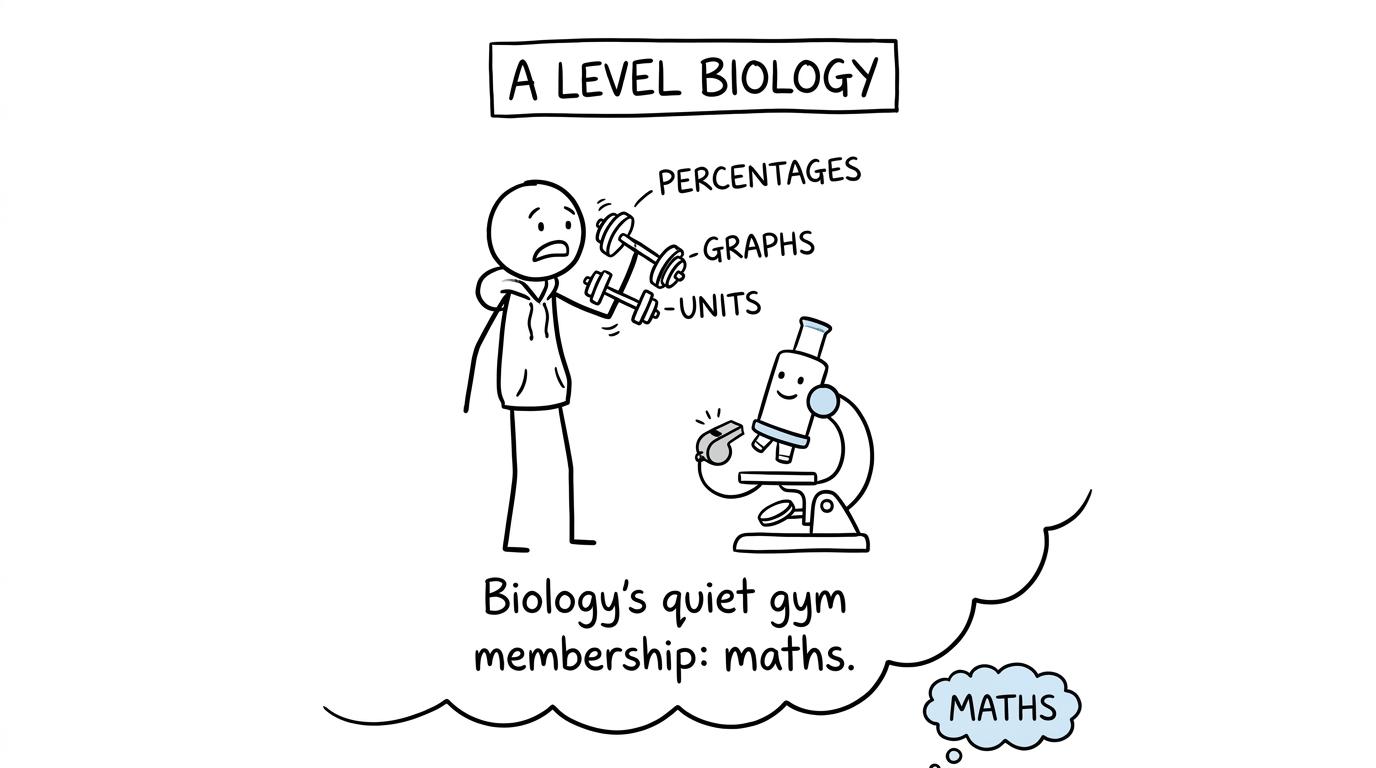 A student training their maths skills for A Level Biology
If Biology is part of your sixth-form plan, prioritise:
- fractions, ratios and percentages;
- standard form and significant figures;
- substituting into and rearranging formulae;
- interpreting tables and experimental graphs;
- gradients and rates of change;
- averages, range and probability;
- unit conversions and sensible estimation.
The GCSE Maths revision hub brings together lessons, worksheets, practice questions and papers for Edexcel, AQA, OCR and Eduqas. You can also compare GCSE Maths topics by exam board and tier to identify the skills available on your current route.
How to decide whether Higher tier is right for you
Higher tier can preserve access to grades above 555, but it should not be chosen solely because it sounds more ambitious. Higher papers contain more demanding content, and students who fall sufficiently below the grade 444 boundary risk an unclassified result.
The best tier is the one that gives you a realistic opportunity to demonstrate your knowledge while keeping your intended next step open. Discuss these questions with your science teacher:
- What do my recent assessments suggest?
- Am I secure on the content shared between tiers?
- Which Higher-only topics need attention?
- Does my preferred sixth form require a grade unavailable on Foundation?
- When will the school make its final tier-entry decision?
If you are currently around grade 444 or 555, one mock should not carry the whole decision. Look at performance across several assessments, the types of questions you answer successfully and your teacher's knowledge of your progress.
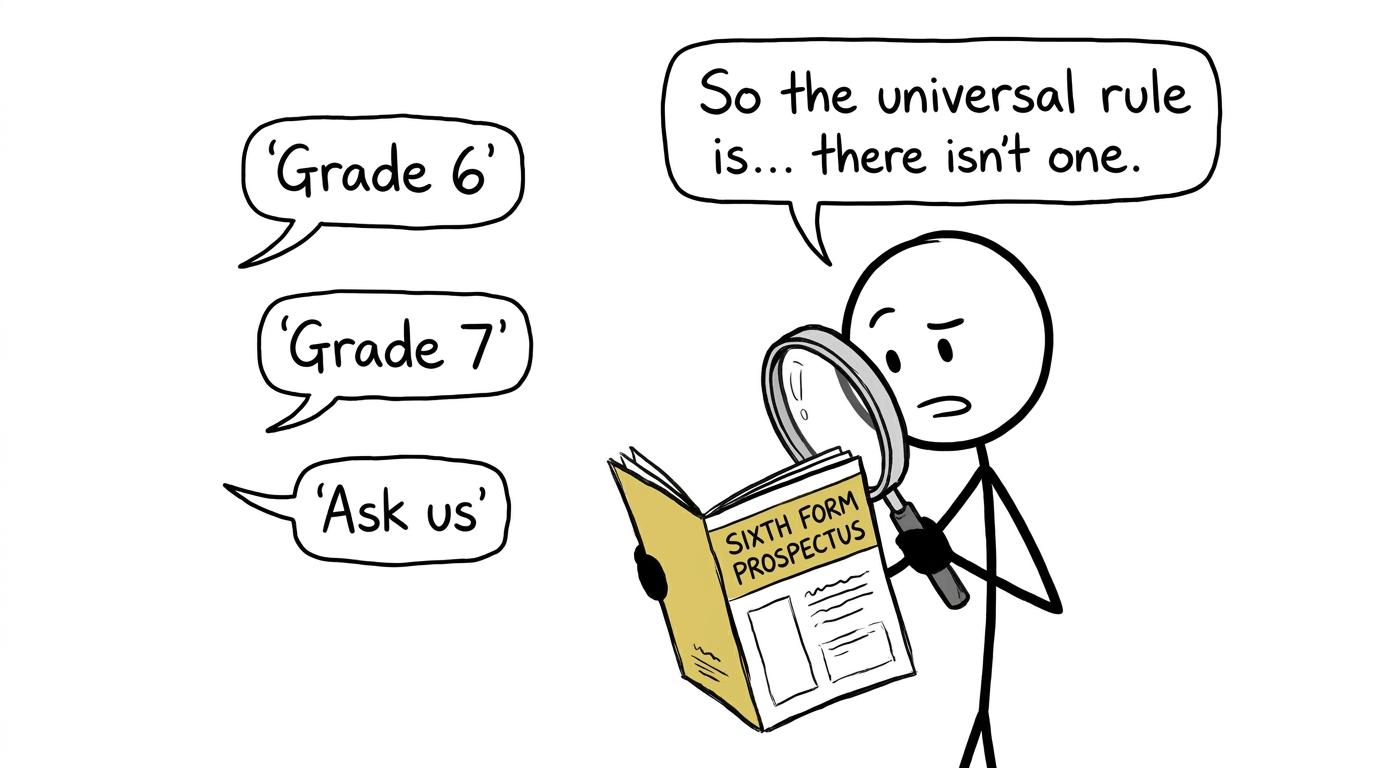 A student discovering that sixth forms have different entry rules
A practical plan before applications close
Create a short list containing your preferred provider and at least one realistic alternative. For each, record:
- the general sixth-form entry requirement;
- the separate requirement for A Level Biology;
- the rule for separate sciences and Combined Science;
- the required GCSE Maths grade;
- whether Higher tier is compulsory;
- whom to contact about borderline results.
Then compare those conditions with your latest grades. If maths is part of the gap, begin with one diagnostic paper rather than random revision. The guide to using GCSE past papers properly explains the useful cycle: complete, mark, diagnose, repair and retest.
Build weak skills through topic lessons and practice questions, then use GCSE predicted papers nearer the exams as additional rehearsal. Predicted papers are practice resources, not promises about the questions that will appear.
If several subjects need attention, a structured one-month GCSE maths revision plan can stop Biology ambitions being undermined by an avoidable Maths result. The MathsGenie revision planner can help you give each weak area a specific place in the week.
Common mistakes when planning for sixth form
Assuming every sixth form uses the same rule
A requirement published by one college tells you nothing certain about another. Check every provider separately and use information for your intended entry year.
Treating Foundation grade 555 as inferior
Grade 555 remains grade 555. The issue is whether the course asks for a higher grade or explicitly requires Higher tier.
Confusing separate Biology with Combined Science
A standalone Biology grade and a two-grade Combined Science award are different qualifications. Copy the exact wording from the admissions policy before deciding whether you meet it.
Checking Biology but forgetting Maths
A student can meet the science condition and still miss a separate Maths requirement. Review both, particularly because A Level Biology contains assessed mathematical skills.
Choosing Higher without considering the risk
Higher opens access to grades 666 to 999, but it is not automatically the safest tier. Use assessment evidence and teacher guidance rather than choosing from pride or anxiety.
Waiting until results day to ask questions
Contact admissions early if the policy is ambiguous. You will make calmer choices when you know the official position and have an alternative route prepared.
Keep the next door open
Higher tier GCSE Biology is often the practical route into A Level Biology because many sixth forms require a grade above the Foundation ceiling. But it is not a universal sixth-form rule, and a Foundation grade 555 may still be enough for providers or courses with a lower threshold.
Your next action is simple: check the exact Biology, Combined Science and Maths conditions for each sixth form, then use your current results to build a targeted revision plan.
MathsGenie can help with the quantitative side of that journey. Start with free revision lessons and practice questions, check progress through mini tests, and move into past papers, predicted papers, mark schemes and video solutions when your foundations are secure. If your plans later include Mathematics itself, preview the A Level Maths revision hub. The goal is not merely to choose a tier. It is to earn the grades that leave you with choices.










