A-Level After GCSE Biology: What Should You Choose?
A-level after GCSE Biology: compare entry grades, maths demands and subject combinations so you can choose your next course confidently on results day.
Results Day can turn a familiar subject into a difficult decision. You may enjoy biology, but should you continue it? And which other subjects belong beside it? If you are considering an A-level after GCSE Biology, the short answer is this: choose A Level Biology when you enjoy explaining biological processes, interpreting evidence and applying ideas to unfamiliar situations. Check your sixth form's entry grades before confirming your place, particularly its requirements for science and maths.
The jump is significant, but it is manageable when your GCSE foundations are secure. A Level Biology is not simply more facts. It combines detailed content with practical work, data analysis and mathematical reasoning.
Your Results Day decision checklist
Before choosing, ask yourself:
- Have I met the exact entry requirements published by my school or college?
- Do I enjoy understanding processes rather than only memorising definitions?
- Am I comfortable with graphs, ratios, percentages and scientific data?
- Does Biology support the university courses, apprenticeships or careers I may consider?
- Do my other A Levels form a balanced and manageable combination?
- Would I still choose Biology if none of my friends did?
That final question matters. Friends can make a timetable feel safer, but they cannot revise the course for you.
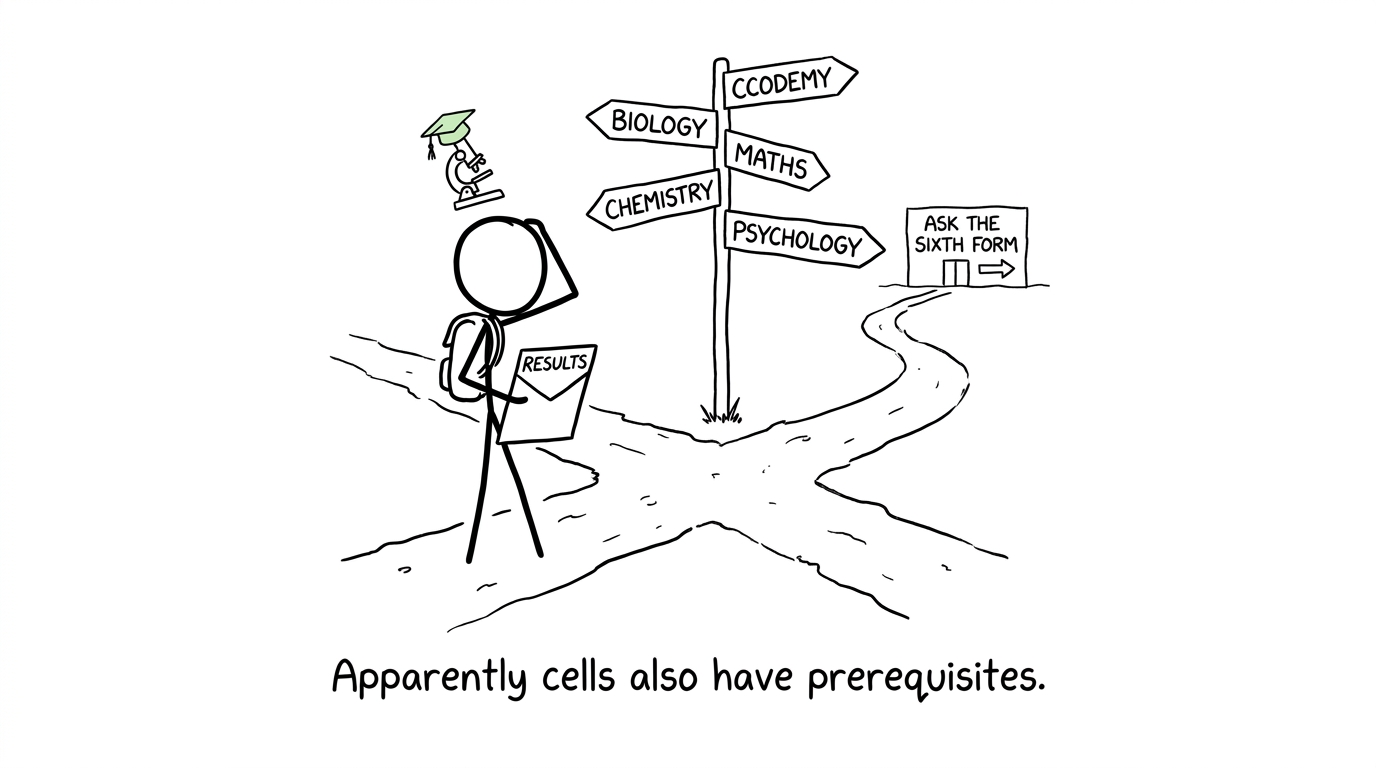 A student choosing between A Levels on Results Day
What grades do you need for A Level Biology?
There is no single national GCSE entry grade for A Level Biology. Exam boards set specifications and assessment requirements, while individual sixth forms set their own admissions criteria.
Current published entry policies commonly ask for grades in the following ranges:
| GCSE background | Entry requirement you may encounter |
|---|---|
| Separate sciences | Grade 666 or 777 in GCSE Biology |
| Combined Science | Grades 666-666 or 777-777 |
| GCSE Maths | Grade 555 or 666, sometimes higher |
| Overall GCSE profile | Several passes, often including English and maths |
These are indicative ranges, not a guarantee. Some schools also require a particular Chemistry grade because biological processes rely on chemical understanding. Read your offer conditions or contact the sixth form rather than assuming that another school's threshold applies.
If you narrowly miss a requirement, speak to the admissions team. They may consider your paper profile, teacher recommendation or available course capacity, but they are not obliged to make an exception.
What changes from GCSE Biology to A Level?
The move from GCSE Biology to A Level changes the depth and style of learning. Familiar areas such as cells, transport, genetics, ecology and energy transfer return, but explanations become more precise and interconnected.
You will be expected to:
- recall accurate scientific terminology;
- apply knowledge in unfamiliar contexts;
- interpret tables, graphs and experimental results;
- evaluate methods, evidence and conclusions;
- understand practical procedures and limitations;
- connect ideas across different parts of the specification.
The exact organisation depends on whether your school uses AQA, OCR, Edexcel or Eduqas. MathsGenie's AQA A Level Biology overview shows how lessons, topic questions, past papers and mark schemes fit around the specification. Students following OCR can use the OCR A Biology revision guides, while the natural selection revision guide offers a useful glimpse of Edexcel A Level depth.
How much maths is in A Level Biology?
Across A Level Biology specifications, at least 10%10\%10% of assessment marks require mathematical skills at Level 222 or above. In practice, this means at least higher-tier GCSE standard, applied within biological questions.
The relevant skills include:
- ratios, fractions and percentages;
- standard form and unit conversions;
- means, probability and sampling;
- interpreting tables, charts and graphs;
- gradients and rates of change;
- substituting into and rearranging equations;
- surface area, volume and scale;
- significant figures and uncertainty;
- logarithmic and exponential functions in suitable contexts.
You do not need A Level Maths to take A Level Biology unless your chosen institution imposes an unusual local condition. However, weak GCSE number skills can make biological questions harder than they need to be.
Start by strengthening the topics Biology repeatedly draws upon. MathsGenie's GCSE ratio revision guide supports proportional reasoning, while the GCSE standard form resources are valuable for cell sizes and magnification. The broader GCSE Maths revision hub provides lessons, practice questions, videos and papers across number, algebra, graphs and statistics.
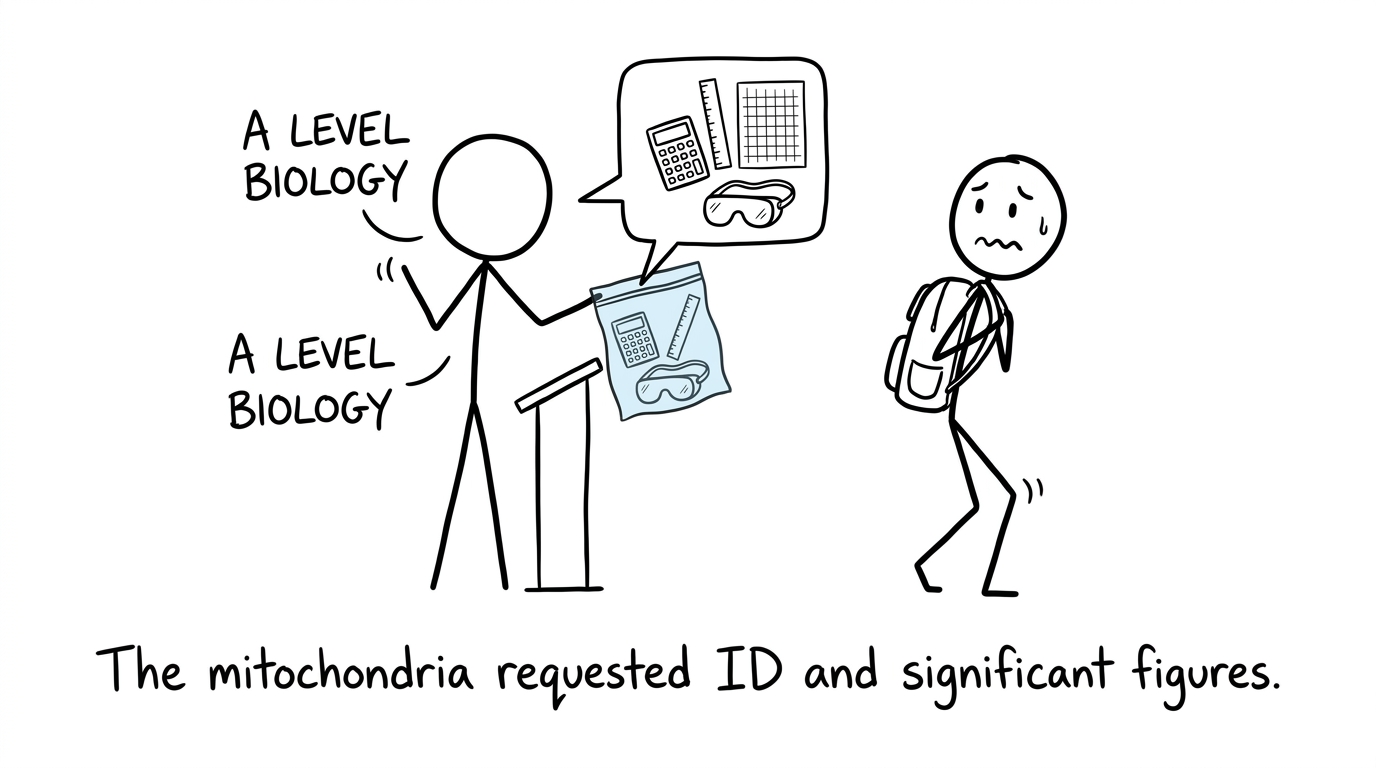 A Level Biology checks a student's calculator and lab equipment
Which A Levels work well with Biology?
Biology, Chemistry and Maths
This is a strong combination for students who enjoy quantitative science and want to preserve a wide range of science-related options. Chemistry supports topics involving biological molecules, respiration and biochemical reactions. Maths strengthens modelling, data handling and logical problem-solving.
It is also demanding. Choose it because the subjects suit your strengths, not because it appears to be the most impressive combination.
Biology, Chemistry and Psychology
Psychology connects naturally with behaviour, research methods and data interpretation. Chemistry maintains a broad laboratory-science foundation. Check university requirements carefully if you already have a particular degree in mind, because required subjects differ between courses and institutions.
Biology, Maths and Psychology
This combination suits students interested in biological and behavioural questions who also enjoy analysing evidence. If you later study growth models or data transformations, MathsGenie's exponentials and logarithms revision guide shows how mathematical ideas develop beyond GCSE.
Biology with Geography or Environmental Science
This may suit interests in ecosystems, conservation, climate, fieldwork or sustainability. Availability varies between sixth forms, so compare course content rather than choosing from the subject title alone.
Common mistakes when choosing A Level Biology
Choosing from the GCSE grade alone. A high grade is encouraging, but enjoyment of analysis, practical work and extended explanations matters too.
Ignoring the maths requirement. Biology is not a maths-free science. Secure the higher-tier GCSE skills now rather than waiting for the first data-heavy assessment.
Assuming all sixth forms use the same threshold. Entry policies vary. Check the written criteria for your chosen institution.
Selecting subjects only for one career idea. Ambitions can change. Research any essential subjects, then choose a combination you can sustain for two years.
Revising by rereading. Recognition can feel like knowledge. Better revision alternates recall, exam questions, marking and targeted repair.
Make the decision, then build the foundations
Choosing A Level Biology is not a promise that every topic will feel easy. It is a decision that the difficult parts are worth learning. Confirm your entry grades, compare the specification with your interests and choose companion subjects that support both your plans and your wellbeing.
Then begin calmly. Use MathsGenie's AQA A Level Biology overview to explore the course, revision lessons and question bank. As your course progresses, combine practice questions with mark schemes, mini tests, past papers, predicted papers and video solutions. A good result is rarely built from one heroic revision session. It comes from a clear loop: learn, practise, check and improve.