

Have I Revised Enough for GCSE Religious Studies?
Have I revised enough GCSE Religious Studies? Use recall, timed answers and mark schemes to judge readiness realistically and plan what to do next.
Revision has a strange habit of feeling unfinished. There is always another quotation to learn, another ethical theme to revisit and another page you could highlight. If you are asking “have I revised enough GCSE Religious Studies?”, the honest answer should not come from your anxiety or the number of hours you have completed. It should come from evidence.
You have probably revised enough when you can recall the required content without notes, apply it accurately to unfamiliar questions, complete timed answers and improve after using a mark scheme. You do not need to feel completely calm. You need repeatable performance.
That distinction matters when Religious Studies is only one part of a busy GCSE timetable. Maths, English and science are competing for the same evenings. The aim is not to keep revising RS until worry disappears. It is to identify what is secure, repair what is not and then give other subjects their fair share of attention.
The quick GCSE Religious Studies readiness checklist
You are approaching exam readiness if you can honestly tick most of these statements:
- I know my exact exam board, specification and components.
- I have checked every required religion, belief, practice and ethical theme.
- I can retrieve key teachings, specialist vocabulary and sources of authority without notes.
- I can explain similarities and differences accurately.
- I can answer both knowledge and evaluation questions.
- I understand the command words and mark tariffs used by my board.
- I have completed timed questions from across the course.
- I mark my work strictly and record why marks were lost.
- I can redo weak questions successfully after a gap.
- My recent performance is becoming stable rather than depending on a friendly question.
This checklist is more useful than counting pages or hours because it measures what the examination actually requires.
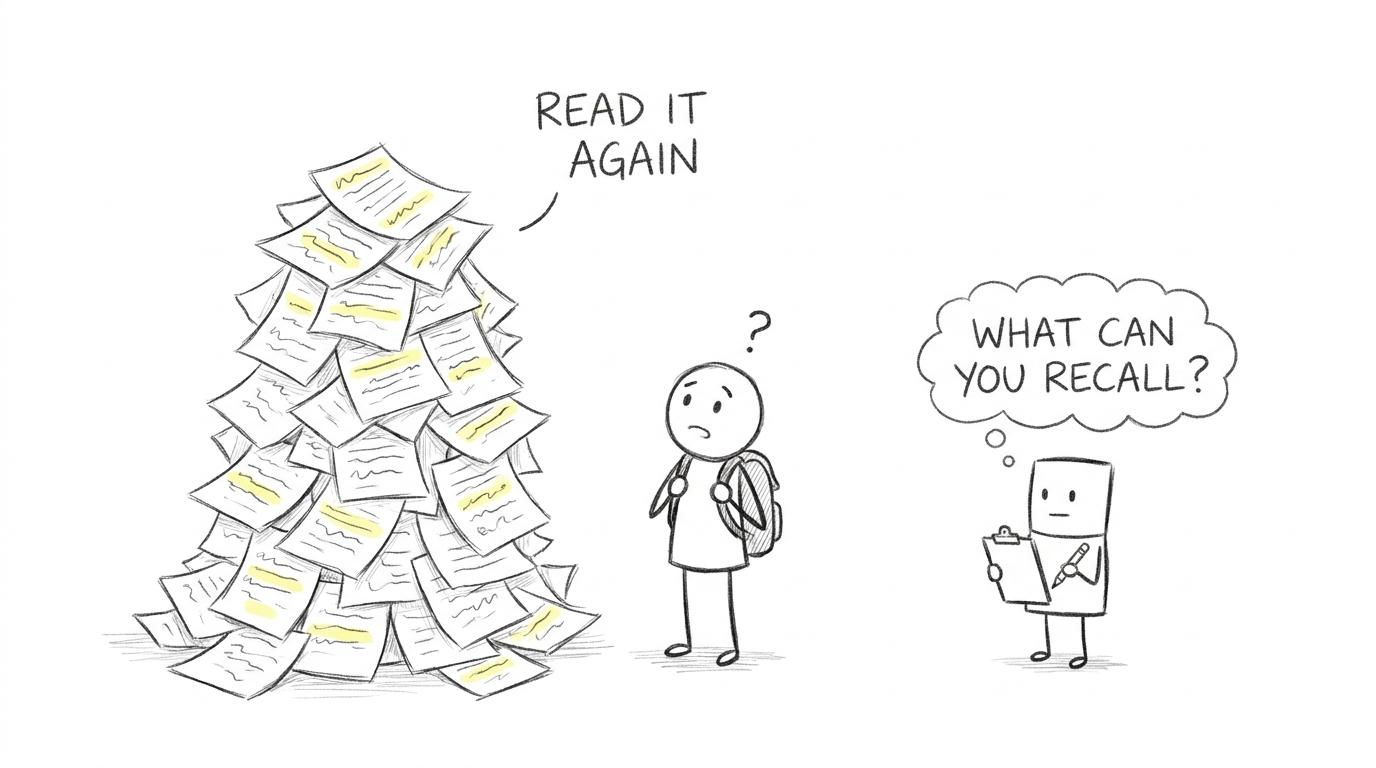 A student compares a mountain of highlighted notes with a small closed-book recall quiz
Start with your specification, not your confidence
A student can work hard and still revise the wrong material. GCSE Religious Studies routes differ between AQA, Edexcel, OCR and Eduqas, while schools select particular religions, themes and components within those specifications.
Begin by obtaining the current specification or a checklist supplied by your teacher. Mark each item as:
- secure: you can explain and use it without help;
- developing: you recognise it but cannot produce a complete answer;
- unsecured; you cannot recall or apply it reliably.
Be specific. “Christianity is fine” tells you little. “Christian beliefs about salvation are secure, but denominational differences in worship are developing” gives you an action.
Also check the current question format for your board. For example, AQA GCSE Religious Studies A uses a 111, 111, 444, 666 and 121212 mark question pattern from summer 202620262026. Other specifications use different structures and weightings, so do not borrow an answer formula from a friend on another board without checking it.
Across GCSE Religious Studies, the central assessment objectives concern knowledge and understanding, usually called AO1, and analysis and evaluation, called AO2. For qualifications following the current Ofqual requirements, these contribute 50%50\%50% each overall. Knowing facts alone is therefore not enough, but neither is writing thoughtful opinions without accurate religious knowledge.
Use closed-book recall as your first test
Recognition creates false confidence. A teaching may look familiar when it is open in front of you, yet disappear when the book closes.
Choose one small specification area and, without notes, retrieve:
- the central beliefs or teachings;
- accurate specialist terms;
- relevant practices and their significance;
- sources of wisdom or authority;
- differences within or between traditions;
- links to the ethical issues you study.
Then check your work against trusted class materials. Correct omissions immediately and test the same content again after several days. Active retrieval is generally more useful for long-term recall than repeatedly rereading the same page, particularly when you receive feedback and correct inaccuracies.
A single successful recall attempt is encouraging, but it is not proof of durable learning. The stronger test is whether the material remains available after a gap and when mixed with other topics.
This principle transfers directly to maths. MathsGenie’s guide to turning notes into active recall shows why producing an answer before checking it reveals more than simply looking through familiar notes.
Test AO1 and AO2 separately
Students sometimes judge their entire readiness from one essay. That can hide the real weakness.
Evidence that AO1 is secure
For knowledge and understanding, ask whether you can:
- define key terms precisely;
- describe beliefs and practices accurately;
- explain why a belief matters to followers;
- connect teachings to sources of authority;
- distinguish between traditions without overgeneralising;
- answer the exact question rather than reciting everything remembered.
If you regularly know the topic but lose marks because explanations stop too early, the problem is not revision quantity. It is development. Practise extending a point through its reason, significance or influence.
Evidence that AO2 is secure
For analysis and evaluation, ask whether you can:
- develop more than one defensible viewpoint;
- support arguments with relevant religious knowledge;
- analyse the strength or significance of a reason;
- compare viewpoints rather than merely listing them;
- reach a justified conclusion that answers the statement;
- adapt your argument when the wording changes.
A memorised essay may survive one familiar question. Real readiness means you can reorganise your knowledge for a new statement.
Let timed answers provide the verdict
The fairest answer to “have I revised enough GCSE Religious Studies?” comes from closed-book work completed under realistic time pressure.
Start with individual questions, then timed sections, and eventually complete papers where suitable materials are available. Use the correct paper for your board and route. Remove notes, silence your phone and follow the permitted time and equipment rules.
Afterwards, mark strictly. Do not award marks for what you intended to write. Classify each loss as one of the following:
- knowledge gap: a teaching, term or practice was missing or inaccurate;
- evidence gap: a relevant source of wisdom or authority was absent or misused;
- explanation gap: the point was asserted rather than developed;
- evaluation gap: arguments lacked analysis or a justified judgement;
- exam-technique gap: the command word, timing or question focus was mishandled.
This approach turns a disappointing mark into instructions. Maths students can use the same process with MathsGenie’s guide to finding weak GCSE topics, where errors become a targeted revision list rather than a vague reason to panic.
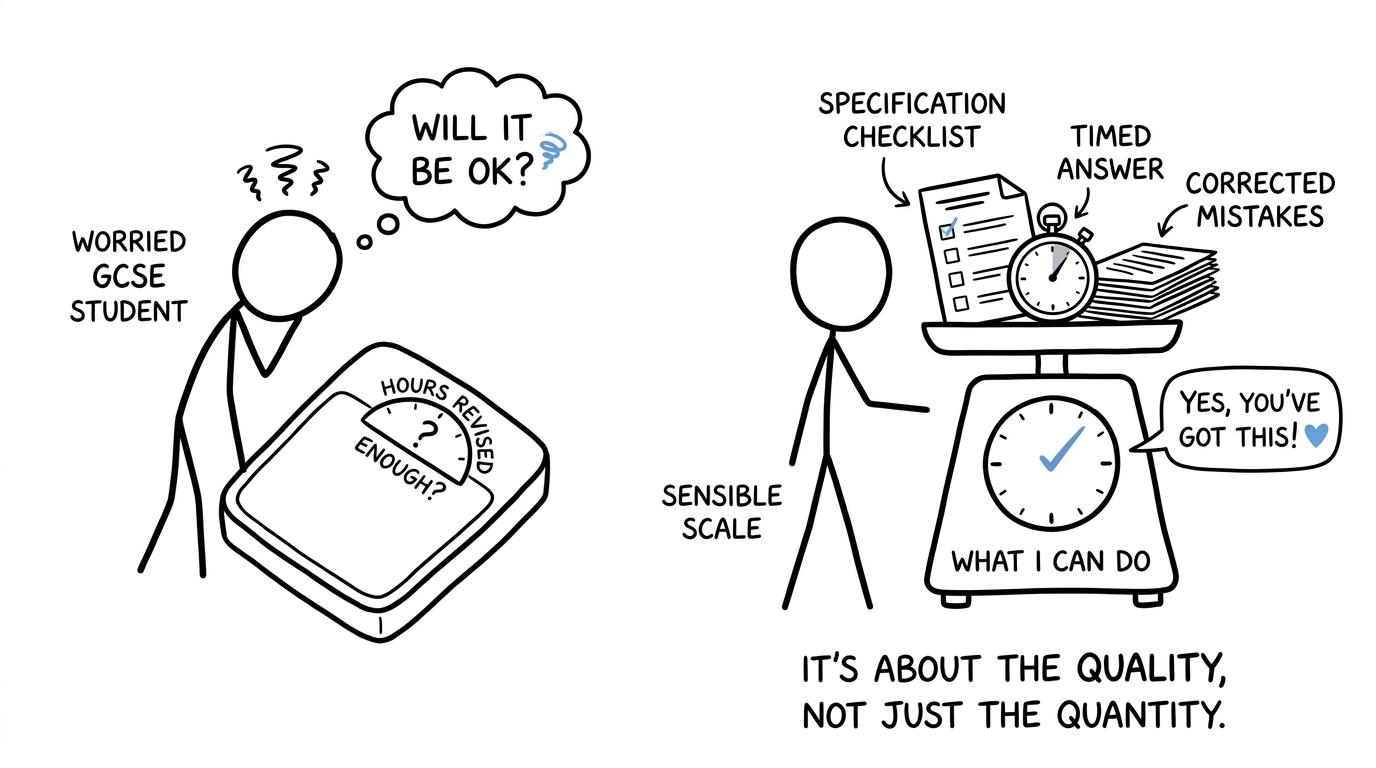 A worried student weighs revision hours against evidence of what they can actually do
Look for consistency, not one impressive result
One strong paper can be flattering. Perhaps it contained your favourite theme or a statement you had already discussed in class. One weak paper can also be misleading if you were tired or used an unfamiliar format.
A better judgement comes from a pattern across several pieces of work. Track:
- marks by question type;
- topics producing repeated errors;
- unfinished questions;
- missing or inaccurate evidence;
- whether corrected weaknesses remain fixed later.
You are becoming ready when performance is reasonably stable across different topics and unseen wording. There is no universal practice-paper mark that proves you have done enough because grade boundaries, paper difficulty and specifications vary. Ask your teacher to interpret your results against your target grade and the standard expected by your exam board.
The crucial question is not “Did I once get this right?” It is “Can I still get it right, without help, when the question looks different?”
Know when to stop revising one topic
Revision time has an opportunity cost. Another hour spent polishing an already secure RS theme may be an hour not spent repairing algebra, practising English analysis or sleeping properly.
Pause intensive work on a topic when you can:
- retrieve its core knowledge after a gap;
- answer different question types without notes;
- use accurate evidence naturally;
- complete the work within a sensible time;
- correct previous mistakes on a fresh attempt.
Do not abandon the topic completely. Move it into maintenance: a short recall check or mixed question later in the week. Spend the saved time on the red and amber areas of your specification.
A clear plan makes that balance easier. Use the free MathsGenie revision planner to protect time for every subject, then place RS sessions around specific outcomes such as “retrieve Sikh practices” or “complete one timed evaluation”, not the vague instruction “revise RS”.
Balance Religious Studies with GCSE maths
Students preparing for several GCSEs do not need separate revision philosophies for every subject. The content changes, but the useful loop remains similar:
Attempt, mark, diagnose, fix and retest.
For RS, the attempt might be a closed-book explanation or timed evaluation. For maths, it might be a topic question, mini test or full paper. In both cases, the mark scheme shows whether confidence matches performance.
MathsGenie can remove much of the decision-making from your maths revision. Start with the GCSE maths revision hub, use GCSE maths mini tests for short diagnostics and follow the GCSE twenty-minute revision routine on crowded school days.
When exams approach, move towards timed papers and fresh questions. The guide to starting GCSE past papers at the right time explains how to progress from short sections to full exam conditions. Edexcel students can also use GCSE maths predicted papers to test whether repaired skills survive unfamiliar wording.
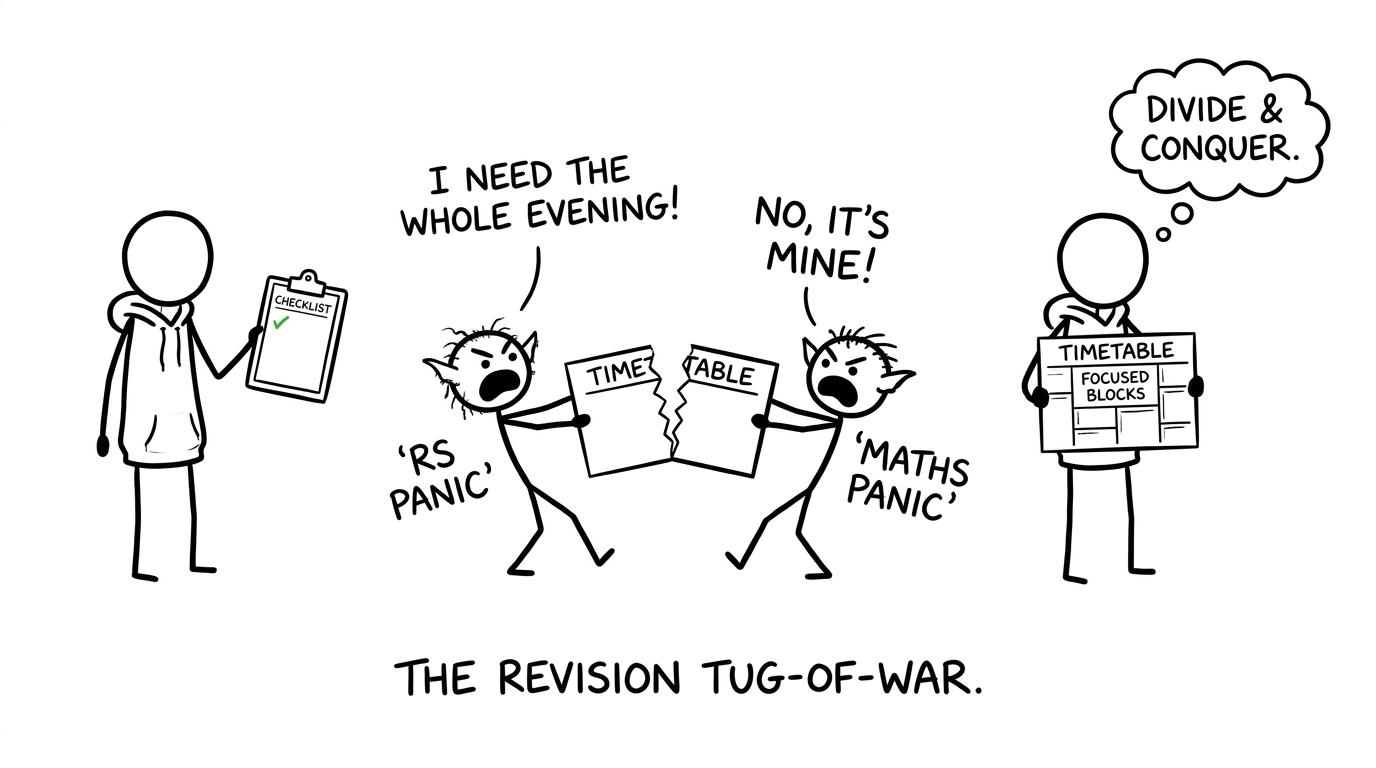 Two revision gremlins compete for a student's timetable while the student calmly creates focused subject blocks
Common mistakes when judging whether you have revised enough
Counting hours instead of outcomes
Time matters, but an hour of rereading is not equivalent to an hour that includes retrieval, timed writing and correction. Record what you can now do, not merely how long you sat at a desk.
Treating familiarity as recall
Recognising a quotation or belief is easier than producing and applying it independently. Close the book before deciding that a topic is secure.
Revising only favourite themes
Comfortable topics create reassuring sessions but leave expensive gaps. Let your specification audit and marked work choose the next task.
Memorising generic evaluation paragraphs
Prepared structures can help organise writing, but the argument must answer the particular statement. Practise adapting knowledge to different wording and conclusions.
Completing papers without reviewing them
A paper is diagnostic evidence, not just a score. Mark it, classify every lost mark, repair the most important gaps and retest them later.
Assuming anxiety proves you are unprepared
Nerves are not a reliable measurement of knowledge. Some well-prepared students remain anxious, while an untested student may feel confident. Trust repeated closed-book evidence more than either feeling.
You have done enough when the evidence becomes boring
Being ready rarely feels dramatic. It looks quieter: you know what is on your specification, recall it without constant prompting, handle AO1 and AO2, finish timed work and stop repeating the same errors.
You may still have weaker areas. Almost everyone does. The realistic goal is not perfect knowledge or the disappearance of uncertainty. It is dependable performance and a short, specific list of remaining priorities.
Run one honest RS diagnostic, mark it and schedule the necessary repairs. Then give maths the same evidence-led treatment. Use MathsGenie’s free revision lessons, practice questions, mini tests, past papers, predicted papers, mark schemes and video solutions to turn the rest of your GCSE revision into measurable progress rather than endless worry.











