Have I Revised Enough for GCSE Chemistry?
Have I revised enough GCSE Chemistry? Use recall, exam questions, practical knowledge and timed papers to judge your readiness calmly before exam day.
Revision has an awkward feature: you can spend hours doing it and still wonder whether any of it counts. A full notebook may look reassuring, yet the question remains: have I revised enough GCSE Chemistry to perform well in the exam?
The realistic answer does not come from counting hours or waiting to feel completely confident. You have revised enough when you can produce consistent evidence: you have covered your specification, recalled key ideas without notes, applied them to unfamiliar questions, handled practical and mathematical skills, and performed near your target under timed conditions.
Anxiety asks how much more you could do. A useful revision system asks what you can reliably do now.
The short GCSE Chemistry readiness checklist
You are approaching exam readiness when you can:
- identify your exam board, qualification and tier correctly;
- account for every specification topic rather than revising only favourites;
- recall definitions, processes and chemical tests without prompts;
- answer mixed questions where the topic is not announced in advance;
- explain required or core practicals, including variables, risks and evaluation;
- complete Chemistry calculations with correct units and sensible rounding;
- finish timed sections or papers without relying on notes;
- mark answers honestly and explain why each mark was lost;
- return to previous weaknesses and answer fresh questions successfully;
- achieve a reasonably stable standard across more than one paper.
No single tick proves that you are ready. Together, however, they provide far better evidence than the number of highlighted pages in your folder.
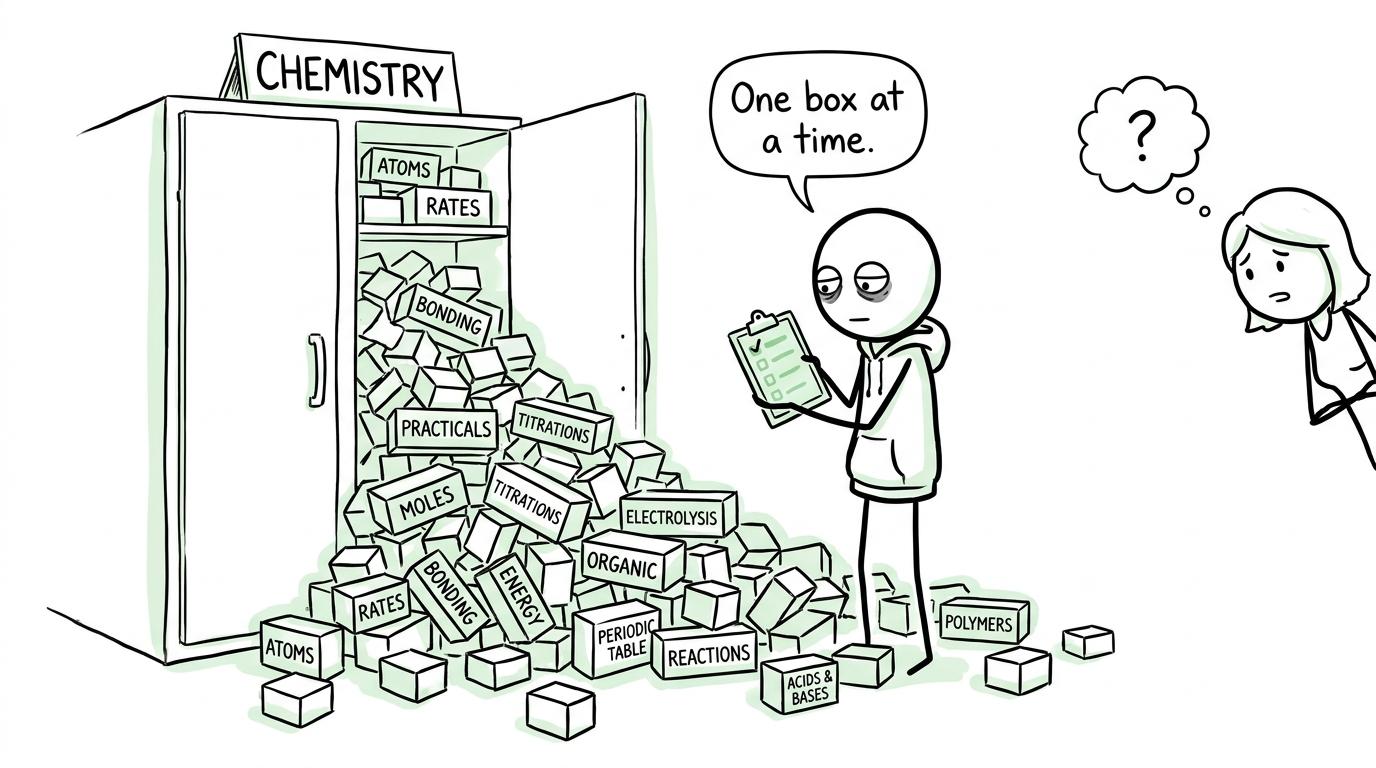 A student calmly tackling a cupboard full of Chemistry topics one box at a time
Start with the exact course you are taking
Before measuring progress, make sure you are measuring the right material. Check whether you study Combined Science or separate GCSE Chemistry, which board you use, and whether your papers are foundation or higher tier where applicable.
AQA, Edexcel, OCR and Eduqas organise and assess content differently. Even where the underlying Chemistry overlaps, paper structures, practical activities and topic groupings are not identical. Use your current specification as the master checklist and confirm the details with your teacher rather than relying on a generic online list.
For example, the current AQA separate Chemistry specification divides assessment across two written papers. It includes topics ranging from atomic structure and quantitative Chemistry to organic Chemistry, chemical analysis and the use of resources. AQA also states that assessment covers knowledge, application and analysis, while questions drawing on practical work account for at least 15%15\%15% of the qualification's marks.
That matters because revision cannot be judged by recall alone. Browse the free AQA GCSE Chemistry revision resources for board-specific lessons, exam-style questions, past papers and mark schemes.
Use four tests instead of counting revision hours
Hours measure attendance. Tests measure readiness. A student who spends three hours copying notes may learn less about their exam readiness than one who completes and reviews a focused timed section.
The coverage test
Create a list from your specification and label each area:
- Secure: you can recall and apply it independently;
- Developing: you understand the main idea but make errors;
- Uncovered: you cannot yet explain or use it.
Be specific. “Quantitative Chemistry” is too broad to diagnose. Break it into smaller areas such as relative formula mass, reacting masses, concentration, yields and atom economy where these appear on your course.
You do not need every line to feel effortless before attempting papers. You do need to know where the gaps are. An entire red topic is more urgent than polishing a green one because it may leave you unable to begin several questions.
If the list looks overwhelming, the GCSE revision catch-up guide shows how to turn a large backlog into a manageable paper, repair, and retest cycle.
The closed-book recall test
Choose a small topic and close everything. Write what you know about its key definitions, processes, observations and explanations. Then compare your recall with your specification, lesson material or mark scheme.
This test distinguishes recognition from retrieval. A page can look familiar because you have read it repeatedly. The examination asks you to produce relevant knowledge when the page is gone.
Recall is secure when it survives a delay and a change of wording. Revisit the topic on another day rather than immediately repeating the same answer from memory. The aim is not to remember the layout of your notes; it is to retrieve the Chemistry.
The application test
Official assessment objectives across GCSE Chemistry specifications do not reward knowledge alone. Students must also apply ideas and analyse information, including in practical or unfamiliar contexts.
Try mixed exam questions without being told which chapter they test. Can you recognise that a graph concerns rate, decide which chemical principle is relevant, and build an answer from the information provided?
This is where exam practice becomes diagnostic. The guide to revising GCSE Chemistry efficiently explains a useful loop: retrieve, check, repair and repeat. If you are hovering around a pass, the more targeted GCSE Chemistry pass-grade revision plan can help separate knowledge gaps from application, writing and maths gaps.
The performance test
Finally, complete unseen material under realistic conditions. Use the correct tier and board, remove your notes, follow the stated time and mark the work strictly.
Do not judge readiness from one unusually strong or weak result. Compare several recent attempts. Look for:
- a mark range that is becoming more stable;
- fewer questions you cannot start;
- repeated weaknesses becoming less frequent;
- enough time to reach the end and check answers;
- performance that matches the target agreed with your teacher.
Use grade boundaries only for the correct board, qualification, tier, paper and examination series. Boundaries can change, so an old raw-mark target is not a permanent promise of a particular grade.
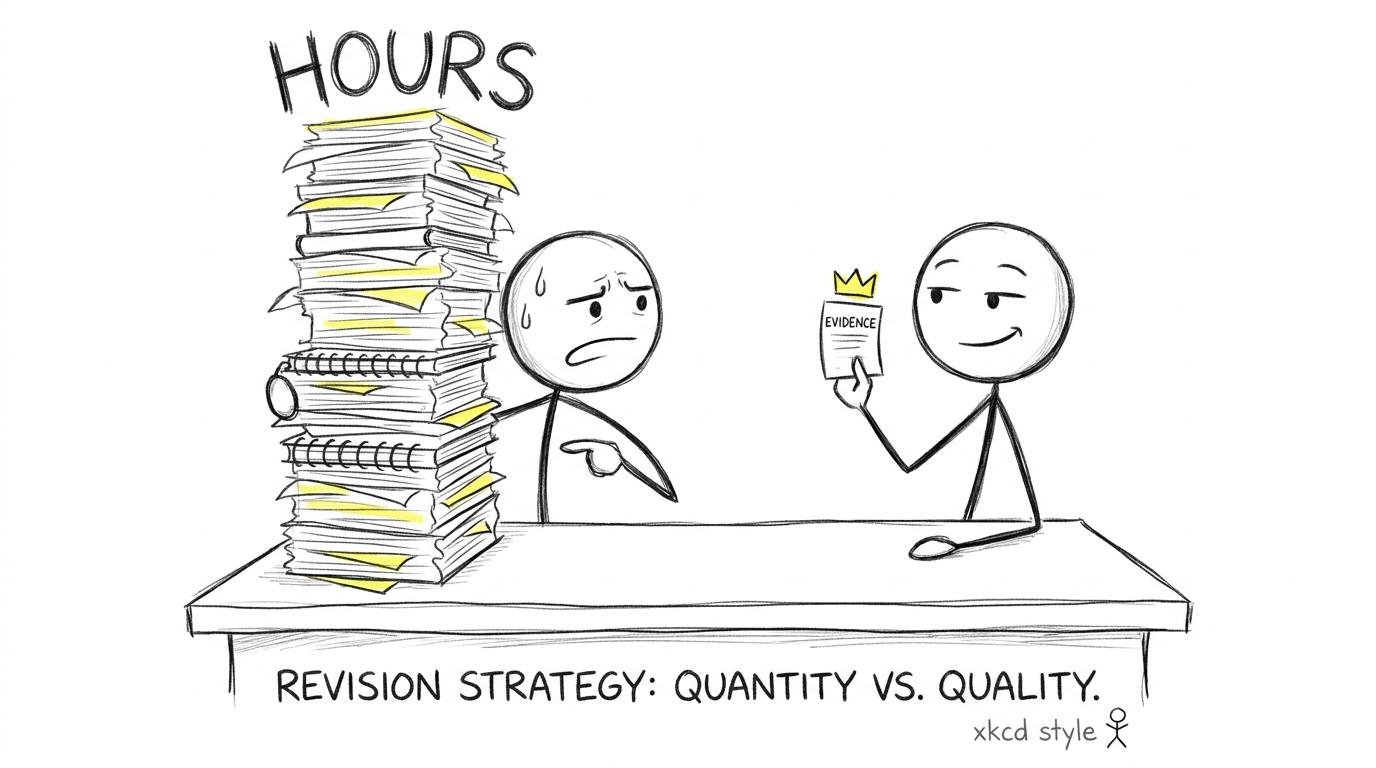 A tiny marked practice paper wearing a crown beside a tower of revision hours
Check practical knowledge, not just theory
Practical work is not an optional corner of GCSE Chemistry. Written examinations can ask about apparatus, variables, observations, risks, accuracy, data and improvements. The named activities vary between specifications, so use the list for your board and qualification.
For each required or core practical, check whether you can explain:
- the purpose and outline method;
- the independent, dependent and control variables;
- the measurements and suitable apparatus;
- relevant hazards and how risk is reduced;
- expected observations or data presentation;
- limitations, sources of uncertainty and realistic improvements;
- how the results support a conclusion.
Memorising a method word for word is not enough if you cannot adapt it. A question may change the substance, apparatus or measured quantity while preserving the same investigative principle.
Audit the maths inside GCSE Chemistry
For students balancing Chemistry with maths revision, calculation questions offer a useful advantage: the weaknesses are often identifiable. You may understand the science but lose marks through conversion, rearrangement, ratio, graph reading or significant figures.
Depending on your specification and tier, relationships may include:
concentration=mass of solutevolume of solution\text{concentration} = \frac{\text{mass of solute}}{\text{volume of solution}}concentration=volume of solutionmass of solute mean rate=quantity of reactant used or product formedtime\text{mean rate} = \frac{\text{quantity of reactant used or product formed}}{\text{time}}mean rate=timequantity of reactant used or product formed Rf=distance moved by substancedistance moved by solventR_f = \frac{\text{distance moved by substance}}{\text{distance moved by solvent}}Rf=distance moved by solventdistance moved by substanceDo not merely memorise a triangle or formula. Check that you can select the correct relationship, rearrange it, convert units, substitute accurately and interpret the result.
Your Chemistry maths audit should include ratios, fractions, percentages, standard form, means, graphs, gradients, unit conversions and rearranging formulae at the level required by your course. MathsGenie's direct and inverse proportion guide can strengthen proportional reasoning, while the rearranging harder formulae guide supports more demanding algebra.
After a calculation error, label the cause: formula choice, rearrangement, conversion, calculator entry, rounding or missing unit. “Maths mistake” is too vague to repair.
Turn every past paper into evidence
A paper is useful only if it changes what you do next. The total mark tells you where you finished; your corrections explain how to move.
After each timed attempt:
- mark it using the official mark scheme;
- record every lost mark;
- classify the cause as knowledge, application, practical, maths or exam technique;
- write one precise action for each recurring problem;
- practise that micro-skill;
- re-attempt the question without support after a gap;
- use a fresh question later to test whether the improvement transfers.
The AQA Chemistry past-paper strategy explains how to move from simply completing papers to diagnosing weaknesses. Use the GCSE mark-scheme improvement guide when your answers seem correct but repeatedly miss credited detail.
A realistic stopping rule for revision
You will probably never reach a moment when every topic feels perfect. A better stopping rule is evidence-based.
You are likely to have revised enough for the next stage when:
- the whole specification has been audited;
- there are no major topics you have completely ignored;
- you can retrieve core content without notes;
- practical questions no longer feel separate from the course;
- recurring calculation errors have been identified and reduced;
- several timed attempts show a stable level near your target;
- your remaining weaknesses are specific enough to fit on a short list.
At that point, revision should become narrower rather than longer. Repair the few errors that still recur, complete short mixed sets and protect your sleep and concentration. The GCSE Chemistry exam-week checklist provides a calm structure for that final phase.
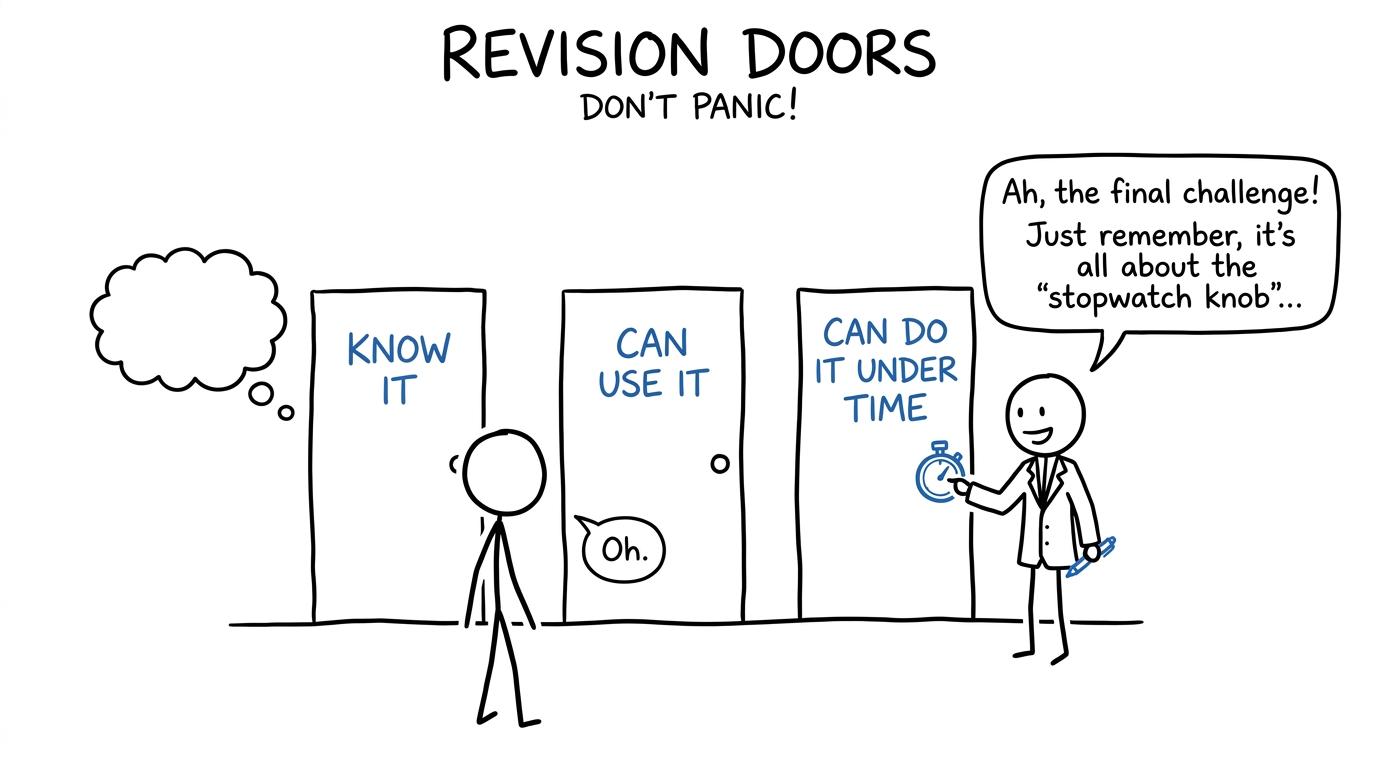 A student choosing between knowing Chemistry and performing it under time
Common mistakes when deciding whether you have revised enough
Mistaking familiarity for mastery
Recognising a highlighted paragraph is not the same as producing an answer. Include closed-book recall and unseen questions in every revision cycle.
Revising favourite topics repeatedly
Comfortable topics make sessions feel productive. The specification checklist reveals whether that feeling has hidden entire gaps.
Treating one paper as a final verdict
One mark can be affected by topic mix, tiredness or generous self-marking. Look for a pattern across multiple attempts and use each one diagnostically.
Ignoring practical and mathematical marks
Students sometimes revise Chemistry as a collection of facts. Practical design, data analysis, graphs, units and calculations are part of the assessment, not extras.
Reading the mark scheme without reattempting
A correction can look obvious while it is visible. Close the scheme, wait, and answer again. Then use a different question to check transfer.
Using predicted material as a replacement for coverage
Predicted papers can provide fresh practice, but no prediction removes the need to revise the full specification. In maths, MathsGenie's Edexcel GCSE predicted papers are designed to complement lessons and past papers, not replace systematic coverage. Apply the same principle to Chemistry.
Finish with evidence, not a feeling
The question “Have I done enough?” rarely produces calm because there is always another page available. Replace it with better questions: What can I retrieve? What can I apply? Which marks am I still losing? Does my performance hold up under time?
MathsGenie gives you a free place to build that evidence. Use Chemistry revision lessons and practice questions to repair gaps, then use past papers, mark schemes and exam guidance to test whether the repair worked. For the mathematical skills underneath Chemistry, use MathsGenie's revision guides, mini tests, predicted papers and video solutions.
Choose one weak area now. Test it without notes, mark it honestly and schedule a fresh retest. That small loop tells you more about readiness than another evening spent wondering.