

GCSE Mark Schemes: Improve Fast (Even in Chemistry)
GCSE mark schemes can boost marks fast. Learn how to read method marks, fix errors, and use YesGenie past papers and mini tests effectively.

If you have ever opened a mark scheme and felt that sinking feeling: I would never have written it like that; you are not alone. For many GCSE students, the mark scheme looks less like feedback and more like a verdict. But a mark scheme is not there to prove you wrong. It is there to show you how examiners think, how marks are actually awarded, and what you can do next time to pick up easier marks.
This matters even if today’s frustration came from GCSE Chemistry. The same skill that helps you spot “allow” and “ignore” on a chemistry mark scheme also helps you collect method marks in maths, where one clean line of working can turn a near-miss into 333 or 444 marks. The quickest improvers are rarely the most naturally confident; they are the ones who learn to treat mark schemes like a map.
 A student faces the mark scheme scroll
The mark scheme mindset (and why it works for GCSE Chemistry and maths)
A mark scheme is a record of what counts. Not what is “nice”, not what is “clever”, not what your teacher would personally prefer: what counts for the exam board (AQA, Edexcel, OCR, Eduqas, WJEC).
In GCSE Chemistry, marks often come from precise language: “because”, “so that”, correct state symbols, correct units, correct reasoning. In GCSE maths, marks often come from visible method: rearranging, substituting, simplifying, showing a key step.
The overlap is this: both subjects reward exam technique. If you can read a mark scheme well, you can reverse-engineer what your next answer must look like.
A quick checklist: how to use a GCSE mark scheme properly
Use this after every paper or set of practice questions:
- Mark it once with the official mark scheme, no arguments.
- Identify the mark type: is it a one-mark fact, or method + accuracy?
- Circle the first wrong step (not the final wrong answer).
- Write the “minimum change” needed to gain the marks next time.
- Create one takeaway: a sentence you will remember under pressure.
- Redo the question cold two days later.
For maths practice, build this into your routine using GCSE Past papers and short bursts from Edexcel GCSE Maths Mini Tests.
What the symbols on a GCSE mark scheme are really telling you
Most students look at the final answer line first. Examiners often look at method first.
Here are the mark-scheme ideas that matter most across subjects:
Method marks vs accuracy marks (the hidden reason you “nearly got it”)
In maths, many questions are effectively split into “do the right process” then “get the right value”. You will often see this written as something like M1M1M1 (method) and A1A1A1 (accuracy) in many exam-board mark schemes.
In chemistry, it is similar but less explicit: you might get a mark for identifying the correct principle (e.g. conservation of mass), then another for the correct consequence (e.g. balanced equation or correct conclusion).
Your job is to learn: which part did I lose? Not “I got it wrong”, but “I lost the method because I skipped a step” or “I lost accuracy because I rounded too early”.
“Allow”, “ignore”, and “or equivalent” (why wording matters in Chemistry)
Chemistry mark schemes often include:
- Allow: alternative wording is acceptable.
- Ignore: extra detail won’t be penalised unless it contradicts.
- Or equivalent (oe): the same idea in different words.
That last one is a gift: it tells you the examiner is looking for an idea, not a specific sentence. In maths, “oe” often appears when different algebraic forms are equivalent.
Follow-through (why one mistake doesn’t have to ruin the whole question)
In maths mark schemes you’ll sometimes see follow-through marks (often written as ftftft). This means if you made an earlier error but used your value consistently, you can still earn later marks.
There is a chemistry version too: if you use your calculated moles consistently in later steps, you may still get marks even if the first calculation was off.
The revision lesson: stop assuming an early slip means “no point continuing”. Always continue.
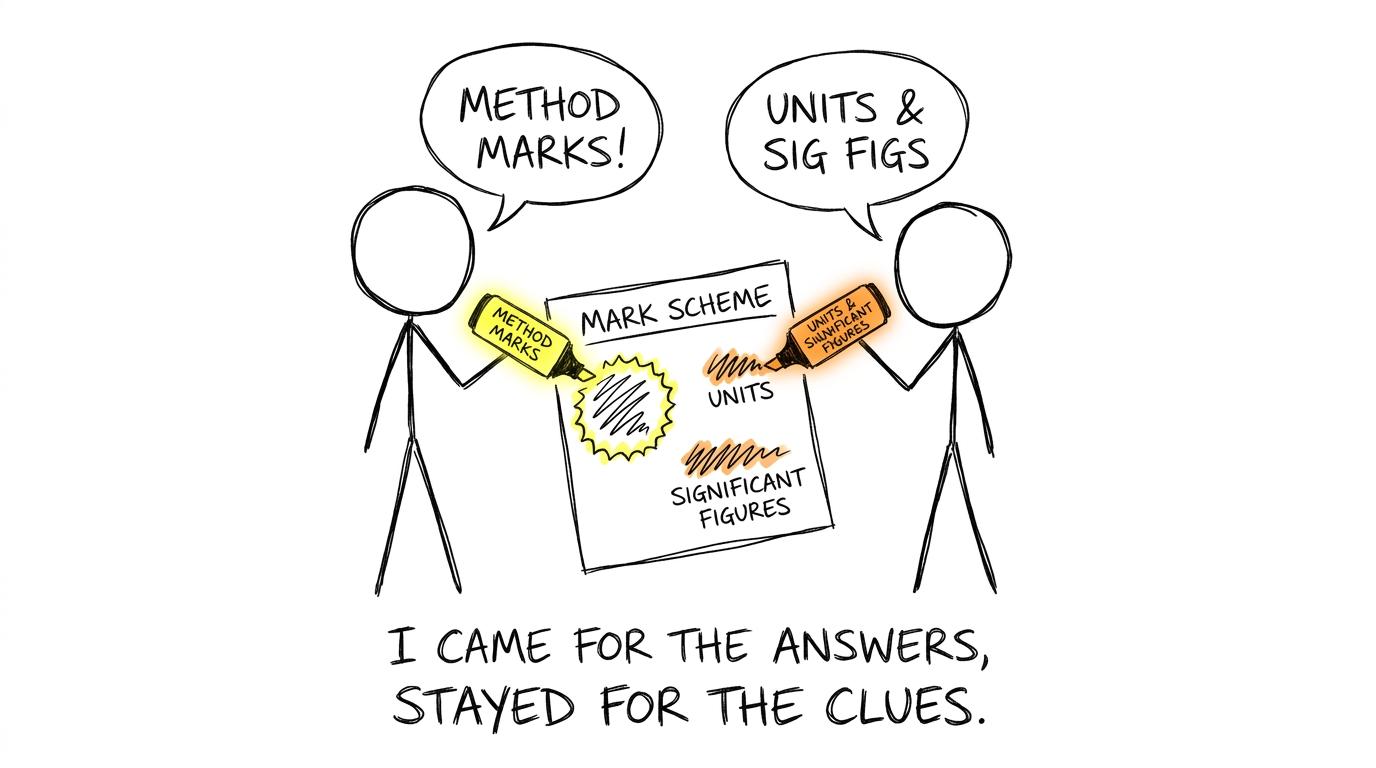 Highlighting method marks and units
Worked example: using a mark scheme to upgrade your maths method
Even though this post starts with GCSE Chemistry, you are revising on YesGenie because your maths grade matters too. So let’s practise the mark-scheme skill on a classic multi-mark maths question.
Example: percentage change (method marks are the real prize)
Question: A laptop costs £480480480. It is reduced by 15%15\%15%. What is the sale price?
A mark scheme for this sort of question typically rewards a correct method (find 15%15\%15% of 480480480 or multiply by 0.850.850.85) and then the correct final answer.
Method 1 (multiplier):
Sale price =480×0.85= 480 \times 0.85=480×0.85.
480×0.85=408 480 \times 0.85 = 408 480×0.85=408So the sale price is £408408408.
Method 2 (find the reduction then subtract):
Reduction =15%= 15\%=15% of 480480480:
0.15×480=72 0.15 \times 480 = 72 0.15×480=72Sale price =480−72=408= 480 - 72 = 408=480−72=408.
How to use the mark scheme if you got £727272 and stopped: You likely earned the method mark for calculating the reduction, then lost the accuracy/finishing mark for not completing the final subtraction. Your fix is not “revise percentages again”. Your fix is: always write the final statement the question asks for. Mark schemes train you to answer the command word.
For targeted practice on this kind of skill, use a revision guide section like Edexcel GCSE Maths Revision Guides and then test it with a mini test.
How to use a GCSE Chemistry mark scheme without memorising it
Chemistry mark schemes can feel harsh because they are specific. The trick is to stop treating them like a script and start treating them like a set of repeatable patterns.
Build a “mark scheme translation” notebook
On one side, write what you wrote. On the other side, write what the mark scheme rewarded.
Example patterns:
- If the mark scheme rewards cause and effect, practise writing in two clauses: “because… therefore…”.
- If it rewards correct units, underline units in the question before you start.
- If it rewards state symbols, make them part of your checking routine.
That same approach carries into maths: you learn what the examiner wants to see (a rearrangement, a substitution, a diagram, a conclusion).
The YesGenie way: turn mark schemes into a revision system
The problem with mark schemes is not the documents. It is what students do with them: a quick glance, a shrug, then on to the next topic.
Instead, use this loop:
Choose the right paper for your tier and board
Start with GCSE Past papers. If you are doing Edexcel maths (new spec or old), you can also use Edexcel GCSE Old Maths Revision to match what your school is teaching.
Mark tightly, then annotate loosely
Mark tightly means: follow the scheme exactly. Annotate loosely means: write your own explanation in plain English.
If a maths mark scheme shows a clean chain like 34x=15⇒x=20\frac{3}{4}x = 15 \Rightarrow x = 2043x=15⇒x=20, your annotation might be: “undo multiplication by 34\frac{3}{4}43 by multiplying by 43\frac{4}{3}34”. That annotation is what you will remember in the exam.
Use shorter practice to repeat the skill
Long papers are great, but repetition builds fluency. Add Edexcel GCSE Maths Mini Tests and the wider bank of Resources to cycle the same skill multiple times.
Use topic lessons to repair the exact weakness
When the mark scheme shows you a missing step, go straight to the lesson for that step. For example, if your mistake was in trig or 3D geometry, a page like 3D Pythagoras and Trigonometry gives you structured practice and worked solutions.
Common mistakes students make with mark schemes
- Only checking the final answer and ignoring method marks. In GCSE maths, the working is often where most of the marks live.
- Copying the mark scheme into your notes without understanding it. You want a rule you can reuse, not a transcript.
- Assuming your wording is “basically the same” in chemistry. Mark schemes often reward specific meanings, so you must match the idea precisely.
- Not learning from “almost correct” answers. These are the highest-return fixes because you are already close.
- Changing too much. The best improvements come from the smallest consistent habit: show one more step, add the unit, state the conclusion.
- Never reattempting the question. A mark scheme only becomes revision when you try again without looking.
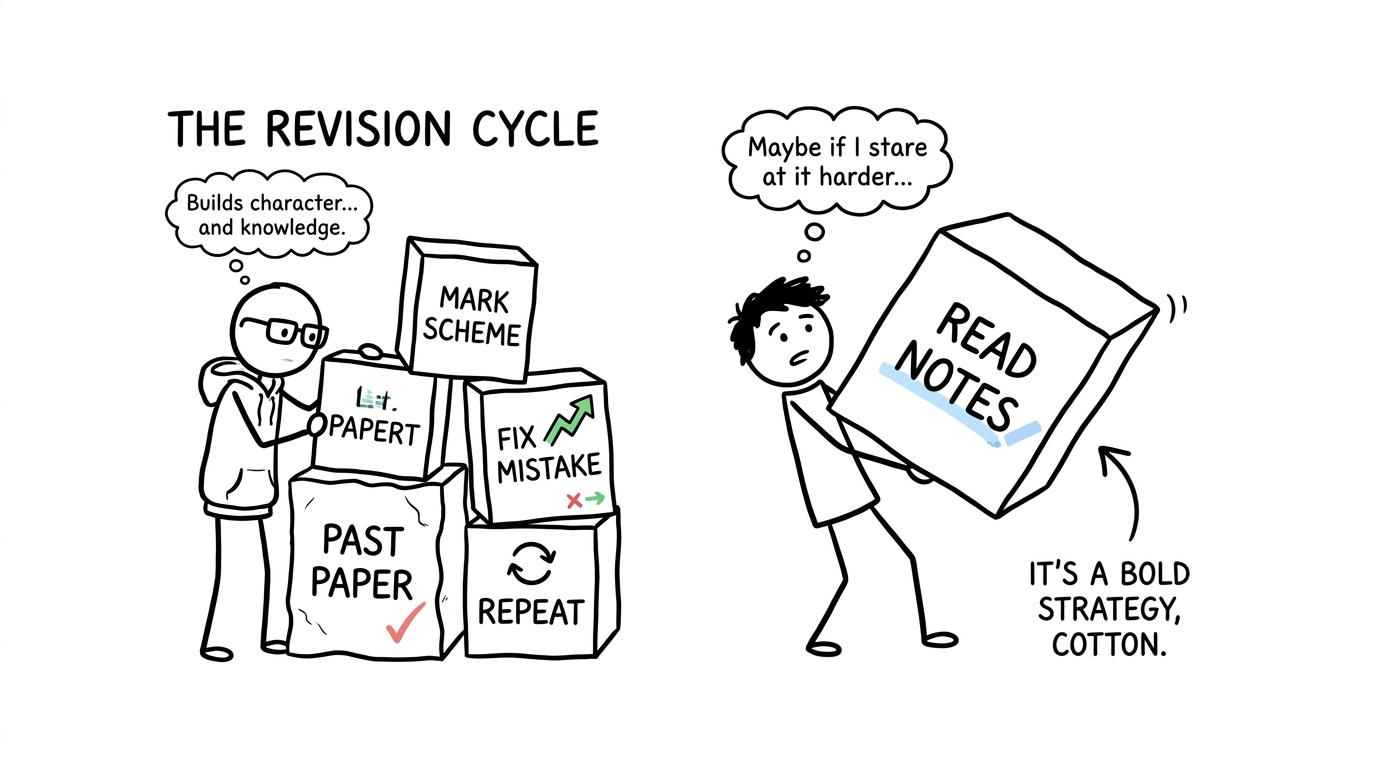 Blocks: past paper, mark scheme, fix, repeat
Bringing it together: GCSE improvement is often a mark-scheme skill
You do not need a new personality to improve your GCSE grades. You need a better feedback loop. Mark schemes are the cheapest, fastest feedback loop you can get because they show you exactly how marks are awarded.
If you want to turn that into consistent progress, use YesGenie like a system: practise a paper from GCSE Past papers, mark it carefully, repair the specific weakness with a targeted lesson or revision guide (for example Edexcel GCSE Maths Revision Guides), then repeat the skill with Edexcel GCSE Maths Mini Tests. For extra variety and structured practice sessions, browse the full Resources.
The quiet truth is that mark schemes are not the enemy. They are a set of clues left behind by the examiner. Follow them, and your GCSE answers start to look like they belong in the top bands. in Chemistry, in maths, and in the moments where exam technique matters most.










