Have I Revised Enough GCSE Arabic? An Honest Test
Have I revised enough GCSE Arabic? Use this evidence-based checklist to test listening, speaking, reading and writing without letting anxiety decide.
Revision creates a strange problem: the more you learn, the more clearly you can see what you do not know. A vocabulary list that once looked manageable begins to feel endless. One hesitant speaking answer can make an entire evening seem wasted.
If you are asking “have I revised enough GCSE Arabic?”, the short answer is this: you have revised enough when you can produce consistent evidence across listening, speaking, reading and writing without depending heavily on notes. Hours completed and pages highlighted do not prove readiness. Timed tasks, honest marking and successful retests do.
This matters especially when Arabic is competing with GCSE maths and other subjects for your time. The aim is not to feel perfectly calm. It is to gather enough reliable evidence that you know what still needs attention, and what can safely move into maintenance.
The quick GCSE Arabic readiness checklist
You are approaching exam readiness when you can:
- identify your exact specification, tier and assessment format;
- complete unfamiliar listening and reading tasks without a dictionary;
- respond aloud without memorising every sentence word for word;
- write relevant answers covering every required point;
- translate in both directions at the level required by your paper;
- recognise vocabulary and grammar across the full range of themes;
- work within realistic time limits;
- explain why you lost marks and correct the cause;
- repeat a successful performance several days later.
A single good task is encouraging. Repeated performance is evidence.
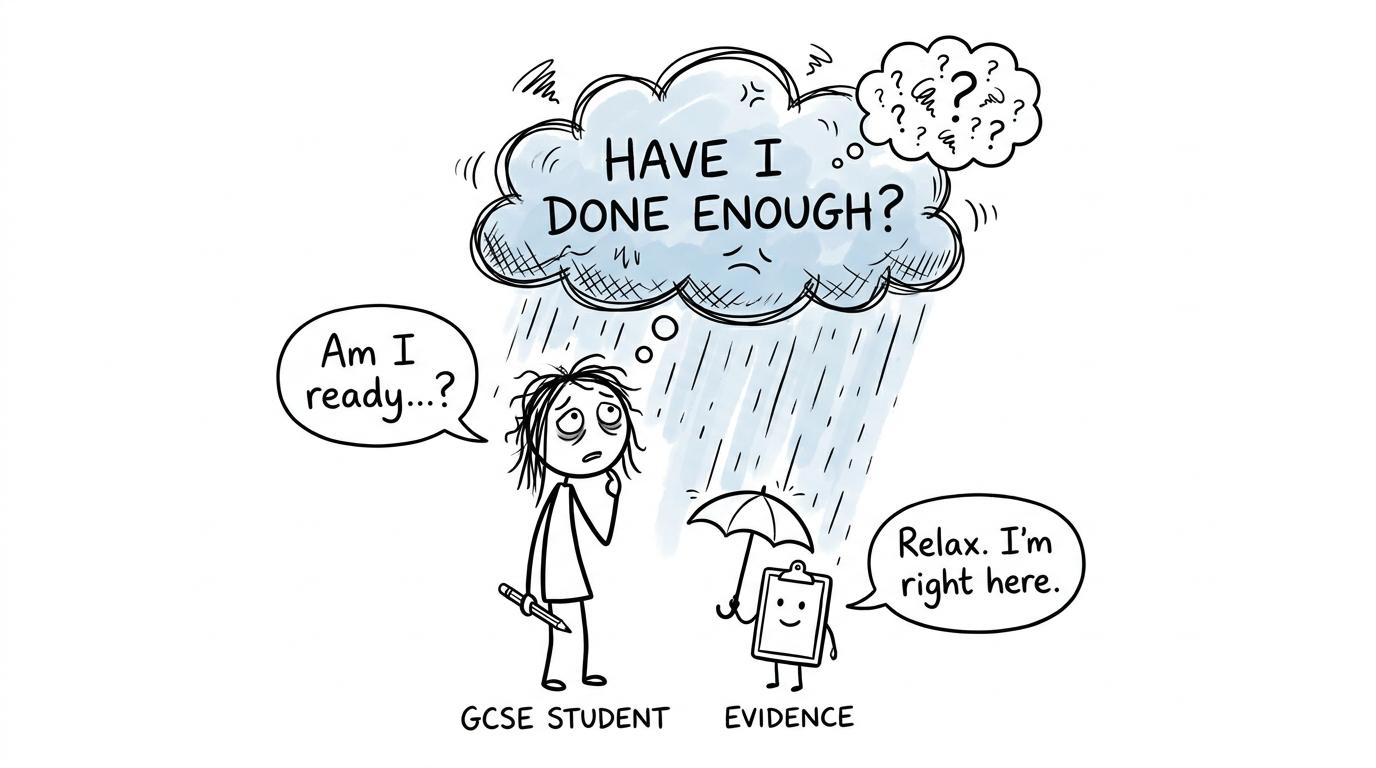 A student shelters from an anxious revision cloud using evidence
Start with the paper you will actually sit
Do not judge your preparation against a vague idea of “Arabic”. Check the specification used by your school, the tier entered and the exact tasks you will face. Qualification structures can change, and an International GCSE may not follow the same format as a GCSE in England.
For the current Pearson Edexcel GCSE Arabic qualification, listening, speaking, reading and writing are assessed separately, with each skill contributing rac{1}{4}=25\% of the qualification. Students enter Foundation or Higher tier across all four papers, rather than mixing tiers. Dictionaries are not permitted.
The specification covers five broad themes: identity and culture; local area, holiday and travel; school; future aspirations, study and work; and the international and global dimension. Knowing vocabulary from only your favourite themes is therefore not enough.
Your teacher should be the final source for your board, tier and speaking arrangements. In the same way, students balancing Arabic with maths should confirm whether their maths papers are Edexcel, AQA, OCR or Eduqas. The GCSE maths revision hub lets you select the appropriate board instead of revising for the wrong paper.
Replace revision hours with four kinds of evidence
Time is an input. Performance is the output.
Three hours spent copying vocabulary can feel productive while revealing almost nothing about whether you can understand an unfamiliar recording. A shorter closed-book task may provide more useful information because it forces retrieval.
Divide your evidence into four columns: listening, speaking, reading and writing. Give each one a colour after a realistic task:
- Green: secure without prompts and within the time available.
- Amber: partly secure, but vocabulary, accuracy or timing breaks down.
- Red: unable to begin reliably or heavily dependent on notes.
Do not average the colours into one comforting overall judgement. Four green reading tasks do not cancel a red speaking task. Since the four Edexcel skills are equally weighted, neglecting one leaves a substantial part of the qualification exposed.
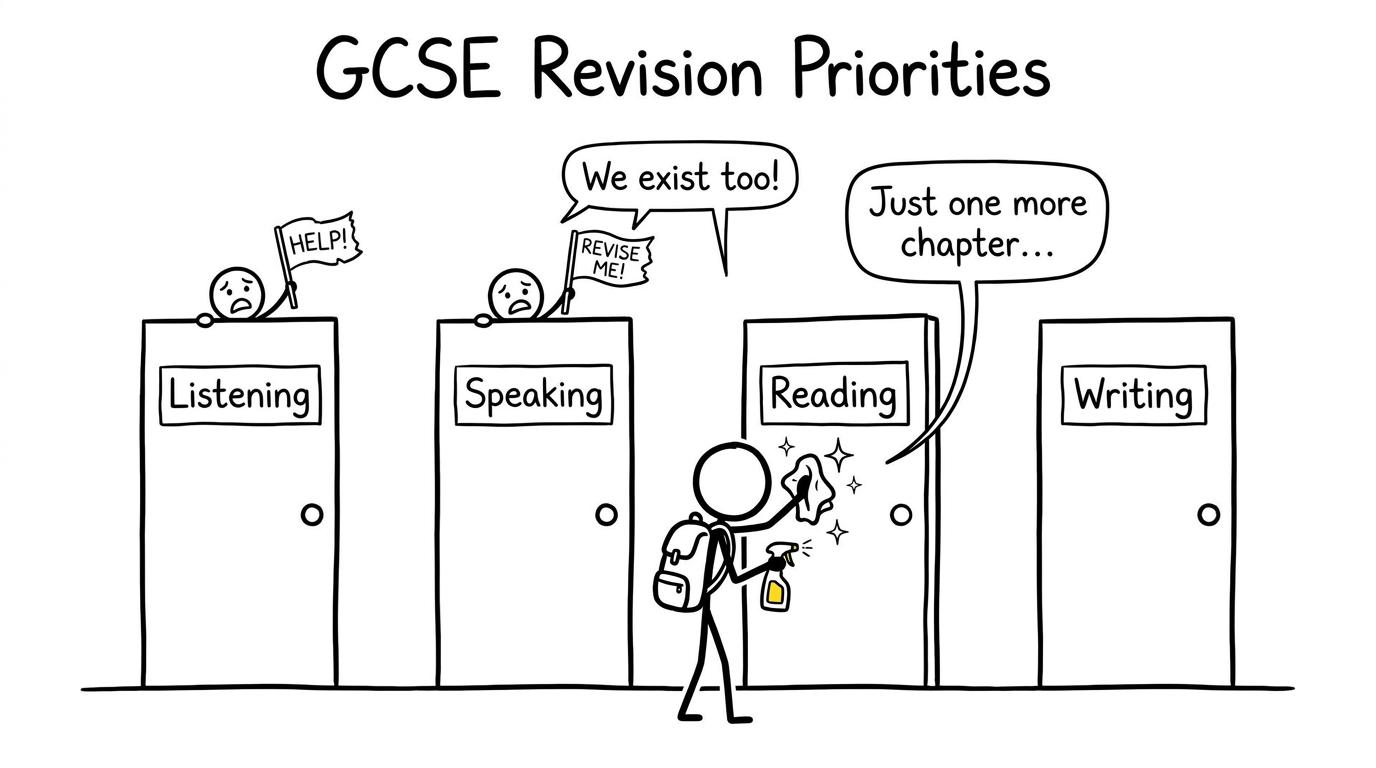 A student polishes only one of four language-skill doors
Listening evidence
You need more than recognition when reading a transcript. Use unfamiliar audio and test whether you can identify the overall message, important details, opinions and references to different time frames.
After marking, classify each error. Did you not know the word? Did you know it but fail to recognise it at normal speed? Did you miss a negative, speaker change or question instruction? Those are different weaknesses and need different repairs.
Listening is moving towards green when your result remains reasonably stable across different topics and voices. Replaying one familiar recording until you know its sequence is memory for that recording, not general listening readiness.
Speaking evidence
For Edexcel GCSE Arabic, the speaking assessment includes a role play, a picture-based task and a conversation. Readiness therefore means being able to communicate and react, not merely deliver a polished paragraph.
Record yourself completing an unseen or teacher-approved prompt. Then listen for:
- whether you answered the question directly;
- whether your meaning remained clear;
- whether you developed answers with details and opinions;
- whether you used more than one time frame where appropriate;
- whether hesitation prevented communication;
- whether you could handle an unexpected follow-up.
A prepared bank of flexible phrases can help. A completely memorised script is fragile because one unfamiliar question can take the conversation away from it.
Reading evidence
Reading readiness involves extracting information from varied texts rather than translating every word. The Edexcel reading paper can include formats such as advertisements, emails, letters, articles and literary texts, as well as translation from Arabic into English.
Use unseen material and close your vocabulary list. Ask whether you can infer meaning from context, distinguish fact from opinion and answer in the language requested by the question. If one unknown word causes you to abandon the whole passage, practise reading around gaps rather than reaching immediately for a translation.
Writing evidence
Writing should be tested under a time limit and against the task instructions. Check that you have covered every required point, communicated relevant ideas and used vocabulary and structures accurately enough to make your meaning clear.
You also need to practise translation into Arabic where required by your paper. Drafting an impressive answer at home with unlimited checking is useful during learning, but it is not proof that you can reproduce the skill in the examination.
When reviewing your work, separate errors into content, grammar, vocabulary, spelling or script, and timing. A specific diagnosis creates a specific next action.
Use the attempt, mark, fix and retest cycle
The most honest revision cycle is simple:
- attempt an unfamiliar task without notes;
- check it using an appropriate mark scheme or teacher feedback;
- record the precise reason for each lost mark;
- practise the smallest skill that would correct it;
- retest with different material after a gap.
The retest matters. Looking at a correction can create the feeling of understanding before the learning is secure.
MathsGenie uses the same logic for maths preparation. Its guide to finding your weakest GCSE topics explains how to turn errors into targeted revision, while using past papers properly shows why a paper should lead to marking, repair and another test.
Apply that process independently to Arabic, then use it again for maths. A method can transfer between subjects even when the content cannot.
How much evidence is enough?
There is no universal number of hours because students begin from different places. Instead, look for a pattern across several days.
You probably need more focused revision if:
- one skill remains consistently red;
- performance collapses when notes disappear;
- you recognise vocabulary but cannot retrieve it;
- familiar tasks go well but unseen ones do not;
- timing prevents you from finishing;
- the same errors return after correction.
You are closer to enough when all four skills have recent evidence, weak areas improve on retesting and timed work no longer produces completely new categories of problem. This does not mean every answer is perfect. It means your remaining mistakes are limited, understood and being managed.
A GCSE one-month revision plan can help you organise the maths side of your timetable, while the twenty-minute maths revision routine is useful when Arabic speaking or listening practice needs the longer block that day.
Balance GCSE Arabic with maths revision
Arabic needs frequent contact because vocabulary retrieval, listening recognition and speaking fluency can fade when left untouched. Maths also benefits from regular question practice. The answer is not to alternate between enormous subject marathons.
Build a weekly rhythm containing:
- short Arabic vocabulary retrieval on several days;
- regular listening and speaking rather than leaving both until the weekend;
- one timed Arabic reading or writing task;
- focused maths topic practice based on lost marks;
- a timed maths paper section or mini test;
- protected time for marking and corrections.
On MathsGenie, use Edexcel GCSE maths past papers if that is your board, or choose board-specific material through the main revision hub. The MathsGenie resources collection provides shorter tests and structured practice when a full paper would crowd out language revision.
A timetable is working when it responds to evidence. If speaking is red and algebra is green, giving both equal time merely because the timetable says so is neat but inefficient.
Common mistakes when deciding whether you have revised enough
Counting completed resources
Finishing a textbook chapter or vocabulary deck records activity, not retention. Close the resource and test what you can produce.
Revising only the comfortable skill
Students naturally return to work that feels fluent. Strong readers may keep reading while avoiding speaking; confident speakers may delay writing. Your weakest colour should usually receive the next focused session.
Using familiar material as the final test
Repeated material is excellent for learning but poor as the only measure of readiness. Your final check should include unseen questions and realistic constraints.
Treating every error as “more vocabulary needed”
Vocabulary may not be the real cause. The problem could be verb formation, agreement, reading the instruction, recognising speech at speed or planning time. Diagnose before adding another list.
Ignoring the mark scheme and task requirements
A generally good answer can still miss required content. Learn what each task asks you to demonstrate and check every bullet point before finishing.
Continuing because stopping feels irresponsible
More revision is not always better revision. Once the planned task is complete, mark it, schedule the next action and rest. Exhaustion can make tomorrow's retrieval less reliable.
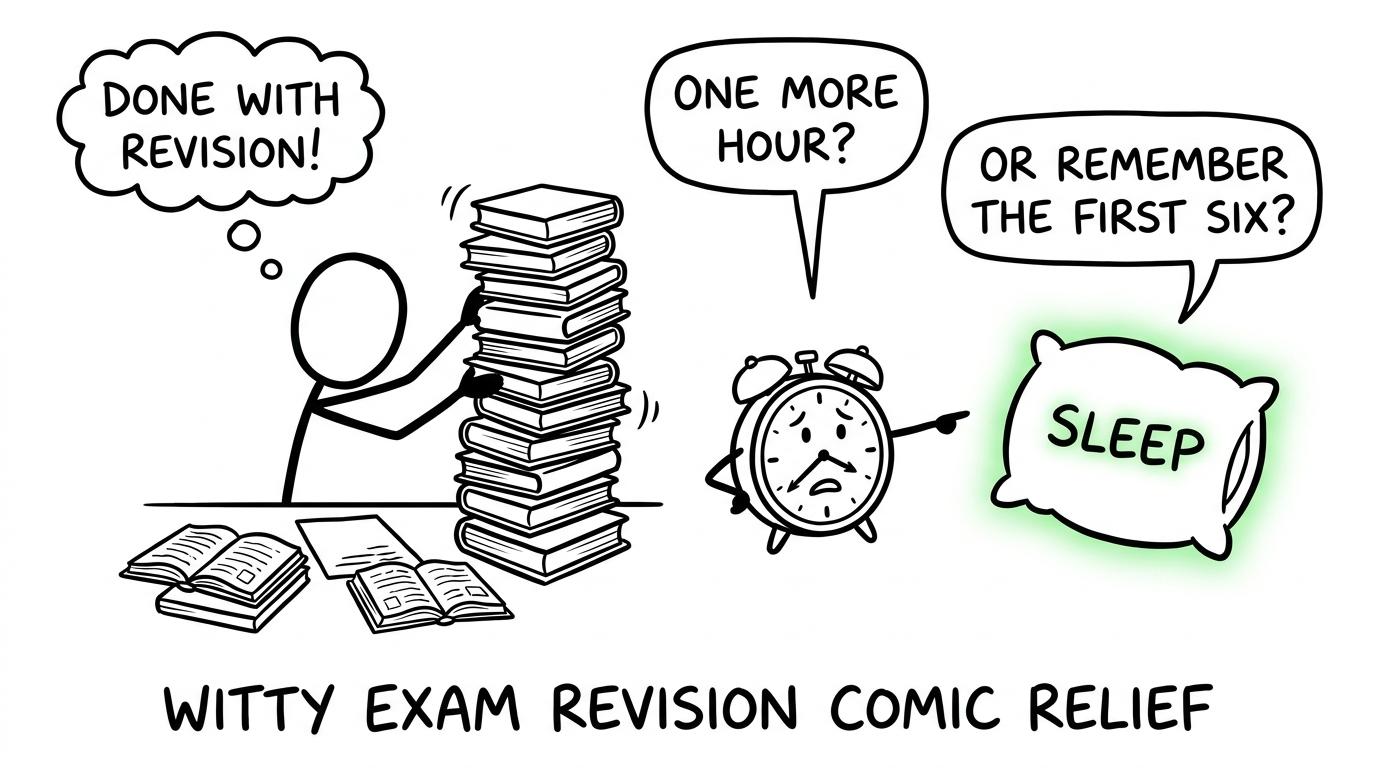 An alarm clock recommends sleep instead of another giant book stack
The article on GCSE revision mistakes that waste time offers a useful parallel for keeping maths sessions active and focused.
Stop asking anxiety to calculate readiness
Anxiety is persuasive because it can always invent another topic you might have forgotten. It cannot give you a fair measurement.
Evidence can.
Check your specification. Test all four skills. Work without notes. Mark honestly. Repair the exact weakness and return to it after a gap. When performance becomes consistent, move that skill into maintenance and give the time to a genuine red area.
Then bring the same disciplined approach back to maths. Start from the MathsGenie GCSE maths revision hub, choose your board and tier, and combine free revision lessons with practice questions, mini tests, past papers, predicted papers, mark schemes and video solutions. You do not need revision to feel endless. You need it to leave evidence.