Hate GCSE English Literature? How to Revise
Hate GCSE English Literature? How to revise with short sessions, active recall, essay plans and a realistic routine that leaves time for GCSE maths.
Disliking a subject creates a particular kind of revision problem. You know the work matters, but every other task suddenly feels more inviting. Even rearranging your desk can seem urgent.
If you have searched for “hate GCSE English Literature: how to revise?”, the short answer is this: stop waiting to enjoy the subject. Break it into small, mark-focused tasks, revise actively for short periods and measure what you can recall or plan without notes. You do not need to love a novel, play or poetry anthology to become better at answering questions about it.
That matters when you are also preparing for GCSE maths. Your goal is not to let English Literature consume the evening or to avoid it until panic arrives. It is to build a routine small enough to repeat.
Your practical revision checklist
Use this as your starting point:
- Confirm your exam board, set texts and paper requirements.
- Turn each text into themes, characters, key moments and short quotations.
- Revise for 151515 to 252525 minutes at a time.
- Retrieve information before opening your notes.
- Create essay plans more often than full essays.
- Use questions and mark schemes to understand what earns marks.
- Keep a short list of gaps and revisit them on another day.
- Protect separate time for maths and your other GCSE subjects.
The system is deliberately simple. When motivation is low, reducing the number of decisions you must make is often more useful than writing an ambitious timetable you will not follow.
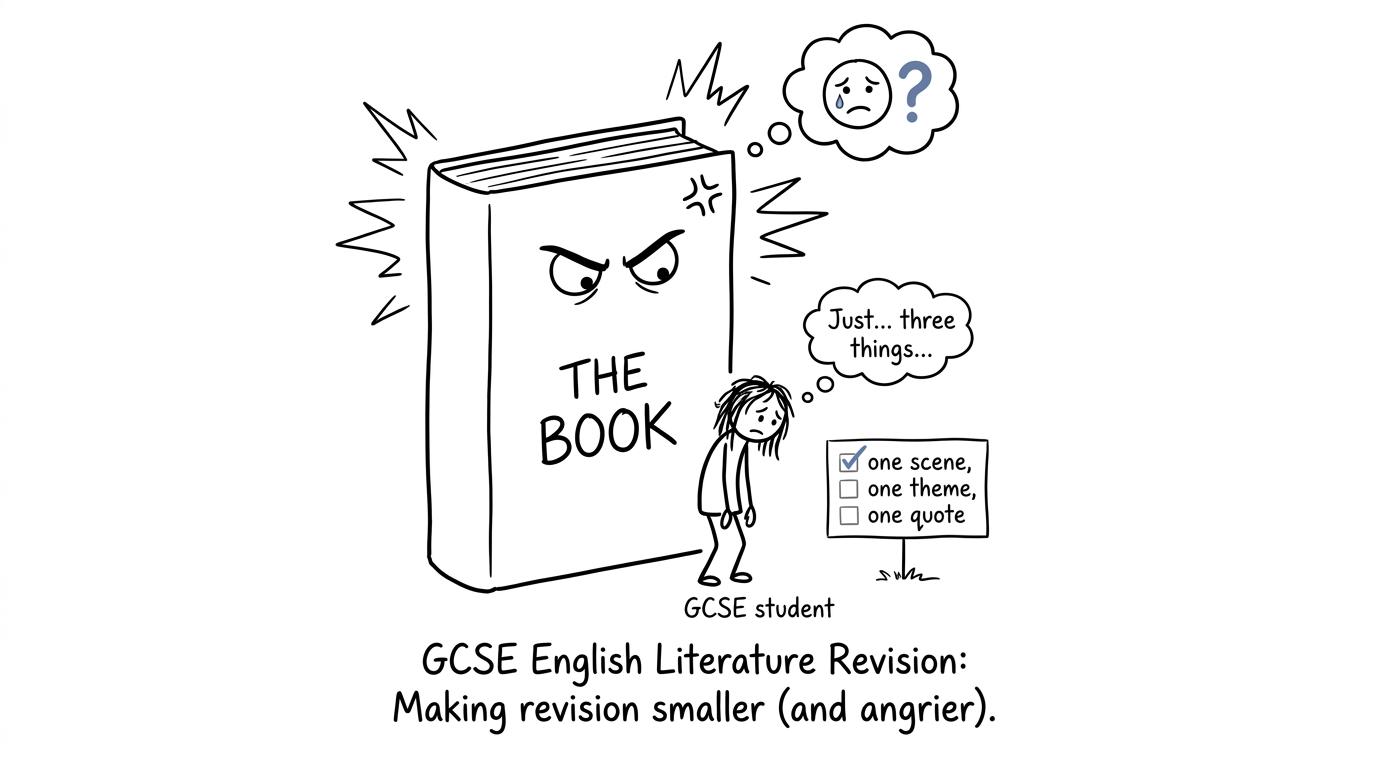 A student reducing a giant English Literature book to three manageable revision tasks
Why English Literature revision feels difficult
English Literature can feel vague compared with maths. A maths question usually has a visible destination, even when the route is difficult. Literature asks you to select evidence, build an interpretation and explain how a writer creates meaning. There may be more than one defensible response.
That does not mean marking is random. GCSE English Literature questions assess defined skills. Across specifications, these commonly include responding to the text, supporting ideas with references, analysing language, form and structure, and understanding relevant context. Spelling, punctuation and grammar are also assessed in specified parts of some papers. The exact weighting and paper structure vary, so check the current specification for AQA, Edexcel, OCR or Eduqas with your teacher.
English Literature is also untiered, unlike GCSE maths, where students sit Foundation or Higher tier papers. That can make the course feel broad. The answer is not to revise everything equally. It is to identify the knowledge that can support several possible questions.
Replace motivation with a starting rule
Motivation is unreliable because it often appears after a task has begun, not before it. Create a rule that removes negotiation:
At the scheduled time, I will revise one Literature target for 202020 minutes. I can stop when the timer finishes.
Choose the target in advance. “Revise English” is too large. Better targets include:
- recall five events from one act or chapter;
- organise quotations by theme;
- plan a response to one character question;
- annotate one poem from memory;
- compare two poems using three points;
- improve one paragraph using a mark scheme.
A small task gives your attention somewhere to land. If you continue after the timer, that is useful. If you stop, you have still completed a real session.
MathsGenie’s twenty-minute GCSE revision routine uses the same principle for maths: choose a narrow target, practise actively, check the result and decide the next step. The content changes between subjects, but the habit transfers well.
Revise what the examiner can reward
When you dislike a subject, it is tempting to spend time making revision look productive. You may copy character profiles, colour-code pages or watch videos without testing yourself. These activities can support learning, but they do not prove that you can retrieve and use ideas independently.
A stronger Literature session produces one of four things:
- recalled knowledge;
- a quotation bank;
- an essay plan;
- an improved exam response.
Think in terms of outputs rather than time spent. “I revised for an hour” tells you little. “I planned two questions and found that I could not explain the structure of one poem” gives you evidence and a next action.
This reflects established revision guidance. Active retrieval means attempting to remember before checking notes. Feedback then matters because an unchecked mistake can become more familiar. Planning, monitoring and evaluating your learning also helps you choose the right technique rather than repeating whatever feels easiest.
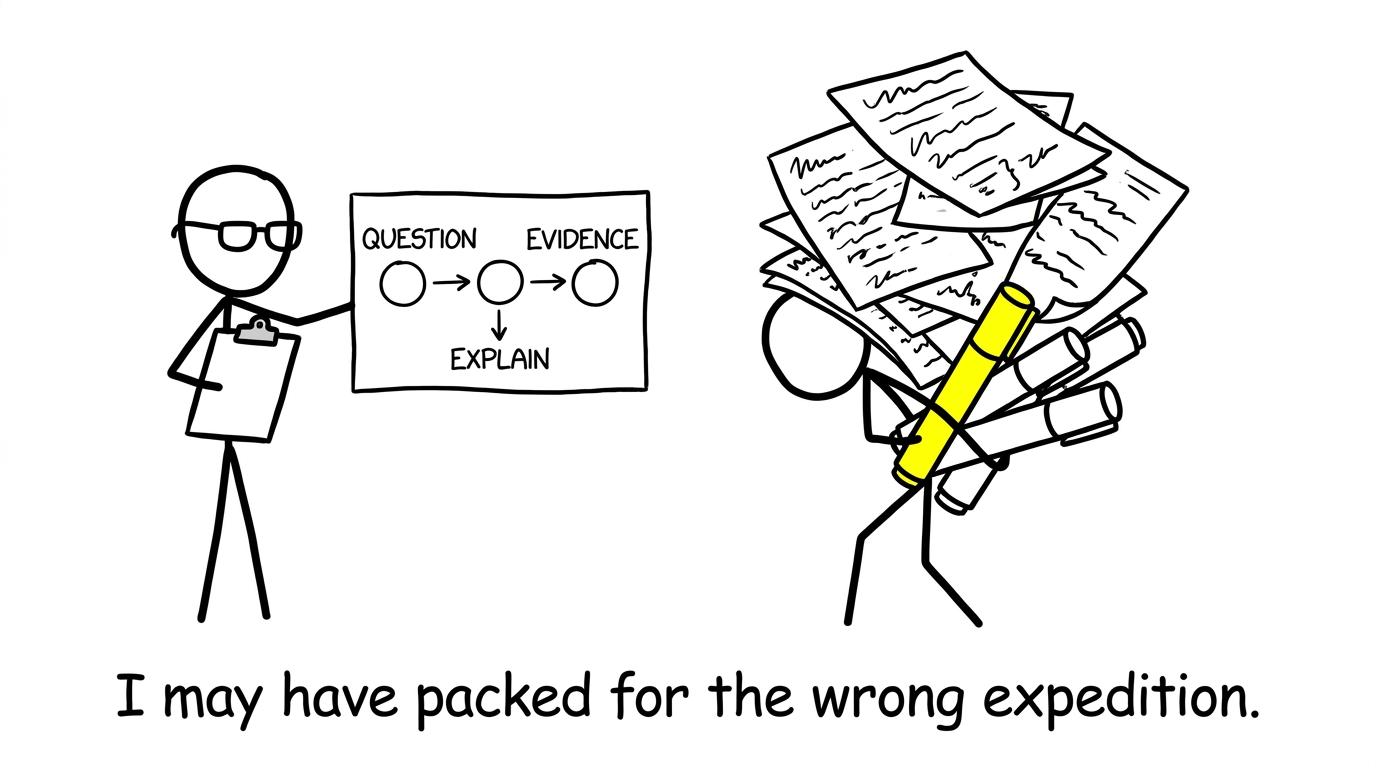 A student bringing excessive highlighters to an examiner who only wanted a clear answer plan
Build a minimum viable knowledge bank
You do not need to memorise every page. Build a compact bank for each set text using four headings.
Plot and key moments
Write the important events in order, then explain why each matters. Focus on turning points, changes in relationships and moments connected to major themes.
Characters and relationships
For each central character, know their role at the beginning, how they develop and which relationships reveal the writer’s ideas. Avoid reducing a character to a list of adjectives. Development is usually more useful than description.
Themes and writer’s choices
Connect each theme to several moments across the text. Add methods you can analyse, such as imagery, contrast, stage directions, narrative viewpoint, structure or recurring motifs. The relevant methods depend on the text and question.
Short, flexible evidence
Select brief quotations or precise textual references that can support more than one idea. Test yourself by covering the quotation, recalling it and then checking the wording. Your school should confirm the rules on text access for your board and component, so do not build your strategy on assumptions about what will be provided in the exam.
Keep context attached to interpretation. A detached paragraph of historical facts is rarely as useful as a relevant contextual point that clarifies the writer’s idea or a contemporary audience’s response.
Use essay plans when full essays feel impossible
A blank page can make Literature revision feel heavier than it is. An essay plan lowers the entry cost while still practising the decisions an exam requires.
For one question, write:
- a clear overall argument;
- three distinct points that develop that argument;
- evidence for each point;
- the writer’s method you could analyse;
- relevant context where it genuinely strengthens the explanation;
- a final note showing how your argument answers the question.
Complete some full timed responses as the exams approach, because planning alone cannot develop writing stamina or timing. But you do not need a full essay every evening. Several focused plans can expose gaps across more of the specification.
Afterwards, compare your work with the assessment objectives, teacher feedback and an official mark scheme. Ask what is missing rather than simply deciding whether the plan is “good”.
Balance Literature with GCSE maths
Students often revise the subject they prefer. If that is maths, English Literature keeps being moved to tomorrow. If maths feels safer because answers are more definite, use that preference to structure the evening rather than letting it control the evening.
A realistic sequence might be:
- 202020 minutes of Literature retrieval or planning;
- a short break;
- 303030 to 454545 minutes of targeted maths practice;
- 101010 minutes marking and recording corrections.
Alternate which subject comes first across the week if necessary. The important point is that both receive protected time.
Use the GCSE maths revision timetable guide to organise your wider week, or adapt the one-month GCSE maths revision plan when exams are close. A revision planner should show tasks, not just subjects: “Macbeth theme plan” is clearer than “English”, just as “circle theorems questions” is clearer than “maths”.
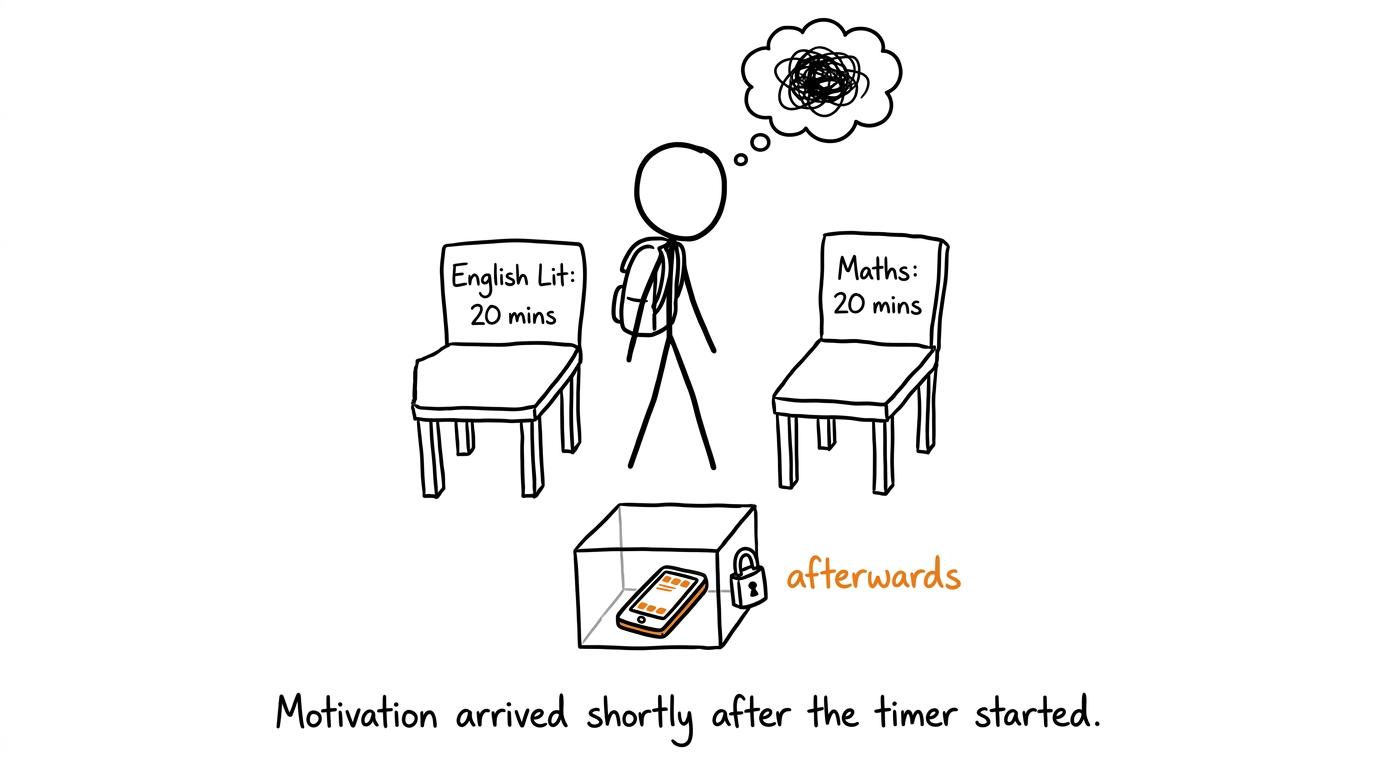 A student balancing short English Literature and maths sessions while the phone waits in a box
Create a feedback loop for both subjects
Revision improves when each attempt changes the next session. Keep a simple gap list for English Literature:
- quotation not recalled accurately;
- argument became repetitive;
- method named but not analysed;
- context was disconnected;
- comparison between poems was unclear;
- response drifted away from the question.
Then schedule one small repair task. This is similar to finding lost marks in maths. MathsGenie’s guide to identifying your weakest GCSE topics explains how evidence can replace guesswork, while the article on using GCSE past papers properly shows the paper, mark, fix and retest cycle.
For maths, the free GCSE maths revision hub brings together exam-board resources, revision lessons, topic practice, mini tests, past papers and predicted papers. Keeping those resources organised reduces the temptation to spend half a session searching for something to do.
Common mistakes when you hate GCSE English Literature
Waiting until you feel interested
Interest may grow as understanding improves, but it is not a dependable starting condition. Begin with a fixed, small task instead.
Rereading instead of retrieving
Rereading can make content look familiar without making it recallable. Close the book, write what you remember and then check it.
Memorising quotations without ideas
Evidence earns its place by supporting an interpretation. Connect every chosen quotation or reference to characters, themes, methods and possible questions.
Writing generic context paragraphs
Context should illuminate the text and answer. Avoid forcing memorised historical facts into every paragraph.
Avoiding timed writing completely
Essay plans are efficient, but some timed responses are necessary. Introduce them gradually: one paragraph, then a section, then a complete response.
Letting one disliked subject damage the whole timetable
A difficult Literature session does not mean the evening is lost. Stop at the planned time, record the next action and move to maths or another subject. The guide to GCSE revision mistakes can help you remove other habits that quietly consume revision time.
You do not have to love it to improve
The useful question is not, “How do I make myself enjoy every text?” It is, “What is the smallest task I can complete today that makes an exam question easier tomorrow?”
Choose one text. Set a 202020-minute timer. Recall a theme, organise a few pieces of evidence or plan one answer. Check the result and write down the next gap. Then stop or move to your planned maths session.
For the maths part of your GCSE preparation, make MathsGenie your free revision base. Start with revision lessons and practice questions, test yourself with mini tests, and build exam confidence through past papers, predicted papers, mark schemes and video solutions. You may not control which subjects you enjoy, but you can build a revision system that keeps moving even when motivation does not.