Harder GCSE: Religious Studies or Citizenship?
Harder GCSE Religious Studies or Citizenship Studies? Compare content, writing, exams, revision workload and skills to decide which subject suits you.
Choosing between two essay-based GCSEs can feel like choosing between two locked doors. You can read the labels, but you cannot quite see the workload behind them. If you are wondering which is the harder GCSE, Religious Studies or Citizenship Studies, the honest answer is that neither is universally harder. Religious Studies usually demands more detailed knowledge of beliefs, practices and sources of authority. Citizenship Studies places more emphasis on politics, law, evidence and applying ideas to real situations.
The better choice depends on how you think. Students who remember teachings and build balanced ethical arguments may prefer Religious Studies. Those who enjoy current affairs, government and practical action may find Citizenship Studies more natural.
The quick comparison
| Area | GCSE Religious Studies | GCSE Citizenship Studies |
|---|---|---|
| Main content | Religions, beliefs, practices, ethics and philosophy | Politics, law, rights, society and active citizenship |
| Typical memory demand | Teachings, practices, viewpoints and sources of authority | Institutions, processes, terminology and contemporary examples |
| Main writing skill | Explaining beliefs and evaluating ethical or religious claims | Applying knowledge, analysing evidence and reaching substantiated judgements |
| Practical element | Normally none | A citizenship action must be undertaken and is examined in the written papers |
| Assessment | Written examinations | Written examinations |
| Best suited to | Students interested in belief, ethics and philosophical questions | Students interested in politics, law, society and public issues |
This comparison is a guide, not a verdict. The exact route depends on your exam board and the options selected by your school, so check the current specification before deciding.
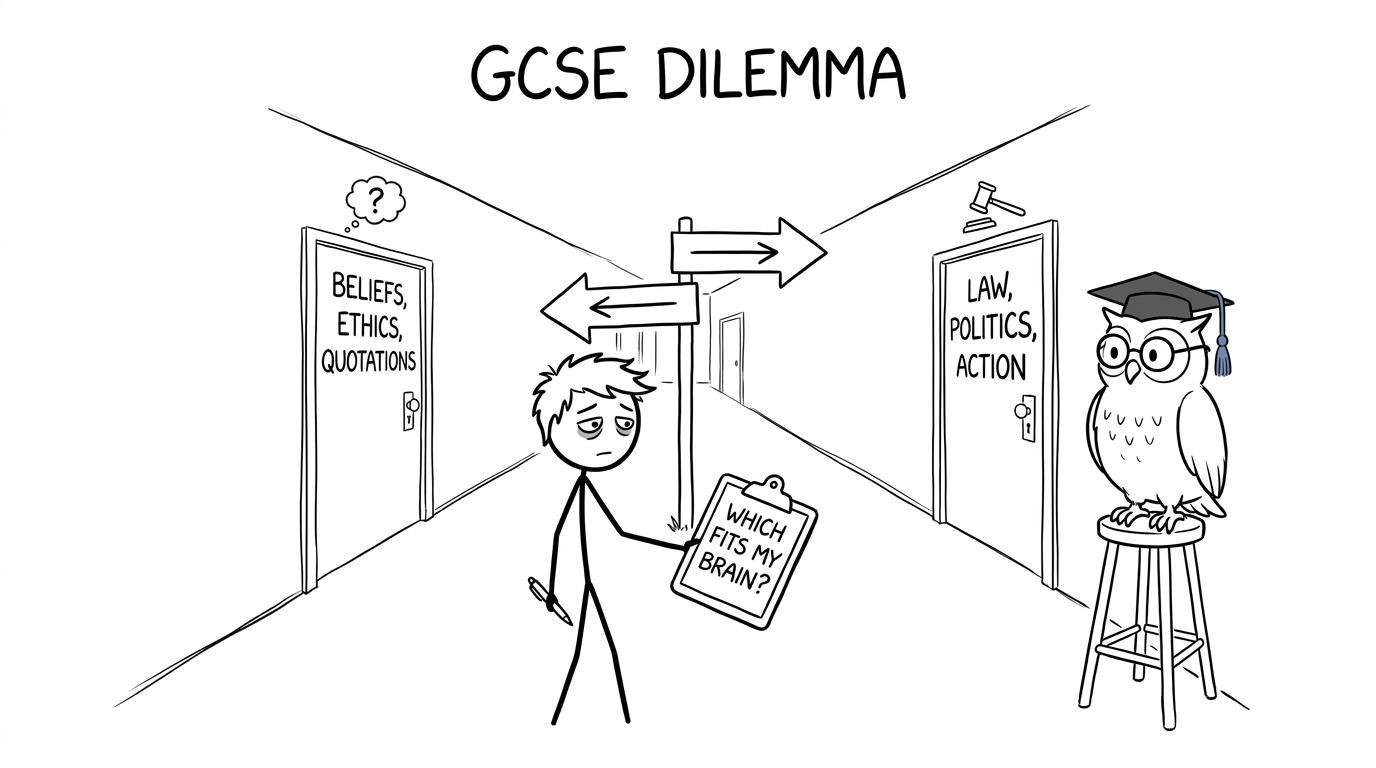 A GCSE student choosing between beliefs and citizenship
What makes GCSE Religious Studies difficult?
Religious Studies is not simply a test of whether you know what a religion teaches. It tests whether you can explain beliefs accurately, show their influence and evaluate competing views.
Ofqual's assessment objectives divide GCSE Religious Studies equally between knowledge and understanding and analysis and evaluation. In broad terms, AO1 accounts for 50%50\%50% of the qualification and AO2 accounts for the other 50%50\%50%. A student who memorises facts but cannot evaluate a statement will therefore leave a large part of the available marks untouched.
The volume of beliefs and practices
The national subject content requires students to demonstrate knowledge and understanding of two religions. This can include beliefs, worship, festivals, moral principles, sources of authority and differences within a religious tradition.
The challenge is precision. Saying that a group “believes in God” is rarely enough. Strong answers distinguish between traditions, explain why a belief matters and connect it to practice. You may also need appropriate references to scripture or another source of wisdom and authority.
On AQA Religious Studies A, for example, students complete one component on the beliefs, teachings and practices of two religions and another on thematic or textual studies. Each component is worth 50%50\%50%. The current AQA structure uses two written examinations, each lasting one hour and forty-five minutes. Edexcel Religious Studies A uses three externally examined papers, illustrating why the exam board matters when comparing workload.
Evaluation is more than giving an opinion
A long Religious Studies response is not rewarded merely because it contains a personal view. You need a reasoned argument that considers different religious and non-religious perspectives, uses accurate support and reaches a justified conclusion.
This can suit students who like philosophical questions because the arguments often have a recognisable rhythm: claim, explanation, alternative perspective and judgement. Yet that same structure can become difficult under time pressure when several developed arguments are required.
What makes GCSE Citizenship Studies difficult?
Citizenship Studies often appears more familiar because its topics include Parliament, elections, law, rights and the media. Familiarity can be misleading. Knowing that Parliament makes laws is not the same as accurately explaining a legislative process, applying political knowledge to a source or evaluating the likely effectiveness of citizen action.
Across GCSE Citizenship Studies specifications, AO1 has a weighting of 30%30\%30%, AO2 has a weighting of 30%30\%30%, and AO3 has a weighting of 40%40\%40%. Analysis and evaluation therefore carry the largest share. The subject rewards students who can use knowledge rather than simply repeat it.
Politics and law require exact language
Citizenship contains a substantial specialist vocabulary. Parliament, government and the judiciary are connected, but they are not interchangeable. Civil and criminal law are not the same. A pressure group, political party and trade union may all influence decisions, but they operate differently.
This makes the course demanding for students who rely on general knowledge. News awareness can provide useful context, but the specification remains the boundary of what must be revised. Current examples are valuable only when they are accurate, relevant and connected to the question.
Citizenship action adds a different kind of workload
Students must undertake citizenship action. This might involve investigating an issue, planning action, using citizenship skills and evaluating its impact. It is not simply an optional class project.
The precise assessment arrangement varies by board. For AQA, students sit two written papers, each worth 50%50\%50%, and Paper 1 includes questions about their citizenship action investigation. Edexcel also uses two written papers, each worth 50%50\%50%, with students examined on their experience of taking citizenship action. OCR uses three written components and also requires citizenship action.
The action is generally assessed through the examinations rather than as a separate coursework grade. Even so, planning, carrying out and remembering the project creates a workload that Religious Studies normally does not have.
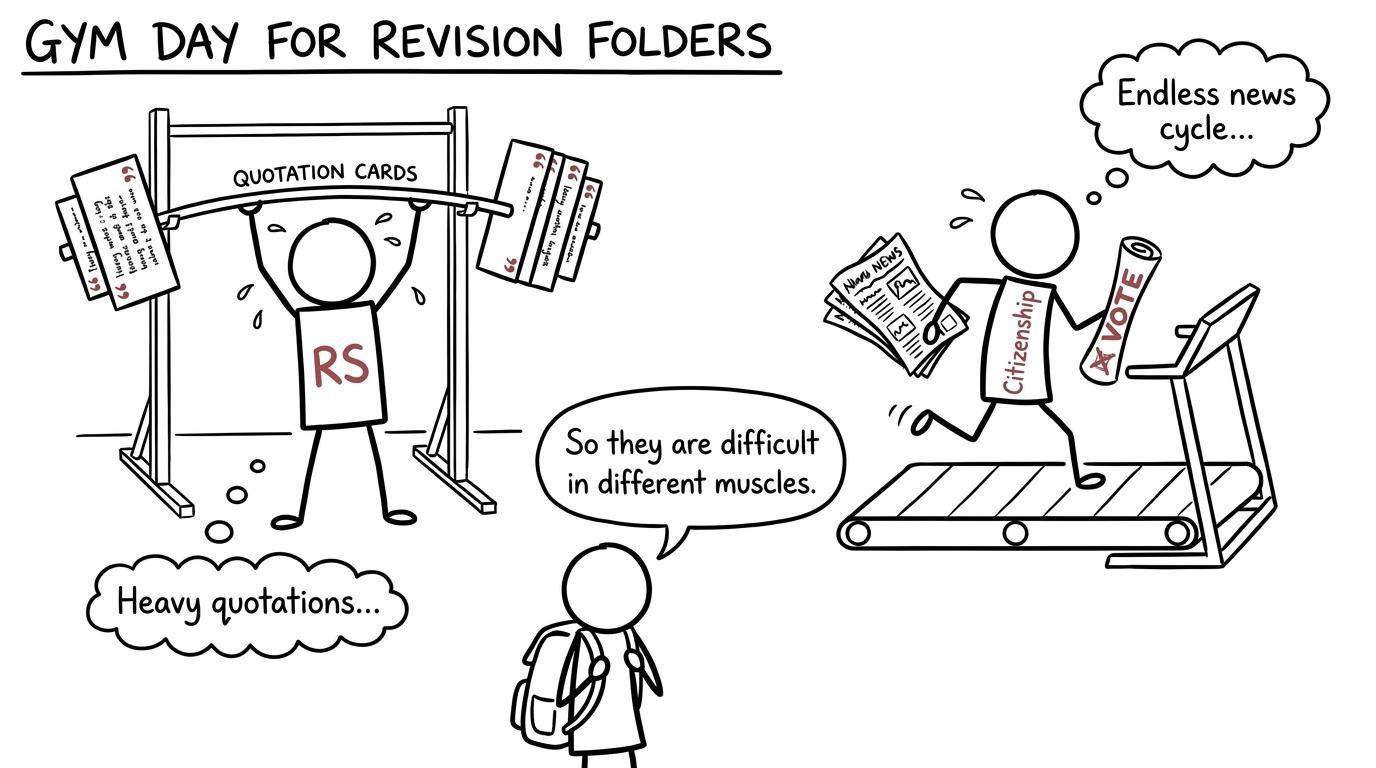 RS and Citizenship training different revision muscles
Which subject has the heavier revision workload?
Religious Studies tends to have the heavier content-recall workload. You may need to remember beliefs from two religions, differences within traditions, practices, ethical viewpoints and supporting sources. The facts also need to be organised by topic so they can be retrieved quickly.
Citizenship Studies tends to have the heavier application workload. You need secure knowledge of political and legal systems, but you must repeatedly apply it to evidence, scenarios, debates and action. The citizenship investigation also requires engagement beyond ordinary note learning.
A useful way to compare them is to ask what makes you tired:
- If learning teachings and precise religious perspectives feels slow, Religious Studies may be harder.
- If interpreting sources and applying political knowledge feels uncertain, Citizenship Studies may be harder.
- If extended writing is your main weakness, both will require deliberate practice.
- If you dislike project-based activity, Citizenship's action requirement may feel like the larger burden.
- If you struggle to separate similar viewpoints and support them accurately, Religious Studies may demand more revision time.
Neither qualification is tiered. Unlike GCSE maths, there is no foundation or higher paper choice to change the range of available grades. All candidates face the full assessment demand for their specification.
Which GCSE is easier for a maths-focused student?
Being comfortable with maths does not automatically favour one subject. However, some habits transfer surprisingly well.
Citizenship can appeal to students who like systems. Government, law and participation contain processes, categories and cause-and-effect relationships. Source questions also reward careful interpretation rather than decorative writing.
Religious Studies can appeal to students who enjoy logical argument. A strong evaluation behaves rather like a proof: each claim needs support, assumptions must be clear and the conclusion should follow from the reasoning. The subject is not mathematical, but disciplined thinking matters.
The larger issue is revision time. Your option subjects must fit alongside compulsory GCSEs, including maths. Before choosing, look at your whole timetable. The GCSE Maths Revision hub helps you see the lessons, practice questions, papers and mini tests that already need space in your week. The full GCSE maths topic list by board and tier can make that commitment more visible.
How to decide which subject fits you
Look at real specification content
Do not choose from the subject title. Ask your school which exam board and route it teaches, then compare the actual topics and paper structure. AQA, Edexcel and OCR do not package every course identically, and schools select particular religions, themes and teaching routes.
Test both types of thinking
Read one authentic question from each subject. Do not try to produce a polished answer. Instead, ask:
- Can I generate specific knowledge for this question?
- Do I understand the command word?
- Would I enjoy improving this type of answer over two years?
- Does the content create curiosity or only resistance?
One difficult question proves very little. Look for the pattern across several topics.
Judge workload honestly
A subject you enjoy is not automatically easy, but interest reduces friction. Students are more likely to revisit difficult material when the questions matter to them. The best option is often not the subject with the shortest specification. It is the one whose difficult work you are more willing to practise.
That principle also improves maths revision. MathsGenie's guide to the best order for learning GCSE maths topics shows how sequencing can make a large course manageable. If exams are approaching, a structured one-month GCSE maths revision plan can help protect maths time while you revise essay subjects.
How to manage both essay revision and maths
A common mistake is to revise essay subjects by rereading notes and maths by watching solutions. Both methods feel productive because recognition is comfortable. Exams require retrieval and performance.
Use short, separate cycles:
- For Religious Studies, retrieve beliefs, teachings and contrasting views, then plan a timed response.
- For Citizenship, retrieve key processes and terminology, then apply them to a source or issue.
- For maths, learn or review a method, complete practice questions, mark them and retest the weakness.
Introduce full papers gradually. The guide to when to start GCSE past papers explains why shorter diagnostic work should lead into timed papers rather than being replaced by them. Near an exam, the GCSE maths night-before plan can also help you avoid sacrificing sleep to unfocused revision.
Common mistakes when comparing these GCSEs
Assuming Citizenship is just current affairs
Current examples may support an answer, but they cannot replace specification knowledge. Students still need accurate political, legal and social concepts.
Assuming Religious Studies is just personal opinion
Evaluation must be informed by knowledge. Unsupported opinions do not meet the same standard as developed arguments grounded in religious and non-religious perspectives.
Ignoring the citizenship action requirement
Citizenship involves practical participation that is assessed through written examinations. Consider the planning and reflection involved, not only the final exam timetable.
Comparing paper numbers without comparing total demand
More papers do not automatically mean a harder qualification. Duration, content, assessment objectives and question styles all matter. Exam structures also vary between boards.
Choosing based on somebody else's grade
Another student's result reflects their teaching, interests, preparation and exam performance. It does not establish which subject will be easier for you. Grade boundaries also vary by qualification and exam series, so raw percentages are not a reliable shortcut for comparing subjects.
The final verdict
So, is the harder GCSE Religious Studies or Citizenship Studies? Religious Studies is likely to feel harder if you dislike learning detailed beliefs, practices and supporting sources. Citizenship Studies is likely to feel harder if you dislike politics, legal processes, evidence analysis or practical action. Both demand accurate knowledge, extended writing and justified evaluation.
Choose using your school's actual specification, your response to real questions and the workload you can sustain beside maths. Then make the rest of your revision simpler. Start with the free MathsGenie GCSE maths resources, use revision lessons and practice questions to repair weak topics, and build towards mini tests, past papers, predicted papers, mark schemes and video solutions. A good subject decision protects your time. A good revision system makes that time count.