

Harder GCSE ICT or Computer Science? A Fair Guide
Harder GCSE ICT or Computer Science? Compare coding, theory, practical workload, exams and maths skills to choose the qualification that fits you best.
Choosing between two subjects can feel strangely harder than revising either of them. One may sound practical and familiar; the other may seem technical, mathematical and full of code. So, which is the harder GCSE: ICT or Computer Science?
For most students, GCSE Computer Science is harder conceptually. It requires programming, computational thinking, algorithms, data representation and detailed knowledge of computer systems. ICT-based qualifications are usually less abstract, but their practical projects, documentation and controlled deadlines can create a substantial workload. The honest answer depends on your strengths and, crucially, the exact qualification your school offers.
Before deciding, check:
- the official qualification title and code;
- whether assessment is mainly examinations or practical work;
- how much programming is required;
- whether you prefer logical problems or extended project work;
- which course your school can teach and support effectively.
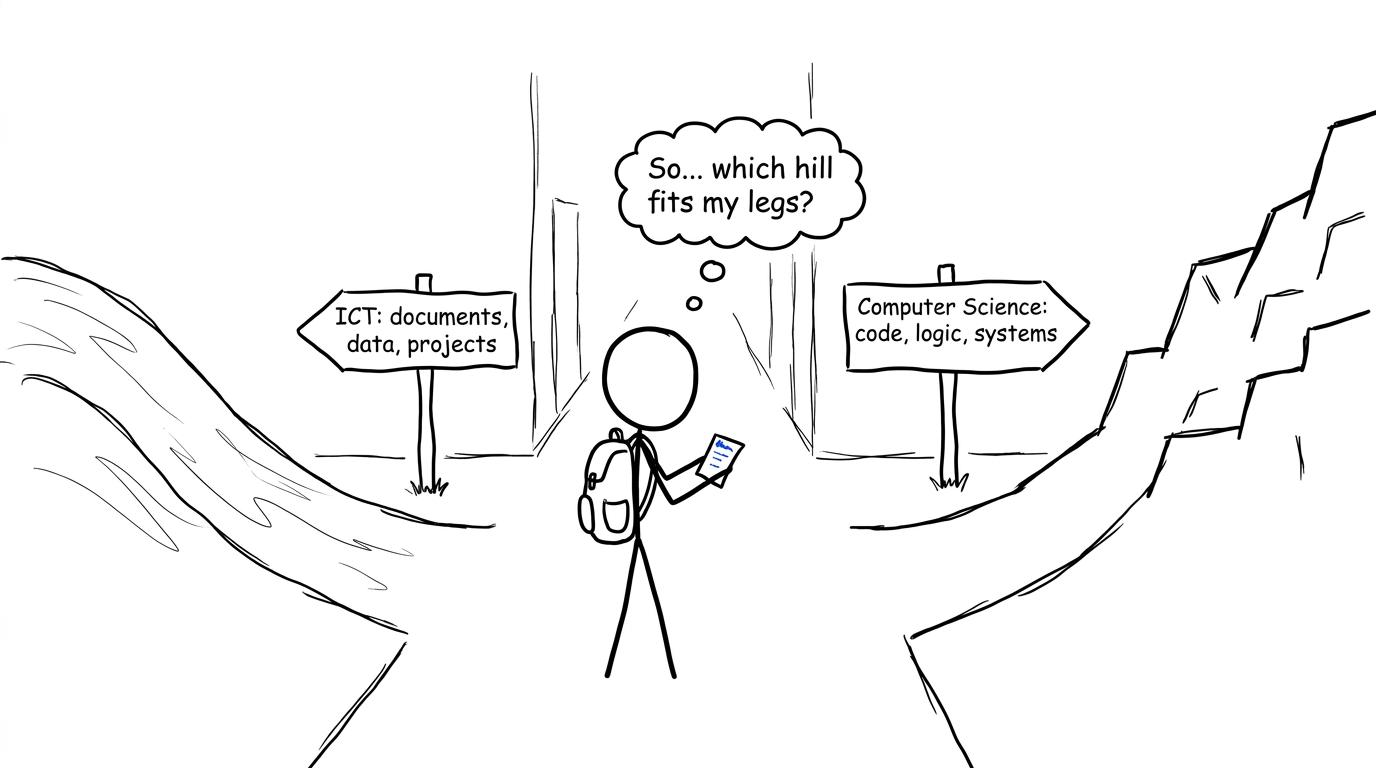 A student choosing between the different hills of ICT and Computer Science
First, check whether it really is GCSE ICT
The name matters more than many students realise. In England, the former GCSE ICT was withdrawn, with its final examinations taking place in 2019. GCSE Computer Science remains available through boards including AQA, Pearson Edexcel and OCR.
Schools may still use “ICT” informally to describe a digital or information technology course. The qualification might instead be a vocational award, Technical Award, Cambridge National or another course with practical assessment. These are not automatically easier versions of GCSE Computer Science. They have different content and assessment models.
The position is also different across the UK. Wales has had WJEC ICT and Digital Technology qualifications, and new made-for-Wales qualifications are being introduced on their own timetable. Course availability can therefore depend on where you live and when you will be examined.
Ask your teacher for the qualification title, awarding body and specification code. Then compare the actual specifications rather than comparing two labels that may describe different courses.
The short answer: which subject is harder?
GCSE Computer Science will generally feel harder if you dislike abstract reasoning, coding or solving unfamiliar problems. ICT will generally feel harder if you dislike sustained practical work, detailed evidence, evaluation and managing project deadlines.
| Area | ICT-style qualification | GCSE Computer Science |
|---|---|---|
| Main emphasis | Using digital tools to create effective solutions | Understanding computation and designing algorithms |
| Typical content | Documents, spreadsheets, databases, multimedia, digital systems and evaluation | Programming, algorithms, data representation, networks, cyber security and computer architecture |
| Mathematical demand | Usually low to moderate | Moderate, especially for binary, logic and algorithms |
| Practical workload | Often substantial and deadline-driven | Regular programming practice, with final assessment commonly examination-based |
| Main difficulty | Accuracy, documentation and completing extended tasks | Abstraction, problem-solving and applying knowledge under exam conditions |
| Best suited to | Organised students who enjoy producing and improving digital products | Students who enjoy logic, coding and understanding how systems work |
Neither column means “easy”. They simply place pressure in different places.
Why GCSE Computer Science often feels harder
Programming must be practised, not merely remembered
Programming is cumulative. If variables, selection and iteration are insecure, later work with arrays, subroutines and more complex algorithms becomes difficult. Reading notes can help you recognise terminology, but recognition is not the same as being able to trace, write, test and refine code.
Current Computer Science specifications require students to understand practical programming and computational problem-solving. Depending on the exam board, students may need to answer using program code, pseudocode, flowcharts or an exam reference language.
That makes revision closer to learning algebra than memorising a list of facts. You need repeated practice, feedback and correction. The same principle supports effective maths revision: learn a method, practise it, mark it and return to the errors. MathsGenie’s guide to revising GCSE maths efficiently explains how to build this kind of feedback loop.
The theory is broader than coding
Computer Science is not simply a programming course. Official GCSE content includes algorithms, binary and hexadecimal representation, Boolean logic, computer architecture, storage, networks, cyber security and the ethical, legal and environmental effects of technology.
OCR’s current course, for example, includes one component on computer systems and another on computational thinking, algorithms and programming. Each contributes 50%50\%50% of the qualification. AQA also divides assessment between computational thinking and programming skills, and wider computing concepts.
A student who enjoys Python may still find network protocols difficult. Another may understand hardware but struggle to construct an algorithm under time pressure. The breadth is part of the challenge.
Examinations test application
Computer Science questions frequently ask you to apply knowledge rather than repeat a definition. You may have to trace an algorithm, locate an error, design a solution or explain why one approach is appropriate.
This resembles a demanding GCSE maths question: the method may be familiar, but the context is new. Strengthening algebra, data and probability through the GCSE maths revision hub can support the disciplined reasoning needed across both subjects.
Why ICT can still have the heavier workload
Conceptual difficulty and workload are not the same thing. A course can contain more accessible ideas while consuming more time.
Traditional ICT qualifications placed considerable weight on practical or controlled assignments. WJEC’s GCSE ICT structure, for example, included examinations alongside extended controlled assessment in which students produced, tested and evaluated ICT solutions. Practical tasks could involve databases, spreadsheets, multimedia products and communication for a specified audience.
That work demands:
- careful file and version management;
- evidence of planning and development;
- accurate use of software;
- testing against requirements;
- explanation and evaluation of decisions;
- steady progress before fixed deadlines.
A small mistake may require several connected sections to be updated. Leaving the project until the final week is rarely recoverable in the way that a short knowledge topic might be.
This is why some organised, technically confident students find ICT comfortable, while others experience it as relentless. Its difficulty is often logistical: many small requirements must be completed consistently.
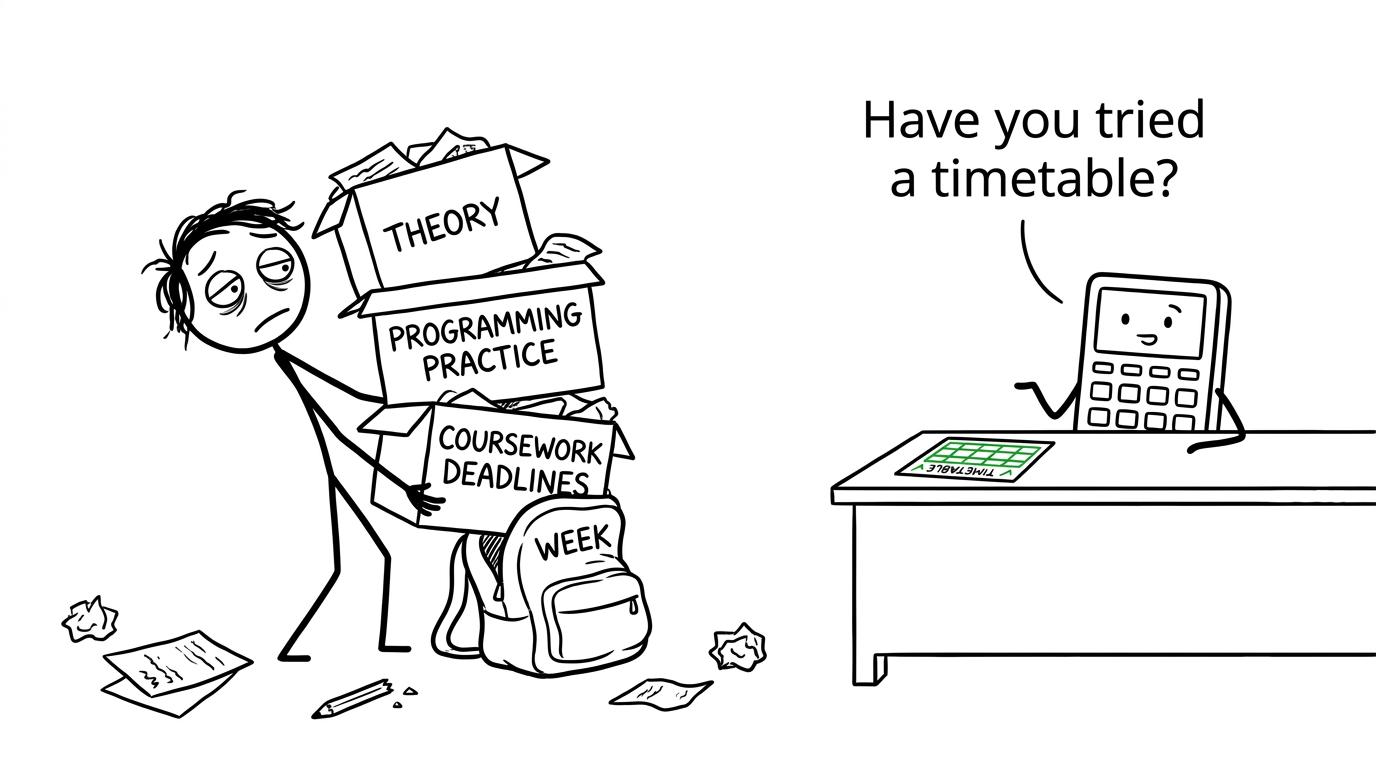 A student trying to fit theory, programming and coursework into one revision week
How much maths is in Computer Science?
GCSE Computer Science is not another GCSE Maths course, but mathematical confidence helps. Relevant skills include:
- understanding place value when converting between decimal, binary and hexadecimal;
- following logical conditions involving AND, OR and NOT;
- using variables and relational operators;
- interpreting tables and structured data;
- calculating file sizes or storage requirements where specified;
- recognising patterns and expressing a process precisely.
Boolean values are commonly represented by 000 and 111, while binary place values follow powers of 222:
20, 21, 22, 23,…2^0,\ 2^1,\ 2^2,\ 2^3,\ldots20, 21, 22, 23,…The important skill is not advanced calculation. It is accuracy within a chain of reasoning. One incorrect condition can change the outcome of an entire algorithm, just as one sign error can derail an algebraic solution.
If number fluency or algebra is a weak point, follow a sensible learning sequence rather than jumping randomly between topics. MathsGenie’s guide to the best order for learning GCSE maths topics provides a useful structure. Students working with data can also use the free GCSE Statistics revision area to strengthen interpretation and data-handling skills.
Which course is likely to suit you?
Choose Computer Science if you enjoy asking how a system works beneath the screen. You do not need to arrive as an expert programmer, but you should be willing to practise when code fails. Debugging is not evidence that you are bad at the subject. It is part of the subject.
An ICT-style course may suit you if you prefer using technology to solve practical problems for users. Strong attention to layout, purpose, accuracy, testing and evaluation matters. You should also be comfortable maintaining effort across a longer project.
A useful decision test is to separate interest from familiarity. Using a computer every day does not necessarily mean you will enjoy Computer Science. Equally, enjoying games does not automatically mean you will enjoy programming. Look at specimen questions and sample tasks from your school’s precise qualification before choosing.
Also consider teaching arrangements. Access to regular programming feedback can make a major difference in Computer Science, while clear milestone planning is especially important for a practical ICT course.
Comparing the real revision workload
Computer Science usually needs frequent, shorter sessions. A balanced week might include code tracing, programming practice, retrieval of theory and an examination question. Long gaps are costly because programming fluency fades.
ICT project work often needs longer blocks in which you can develop, test and document a product without repeatedly stopping. Its workload may be concentrated around controlled-assessment milestones.
Whichever course you take, protect your maths preparation rather than letting another subject absorb every evening. The one-month GCSE maths revision plan shows how to combine focused topic sessions with timed practice. Nearer the exams, Edexcel GCSE Maths predicted papers can provide additional rehearsal alongside official past papers.
Common mistakes when comparing ICT and Computer Science
Assuming ICT is automatically easy
Practical assessment can involve substantial planning, testing and written evaluation. Familiar software does not remove the need to satisfy precise assessment criteria.
Choosing Computer Science because you like technology
Interest in phones, games or computers is a useful starting point, but the course focuses on algorithms, programming and systems. Check whether you enjoy the underlying reasoning.
Ignoring the exact qualification
“ICT” may be a classroom label rather than the title printed on your certificate. Assessment percentages and task types cannot be compared fairly until you know the board and specification.
Revising programming by watching
Watching someone else code can create an illusion of fluency. Write, trace, test and debug programs yourself. Active practice reveals gaps that videos cannot.
Treating every lost mark as a knowledge problem
Some marks disappear through weak terminology, incomplete explanations, coding syntax, poor time management or missing project evidence. Diagnose the cause before choosing the remedy. The same idea is explored in MathsGenie’s advice on redoing past papers effectively.
Make the decision from evidence, not reputation
For most students, GCSE Computer Science is the harder academic course because it combines abstract theory, programming and unfamiliar problem-solving. An ICT-style qualification may be less conceptually demanding, yet harder to manage if it carries extensive practical work and documentation.
The better question is not simply, “Which is easier?” It is, “Which kind of difficulty am I more willing to practise?” Ask for the exact specification, inspect the assessment structure and try representative tasks from both options.
Then keep your wider revision steady. MathsGenie gives you free revision lessons, practice questions, mini tests, past papers, predicted papers, mark schemes and video solutions for GCSE and A Level maths. Start with the GCSE maths revision hub, identify the skills costing you marks and build a routine that leaves room for every subject on your timetable.











