Harder GCSE English Literature or English Language?
Harder GCSE English Literature or English Language? Compare workload, exam demands and revision styles, then balance English with GCSE maths revision.
The uncomfortable thing about comparing GCSE English subjects is that they can both feel difficult for opposite reasons. If you are wondering whether it is harder GCSE English Literature or English Language, the short answer is this: Literature usually has the heavier content and memory workload, while Language can be harder to predict and perform consistently in under timed conditions.
That distinction matters. A student who remembers quotations easily may prefer Literature. Another who responds confidently to unfamiliar texts may find Language more manageable. Neither qualification is objectively harder for everyone, and the exact assessment structure depends on your exam board and specification.
For students also preparing for GCSE maths, the useful question is not simply which subject is harder. It is which one needs more of your limited revision time.
The comparison at a glance
| GCSE English Literature | GCSE English Language |
|---|---|
| Requires detailed knowledge of set texts | Uses unfamiliar reading material in the exam |
| Often involves learning flexible quotations | Rewards rapid interpretation and evidence selection |
| Includes analysis of language, form, structure and context | Includes reading analysis and purposeful writing |
| Has a larger content-revision burden | Has a larger skills-practice burden |
| Can become predictable through careful text preparation | Can feel less predictable because extracts and tasks are unseen |
A sensible conclusion is:
- Literature is often harder to revise for because there is more named content to retain.
- Language is often harder to guarantee a result in because you must apply your skills to unfamiliar material.
- Your stronger subject depends on your reading, writing, memory and time-management profile.
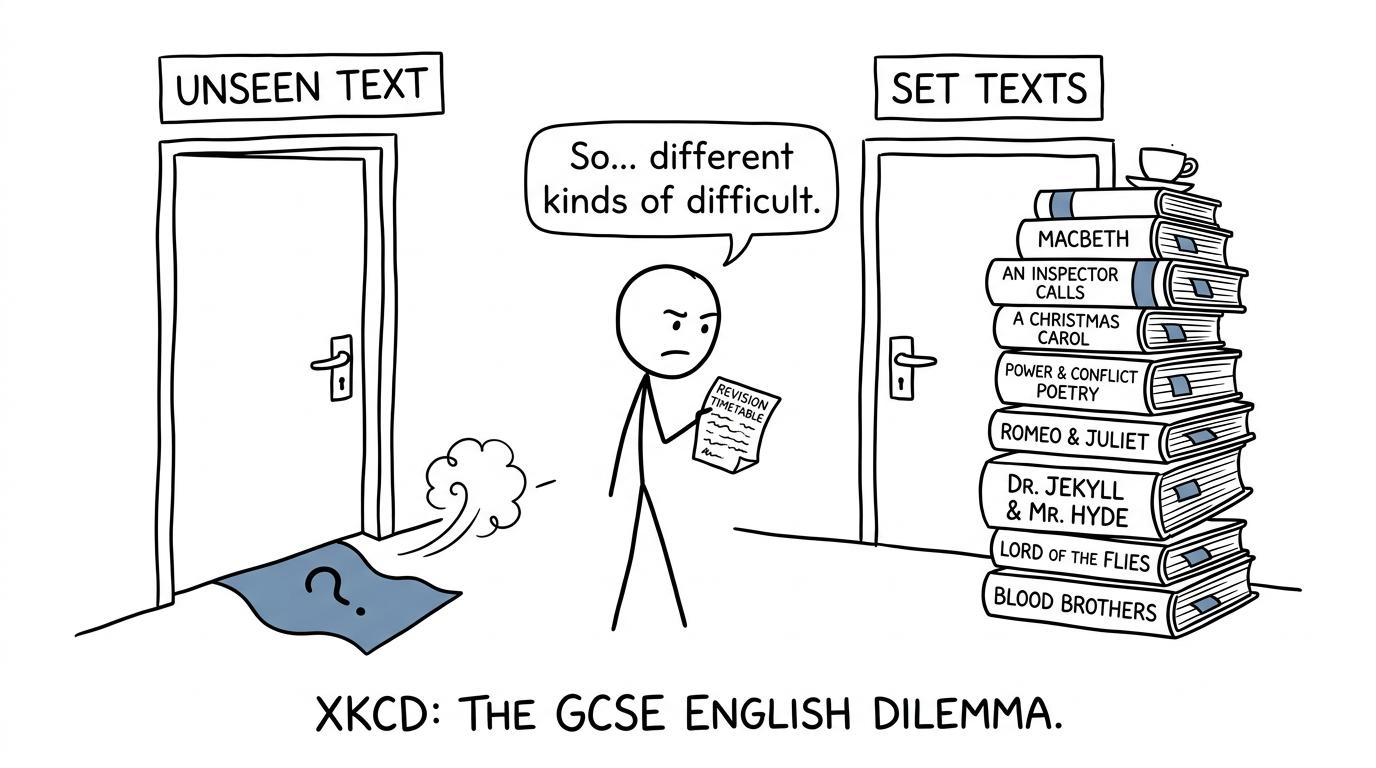 A student choosing between an unseen text and a tower of set books
Why GCSE English Literature can feel harder
Literature asks you to know texts closely enough to construct a convincing interpretation without simply retelling the plot. Depending on your specification, this may include Shakespeare, a nineteenth-century novel, modern prose or drama, anthology poetry and unseen poetry.
That creates a visible workload. You can see the books, characters, themes, quotations and contextual ideas waiting to be revised.
For example, the current AQA English Literature specification has two written papers. It assesses understanding and response, textual references, analysis of language, form and structure, relevant context, and aspects of written accuracy. AQA examinations are closed book, although the question paper supplies any extract or other stimulus required. OCR, Pearson Edexcel and Eduqas use their own paper structures and text lists, so students should always check the specification named by their school.
The memory burden is real
Strong Literature revision is not about memorising an essay for every possible question. That approach creates enormous work and collapses when the wording changes.
Instead, students need:
- secure knowledge of plot, character development and themes;
- a small bank of versatile quotations;
- understanding of how methods create meanings;
- relevant contextual knowledge rather than detached historical facts;
- practice adapting ideas to the precise question.
This resembles maths more than it first appears. Memorising a model solution is fragile; understanding why a method works is transferable. In Literature, a well-understood quotation can support several arguments. In maths, a well-understood method can survive unfamiliar wording.
Literature exposes gaps in preparation
If you have not revised a character or theme, an examination question can make that gap painfully obvious. This is why Literature often feels demanding during the months before the exams: preparation stretches across several texts rather than one isolated skill.
The positive side is that the workload is relatively visible. You can map the texts, identify weak areas and reduce uncertainty one section at a time.
Why GCSE English Language can feel harder
English Language has less set-text content to memorise, but that does not make it easy. It asks you to apply reading and writing skills to material you have not prepared in advance.
In the current AQA specification, both written papers contain unseen texts. Paper One combines creative reading with descriptive or narrative writing. Paper Two combines writers' viewpoints and perspectives with writing that presents a viewpoint. Each paper lasts one hour and forty-five minutes and carries half of the written qualification. The spoken language assessment is reported separately and does not contribute to the final written GCSE grade.
Other boards organise their assessments differently. Always use your own exam board's specification, sample material and teacher guidance rather than assuming that an AQA question order applies to Edexcel, OCR or Eduqas.
Unseen material creates uncertainty
In Literature, you know the world from which the question will come. In Language, the source itself is new. You must quickly identify relevant details, interpret implications and analyse a writer's choices.
That can particularly challenge students who need time to settle into a text. The skill is not just reading well. It is reading selectively while remaining aware of the question and the available marks.
Writing performance can vary
Language also rewards the ability to communicate clearly for a specified purpose and audience. Organisation, vocabulary, sentence control, spelling and punctuation matter. On AQA, the writing assessment objectives together account for half of the written qualification, including a substantial weighting for technical accuracy.
A student may understand the task but lose control through rushed planning, repetitive expression or an unfinished response. Language therefore benefits from repeated timed practice rather than passive revision.
Which subject has the greater workload?
For most students, English Literature has the larger content workload. There are set texts to revisit, themes to connect and quotations to retrieve. English Language generally has less prescribed knowledge but requires continued practice because analytical reading and writing fluency develop through use.
The difference can be described as stock and flow.
Literature has more stock: knowledge accumulated and retained before the examination. Language has more flow: decisions made in real time as you read, plan and write.
That is why counting revision hours alone can be misleading. A Literature session might focus on consolidating a character across a whole play. A Language session might involve one timed response followed by careful marking. Both can be productive, but they solve different problems.
Decide which English GCSE is harder for you
Do not base your answer on which lesson feels more comfortable. Use evidence from recent assessments.
Check your lost marks
Review a Literature assessment and a Language assessment. For each lost mark, record the broad cause:
- missing knowledge;
- weak evidence;
- limited analysis;
- poor question focus;
- inaccurate writing;
- unfinished work;
- ineffective timing.
Then look for repetition. If Literature marks are mainly lost because you cannot retrieve useful textual details, you have a knowledge problem. If Language marks disappear near the end of every paper, you may have a timing problem rather than an English problem.
MathsGenie's guide to finding your weakest GCSE topics uses the same principle: diagnose from evidence, practise the weakest area and retest it. The subjects differ, but honest feedback works in both.
Compare improvement, not just scores
One raw mark does not tell the whole story. Ask what happened after revision. Did quotation retrieval improve your Literature response? Did timed planning make your Language writing more controlled?
The subject in which focused practice produces rapid improvement may not deserve as much emergency revision as the subject where the same weaknesses keep returning.
Balancing English with GCSE maths revision
English can quietly consume every evening because reading and essay writing have no obvious stopping point. Maths can do the same when a full paper becomes the default task. The answer is to give each session a clear purpose.
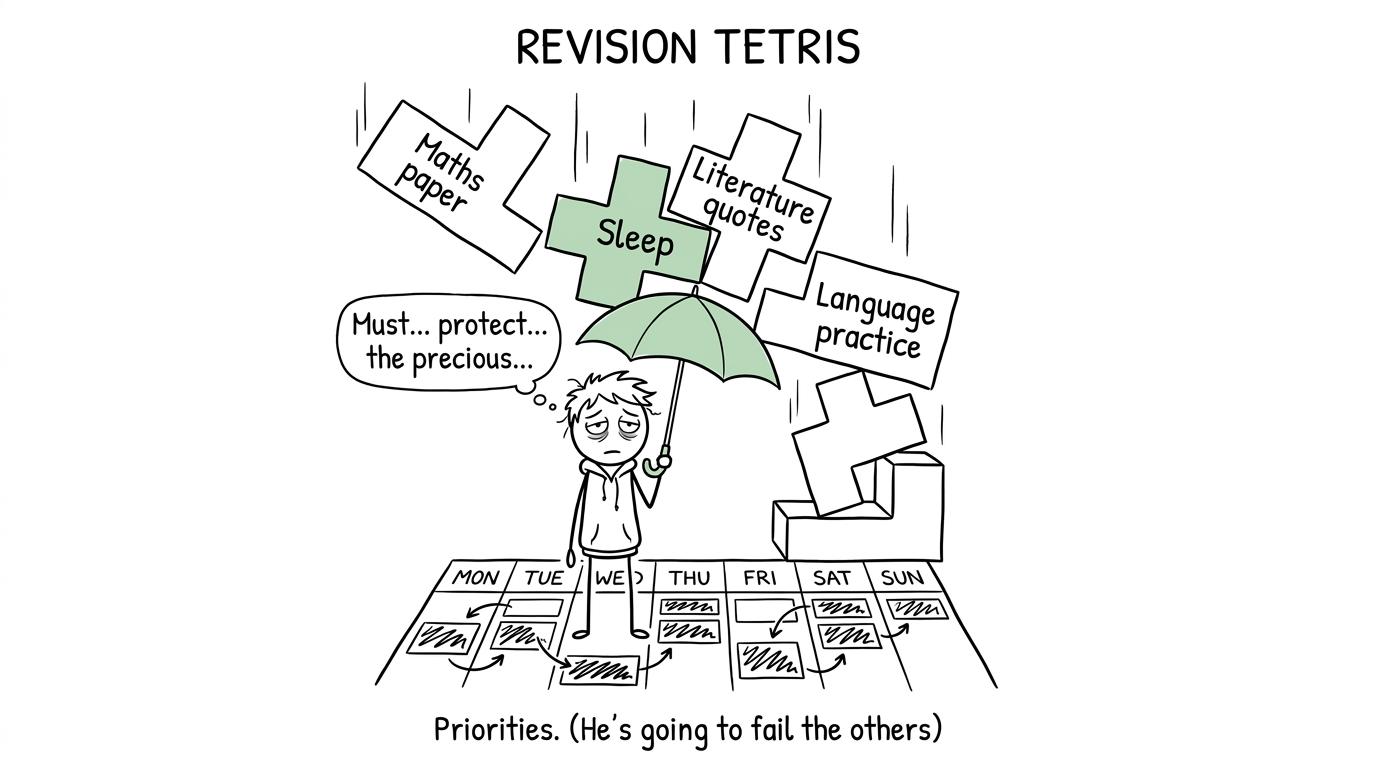 A student protecting sleep while English and maths revision blocks fall into a calendar
A balanced week might include Literature retrieval, one timed Language section and several short maths topic sessions. The exact allocation should follow your assessment evidence, not an equal-time rule.
Use the GCSE one-month maths revision plan if you need a repeatable weekly structure. On busy school days, the twenty-minute maths revision routine can protect mathematical fluency without crowding out English preparation.
When you need fast evidence of progress, try Edexcel GCSE maths mini tests. Longer sessions can be reserved for Edexcel GCSE maths past papers, with the method adapted to the board and tier you actually take.
The aim is not to revise every subject every night. It is to stop one difficult subject from making the others invisible.
Common mistakes when comparing the subjects
Assuming Language needs no revision
There may be fewer facts to memorise, but reading selection, analysis, planning and accurate writing need deliberate practice. Completing timed sections and reviewing them is more useful than repeatedly reading generic technique notes.
Memorising complete Literature essays
Prepared paragraphs can become irrelevant when the examination question takes a different angle. Learn adaptable evidence, arguments and connections instead.
Ignoring the exact exam board
AQA, Pearson Edexcel, OCR and Eduqas do not use identical papers. Question order, duration, text choices and assessment arrangements can differ. Your teacher and current specification should be the final authority.
Treating difficulty as fixed
A weak mock result is evidence about your current preparation, not a permanent label. Difficulty changes when knowledge becomes retrievable and routines become familiar.
Sacrificing maths whenever English feels urgent
Urgency is not always priority. Preserve short maths sessions, then build towards timed practice. MathsGenie's advice on when to start GCSE past papers helps you place full papers at the right stage rather than using them too early or too often.
The final verdict
So, is GCSE English Literature or English Language harder? Literature usually carries the greater revision workload because of its set texts, quotations and contextual understanding. Language often presents the greater performance uncertainty because its reading material is unseen and its writing must be produced accurately under pressure.
The harder subject is the one whose demands least match your current strengths. Find that answer through marked work, not reputation.
Then protect the rest of your timetable. Use Literature sessions to build connected knowledge, Language sessions to practise timed application, and MathsGenie to keep maths revision structured. Start with free revision lessons and practice questions, test yourself with mini tests, and move towards past papers and GCSE predicted papers. Mark every attempt, use the mark schemes and video solutions, and let each mistake decide what you revise next.