Group vs 1:1 Tutoring GCSE Classical Civilisation
Group vs 1:1 tutoring GCSE Classical Civilisation compared by feedback, discussion, cost and learning needs, helping you choose the right support.
A tutoring choice can look simple until you are the person making it. One option offers a room full of ideas; the other offers undivided attention. If you searched for group vs 1:1 tutoring GCSE Classical Civilisation, the short answer is this: group tutoring is usually better for discussion, shared interpretation and affordability, while one-to-one tutoring is better for targeted feedback, individual knowledge gaps and personalised exam practice.
Neither format is automatically superior. The better choice depends on what is currently costing you marks, how confidently you participate and whether the tutor understands your exact specification.
The quick decision checklist
Choose group tutoring if you:
- learn by hearing different interpretations;
- are comfortable contributing to discussions;
- want a more affordable option;
- need motivation from revising alongside other students;
- have broadly similar needs to the rest of the group.
Choose one-to-one tutoring if you:
- have specific gaps in content knowledge;
- need detailed feedback on extended responses;
- find it difficult to ask questions in front of others;
- need sessions adapted to your pace, confidence or learning needs;
- are approaching the exam with limited time and clear priorities.
Before booking either, ask whether the tutor teaches the precise components studied by your school. That matters more than an impressive-sounding general description of classics tuition.
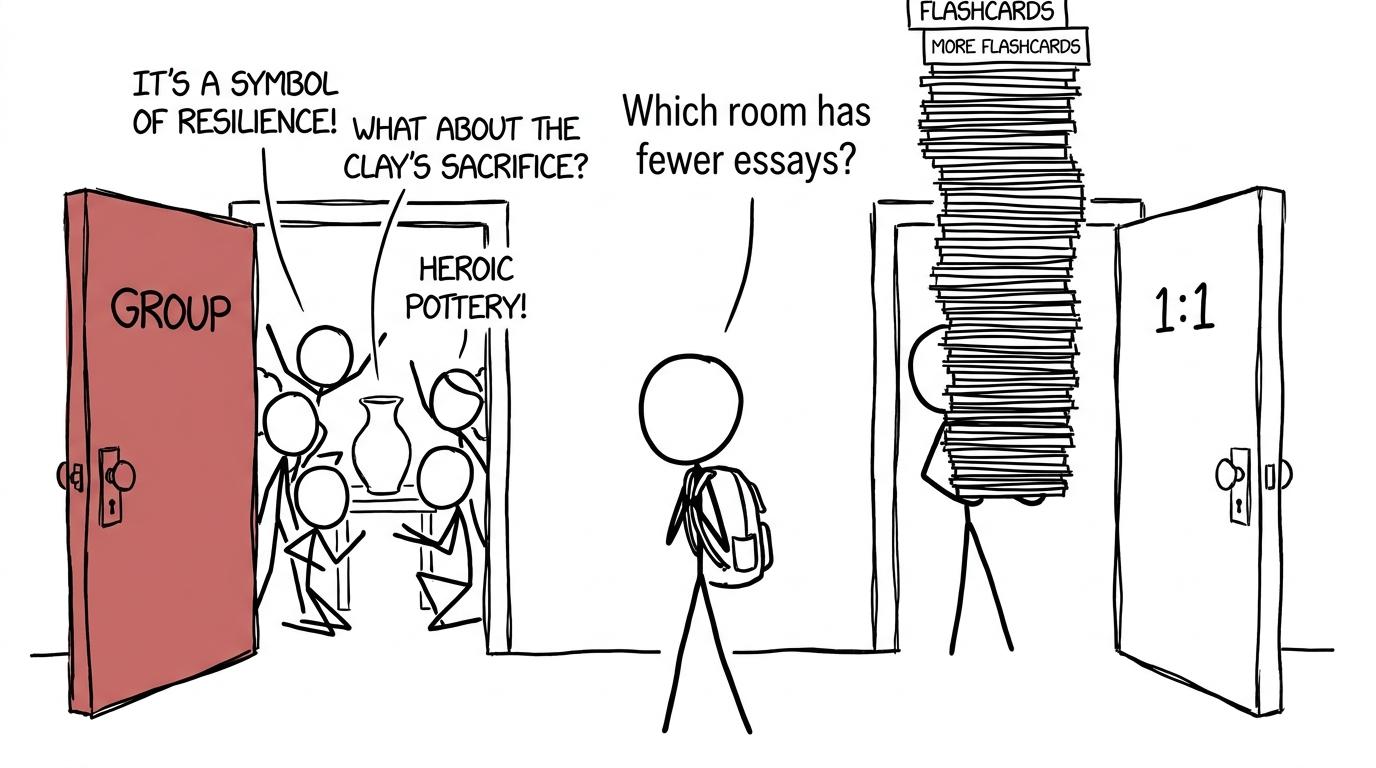 A student choosing between lively group tuition and an enormous stack of one-to-one flashcards
What GCSE Classical Civilisation actually demands
The current Cambridge OCR GCSE Classical Civilisation qualification is not simply a memory test about gods, heroes and Roman buildings. Students take one Thematic Study and one Literature and Culture component. Each is assessed through a written examination lasting one hour and thirty minutes and worth 50%50\%50% of the qualification.
The Thematic Study choices are Myth and Religion or Women in the Ancient World. Literature and Culture options include The Homeric World, Roman City Life, and War and Warfare. Students encounter literary evidence alongside visual and material sources, with both shorter questions and extended responses.
The assessment objectives help explain why tutoring format matters. AO1, knowledge and understanding, accounts for 60%60\%60% of the assessment. AO2, analysis and evaluation using evidence and coherent reasoning, accounts for 40%40\%40%.
A student might therefore know the story of Odysseus yet struggle to evaluate what a source suggests about heroic values. Another might write intelligently but confuse key details from Greek and Roman religious practice. The first needs analytical practice; the second needs accurate, structured retrieval. They may not benefit equally from the same tutoring arrangement.
The real strengths of group tutoring
Discussion reveals more than one valid interpretation
Classical Civilisation involves interpretation. A literary character, artefact or religious practice can often be approached from several defensible angles, provided the argument remains grounded in evidence.
In a well-run group, one student may notice how a source presents power, while another focuses on gender, status or audience. Listening to both can prevent the mistaken belief that every extended question has one hidden answer. It also teaches students to test an interpretation rather than merely state it.
This is where group tutoring can be especially valuable. The tutor can challenge the group to compare claims, select relevant evidence and explain why one judgement is more convincing than another.
Shared questioning can expose hidden gaps
Students do not always know what they do not know. Someone else may ask about the context of a vase, the reliability of a literary source or the difference between Greek and Roman practice. That question can uncover a gap shared by several members of the group.
Group sessions can also reduce the feeling that everyone else understands the course perfectly. Confusion becomes something to investigate rather than conceal.
The social structure can improve consistency
A regular group creates accountability. Students arrive knowing that they may be asked to contribute, compare evidence or review an answer. For someone who struggles to begin revision alone, that rhythm can matter.
Research summarised by the Education Endowment Foundation indicates that small-group tuition can improve attainment when it is targeted, consistent and aligned with classroom teaching. Its definition of a small group is generally two to five pupils. The research covers tuition broadly rather than GCSE Classical Civilisation specifically, so it should guide expectations rather than promise a particular grade.
Group tuition is normally more economical
Because the tutor's time is shared, the cost per student is generally lower than individual tuition. That may make regular sessions sustainable for longer. A strong term of group tuition can be more useful than a few isolated one-to-one sessions that end before new habits take hold.
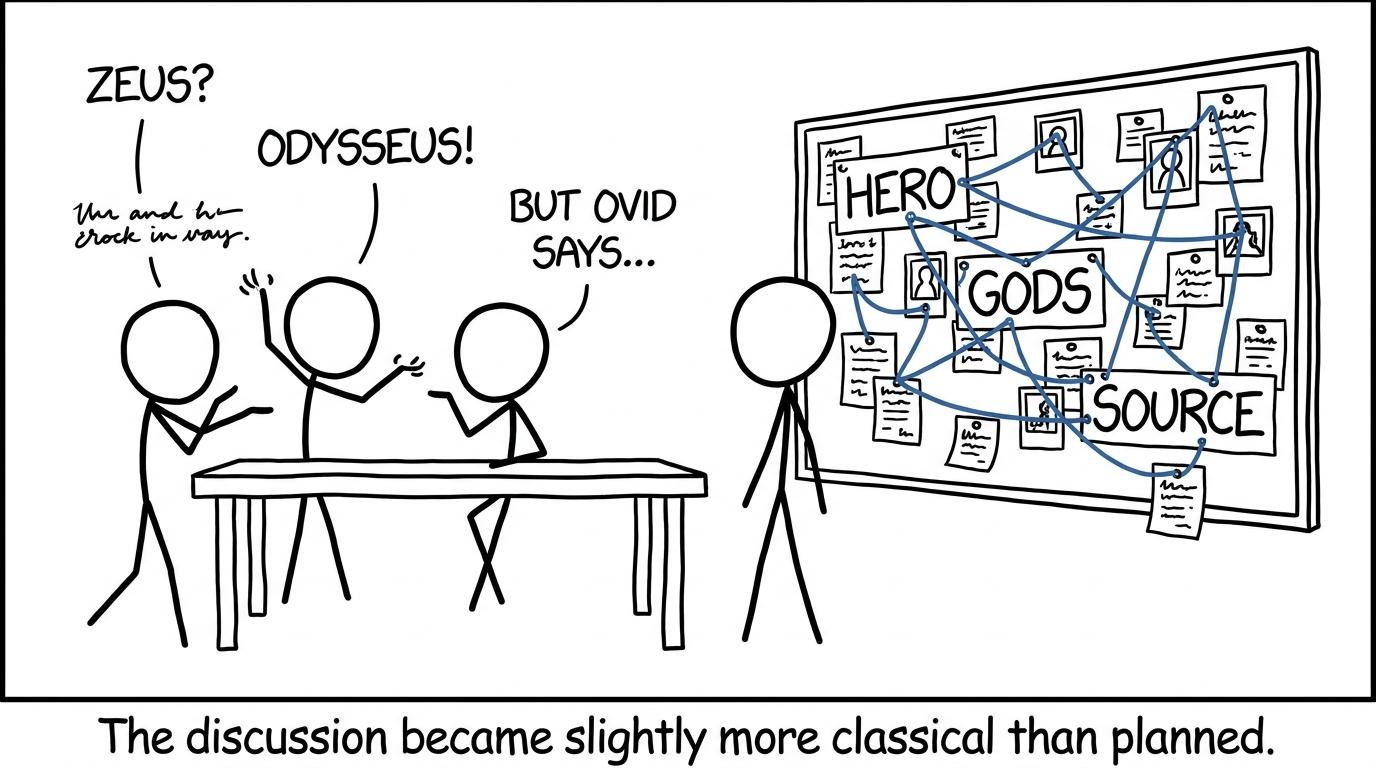 A Classical Civilisation group discussion becoming an elaborate evidence investigation
Where group tutoring can fall short
A group only works when its members are reasonably well matched. If one student is revising Myth and Religion while another needs Women in the Ancient World, shared teaching becomes difficult. The same problem appears when students study different Literature and Culture options.
Pace matters too. A confident student may dominate discussion while a quieter student leaves with misconceptions untouched. As groups grow, personalised feedback becomes harder. Research on tutoring suggests that effectiveness tends to diminish as groups become larger, especially beyond six or seven pupils.
Before joining, ask:
- How many students will attend?
- Does everyone study the same Cambridge OCR components?
- Will written work receive individual feedback?
- How will the tutor check each student's knowledge gaps?
- Are sessions planned around the specification and classroom course?
A session marketed as a group may resemble a small class rather than targeted tuition. The label matters less than what happens during the hour.
The real strengths of one-to-one tutoring
Every minute can address your needs
Individual tuition can begin with diagnosis. Perhaps you repeatedly lose marks when comparing Greece and Rome. Perhaps your source knowledge is secure but your judgements remain vague. A tutor can identify that pattern and build the session around it.
This focus is especially useful near an examination, when revising an entire textbook is less sensible than repairing the gaps visible in marked work.
Feedback can become precise
Extended responses improve through specific feedback. “Add more detail” is rarely enough. A one-to-one tutor can show where an argument becomes descriptive, where evidence needs explaining and where a conclusion fails to answer the exact question.
The student can then revise the response immediately and explain the reasoning aloud. That cycle is difficult to reproduce when a tutor must divide attention across several people.
The pace belongs to the student
Some students need extra time to process an unseen visual source. Others understand quickly and need harder questions rather than another explanation. Individual tuition allows the tutor to slow down, accelerate or change approach without affecting anyone else.
It may also suit students who are easily distracted, reluctant to speak in groups, or who require more personalised support. These benefits depend on a calm and responsive tutor, not merely the absence of other students.
One-to-one tuition can target urgent gaps
EEF evidence finds that one-to-one tuition has a positive average effect, particularly when it is linked to normal teaching and aimed at identified weaknesses. However, comparisons with groups of two or three produce mixed results. In some studies individual tuition performs better; in others, very small groups are similarly effective.
The practical lesson is important: paying for individual attention does not guarantee better teaching. Tutor expertise, planning, attendance and the quality of feedback remain decisive.
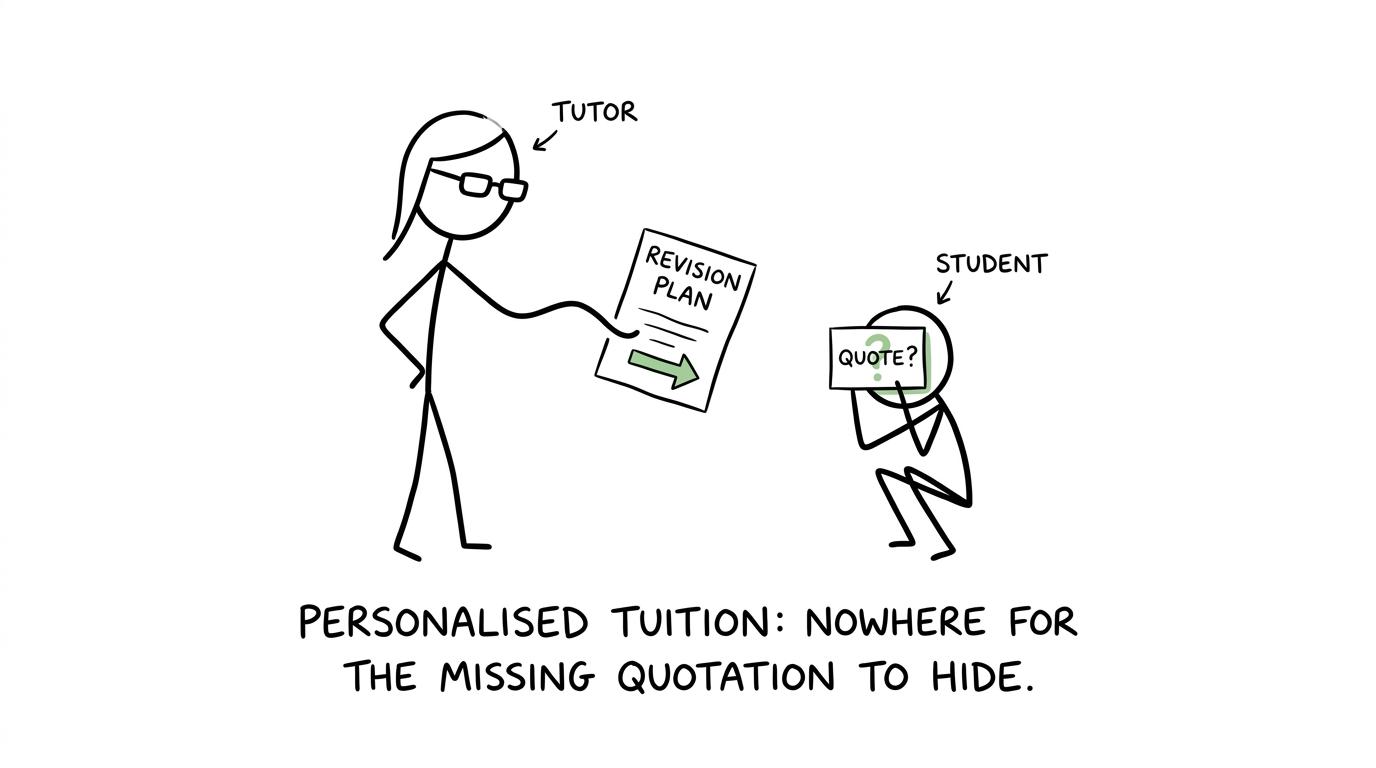 A flashcard discovering there is nowhere to hide during personalised tuition
Where one-to-one tutoring can fall short
The clearest disadvantage is cost. Individual tuition concentrates the tutor's time on one student, so it is normally more expensive per session. Families should consider whether the arrangement is sustainable rather than judging only the first lesson.
There is also less exposure to alternative interpretations. A good tutor can introduce contrasting views, but this is not quite the same as hearing another student form and defend an argument in real time.
One-to-one lessons may also encourage passivity if the tutor talks for most of the session. Personalised tuition should require the student to retrieve facts, analyse sources, plan responses and make judgements. A private lecture is still a lecture.
Which option suits which student?
Choose a group for interpretation and momentum
Group tutoring is likely to suit a student who has reasonable content knowledge but needs to become more confident discussing sources and constructing arguments. It can also suit someone who works better with a regular social commitment.
The best group is small, studies the same components and includes individual checking rather than relying only on open discussion.
Choose one-to-one support for diagnosis and precision
Individual tuition is likely to suit a student with uneven knowledge, repeated problems in written answers or limited time before the examination. It is also sensible when a student's confidence, attention or learning needs make group participation difficult.
Bring marked school assessments to the first session. Specific evidence gives the tutor a better starting point than “I need help with everything”.
Consider a blended approach
The choice need not be permanent. A student could use a weekly group for discussion and occasional individual sessions for detailed feedback. Another might begin one-to-one, repair major gaps and move into a group once their confidence improves.
Think of tutoring as a tool selected for a problem, not an identity. The question is not which format sounds more serious. It is which format changes what you can do independently.
How to judge the tutor, not just the format
A strong tutor should know the Cambridge OCR specification and your chosen components. They should distinguish AO1 knowledge from AO2 analysis, use appropriate source-based and extended-response tasks, and give feedback connected to assessment requirements.
Ask for a clear plan covering:
- the gaps being targeted;
- how progress will be checked;
- how tuition connects with school lessons;
- what independent practice is expected;
- when the plan will be reviewed.
Consistency matters. Educational research supports sustained, regular tuition more strongly than disconnected emergency sessions. The student must still complete the thinking between meetings.
That principle applies across GCSE revision. Maths students can use the twenty-minute maths revision routine to keep daily practice manageable while balancing another essay-based subject. If it is unclear where maths marks are disappearing, the weak-topic diagnostic guide provides a practical method for turning mistakes into priorities.
Common mistakes when choosing tuition
Choosing by price alone. The cheapest session is poor value if it covers the wrong component. The most expensive tutor is not automatically the best match.
Ignoring group size. Three students discussing the same source is targeted small-group tuition. A much larger class offers a different level of attention.
Assuming tutoring replaces independent revision. Sessions should create clearer practice between meetings, not remove the need for it.
Failing to share school feedback. Marked assessments, teacher comments and the component list help a tutor target genuine weaknesses.
Measuring progress through confidence alone. Confidence matters, but it should be accompanied by stronger recall, better source analysis and improved timed responses.
Letting one subject consume the timetable. Classical Civilisation support should fit alongside English, science and maths. Use Edexcel GCSE Maths mini tests for short, focused practice, or follow the one-week GCSE maths revision plan when a structured reset is needed.
Make the choice that solves the real problem
Group tutoring is often the better choice for collaborative interpretation, motivation and value. One-to-one tutoring is often better for precise diagnosis, personal feedback and highly targeted exam preparation. The quality of the tutor, alignment with your exact components and your willingness to practise independently matter more than the label.
Choose one weakness you want tuition to change. Review the arrangement after several consistent sessions using actual work, not just impressions. If the weakness is not improving, adjust the plan or format.
And keep the rest of your GCSE preparation moving. MathsGenie gives you free GCSE maths revision resources, GCSE predicted papers, revision lessons, practice questions, mini tests, mark schemes and video solutions. When you are ready to build exam stamina, use the guide to starting GCSE past papers and turn each mistake into the next focused revision task.