Group vs 1:1 Tutoring for GCSE Arabic
Group vs 1:1 tutoring GCSE Arabic explained: compare feedback, speaking practice, cost and pace, then choose the right support for your needs.
A tutoring choice can look simple until you imagine the actual lesson. In one room, every question is yours to ask. In another, several students speak, listen, make mistakes and learn from one another. Both can work, but they solve different problems.
The short answer to group vs 1:1 tutoring GCSE Arabic is this: choose one-to-one tuition when you need highly personalised correction, flexible pacing or focused help with a particular weakness. Choose a small group when you need varied speaking practice, peer learning, structure and better value. The tutor's subject knowledge, diagnosis and feedback often matter more than the format alone.
For students also preparing for GCSE maths, there is another consideration: time. Arabic support must fit into a wider revision plan without pushing maths past papers, topic practice and rest to the edges of the week.
A quick decision checklist
Before comparing formats in detail, ask:
- Do you need intensive help with one skill, such as speaking or writing?
- Are you confident speaking Arabic in front of other students?
- Do you learn from hearing different answers and viewpoints?
- Does the tutor teach your exact GCSE Arabic specification and tier?
- How large is the group, and how much individual feedback will you receive?
- Can the sessions fit consistently around school and maths revision?
- Is progress checked through exam-style tasks rather than vague impressions?
If several answers are unclear, do not choose based only on price or the promise of a high grade. Ask to see the lesson structure, feedback process and plan for monitoring progress.
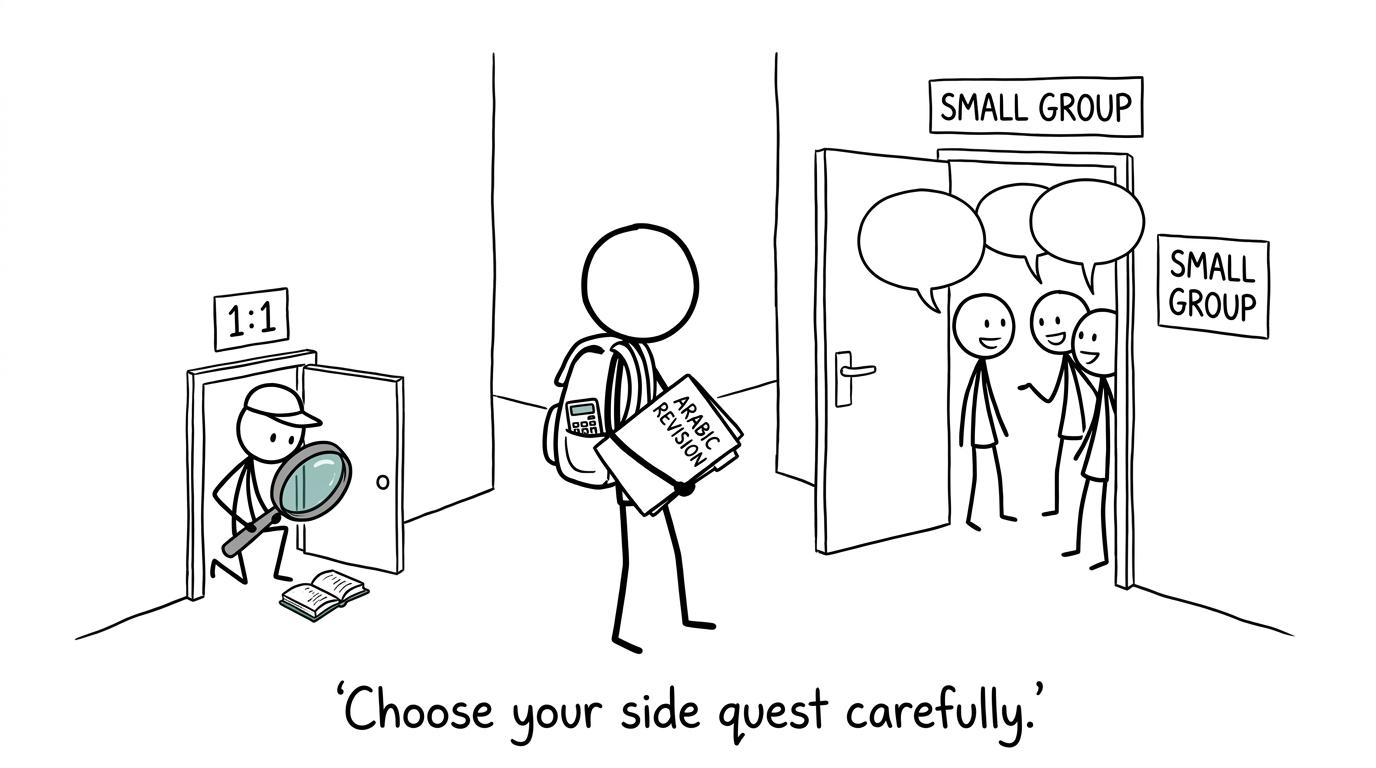 A student choosing between one-to-one and small-group tutoring
What GCSE Arabic tutoring needs to cover
GCSE Arabic is not simply a test of whether you can hold an everyday conversation. Students taking the current Pearson Edexcel GCSE Arabic qualification are assessed through listening, speaking, reading and writing. Each skill contributes 25%25\%25% of the qualification, and students enter either foundation or higher tier across the papers.
That balance matters when choosing tuition. A student who speaks Arabic at home may be verbally confident but still need support with formal writing, spelling, translation or responding precisely to an exam prompt. Another student may read accurately yet hesitate during an unrehearsed conversation.
A suitable tutor should therefore begin with diagnosis. This might involve reviewing school feedback, a marked writing task, a recorded speaking response and performance on listening or reading questions. The goal is to identify which skill is losing marks and why.
Check the qualification carefully, too. GCSE Arabic is not interchangeable with an International GCSE Arabic course, and specifications can have different structures. Confirm the board, specification code, tier and exam year with your school before paying for tuition.
The real strengths of one-to-one GCSE Arabic tutoring
One-to-one tuition gives the tutor complete visibility of one student's thinking. There is nowhere for a misunderstanding to hide, but there is also nowhere for the student to hide. That can be demanding and extremely useful.
Personalised language correction
Arabic writing and speaking can require close attention to vocabulary choice, grammatical accuracy, pronunciation and register. In an individual lesson, the tutor can stop at the precise point where an error occurs, explain it and ask the student to try again.
That immediate correction is especially valuable when the same mistake keeps appearing. Instead of completing a general class activity, the student can spend more time on the pattern responsible for lost marks.
A pace built around one learner
One-to-one tutoring can slow down when a concept is fragile and accelerate when it is secure. This may suit students who joined the course late, have uneven prior knowledge or need a short period of targeted catch-up.
It can also support students who feel too anxious to speak in a group. A quieter setting may make it easier to attempt longer answers without worrying about comparison. However, good tuition should gradually build independence rather than making the tutor a permanent safety net.
Efficient preparation for specific tasks
If a speaking assessment is approaching, an individual tutor can focus closely on responsiveness, clarity and development of answers. If writing is the weakness, sessions can prioritise planning, accuracy and self-correction.
The limitation is variety. A student who only speaks with one familiar tutor may become comfortable with that person's pace and questioning style. Listening to different voices and interacting with peers can provide a broader challenge.
Where small-group Arabic tutoring can be better
The Education Endowment Foundation defines small-group tuition as one tutor working with between 222 and 555 pupils. Its evidence reviews indicate that both one-to-one and small-group tuition can improve attainment, although results vary considerably. Small groups are generally more cost-effective, particularly when teaching is targeted to diagnosed needs.
That evidence covers tutoring broadly rather than GCSE Arabic specifically, so it should guide rather than decide your choice.
More varied speaking and listening
Language is social. In a well-run group, students hear different answers, accents, vocabulary choices and mistakes. They must listen carefully because the next question may not follow a familiar script.
Role-play and conversation activities can also feel more natural when several students participate. One student may ask a question, another may respond and a third may evaluate whether the response was clear. The tutor remains responsible for correcting misconceptions and ensuring that confident speakers do not dominate.
Learning from other students' questions
Sometimes another student's question reveals a gap you did not know you had. Seeing several responses to the same prompt can help you distinguish a basic answer from one that is developed, accurate and relevant.
This is one reason a genuinely small group differs from an ordinary class. There should still be time for each learner to speak, write and receive feedback. Once the group becomes too large, individual participation and correction can shrink quickly.
Accountability without total attention
Some students work better when other learners expect them to arrive prepared. A group can create routine and a sense of shared momentum. It also gives students short periods to think independently while the tutor works with someone else.
The risk is mismatch. If group members follow different specifications, work at very different levels or have unrelated weaknesses, the lesson may become general rather than targeted.
Group vs one-to-one tutoring at a glance
| Factor | Small-group tuition | One-to-one tuition |
|---|---|---|
| Lesson pace | Shared across the group | Adapted to one student |
| Speaking practice | Varied peer interaction | Intensive tutor interaction |
| Individual correction | Available but divided | Continuous and detailed |
| Peer learning | Strong when the group is well matched | Limited |
| Confidence | Can build confidence through shared practice | Can feel safer for an anxious student |
| Scheduling | Usually fixed | Often more flexible |
| Cost per student | Usually lower | Usually higher |
| Best fit | Students with similar goals who learn socially | Students with specific gaps or complex needs |
Neither column is automatically better. A weak one-to-one tutor does not become effective because the lesson is private, while an expert small-group tutor cannot personalise a lesson if the group is badly matched.
Which type of student suits each option?
One-to-one may suit you if
- you have a sharply defined weakness;
- you need substantial correction in writing or pronunciation;
- you are catching up after missed teaching;
- you become overwhelmed or silent in groups;
- your timetable requires flexibility;
- you need work aligned closely with teacher feedback.
A small group may suit you if
- you learn by listening to other students;
- you need more spontaneous conversation practice;
- you are comfortable attempting answers publicly;
- the group follows the same board and tier;
- you want regular structure at a lower cost;
- you can work independently between your turns.
A hybrid approach can also be sensible. For example, a student might attend regular small-group sessions and book a limited number of individual sessions for diagnosis or a stubborn weakness. More tuition is not automatically better. Every session needs a clear purpose.
How to judge the tutor, not just the format
Ask prospective tutors practical questions:
- Which GCSE Arabic specification do you teach?
- How do you assess listening, speaking, reading and writing?
- How often will I receive individual feedback?
- What is the maximum group size?
- How do you group students by level and need?
- Will we use official-style questions and assessment criteria?
- How will progress be reported?
- What independent practice is expected?
A strong answer should be specific. Look for a cycle of diagnosis, teaching, practice, feedback and retesting. This is the same principle that makes maths revision effective: find the marks being lost, repair the underlying skill and test it again.
Fitting Arabic tutoring around GCSE maths revision
Tutoring competes for the same finite hours as homework, sleep and other subjects. A productive Arabic session can still become a poor decision if it leaves no time to maintain maths skills.
Start with a weekly plan. MathsGenie's one-month GCSE maths revision plan offers a useful structure built around diagnosis, topic work and paper practice. You can place Arabic tuition into the same calendar, then protect separate maths sessions rather than revising whichever subject feels most urgent that evening.
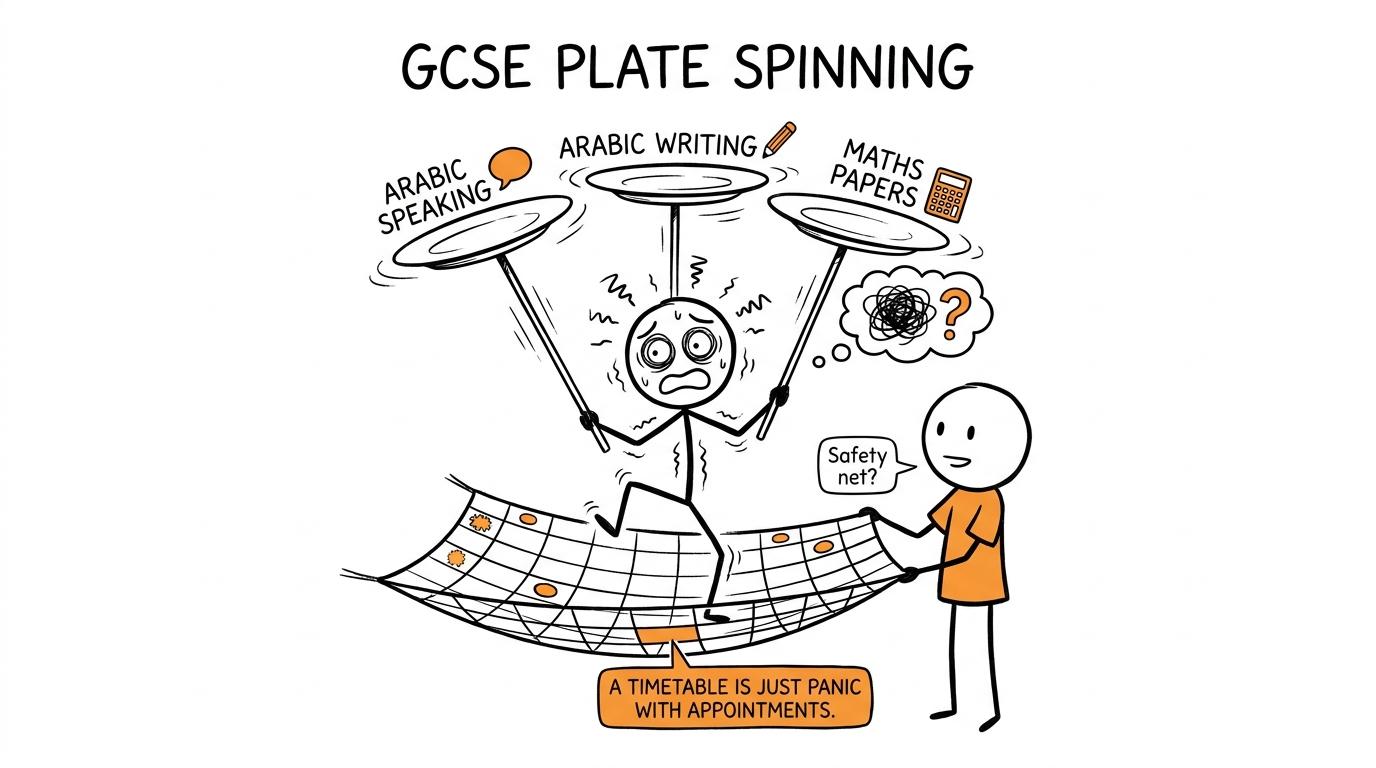 A student balancing Arabic, maths and a revision timetable
Use the GCSE maths revision hub to select your board and tier. If you are unsure what belongs on your plan, the GCSE maths topics by exam board and tier provides a clear checklist, while the best order for learning GCSE maths topics can help you sequence weaker skills.
A balanced week might contain one Arabic tutoring session, one Arabic follow-up task, two focused maths topic sessions and one timed maths paper section. Adjust that pattern according to school deadlines and the evidence in your marked work.
When it is time for full-paper practice, use material that matches your exam board. MathsGenie provides Edexcel GCSE maths past papers with mark schemes and solutions, as well as an OCR GCSE maths revision hub. The guide to starting GCSE past papers at the right time explains how to move from short diagnostic tests to complete timed papers.
MathsGenie is a maths revision resource, not an Arabic tuition provider. Its role here is to keep the rest of your GCSE preparation organised through free lessons, practice questions, mini tests, mark schemes, video solutions, past papers and predicted papers.
Common mistakes when choosing GCSE Arabic tuition
Assuming a fluent speaker is automatically an exam specialist
Language fluency is important, but a tutor must also understand the specification, task formats, tier demands and assessment criteria. Ask how teaching is connected to marks.
Choosing a group without checking its size
A group advertised as “small” may not match the research definition of between 222 and 555 learners. Ask for the maximum number and how speaking time is distributed.
Paying for one-to-one tuition without a diagnosis
Private attention is easily wasted on topics already secure. The tutor should identify the precise gap before building a programme.
Mistaking comfort for progress
Enjoyable conversation can build confidence, but it does not automatically improve writing accuracy, reading comprehension or exam technique. Progress should be visible in repeated tasks and feedback.
Letting tutoring replace independent practice
A tutor can explain and correct, but the student still has to retrieve vocabulary, produce language and revisit mistakes alone. The lesson begins the learning cycle; it does not complete it.
Neglecting maths and other GCSE subjects
Booking several sessions can create the feeling of working hard while reducing time for independent revision elsewhere. Use a timetable and judge every commitment by what it displaces.
Make the choice that matches the problem
The best GCSE Arabic tutoring format is the one that addresses your actual barrier. Choose one-to-one tuition for concentrated personal feedback, flexible pacing and specific gaps. Choose a small, well-matched group for varied speaking, peer learning, accountability and value. If possible, review the decision after a short block using marked evidence rather than intuition alone.
Then protect the rest of your GCSE plan. Open the MathsGenie GCSE maths revision hub, choose your board and tier, and use revision lessons and practice questions to repair weak topics. Build confidence with mini tests, then move to past papers, mark schemes, video solutions and predicted papers. Good revision is rarely about finding more hours. It is about giving each hour a clear job.