

Group vs 1:1 Tutoring GCSE French: Which Is Better?
Group vs 1:1 tutoring GCSE French compared clearly: costs, feedback, speaking practice and the best fit for different students preparing for exams now.
Choosing a tutor can feel like choosing the answer before you fully understand the question. One-to-one tuition promises complete attention. Group tuition offers conversation, shared ideas and usually a lower cost. Both sound useful, but useful for whom?
The short answer to group vs 1:1 tutoring GCSE French is this: one-to-one tuition is usually better for a student with specific gaps, low confidence or an urgent target, while a small group can be better for students who need regular speaking interaction, peer motivation and affordable ongoing practice. Neither format is automatically superior. Tutor quality, group size, feedback and consistency matter more than the label.
For students balancing French with GCSE maths and other subjects, the best option is the one that solves the actual problem without consuming the rest of the revision timetable.
A quick decision checklist
Choose one-to-one GCSE French tutoring when you:
- have precise weaknesses in grammar, pronunciation, listening or writing
- find it difficult to ask questions in front of other students
- need lessons adapted to your exam board, tier and current level
- have missed teaching or need to close gaps quickly
- want detailed correction of written and spoken French
Choose small-group French tutoring when you:
- learn by hearing other students speak and make corrections
- need realistic conversation practice with different voices
- are motivated by a regular group commitment
- want a more affordable option
- are comfortable contributing rather than remaining silent
If several points apply on both sides, a hybrid approach may work best: regular group lessons for breadth and occasional individual sessions for diagnosis and targeted repair.
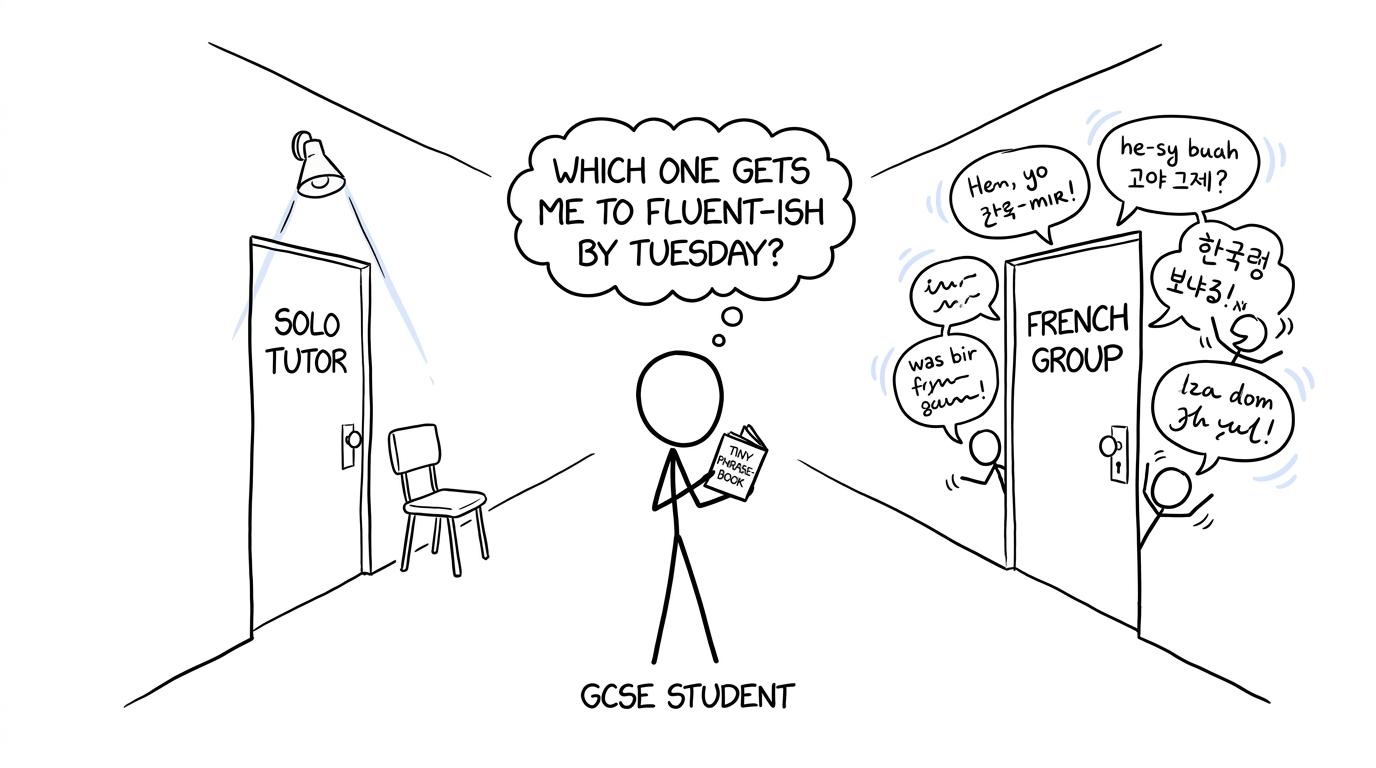 A student choosing between solo French tutoring and a lively group
The real differences between group and one-to-one tutoring
The visible difference is the number of students. The important difference is what that number changes.
| Factor | Small-group tutoring | One-to-one tutoring |
|---|---|---|
| Teacher attention | Shared between students | Focused entirely on one student |
| Lesson pace | Must suit the group | Can change immediately |
| Speaking variety | Several voices and responses | Sustained dialogue with the tutor |
| Personal feedback | Useful but necessarily limited | Usually more detailed and frequent |
| Social pressure | Can encourage or inhibit participation | Private, although sometimes intense |
| Cost per session | Usually lower | Usually higher |
| Best use | Regular interaction and shared practice | Diagnosis and targeted improvement |
Educational evidence supports both models. The Education Endowment Foundation’s broader tutoring evidence reports positive average effects for one-to-one and small-group tuition, with one-to-one tuition showing a slightly higher overall average. However, these findings cover different subjects, ages and settings. They are not proof that individual tuition will always produce a better French grade.
The same evidence emphasises targeting, curriculum alignment and tutor preparation. In other words, a well-run group addressing your real weaknesses can be more useful than an individual lesson built around generic worksheets.
When one-to-one GCSE French tutoring is better
You need precise feedback
French contains small details that can change the quality of an answer: verb endings, adjective agreement, tense selection, pronunciation and the accuracy of familiar vocabulary. In an individual lesson, the tutor can stop at the exact point where your understanding becomes uncertain.
That attention is particularly valuable when you repeatedly make the same errors but cannot identify the pattern. A tutor can compare several pieces of work, diagnose the cause and choose practice that addresses it.
Speaking feels difficult or embarrassing
A private setting can make it easier to attempt unfamiliar sounds, pause, restart and ask basic questions. For some students, this creates the safety needed to begin speaking more freely.
One-to-one tuition is not automatically less pressurised, however. Being the only student means there is nowhere to disappear. A good tutor manages this by building from short, manageable responses towards spontaneous conversation rather than treating every silence as a failure.
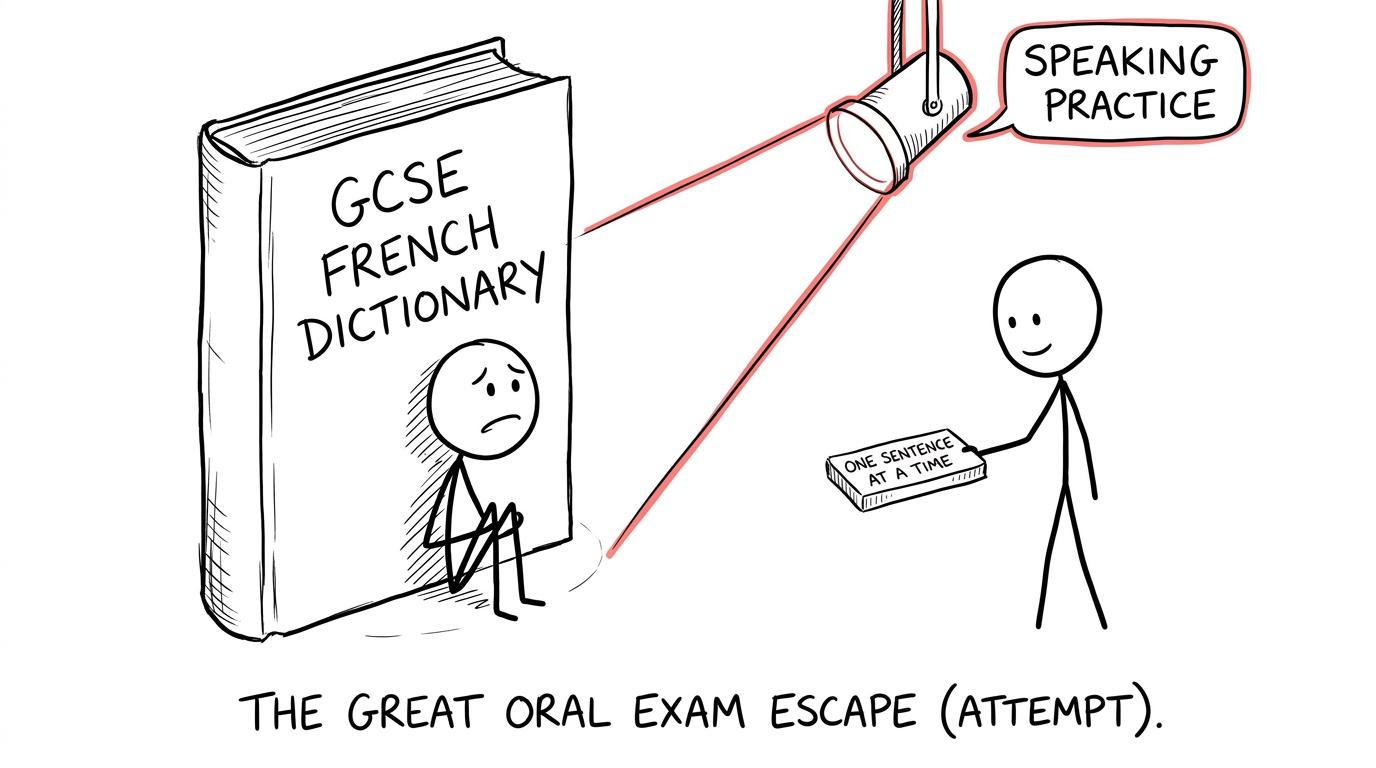 A student taking French speaking practice one sentence at a time
Your revision needs are unusual
Individual tuition is often the stronger choice if you have missed a substantial part of the course, changed schools, moved between specifications or have a pronounced imbalance between skills. A student who writes accurately but struggles to process spoken French does not need an equal amount of everything.
Current GCSE French qualifications in England, first assessed under the reformed specifications from summer 2026, continue to assess listening, speaking, reading and writing. They also place explicit attention on prescribed vocabulary, grammar and sound-symbol relationships. Exact tasks and timings depend on the exam board and tier, so a tutor should work from the correct current specification rather than recycled materials.
When group GCSE French tutoring is better
You need genuine interaction
Languages are social. In a group, you hear different accents, speeds, ideas and mistakes. You also learn to respond when another student says something you did not predict.
That unpredictability can help with spontaneous speaking. It moves practice beyond memorising a paragraph and reciting it to the same adult each week. Listening to a peer’s answer can also reveal vocabulary or sentence structures you had not considered.
Motivation improves around other students
Some students revise more consistently when other people expect them to arrive prepared. A group provides a rhythm: vocabulary to learn, speaking to complete and work to compare.
This only helps when the atmosphere is constructive. A competitive or badly matched group can make quieter students contribute less. Before joining, ask how the tutor distributes speaking time and prevents confident students from dominating.
The group is genuinely small
The Education Endowment Foundation defines small-group tuition as one educator working with approximately 222 to 555 pupils. Its evidence suggests that tutoring becomes less effective as groups grow, particularly once they move beyond roughly 666 or 777 students.
For French, headcount matters because every extra student reduces individual speaking and feedback time. A class marketed as a tutoring group may function more like another classroom if most students spend the session listening passively.
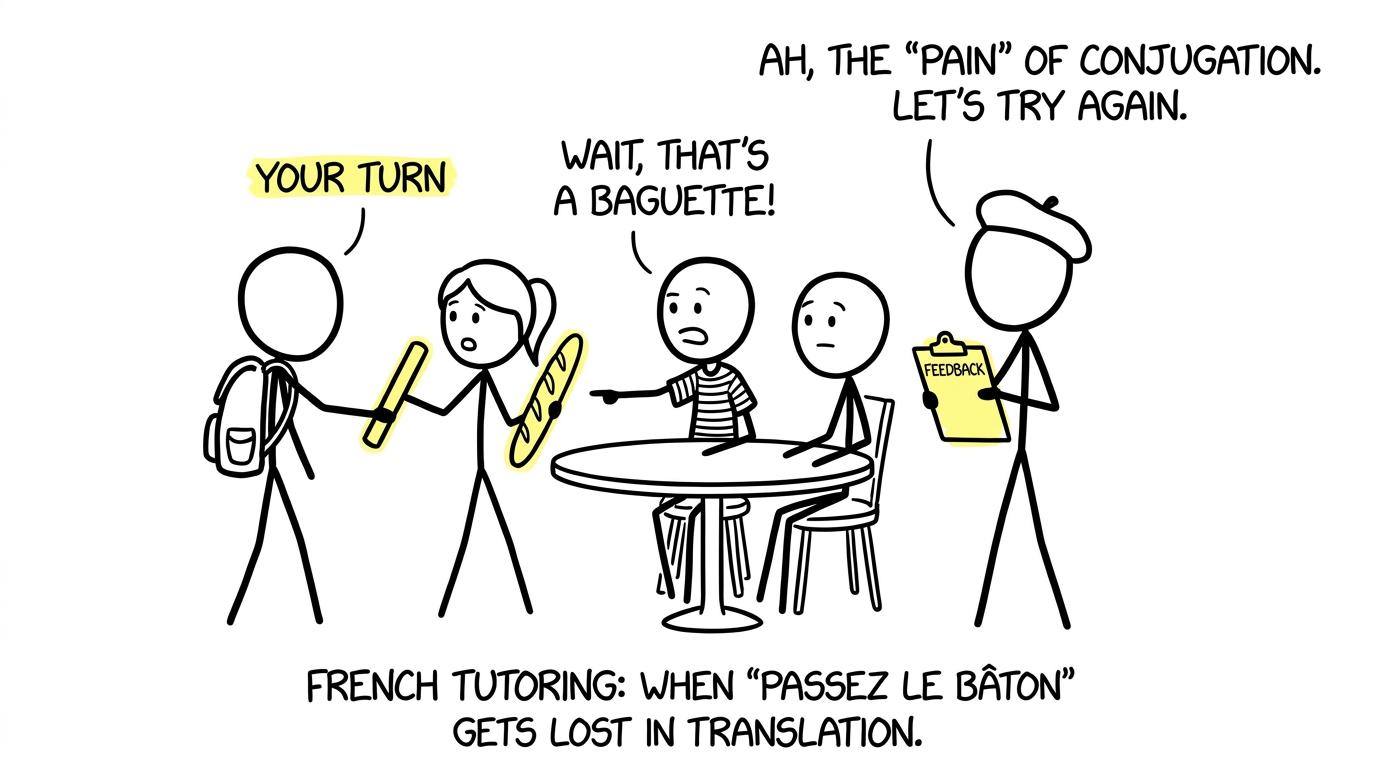 Students passing the French conversation baton and one accidental baguette
Match the tutoring format to the problem
Do not begin with, “Which option sounds best?” Begin with, “Where am I losing marks?”
A simple diagnostic should consider:
- comprehension of spoken French
- reading accuracy and inference
- pronunciation and spontaneous responses
- grammar and vocabulary recall
- translation in both directions where required
- extended writing and checking
- confidence under timed conditions
This is the same principle that makes maths revision efficient. MathsGenie’s guide to finding your weakest GCSE maths topics begins with evidence from attempted questions rather than guesswork. Apply that thinking to French: collect marked work, teacher comments and practice results before paying for support.
Then ask each prospective tutor what the first month would address. A useful answer should be specific. “We will improve French” is not a plan. “We will diagnose listening and verb-tense errors, then review progress after four sessions” is much closer to one.
Questions to ask before choosing a French tutor
Ask the tutor or provider:
- Which GCSE French specifications do you currently teach?
- How will you identify my weakest skill?
- How much French will I speak in each session?
- How quickly will written work be corrected?
- What is the maximum group size?
- Are students grouped by level, tier or target?
- What happens if the group pace is unsuitable?
- How will progress be reviewed?
For group tuition, request a trial session if one is available. Notice how much each student participates and whether feedback is individual. For one-to-one tuition, look for adaptation rather than constant explanation. A student should be producing French, not simply watching the tutor produce it.
Fitting French tutoring around GCSE maths revision
The best French support can still become a poor decision if it displaces essential revision elsewhere. Tutoring should supplement normal teaching and independent practice, not absorb every available evening.
Build one timetable for all subjects. The GCSE maths revision timetable guide explains how to combine focused topic work with timed practice. You can give French the same structure while protecting separate maths sessions.
For maths, use the GCSE maths revision hub to choose your exam board and find revision lessons, practice questions, worksheets and papers. Begin paper practice early enough to learn from it, using the guidance on when to start GCSE past papers.
If time is short, avoid letting tutoring create the illusion that all revision has been handled. A tutor covers one subject for one part of the week. MathsGenie’s one-week GCSE maths revision plan can help organise the remaining time, while the night-before GCSE maths plan keeps the final evening focused and calm.
Common mistakes when choosing tutoring
Assuming one-to-one always means personalised
A session is not personalised merely because only one student attends. Repeatedly working through a generic booklet at a fixed pace wastes the main advantage of individual tuition.
Joining a group without checking its size
A group of four and a group of twelve offer very different amounts of speaking time. Ask for the maximum attendance, not the typical attendance.
Choosing entirely by price
Cost matters, but compare value as well as the session fee. Consider preparation, marking, feedback, resources and how much active practice the student receives.
Ignoring the current specification
Materials must match the correct exam board, tier and assessment year. Reformed GCSE French specifications were first assessed in England in summer 2026, so confirm that teaching reflects the current vocabulary, grammar and task requirements.
Mistaking attendance for progress
Progress requires output and correction. The student must speak, write, retrieve vocabulary and respond to feedback between sessions. The same applies in maths: using GCSE past papers properly means marking, diagnosing and repairing errors rather than merely completing papers.
Which option should you choose?
Choose one-to-one tutoring when your difficulty is narrow, personal or urgent. Choose a small group when you need sustained interaction, shared motivation and a more affordable routine. If you are still unsure, trial the format and judge it by three things: how much you participated, how specific the feedback was and whether you knew what to practise afterwards.
The deeper lesson is that revision improves when feedback leads to action. French tutoring can provide that feedback in either format. For maths, MathsGenie provides the independent structure around it: free revision lessons, practice questions, mini tests, past papers, predicted papers, mark schemes and video solutions.
Start at the MathsGenie GCSE maths revision hub, choose your board and tier, and turn every lost mark into the next clear revision task. The right support does not make revision effortless. It makes the next step obvious.










