AQA GCSE Maths Revision Plan: Six-Week Guide
AQA GCSE Maths revision plan for six focused weeks, combining topic practice, past papers, mark schemes and timed review for Foundation or Higher.
Revision often begins with good intentions and a blank timetable. “Revise maths” looks purposeful until Monday arrives and you still do not know where to start.
A useful AQA GCSE Maths revision plan identifies weak topics, schedules practice and turns mistakes into the next session’s priorities. This six-week guide works for Foundation or Higher tier. Spread it out if you have longer, or combine adjacent weeks if time is short, without dropping corrections.
Your revision plan at a glance
Build your routine around five tasks:
- diagnose strengths and weaknesses
- repair gaps with lessons and questions
- revisit topics after a delay
- introduce timed papers
- use marking to choose your next task
AQA GCSE Mathematics has three written papers. Paper 111 is non-calculator; Papers 222 and 333 allow a calculator. Each lasts 111 hour 303030 minutes and carries 808080 marks. Any part of the specification can appear on each paper, so revise broadly rather than assigning topics to particular papers.
Open the AQA GCSE Maths revision hub and confirm your tier before choosing resources.
The six-week AQA GCSE Maths revision plan
Week 1: diagnose before planning
Complete mixed questions or part of an older paper without notes. Choose the correct tier from the AQA GCSE Maths past papers.
Classify lost marks by their cause:
- Knowledge: you did not know the method or fact.
- Application: you could not recognise which method to use.
- Accuracy: arithmetic, algebra or notation went wrong.
- Timing: you needed longer to finish.
Create a traffic-light list: red topics need teaching, amber topics need practice and green topics need occasional review. This gives later sessions a purpose beyond simply filling time.
Weeks 2-3: repair the gaps
A paper reveals weaknesses more efficiently than it repairs them. Focus these weeks on topic practice rather than repeatedly measuring the same gaps.
For each priority topic, review a MathsGenie revision lesson, attempt questions independently and mark them. Redo incorrect questions on a clean page, then return two or three days later for a short mini test.
A session could contain 101010 minutes of recall, 252525 minutes of questions and 101010 minutes of corrections. Adjust the balance to your needs.
Use the GCSE maths revision timetable guide to fit sessions around other subjects. The one-month GCSE maths revision plan offers a shorter structure.
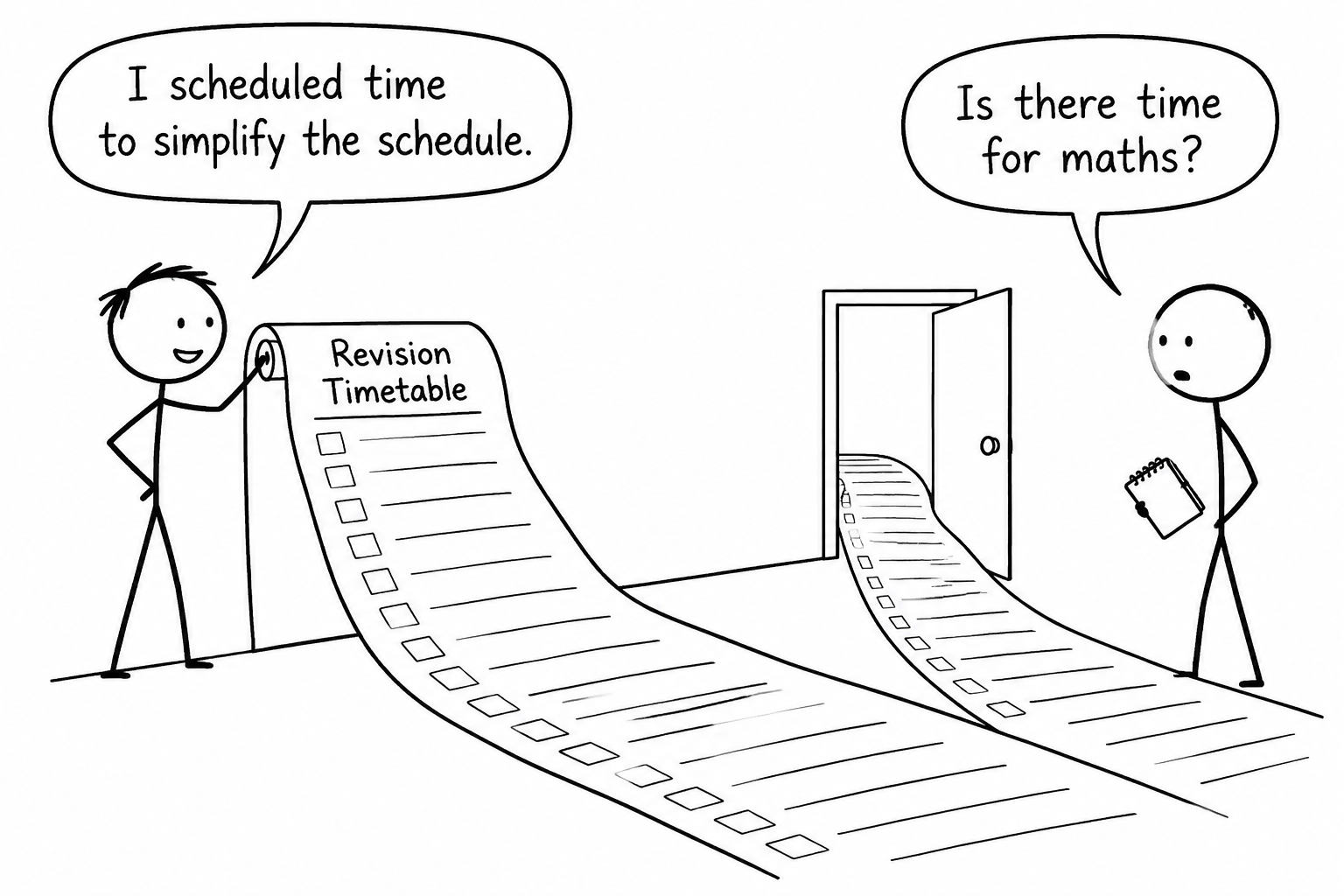 A student discovers that planning revision can become a revision task of its own
Once your priorities are clear, build your schedule in the Revision Planner rather than repeatedly redrawing it.
Week 4: connect methods to questions
Exam questions do not announce which method they require. Mix topics within sessions and include multi-step problems so you practise choosing an approach, not just repeating one.
Keep an error log recording the topic, cause and correction. “Careless mistake” offers little guidance. “Rounded too early” or “used the diameter as the radius” tells you what to change.
Complete one full paper under timed conditions: 909090 minutes, correct equipment and no notes. Keep Paper 111 genuinely non-calculator. For calculator papers, practise accurate entry and show enough working to make your reasoning visible.
Week 5: turn papers into feedback
Complete two timed papers, ideally covering both calculator and non-calculator practice. The GCSE papers collection organises past papers, predicted papers and mini tests by exam board.
After marking, correct questions you could reasonably have answered. Use video solutions when the mark scheme does not explain your difficulty, then retry selected questions after a delay. Recurring weaknesses should become your next topic sessions.
Treat raw marks as diagnostic evidence, not permanent grade predictions: difficulty and grade boundaries vary. For guidance on balancing topics and papers, read when to start GCSE past papers.
Week 6: consolidate without cramming
Complete one final timed paper early enough to review it properly. Then concentrate on recurring errors, essential facts and short questions rather than trying to relearn the specification.
Keep practising non-calculator skills alongside calculator use. Prepare permitted equipment and check your school’s exam arrangements.
Between papers, remembered difficulties can guide revision, but they cannot reliably predict what comes next. Because any specification content may appear on each paper, maintain broad coverage rather than abandoning topics you have already seen.
Make the plan fit your week
Begin with three or four maths sessions weekly, adjusting to your available time and marking evidence. Give each session a precise instruction: “Complete ratio practice and correct errors” is more useful than “revise maths”.
Keep one flexible slot for missed tasks. Moving Tuesday’s work into that space is better than pushing the entire timetable backwards. A workable plan anticipates imperfect weeks.
Common mistakes in maths paper revision
Completing papers without reviewing them
A stack of papers is not the same as progress. Correct errors, revisit the relevant lesson and retry similar questions independently.
Practising only favourite topics
Familiar questions feel reassuring. Let your diagnostic results determine priorities while keeping occasional review of stronger areas.
Neglecting non-calculator skills
Include fractions, percentages, arithmetic and exact values regularly. Calculator confidence should not hide weaknesses that Paper 111 will expose.
Opening solutions too early
Attempt the question first. If stuck, identify where your reasoning stopped before checking the solution.
Planning sessions you repeatedly postpone
Reduce the workload rather than abandoning the routine. A focused session with marking is more useful than an ambitious one that never happens.
Build the plan you can follow
The timetable becomes useful when each box names a topic, task and review point. MathsGenie’s free lessons, practice questions and paper solutions can support that cycle. Build your six-week AQA schedule in the Revision Planner, then let your corrected work guide what happens next.