Edexcel GCSE Maths Revision Plan That Works
Edexcel GCSE Maths revision plan with a practical six-week schedule covering topics, exam practice, past papers and review for every GCSE paper.
A blank revision timetable can feel strangely demanding. You know you need to revise, but deciding what to do first becomes a task of its own. One student might begin by writing “maths” across six evenings, then discover that this says nothing about which topic to practise, how to check progress or when to attempt a full paper.
A useful Edexcel GCSE Maths revision plan is more precise. It moves through three stages: diagnose your weaknesses, rebuild the relevant skills, then practise applying them under exam conditions. The six-week structure below gives you a practical starting point for Foundation or Higher tier.
Exam arrangements can change, so confirm your paper dates and current assessment details with your school and the latest Pearson Edexcel information.
Your revision plan at a glance
Use this checklist before you start:
- Confirm whether you are taking Foundation or Higher tier.
- Write down the dates of all your maths papers.
- Complete a mixed assessment or past paper as a diagnostic.
- Divide topics into red, amber and green categories.
- Give red topics the most time, without abandoning mixed practice.
- Revisit topics after a gap rather than completing them once.
- Include both non-calculator and calculator practice.
- Attempt timed past papers and analyse every lost mark.
The central idea is simple: your plan should respond to evidence. A neat timetable built around topics you already know is comforting, but it is unlikely to change your result.
A six-week Edexcel GCSE Maths revision plan
Imagine the student with the blank timetable has six weeks remaining. Instead of assigning every hour immediately, they give each week a clear job.
| Week | Main purpose | What to do |
|---|---|---|
| Week 1 | Diagnose | Complete a mixed paper, mark it and classify weak topics |
| Week 2 | Repair foundations | Relearn essential skills and answer focused practice questions |
| Week 3 | Strengthen methods | Tackle harder red and amber topics, then revisit Week 2 content |
| Week 4 | Apply skills | Use mixed questions and practise choosing methods independently |
| Week 5 | Build exam technique | Complete timed sections and full papers, then correct mistakes |
| Week 6 | Consolidate | Revisit recurring errors, complete final paper practice and reduce overload |
This is a framework, not a demand to revise for hours every day. Four focused sessions can be more productive than seven vague ones. A typical session might last 454545 minutes:
- 555 minutes recalling key facts or methods without notes
- 151515 minutes using a revision lesson or video solution
- 202020 minutes answering questions independently
- 555 minutes marking and recording errors
If shorter sessions suit you better, use 252525 minutes of focused work and take a proper break before continuing. The quality of attention matters more than making a session look impressive on paper.
If setting up six weeks by hand already feels like another revision task, use the MathsGenie Revision Planner to build your schedule.
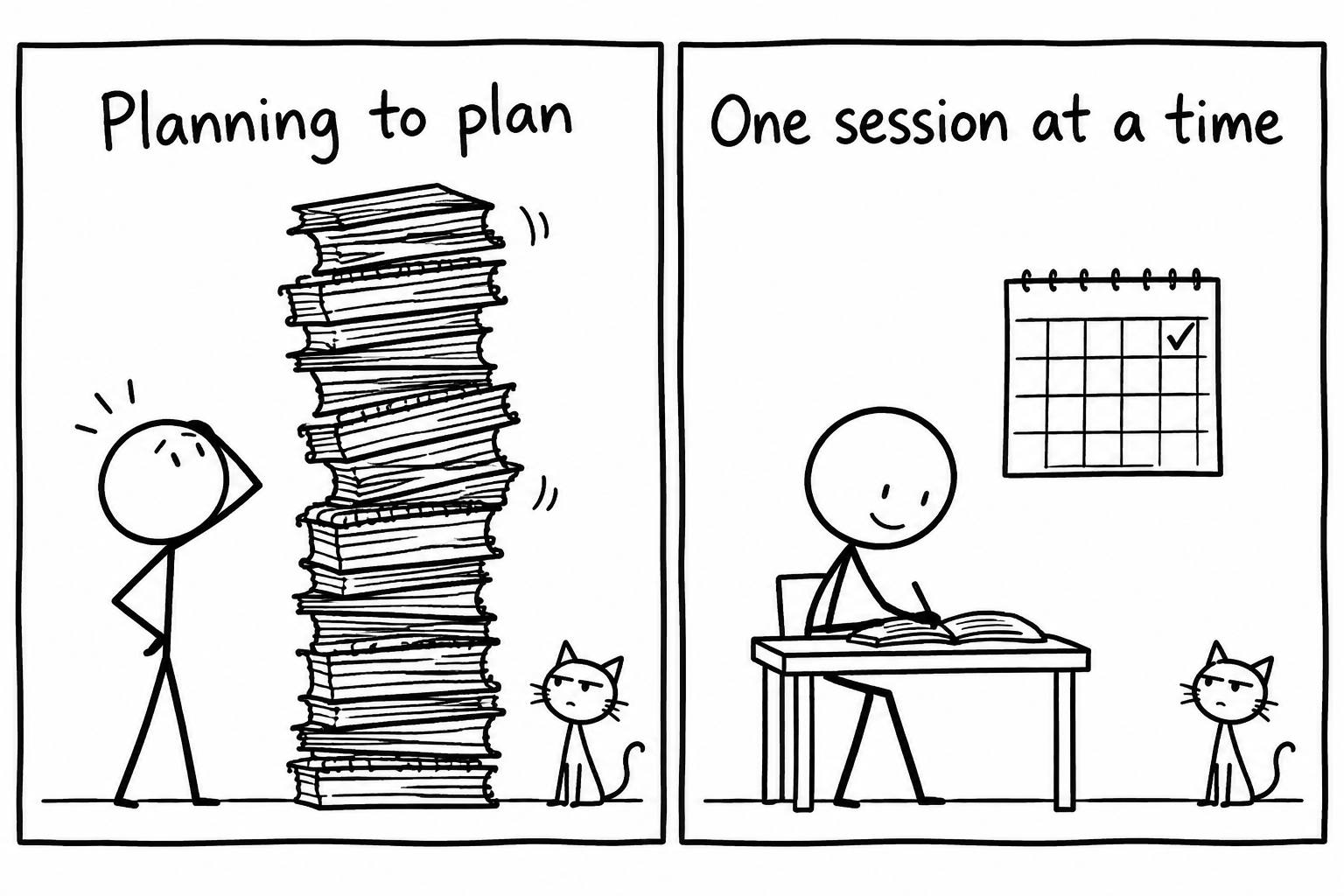 A student escapes a tower of revision planning by choosing one session at a time
Week 1: find where the marks are being lost
The student begins with a paper rather than a textbook. This feels uncomfortable because a diagnostic exposes uncertainty, but that is precisely its value. Use the appropriate paper from the Edexcel GCSE Maths past papers collection and work without notes.
Mark the paper carefully. For each lost mark, record the topic and the reason:
- Knowledge gap: you did not know the fact or method.
- Method error: you knew the topic but used the wrong process.
- Accuracy error: arithmetic, algebra or rounding went wrong.
- Reading error: you missed a condition, unit or instruction.
- Time error: you could not reach or finish the question.
Now classify the topics:
- Red: you cannot begin the question confidently.
- Amber: you understand part of the method but make errors.
- Green: you can answer accurately without support.
This turns “I am bad at maths” into a list of solvable problems. The GCSE Maths revision guide can act as the pillar resource for organising those problems by topic and grade.
Weeks 2 and 3: rebuild skills through active practice
For each red topic, follow a repeatable cycle:
- Recall what you already know without opening your notes.
- Use a MathsGenie revision lesson to rebuild the method.
- Answer several practice questions without copying a model.
- Check your answers with the mark scheme or video solution.
- Write one short correction explaining the mistake.
- Revisit the topic two or three days later.
A correction should identify a decision, not merely display the right answer. For example: “I multiplied before expanding the bracket” is useful. “Careless mistake” is too vague to change future behaviour.
Do not spend both weeks only on difficult material. Keep some green topics in mixed retrieval so familiar skills remain available. Maths is cumulative: a harder ratio, probability or geometry problem may depend on arithmetic and algebra that seemed secure a month earlier.
Use the GCSE Maths videos and practice questions when a method needs rebuilding, and use GCSE mini tests to check whether you can recognise the method without being told the topic.
Week 4: move from topic revision to maths paper revision
Topic practice gives you an important clue: the heading tells you what method to use. An exam paper removes that clue. The question may combine several ideas, and part of the challenge is deciding where to begin.
That is why effective maths paper revision includes mixed sets. During Week 4, alternate between:
- one focused session on a remaining weak topic;
- one mixed set completed without notes;
- one review session revisiting errors from earlier weeks;
- one timed section from a past or predicted paper.
Practise calculator and non-calculator habits separately. On non-calculator questions, write enough working to make your reasoning visible. On calculator questions, avoid treating the display as proof. Record substitutions and intermediate steps, retain sufficient accuracy during calculations, and round only when the question requires it.
The Edexcel GCSE Maths predicted papers can provide additional mixed practice, but predictions should not replace broad revision. Any topic permitted by the specification may need attention.
Weeks 5 and 6: practise, mark and adapt
A completed paper is not the end of a revision session. It is information for the next one.
After each timed paper, calculate your mark and inspect the pattern behind it. If several marks disappeared on algebraic manipulation, schedule algebra. If the methods were correct but questions remained unfinished, practise timed sections. If words such as “estimate”, “prove” or “hence” were overlooked, train yourself to underline command words and conditions.
Use this paper-review routine:
- Mark the paper with the correct mark scheme.
- Retry every incorrect question without looking at the answer.
- Review the method if you are still stuck.
- Attempt a similar question later in the week.
- Add recurring weaknesses to the next schedule.
Leave some papers unseen for realistic timed attempts. Repeating a familiar paper can test whether you learnt from your corrections, but it does not measure exam readiness as honestly as fresh material.
In the final week, avoid trying to relearn the entire course. Prioritise frequent errors, core methods and calm paper routines. Sleep, breaks and ordinary school commitments still matter. A plan that cannot be followed is only decoration.
Common revision-plan mistakes
Treating time as the measure of progress
Three hours with notes open is not automatically better than 404040 minutes of independent questions. Measure completed questions, corrected errors and topics successfully revisited.
Revising topics only once
Understanding something on Tuesday does not guarantee recall three weeks later. Schedule short reviews after increasing gaps so retrieval becomes more reliable.
Completing papers without analysing them
Past papers expose patterns only when you investigate lost marks. Marking, correcting and reattempting are part of the paper, not optional extras.
Spending equal time on every topic
Equal time feels orderly, but your needs are not equal. Let diagnostic evidence decide where most sessions go while preserving some mixed practice.
Planning every minute
Missed sessions happen. Leave one flexible slot each week so a difficult topic or an unexpected commitment does not destroy the whole timetable.
Build your schedule while there is time to use it
The student’s turning point is not writing a more elaborate timetable. It is replacing “revise maths” with specific sessions that connect weak topics, spaced review and paper practice. Knowing that structure helps, but following it consistently is where marks become more attainable.
Your exam dates are fixed, and each unplanned week reduces the time available to revisit what you learn. Build your six-week schedule in the MathsGenie Revision Planner, beginning with your weakest Edexcel GCSE Maths topics.