Grade 6 GCSE Food and Nutrition for Sixth Form
Grade 6 GCSE Food and Nutrition sixth form guidance: check course entry rules, maths and English requirements, alternatives and your next steps.
A results sheet can make one number feel as if it decides everything. It rarely does. If you are searching for grade 6 GCSE Food and Nutrition sixth form guidance, the useful answer is this: a grade 666 is enough for many sixth-form and college food-related courses, but it is not guaranteed to meet every provider's requirements.
Some providers ask for a grade 555 or 666 in GCSE Food Preparation and Nutrition. Others accept a relevant science or hospitality qualification, while a smaller number prefer a grade 777. You may also need to satisfy the institution's general entry rules, particularly for GCSE maths and English.
The right question is therefore not simply, "Is a grade 666 good?" It is, "Does this grade meet the published requirements for the course and institution I actually want?"
The short sixth-form entry checklist
Before making assumptions, check these five things:
- The exact course title: it may be Food Science and Nutrition, Applied Food Science and Nutrition, Hospitality and Catering, or another Level 333 qualification.
- The subject-specific requirement: look for the required grade in Food Preparation and Nutrition or an accepted alternative.
- The general entry requirement: many providers ask for a particular number of GCSEs at grades 444, 555 or above.
- The maths and English rules: these can affect admission to the overall programme even when your food grade is strong enough.
- Any additional conditions: these might include a teacher recommendation, portfolio, interview or evidence of practical interest.
Admissions information can change between intakes. Read the prospectus for your intended year of entry and ask the admissions team if any wording is unclear.
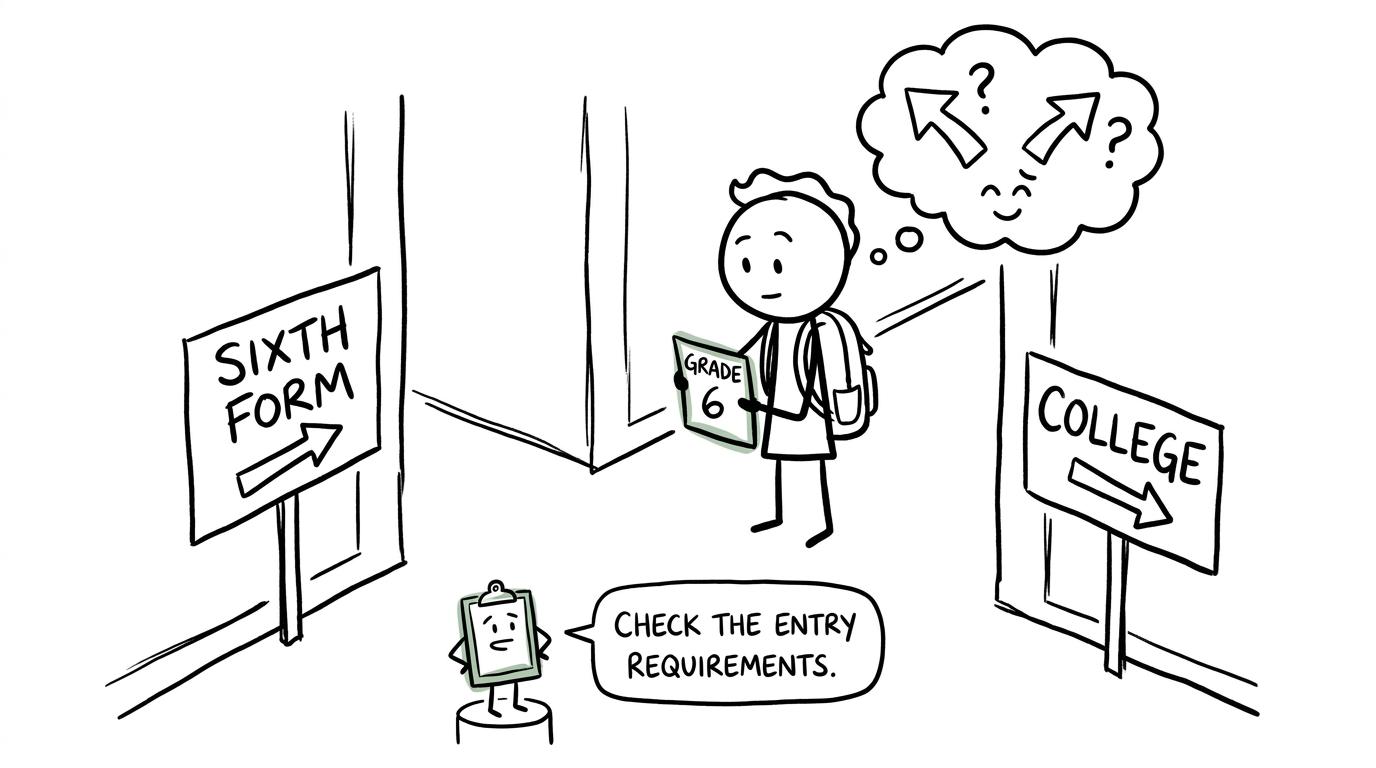 A student choosing between sixth form and college while checking entry requirements
Is a grade 6 in GCSE Food and Nutrition good?
Yes. A grade 666 is a strong GCSE result and sits above the grade 444 standard-pass threshold. It indicates that you have developed a sound understanding of the subject, although admissions teams decide suitability using their own criteria rather than a universal definition of "good".
Current published entry requirements illustrate how much those criteria can vary. Some sixth forms specify a grade 666 in Food Preparation and Nutrition for a Level 333 food course. Other providers publish requirements around grade 555, sometimes accepting a relevant science subject instead. At the more demanding end, an institution may prefer grade 777 in food or consider another strong GCSE where food was not studied.
This variation explains why online answers can sound contradictory. Two students with the same grade can receive different outcomes because they are applying to different courses.
A grade 6 is usually enough when
Your result is likely to be suitable if:
- the course asks for grade 666 or below in GCSE Food Preparation and Nutrition;
- the provider accepts grade 555 alongside a recommendation;
- a related GCSE, such as science, is accepted and you meet that condition;
- you also satisfy the institution's overall GCSE requirements;
- your maths and English grades meet the stated minimums.
Meeting a published minimum makes you eligible to be considered. It does not always guarantee a place, particularly where spaces are limited or the provider considers the complete application.
When a grade 6 might not be enough
A grade 666 could fall short if the chosen course explicitly requires grade 777. You may also have difficulty if your overall GCSE profile does not meet the sixth form's general threshold, even though the food result itself is acceptable.
For example, a provider might require several GCSEs at grade 555 or above and set separate minimums for maths and English. In that situation, admissions staff are assessing a collection of results rather than one subject in isolation.
Do not self-reject before speaking to the provider. Some institutions consider individual circumstances, teacher recommendations or related qualifications. Equally, do not assume flexibility where the prospectus states a firm requirement.
Check which qualification you are applying for
The name of the post-161616 course matters. GCSE Food Preparation and Nutrition does not always progress to a qualification literally called "A Level Food and Nutrition".
Depending on the provider, you might find:
- a Level 333 Food Science and Nutrition qualification;
- an applied or vocational food course;
- Hospitality and Catering;
- Health and Social Care with nutrition-related content;
- science courses that can support later study in nutrition or food science.
These routes can differ in assessment style, practical content and entry criteria. Some include substantial coursework or controlled assessment, while others place more emphasis on examinations. Read the course description as carefully as the grade requirement.
If your long-term interest is dietetics, nutrition, food technology or another university subject, examine future university entry requirements before selecting your Level 333 programme. Certain degree routes may value or require sciences alongside your food-related qualification. Your sixth form or college careers adviser can help you compare those routes without guessing.
Why your GCSE maths grade still matters
Food and nutrition is not separate from maths. Recipes, energy values, portion sizes, costs, nutritional data and experimental results all require confident numerical thinking. More importantly, sixth forms often include GCSE maths in their general admissions criteria, regardless of whether you plan to take A Level Maths.
In England, students on relevant 161616 to 191919 programmes who have not achieved grade 444 or above in GCSE maths or English are generally required to continue studying an approved qualification in the missing subject. That funding rule is not itself a universal sixth-form admissions rule, but it explains why post-161616 providers pay close attention to these grades.
A grade 666 in food therefore cannot automatically compensate for a maths result below a provider's requirement. Check each condition separately.
If maths is the result putting your application at risk, start with the free GCSE Maths revision hub. It brings together revision lessons, worksheets, exam questions and board-specific support for Edexcel, AQA, OCR and Eduqas students.
What to do before you apply
Read the exact admissions wording
Find the current prospectus and separate the information into two lists:
- requirements for joining the sixth form or college;
- requirements for joining the individual food course.
Look for words such as minimum, preferred, recommended and normally. They do not necessarily mean the same thing. If a grade 777 is preferred but grade 666 is not explicitly excluded, ask whether your wider GCSE profile can be considered.
Contact admissions with a precise question
A short, specific enquiry is easier to answer than a general request for reassurance. State:
- your GCSE Food Preparation and Nutrition grade;
- your maths and English grades or predictions;
- the exact course title;
- any relevant science or hospitality results;
- your intended year of entry.
Ask whether you meet both the general and subject-specific criteria. Keep the response so that you can refer back to it when completing your application.
Apply to more than one suitable route
One institution's requirement should not become your definition of your ability. Compare sixth forms, further education colleges and related Level 333 courses. A sensible application plan includes a preferred option and at least one realistic alternative.
If a particular provider requires grade 777, alternatives might include a comparable course with a grade 666 threshold, a broader applied programme or a route accepting science as the relevant GCSE. Choose an alternative you would genuinely be willing to take, not one added only to complete a form.
Protect the maths and English grades around your application
Students sometimes focus so heavily on the subject they hope to continue that they neglect the general requirements which unlock the door. The better approach is balanced: protect your food grade while securing maths, English and the rest of your GCSE profile.
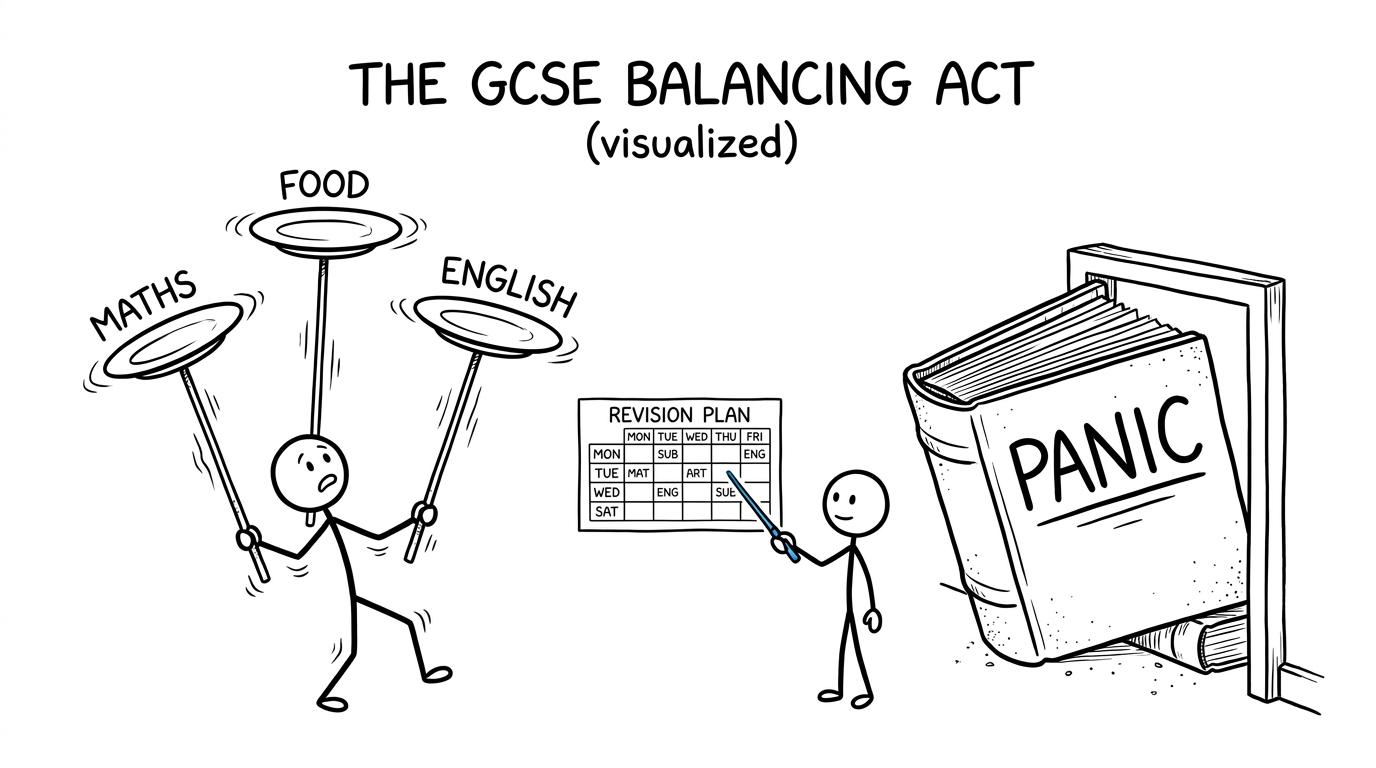 A student balancing maths, food and English revision while panic becomes a doorstop
For maths, begin with evidence rather than mood. The guide to finding your weakest GCSE topics explains how to turn lost marks into a focused revision list. Then use a revision lesson, complete practice questions, mark them and revisit the same skill later.
As exams approach, add full papers gradually. MathsGenie's guide to when you should start GCSE past papers helps you move from topic practice to timed work without abandoning the basics.
Edexcel students can use the Edexcel GCSE Maths past papers, including mark schemes and worked solutions where available. If time is short, a structured one-month GCSE maths revision plan can keep food coursework, other subjects and maths revision in proportion.
Predicted papers have a place too, but use them after diagnosing gaps with real past papers. The guide to GCSE predicted topics explains how to use predictions as practice rather than treating them as a promise about the examination.
Common mistakes when judging whether grade 6 is enough
Looking only at the food requirement
You could meet the course requirement but miss the institution's overall GCSE threshold. Check general entry, subject entry, maths and English separately.
Assuming every food course is the same
Course names can sound similar while qualifications, assessment and progression routes differ. Confirm the awarding body, qualification level and content before applying.
Using an old prospectus
Entry requirements may change between admission years. Make sure the document applies to your intended intake rather than an earlier cohort.
Treating a minimum grade as guaranteed admission
A minimum usually establishes eligibility. Availability, the wider application and additional conditions may still matter.
Giving up because one provider asks for grade 7
That rule belongs to one course at one institution. Search for comparable routes and ask whether related GCSEs or recommendations are accepted.
Ignoring maths until results day
A strong food grade is valuable, but maths may remain part of the general entry decision. Use MathsGenie's GCSE Maths topics by exam board and tier to keep your revision aligned with the specification you actually sit.
Your grade is evidence, not the whole decision
A grade 666 in GCSE Food Preparation and Nutrition is good enough for many sixth-form and college food-related courses. It is not a universal passport, because providers set different subject and general entry requirements. The reliable next step is to check the current prospectus, confirm the exact qualification and ask admissions directly if the wording leaves any doubt.
Then protect the rest of your application. MathsGenie gives you free revision lessons, practice questions, mini tests, past papers, predicted papers, mark schemes and video solutions to turn GCSE maths revision into a clear routine. Open the GCSE Maths revision hub, choose your exam board and tier, and begin with the topic currently costing you the most marks.