Grade 5 GCSE German: Enough for Sixth Form?
Grade 5 GCSE German sixth form entry rules vary by course and provider. See when Grade 5 is enough, when Grade 6 is needed, and your next steps today.
Results-day questions often sound simple but carry much more weight than their wording suggests. Is this grade good? Will they let me in? Have I closed a door without realising it?
If you searched for grade 5 GCSE German sixth form entry advice, the short answer is this: a Grade 5 can be enough to enter sixth form or college, but it is often below the stated requirement for A Level German itself. Many providers currently ask for Grade 6 in GCSE German, while some recommend or require Grade 7. Other courses may accept Grade 5 as part of your overall GCSE profile.
There is no single national sixth-form entry grade for German. Each school or college sets its own general and subject-specific admissions criteria, so the course you want matters more than whether Grade 5 sounds broadly “good”.
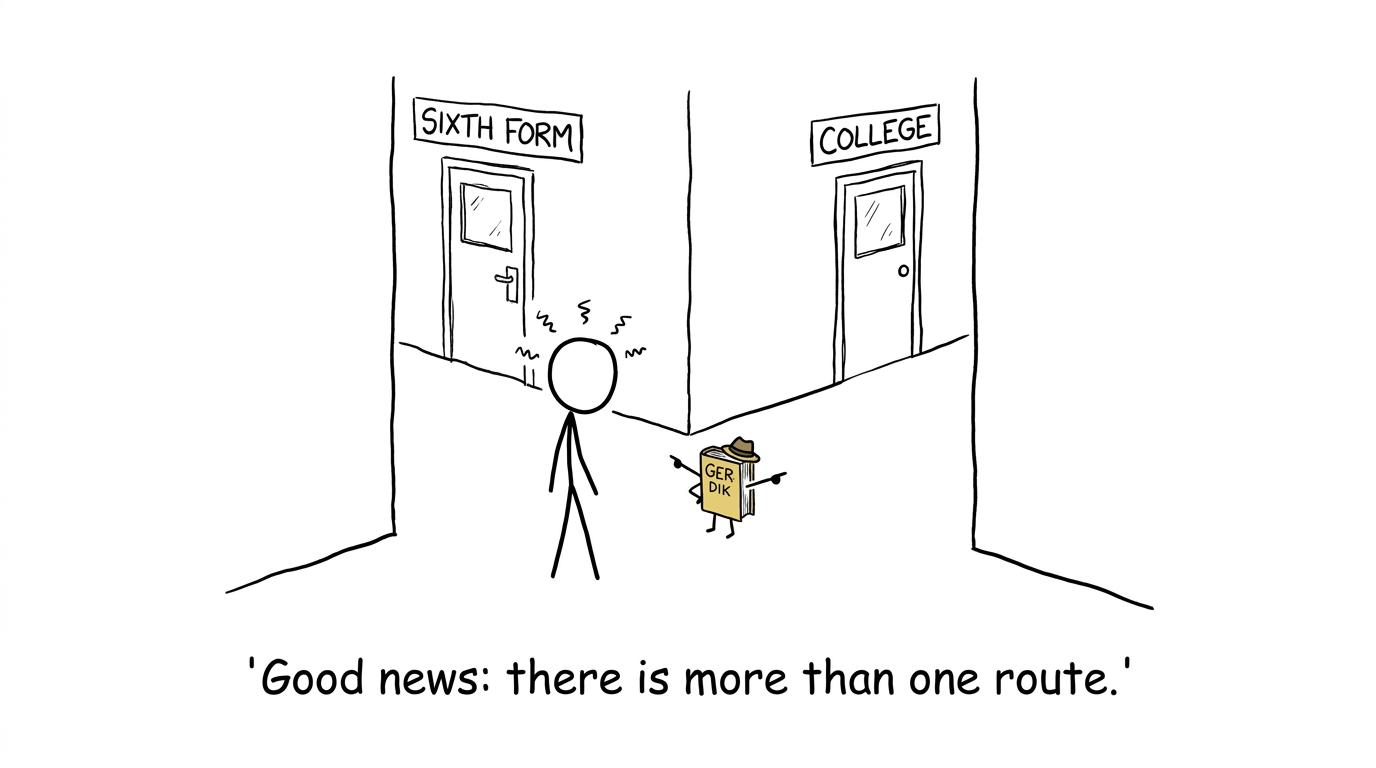 A student choosing between sixth form and college with help from a very confident German dictionary
The quick checklist
Before deciding whether your German grade is enough, check:
- the general entry requirements for your chosen sixth form or college;
- the separate requirements for each A Level or Level 3 course;
- whether A Level German asks for Grade 5, Grade 6 or Grade 7;
- whether GCSE English and maths have minimum requirements;
- whether your provider considers near misses individually;
- whether you have a suitable backup course or provider;
- that you are reading the admissions information for your year of entry.
The important distinction is between getting into the institution and getting onto a particular course. They are related decisions, but they are not the same decision.
Is Grade 5 in GCSE German a good grade?
Yes. Grade 5 is a respectable GCSE pass and demonstrates a meaningful level of ability across listening, speaking, reading and writing. It should not be treated as failure.
However, “good” and “enough” answer different questions.
A Grade 5 may be good enough to contribute towards a sixth form’s overall requirement, such as a specified number of GCSE passes. It may also be sufficient for courses that do not demand a particular German grade. But A Level German is a substantial step up, involving more independent language use, extended writing, translation, discussion and the study of cultural or social material. Providers therefore often set a higher subject threshold.
Current published entry criteria vary. Many sixth forms and colleges ask for Grade 6 in GCSE German, while some set Grade 7 as their recommended minimum. A few may consider Grade 5 alongside teacher evidence, your performance across individual language skills, your wider GCSE profile or an admissions assessment.
This variation is why nobody can reliably answer the question from the grade alone.
When a Grade 5 is likely to be enough
You are not applying for A Level German
If German is not one of your intended subjects, Grade 5 may simply count as one of the GCSEs used to satisfy the provider’s general entry criteria.
Suppose you want to take subjects such as business, sociology, art or a vocational qualification. The German grade may help your overall profile, but the provider will focus on the requirements attached to those chosen courses. Some subjects ask for a related GCSE grade; others look at English, maths or your overall results.
Do not assume that Grade 5 German prevents sixth-form entry just because it may not secure A Level German.
Your provider accepts Grade 5 for German
Some institutions set Grade 5 as the minimum or use guidance rather than an absolute cut-off. If the published criteria say Grade 5, and you also meet the general admissions rules, your grade should normally satisfy that part of the offer.
Read the wording carefully. “Minimum requirement”, “recommended grade” and “typical offer” do not always mean exactly the same thing.
The decision is made individually
Some providers consider students who narrowly miss a subject requirement. They may look at teacher recommendations, mock results, attendance, commitment, speaking performance or whether there were documented circumstances affecting the examination.
Individual consideration is not guaranteed admission. It does mean that a Grade 5 should lead to a conversation rather than an immediate assumption that the answer must be no.
When Grade 5 may not be enough
The course requires Grade 6 or Grade 7 in German
If A Level German explicitly requires Grade 6 and you receive Grade 5, you have missed the published threshold. The same applies where Grade 7 is required or recommended.
Contact the admissions team promptly and ask whether the rule is absolute. Be concise and specific. You could ask:
- whether students one grade below the requirement are considered;
- whether your German teacher can provide supporting evidence;
- whether there is an assessment or interview;
- whether you could begin another course and transfer if appropriate;
- which alternative subject would best fit your programme.
A polite question cannot guarantee a place, but it replaces guesswork with useful information.
You do not meet the general entry profile
A suitable German grade does not override the wider admissions policy. Sixth forms may require a particular number of GCSEs at Grades 4, 5 or above, sometimes with higher grades for an academic A Level programme.
English and maths deserve particular attention. Current providers vary: some expect Grade 4, while others ask for Grade 5 or higher as part of their general criteria. Particular A Levels can also have their own maths or English requirement.
Use the GCSE Maths revision hub to choose your exam board and work on the grades that may determine access to several courses, not just one.
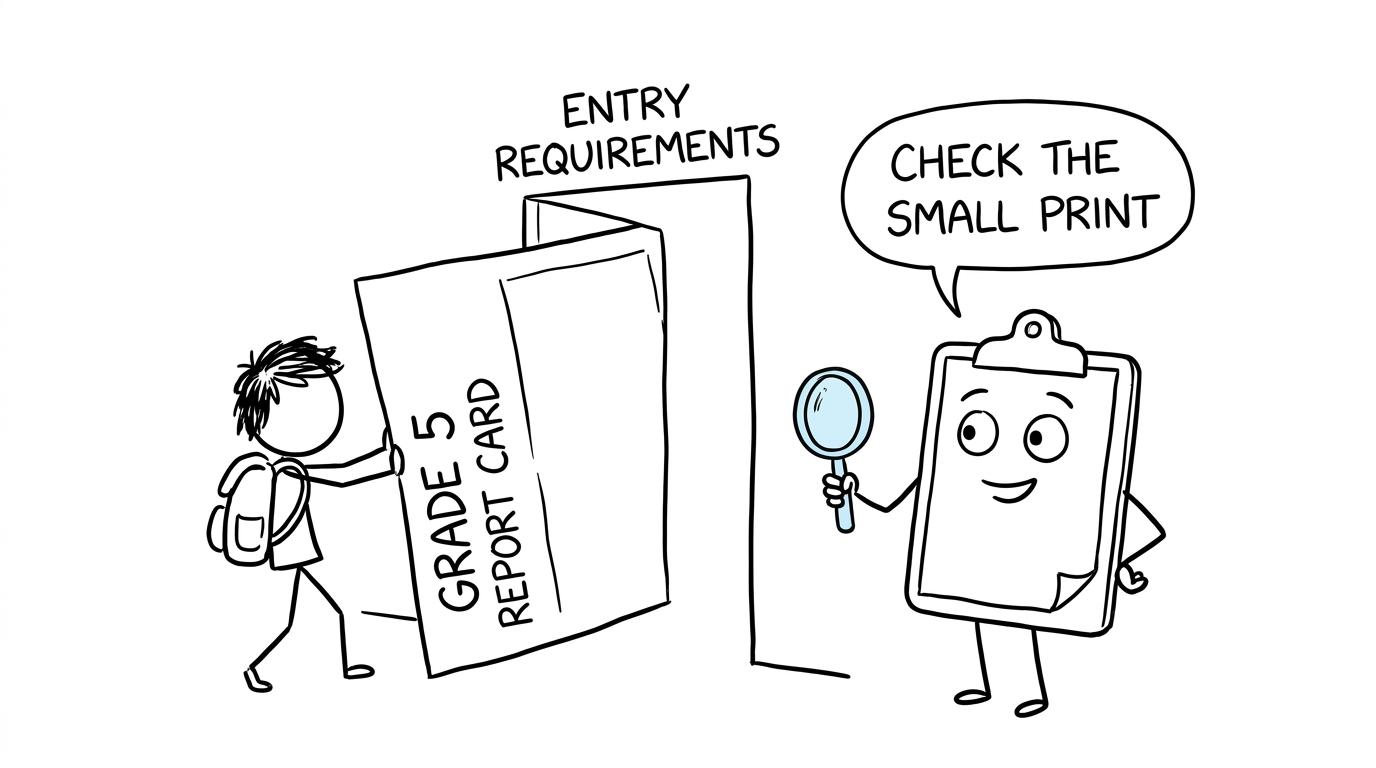 A Grade 5 report card meeting the small print at the admissions doorway
How to check the course you actually want
Admissions pages can look like a wall of grades. Reduce the decision to three layers.
Check the institution-wide requirement
Find the minimum GCSE profile for entry to the sixth form or college. Note the required number of qualifications and any compulsory English or maths grades.
Use the policy for your intended year of entry. Requirements and course availability can change, so an older prospectus or a sibling’s experience may no longer be accurate.
Check every chosen subject separately
Look up all three or four subjects you are considering. Do not check German and stop there.
A student might satisfy the German requirement but miss the threshold for A Level maths, science or another subject. Conversely, Grade 5 German might be irrelevant if German is not part of the chosen programme.
If maths is one of your plans, use the GCSE maths topics by exam board and tier to make sure your revision matches Edexcel, AQA, OCR or Eduqas and the correct foundation or higher tier.
Ask what happens if you miss by one grade
Contact admissions before results day where possible. Ask for the answer in writing so that you know exactly what evidence may be considered.
Useful details include your predicted or mock grade, the course you want and the precise requirement you are asking about. Avoid sending a long argument. The goal is clarity.
What to do before GCSE results day
If you have not yet sat your examinations, the best response is not to predict every admissions decision. It is to improve the grades you can still influence.
For German, use your teacher’s feedback to identify whether listening, speaking, reading, writing, vocabulary or grammar is limiting your performance. Focused revision is more useful than repeatedly rereading everything.
For maths, use the same diagnostic idea. Start with a short test or paper, mark it and identify the topics costing you marks. MathsGenie provides free revision lessons, practice questions, mark schemes, mini tests and video solutions through its GCSE maths resources.
If you are unsure when to move from topic work to complete papers, read when to start GCSE past papers. Edexcel students can then practise with Edexcel GCSE Maths past papers, checking both the tier and calculator rules.
A manageable weekly pattern is:
- revise one specific German weakness;
- complete focused maths topic questions;
- mark both while the work is fresh;
- record a small number of recurring errors;
- retest those skills later in the week;
- keep one session for a timed section or mini test.
If revision feels disorganised, the best order for learning GCSE maths topics offers a clearer route through number, algebra, ratio, geometry, statistics and probability.
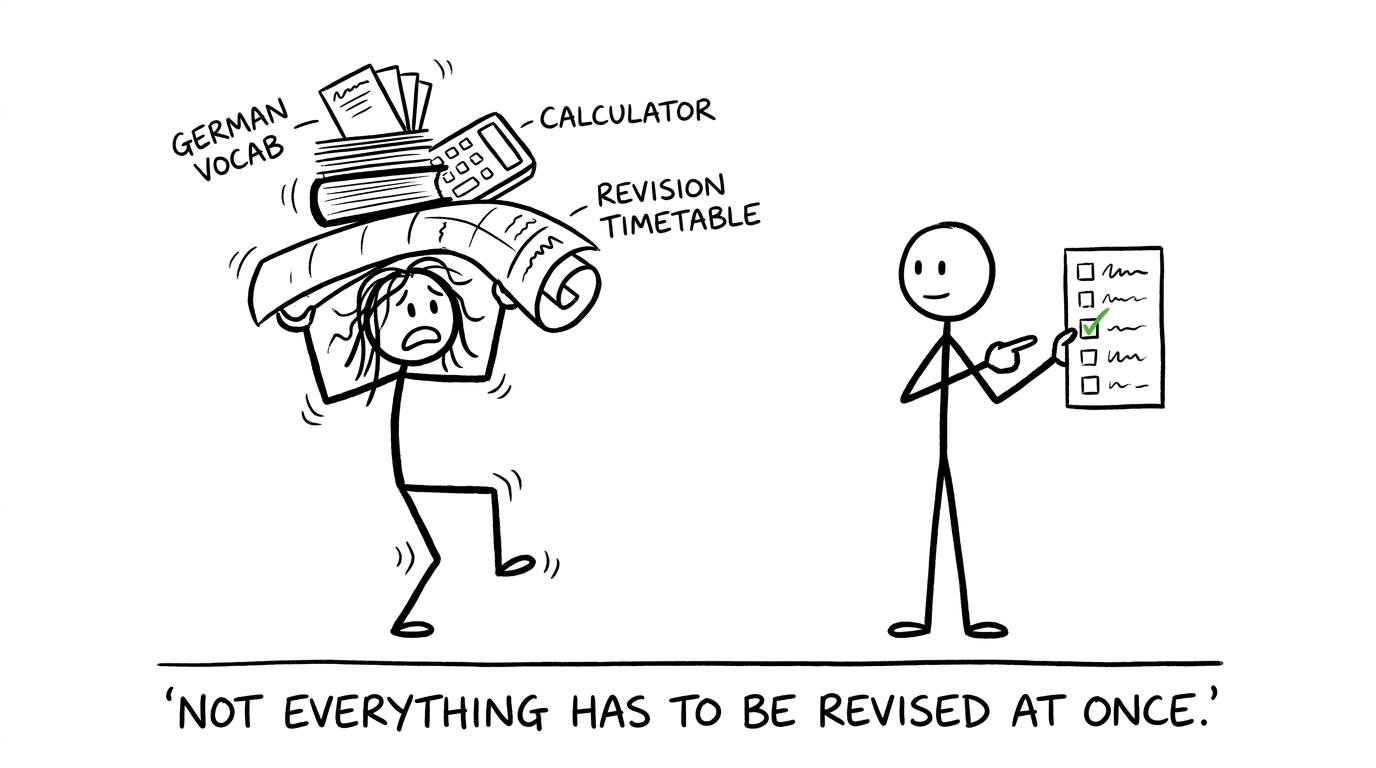 A student balancing German vocabulary, a calculator and a revision timetable
What if you already have Grade 5?
First, compare the result with the written entry requirements. Then act according to what they say.
If Grade 5 meets the requirement, complete any remaining admissions steps. If Grade 6 is required, contact the provider and ask about individual consideration. Have a backup option ready, but do not withdraw your original application before receiving a clear answer.
If you are offered A Level German despite the lower grade, ask the department what preparation it recommends. Acceptance solves the admissions question; it does not remove the need to strengthen vocabulary, grammar and independent language skills before the course begins.
If German is unavailable, consider the wider purpose behind your choice. Were you interested in languages, international work, culture, communication or simply the subject you enjoyed most? Another language course, a different A Level combination or a suitable college qualification may preserve much of that purpose through a different route.
Common mistakes when judging sixth-form entry
Treating a pass as automatic eligibility
Passing GCSE German does not automatically satisfy the entry requirement for A Level German. Always check the subject-specific grade.
Looking only at the German requirement
Your English, maths and overall GCSE profile may determine whether you can enter the programme. Protecting those grades can keep more options open.
Reading an outdated prospectus
Use the policy for the correct admissions year and confirm uncertain information directly with the provider.
Assuming every sixth form has the same rule
Admissions criteria are set locally. One provider may ask for Grade 6 while another recommends Grade 7 or considers Grade 5 individually.
Rejecting yourself before asking
If you narrowly miss the requirement, ask whether there is discretion. Do not describe an exception as an entitlement, but do not assume that no conversation is possible.
Revising without checking mistakes
Completion can feel productive while leaving the same weaknesses untouched. Use mark schemes and solutions to turn errors into specific next actions. The guide to using GCSE past papers effectively explains how to build from diagnosis to timed practice, while predicted GCSE topics and papers can add fresh practice nearer the examinations.
A Grade 5 is information, not a verdict
A Grade 5 in GCSE German can be enough for sixth-form or college entry, particularly when German is not your intended A Level and the rest of your GCSE profile meets the general criteria. For A Level German, however, many providers currently ask for at least Grade 6, with some setting a higher threshold.
Check the exact institution, course and admissions year. Ask what happens with a near miss. Keep a realistic alternative available. Most importantly, do not let anxiety about one result distract you from the grades you can still improve.
MathsGenie can help you strengthen the maths side of that profile for free. Begin with the GCSE Maths revision hub, choose your board and tier, and move from revision lessons to practice questions, mini tests, past papers and predicted papers. Mark every attempt using the available mark schemes and video solutions. One grade may influence a route, but steady, well-directed revision keeps more routes open.