Grade 5 GCSE Food and Nutrition: Sixth Form?
Grade 5 GCSE Food and Nutrition sixth form guidance: check course requirements, overall grades and whether maths or English could affect your place.

A results sheet can make one number feel much larger than it is. You see a grade 5 in Food Preparation and Nutrition, remember the course you want, and wonder whether the door to sixth form has quietly closed.
The short answer is reassuring: a grade 5 is enough for many sixth-form and college food-related courses, but not every course. Current published entry criteria vary. Some providers accept grade 444, many ask for grade 555, and a smaller number prefer or require grade 666. Your overall GCSE profile, particularly maths and English, may matter just as much.
So, if you are searching for grade 5 gcse food and nutrition sixth form guidance, do not judge your chances from that result alone. Check the precise course, institution and entry year before making a decision.
The quick answer and checklist
A grade 5 will often keep food-related Level 333 options open. Before assuming that you qualify, check all of the following:
- the general entry requirements for the sixth form or college;
- the subject-specific Food Preparation and Nutrition requirement;
- the required grades in GCSE Maths and English Language;
- whether science is required or preferred;
- whether prior food study is essential, preferred or unnecessary;
- whether a portfolio, interview or practical skills check is requested;
- whether the criteria apply to your intended year of entry.
Published requirements can change between admission cycles. Use the current prospectus or admissions policy rather than an old screenshot, and ask the admissions team to confirm anything unclear in writing.
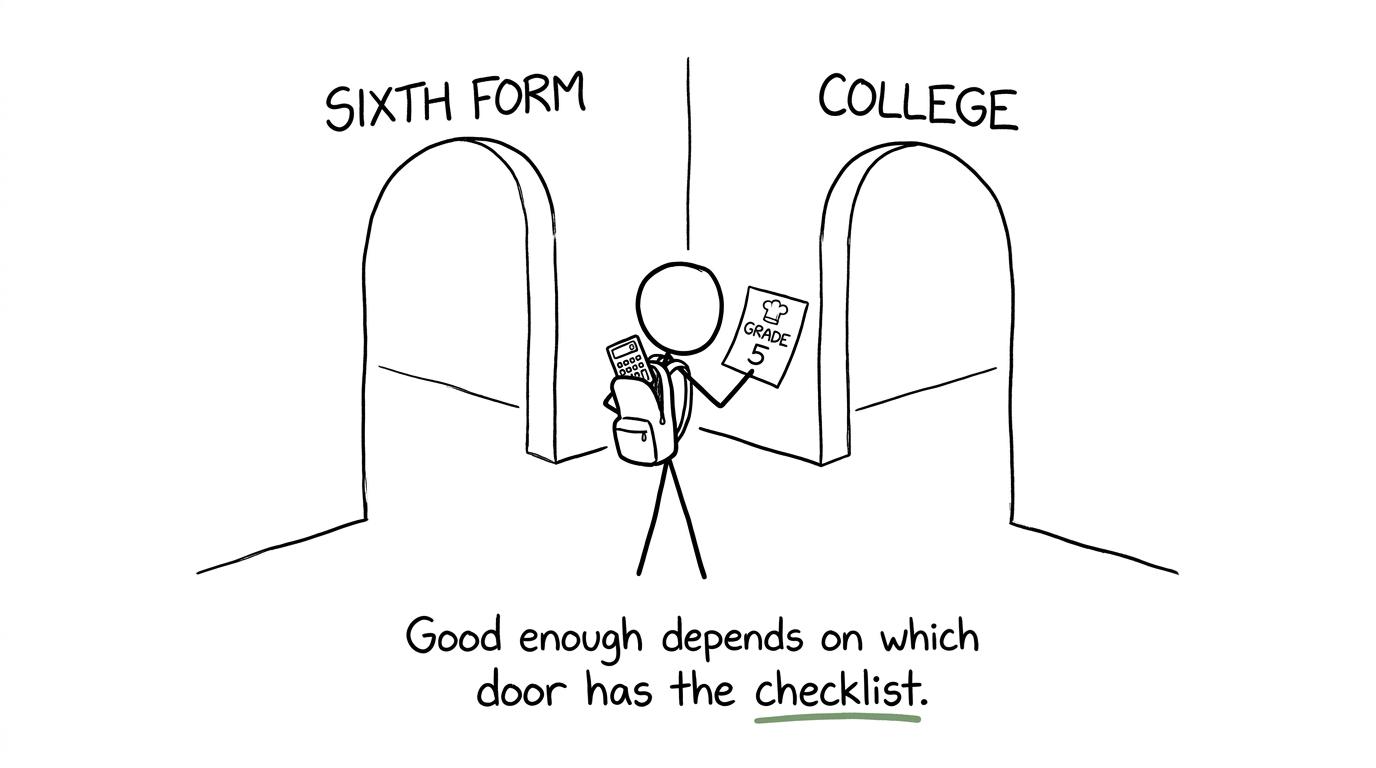 A student choosing between sixth form and college doors while holding a grade 5 result
Is a grade 5 in GCSE Food and Nutrition good?
Yes. In England, GCSEs use the grades 999 to 111, with 999 as the highest grade. Government guidance identifies grade 444 as the standard-pass benchmark, while grade 555 is commonly described as a strong pass. The numerical scale does not translate exactly into the old letter system, although grades 444, 555 and 666 occupy the broad area previously covered by grades C and B.
A grade 5 therefore shows that you achieved a secure result in a qualification combining theoretical knowledge, practical competence, planning and evaluation. It is not a weak grade, nor does it automatically need to be retaken.
Food Preparation and Nutrition is also broader than cooking dishes successfully. Depending on the exam board, students study areas such as nutrition, food science, safety, food choice, provenance and preparation techniques. For AQA, OCR and Eduqas specifications, the written examination accounts for 50%50\%50% of the qualification, with non-exam assessment accounting for the remaining 50%50\%50%. That balance means the final grade reflects several kinds of performance rather than one isolated exam.
Will a grade 5 get you onto the course you want?
Possibly, and often yes, but the course title matters.
Post-161616 food courses are not completely standardised across the country. You may find courses called Food Science and Nutrition, Applied Food Science and Nutrition, Hospitality and Catering, Professional Cookery or another related title. They may be academic, vocational or practically focused, and their admissions rules can differ accordingly.
Recent published requirements illustrate that variation. Some providers accept grade 444 in a relevant food qualification. Many state grade 555 in GCSE Food Preparation and Nutrition. Others ask for grade 666, a science grade, or an appropriate Level 222 vocational result. Some do not require previous food study but may want evidence of practical ability or genuine subject interest.
This is why the most accurate answer is not simply “grade 5 is enough”. It is:
A grade 5 meets the subject requirement where the course asks for grade 555 or below, provided you also satisfy its general and additional entry conditions.
Check the general sixth-form requirement
A subject grade can be acceptable while the overall application falls short. Many Level 333 programmes specify a minimum number of GCSEs at grades 444 or 555 and above. Academic A Level pathways may set a higher overall threshold than vocational programmes.
Read the admissions information twice: once for the institution's general rule, then again for the individual course. These are separate hurdles.
For example, a food course might accept grade 555 in Food Preparation and Nutrition while the sixth form separately expects five GCSEs at grade 555 or above, including particular results in maths and English. Meeting only the food requirement would not guarantee entry.
Check maths, English and science separately
Maths and English frequently appear in general Level 333 entry requirements. Some food science courses also request a particular science grade because students need to interpret evidence, understand chemical and biological processes, and evaluate investigations.
If your GCSE Maths grade is currently around grade 555, read what a grade 5 in GCSE Maths means. It is a strong pass, but the relevant question is whether your chosen destination asks for grade 444, 555 or something higher.
Do not assume that a good food grade compensates automatically for another missing requirement. Equally, do not assume one lower result ends the application. Admissions teams may suggest a different pathway, a Level 222 course followed by progression, or an alternative combination of subjects.
 A student checks the course, overall grades and maths plus English requirements
Why GCSE Maths still matters for food-related courses
Maths may not be the course name, but it often sits quietly inside the work. Food and nutrition can involve:
- scaling quantities and using ratio;
- converting between units;
- calculating percentages and proportions;
- comparing nutritional values;
- interpreting tables, charts and graphs;
- estimating costs and controlling budgets;
- collecting, presenting and evaluating investigation data;
- working accurately with time and temperature.
These skills matter because a sensible conclusion depends on reliable data. A beautifully presented chart cannot rescue incorrect calculations, just as an accurate calculation is less useful if its units are missing.
If maths is one of the grades that could determine your place, begin with the free GCSE Maths revision hub. It provides board-specific revision materials for Edexcel, AQA, OCR, Eduqas, WJEC and CCEA, including practice questions, papers and solutions.
Your goal is not to revise every topic at once. Diagnose the skills costing you marks, practise them, use the mark scheme, and return to them later. The GCSE Maths revision timetable can help turn that process into a manageable routine.
What to do before applying
Build a shortlist with exact requirements
Choose several realistic destinations rather than relying on one. For each course, record:
- the qualification title and level;
- general GCSE requirements;
- required food, maths, English and science grades;
- whether an interview or portfolio is needed;
- the application deadline;
- who to contact with questions.
Separate “required” from “preferred”. A preferred grade is not always an absolute barrier, while a formal minimum usually carries more weight. If wording such as “equivalent qualification” is unclear, ask whether your exact GCSE or vocational award is accepted.
Speak to the provider directly
Ask a precise question rather than “Can I get in?” A useful message would explain your predicted or achieved grades, name the exact course and ask whether you meet both the general and subject-specific criteria.
You can also ask what happens if you miss one requirement by a single grade. There may be no flexibility, but knowing the policy early gives you time to consider alternatives. Never assume discretion will be available on results day.
Keep strengthening the rest of your GCSE profile
Your Food Preparation and Nutrition grade may already meet the target. The greater opportunity could be improving maths, English or science.
Use a diagnostic paper before planning weeks of revision. The one-month GCSE Maths revision plan explains how to identify weak areas and combine topic practice with timed work. If time is short, the one-week maths revision plan offers a more concentrated structure.
Edexcel students can use the Edexcel GCSE Maths revision strategy, while OCR students can follow the OCR GCSE Maths revision plan. Always match your practice to the correct exam board and foundation or higher tier.
 A revision planner negotiates peace between a student and flying maths notes
If your chosen course asks for a grade 6
A grade 5 would not formally meet a stated grade 666 requirement. That is disappointing, but it is information rather than a verdict on your future.
Take these steps:
- confirm that you are reading the criteria for the correct entry year;
- ask whether grade 666 is required or merely desirable;
- find out whether equivalent experience or a practical portfolio is considered;
- investigate similar courses with grade 444 or 555 entry requirements;
- ask about Level 222 routes that progress to Level 333;
- discuss whether a review of marking is appropriate with your school if there is a genuine marking concern.
A GCSE retake is not automatically the best option, especially where substantial non-exam assessment is involved. Seek advice from your school and the intended provider before deciding. If GCSE Maths is the result restricting your route, use a focused GCSE Maths resit revision plan rather than revising without a clear destination requirement.
Common mistakes when checking sixth-form eligibility
Looking only at the food grade
A grade 5 may satisfy the subject rule but not the institution's overall GCSE threshold. Check both.
Treating every food course as identical
Food Science and Nutrition, Hospitality and Catering, and Professional Cookery can have different content, assessment methods and entry conditions. Read the actual course description.
Using last year's prospectus
Requirements and course availability can change. Confirm that the document applies to your intended admission year.
Confusing “preferred” with “required”
These words are not interchangeable. Ask the provider if the distinction is unclear.
Ignoring maths and English until results day
These subjects can affect access to many Level 333 pathways. Improving them may protect several options at once, not merely one food course.
Assuming a grade guarantees a place
Meeting published minimum requirements normally makes you eligible for consideration. It does not necessarily guarantee admission, particularly where places are limited or other conditions apply.
Your grade is one part of the decision
A grade 5 in GCSE Food Preparation and Nutrition is a respectable result and is enough for many relevant sixth-form and college courses. The decisive issue is whether it satisfies the precise course requirement alongside your overall GCSE profile, especially maths, English and sometimes science.
Check current criteria, contact the provider and keep more than one route open. Then focus your revision where it can change the outcome.
MathsGenie can help you strengthen that wider application for free. Start with the GCSE Maths revision hub, choose your board and tier, and use revision lessons, practice questions and mini tests to repair weak topics. Follow them with past papers, predicted papers, mark schemes and video solutions so every mistake becomes a clear next step rather than another reason to worry.