

GCSE vs iGCSE Computer Science: Key Differences
GCSE vs iGCSE Computer Science explained: compare content, exams, programming, grades and recognition, then decide how much the distinction matters.
The name printed on an exam paper can feel strangely important. Add one small letter before GCSE and it is easy to wonder whether you have been placed on a harder course, an easier course or a qualification universities will judge differently.
The short answer to GCSE vs iGCSE Computer Science is reassuring: both are respected qualifications for students of roughly the same age, and both teach programming, algorithms, data representation, computer systems and computational thinking. The meaningful differences are found in the exact specification, assessment format, permitted programming language, grading system and exam timetable.
So the letter matters for revision. It rarely defines your future.
The difference at a glance
Before comparing details, remember that “iGCSE Computer Science” is not one universal course. Cambridge IGCSE Computer Science and Pearson Edexcel International GCSE Computer Science have different specifications and assessments. In the same way, domestic GCSE courses vary between AQA, OCR, Pearson Edexcel and other awarding organisations.
| Feature | GCSE Computer Science | iGCSE or International GCSE Computer Science |
|---|---|---|
| Main setting | Primarily schools in England and the wider UK | International schools, online providers and some UK independent schools |
| Regulation | GCSEs in England are regulated by Ofqual | Arrangements depend on the awarding organisation |
| Typical content | Algorithms, programming, data, systems, networks, security and technology's impacts | Broadly similar core, with board-specific international content and assessment |
| Grading | Usually grades 999-111 in England | Pearson uses 999-111; Cambridge commonly uses A* to G |
| Assessment | Board-dependent written or onscreen examinations | Board-dependent written and practical examinations |
| Recognition | Established UK Level 1/Level 2 qualification | Designed to be comparable with the corresponding GCSE standard |
Your practical checklist is simple:
- identify the full qualification title and syllabus code;
- confirm the awarding organisation;
- download the specification for your examination year;
- check whether programming is written, onscreen or both;
- use past papers produced for that exact course;
- learn the pseudocode conventions and command words in its mark schemes.
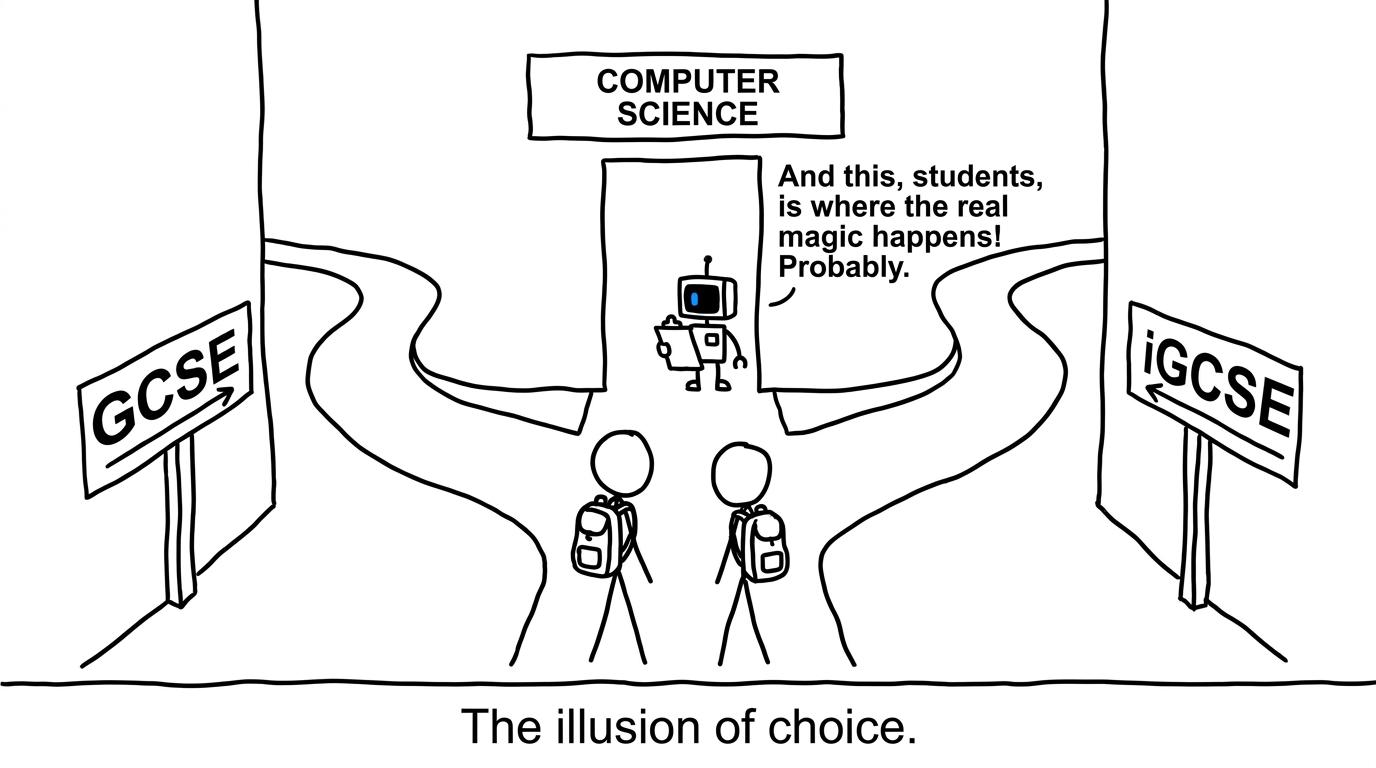 Two students discover that the GCSE and iGCSE paths lead towards the same Computer Science room
GCSE Computer Science follows a national subject framework
GCSE Computer Science specifications in England are built within subject content set by the Department for Education and assessment requirements regulated by Ofqual. That creates a common core across exam boards.
Students are expected to understand areas such as abstraction, decomposition, logic, algorithms and data representation. They also need practical experience of designing, writing, testing and refining programs. Current subject content includes binary and hexadecimal representation, Boolean logic, systems architecture, networks, cyber security and the ethical, legal and environmental effects of technology.
However, “common core” does not mean “identical paper”. OCR GCSE Computer Science J277, for example, has two externally assessed written components, each worth 50%50\%50%. Pearson Edexcel GCSE Computer Science includes an onscreen programming assessment. AQA's assessment and supported programming arrangements depend on the specification and examination year, including changes applying from the summer 202720272027 examinations.
This is why advice such as “revise GCSE programming” is too broad. A student needs to know how their own board turns programming knowledge into marks.
What makes an iGCSE international?
An international GCSE is designed for use across countries and educational settings. References and contexts are intended to work for students beyond one national school system, while examination series may offer greater international flexibility.
That does not mean every topic is globally themed or that the technical principles change. A binary number represents the same value in Birmingham, Belfast or Bangkok. Selection and iteration still behave in the same way. The difference is mainly in how an awarding organisation selects, frames and assesses the material.
Cambridge IGCSE Computer Science 047804780478 for examinations in 202620262026 to 202820282028, for example, has two papers. Paper 1 covers computer systems; Paper 2 covers algorithms, programming and logic. Each lasts 111 hour 454545 minutes, carries 757575 marks and contributes 50%50\%50% of the qualification. Calculators are not permitted.
Cambridge also has precise rules about acceptable answers to coding questions. Most coding solutions in Paper 2 must be written in the required pseudocode. The longer scenario question permits pseudocode or specified languages, currently Python, Visual Basic or Java. Using an unapproved language where the syllabus requires a particular form can lose marks even when the underlying idea is sensible.
Pearson Edexcel International GCSE Computer Science takes a different route. Its structure includes a written principles paper and a practical application paper. That alone shows why students should never treat “iGCSE” as the name of a single exam format.
Students taking international maths can see the same principle on MathsGenie's Edexcel iGCSE Maths revision page: the qualification may cover familiar ideas, but successful preparation still depends on specification-matched questions, papers and solutions.
Content overlap is greater than the difference
Most GCSE and iGCSE Computer Science courses share a substantial intellectual centre:
- algorithm design and problem-solving;
- sequence, selection and iteration;
- variables, data types and data structures;
- programming, testing and debugging;
- binary data and data representation;
- hardware, software and computer architecture;
- networks, internet technologies and cyber security;
- databases and Boolean logic;
- social, ethical, legal and environmental considerations.
The precise depth varies. One board may place more emphasis on a standard algorithm, database operation or emerging technology. Another may prescribe pseudocode more tightly or test practical programming through an onscreen environment.
The safest comparison is therefore not a broad internet list. Put the two current specifications side by side and compare individual statements. Specifications change, and resources prepared for an older examination series may no longer match every requirement.
Assessment format is the difference you will feel most
Course titles are abstract. Exam conditions are not.
Writing an algorithm by hand requires you to communicate logic clearly without running it. An onscreen paper asks you to work inside a programming environment, where syntax, testing and debugging become immediate. A structured theory paper rewards accurate terminology and explanations tied to the scenario.
None is automatically easier. They distribute difficulty differently.
A confident programmer may prefer an onscreen assessment but underestimate extended explanations. Another student may know every definition yet struggle to trace an unfamiliar algorithm. The better question is not “Which qualification is harder?” but “What actions does my mark scheme reward?”
This is the same reason MathsGenie recommends moving from topic knowledge into timed paper practice. The guide to when to start GCSE past papers explains how papers reveal gaps that ordinary notes can hide. Use that principle for Computer Science, but always obtain papers from your own awarding organisation.
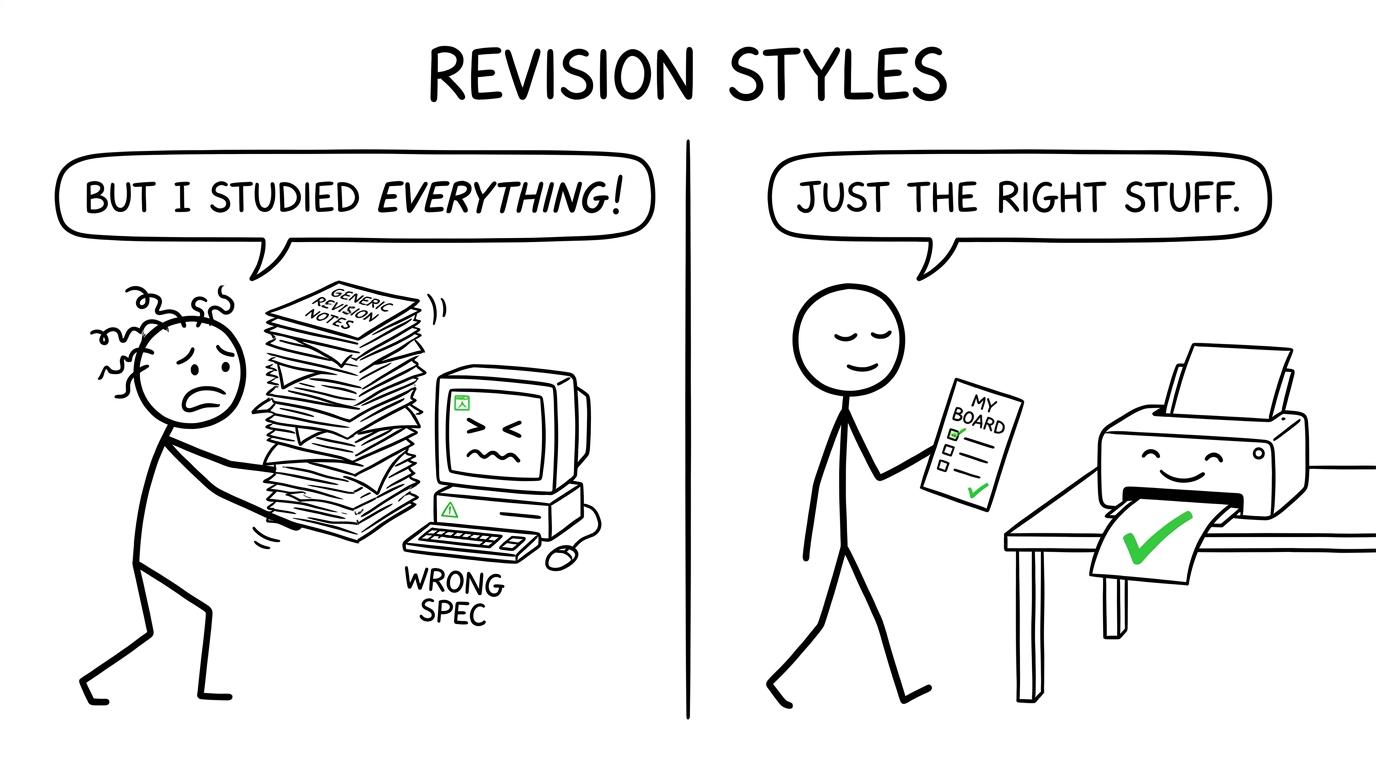 A student discovers that revising the wrong specification creates a heroic amount of unnecessary paper
Does your qualification affect progression?
Both qualifications can provide suitable preparation for A Level Computer Science, provided you develop the underlying knowledge and programming skills. International GCSEs are designed to be comparable with GCSE standards, although grading scales can differ by board.
Schools, colleges and universities may set their own entry requirements, so check the wording rather than assuming. If an entry page asks for a particular grade in GCSE or an equivalent qualification, contact the institution if the treatment of your exact certificate is unclear.
For most students, the achieved grade, mathematical confidence and ability to solve problems will be more consequential than the extra “I” in the title. Neither route creates a shortcut around programming practice.
Where maths fits into both courses
Computer Science uses more maths than its title sometimes suggests. Typical specifications include binary and hexadecimal conversion, binary shifts, data-size calculations, Boolean logic and algorithmic reasoning. You may also meet arithmetic operators, integer division and remainders inside programs.
Strong habits transfer between the subjects:
- show ordered reasoning rather than jumping to a result;
- check units and powers carefully;
- distinguish a value from its representation;
- test boundary cases;
- read command words before answering;
- treat an incorrect result as evidence about the process.
Probability and data work can also strengthen logical precision. MathsGenie's free Edexcel GCSE Statistics revision resources offer lessons, question banks, worksheets and papers for students who want more structured practice with data.
Rather than letting Computer Science revision displace maths entirely, use a balanced plan. MathsGenie's one-month GCSE maths revision plan shows how short topic sessions, retrieval and paper practice can fit together. The revision planner can help you protect time for both subjects.
How to revise whichever course you sit
Start by turning the specification into three lists: secure, uncertain and untested. Then match each weak statement to a suitable question. Do not spend an evening “revising networks” when the real gap is explaining the purpose of a protocol in context.
A reliable loop is:
- review one tightly defined specification statement;
- answer questions without notes;
- mark them using the official mark scheme;
- record whether the problem was knowledge, application, terminology or programming;
- correct the answer;
- revisit the skill with a different question.
Maths students can apply the same diagnosis through MathsGenie's guide to finding weak GCSE topics quickly. For final maths preparation, GCSE predicted papers and video solutions can expose recurring method errors. Predicted papers should complement genuine past papers, not replace them.
Common mistakes when comparing GCSE and iGCSE
Assuming one is automatically harder
Difficulty depends on the specification, paper, teaching and your strengths. Compare assessment demands instead of relying on reputation.
Revising from the wrong board
A video can explain a valid concept while missing the pseudocode convention, terminology or depth required by your examination. Label every resource with its board and syllabus code.
Treating all international GCSEs as identical
Cambridge and Pearson qualifications can differ in grading, paper structure and permitted response formats. “iGCSE” is not enough information for a revision plan.
Learning code without learning how it is assessed
Practical experience is essential, but some papers require handwritten pseudocode or written analysis. Practise in the form required by the exam as well as inside an editor.
Neglecting maths during Computer Science revision
Data representation and logic benefit from careful numerical thinking. Keep maths active with revision lessons, mini tests and timed questions. MathsGenie's exam-week checklist offers a calm structure for marking, correcting and protecting your sleep.
The name matters less than the map
GCSE and iGCSE Computer Science lead through much of the same territory, but they do not use identical maps. Your awarding organisation decides the detailed content, assessment style, grading and acceptable answer formats. Those details matter because marks are awarded against a particular specification.
Find your exact course. Read its current specification. Practise with its own papers and mark schemes. Then give equal care to the transferable skills underneath: logic, precision, programming and problem-solving.
For your maths exams, make MathsGenie your free revision base. Use revision lessons to repair gaps, practice questions and mini tests to build fluency, past papers to develop stamina, and predicted papers with mark schemes and video solutions to sharpen your final preparation. The qualification title may be chosen for you. The quality of your revision is still yours to shape.











