GCSE vs iGCSE Chinese: What’s Actually Different?
GCSE vs iGCSE Chinese explained clearly: compare papers, tiers, speaking tests, grading and content, then learn which differences matter for revision.
A qualification name can look like a small detail until you open the wrong past paper and discover that the speaking task, paper structure and timing do not match what you have learnt.
The short answer to GCSE vs iGCSE Chinese is this: both can assess listening, speaking, reading and writing at a broadly comparable level, usually with grades from 999 to 111. However, they are not the same examination. The number of papers, use of tiers, topic organisation and balance of marks can differ significantly.
For students juggling Chinese with GCSE maths revision, the practical lesson is simple. Confirm the exact exam board, specification code and qualification before choosing revision materials. Revising the right subject through the wrong paper format creates avoidable difficulty.
GCSE vs iGCSE Chinese at a glance
Because “iGCSE Chinese” can refer to qualifications from different awarding organisations, there is no single comparison covering every possible course. This article uses Pearson Edexcel GCSE Chinese and Pearson Edexcel International GCSE Chinese as the clearest like-for-like comparison, while noting where other boards may differ.
| Feature | Edexcel GCSE Chinese | Edexcel International GCSE Chinese |
|---|---|---|
| Specification code | 1CN01\mathrm{CN}01CN0 | 4CN14\mathrm{CN}14CN1 |
| Qualification structure | Four papers | Three papers |
| Skills assessed | Listening, speaking, reading and writing | Listening, speaking, reading and writing |
| Tiering | Foundation or higher tier | Untiered |
| Grade scale | 999 to 111 | 999 to 111 |
| Skill weighting | Each skill contributes 25%25\%25% | Listening 25%25\%25%, speaking 25%25\%25%, combined reading and writing paper 50%50\%50% |
| Speaking options | Mandarin or Cantonese | Mandarin or Cantonese |
| Regulatory position | Ofqual-regulated GCSE | International qualification outside the UK Regulated Qualifications Framework |
The headline difference is therefore not the language itself. It is how your ability is packaged and tested.
Your quick identification checklist
Before downloading any paper, find out:
- the full qualification title;
- the awarding organisation;
- the specification code;
- whether you are entered for Mandarin or Cantonese speaking;
- whether your course is tiered;
- the permitted character format and precise paper requirements;
- the examination series you will sit.
Your teacher or examinations officer can confirm these details. The front of a recent school assessment may also display the board and paper code.
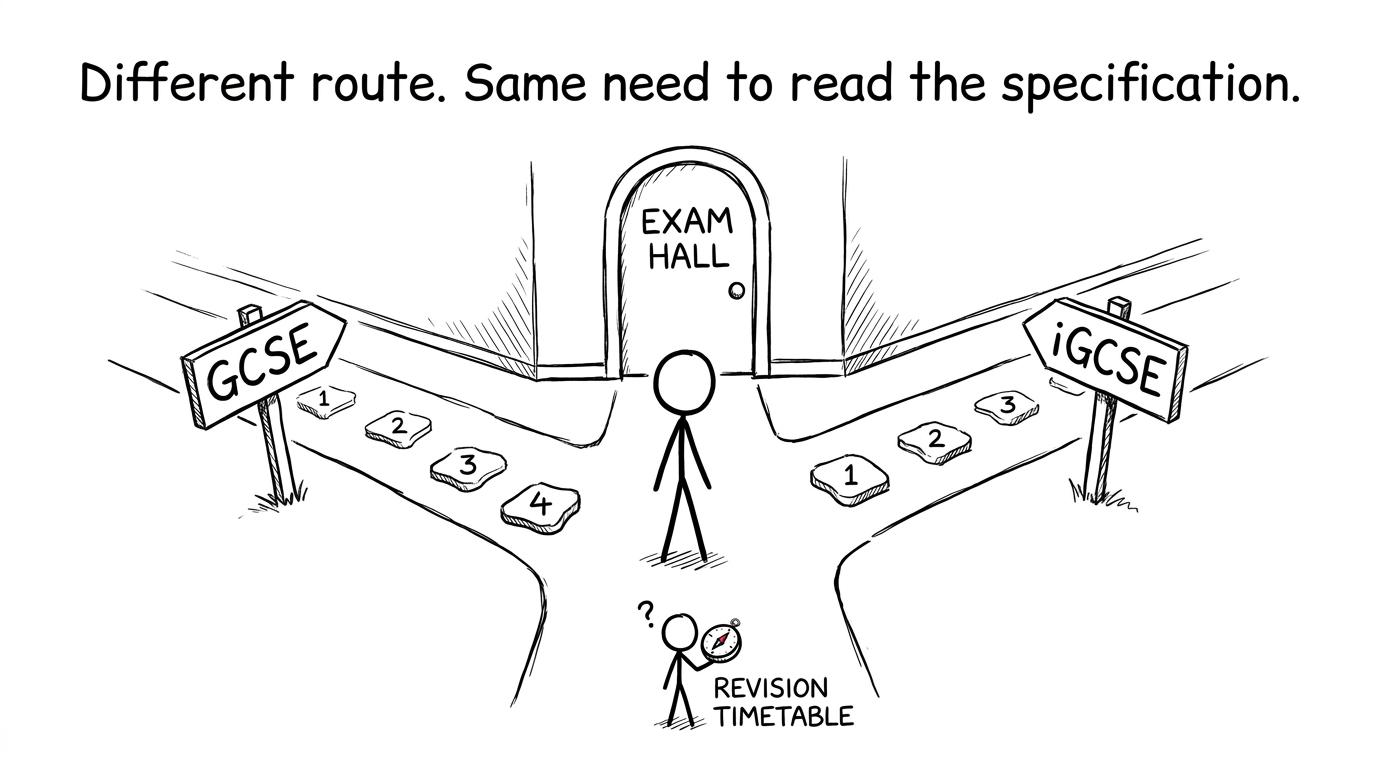 A student discovers that GCSE and iGCSE are different routes towards an exam hall
The biggest difference is the assessment structure
Edexcel GCSE Chinese separates the four language skills into four papers. Listening, speaking, reading and writing each contribute 25%25\%25% of the qualification.
Edexcel International GCSE Chinese uses three papers:
- Paper 1 assesses listening and contributes 25%25\%25%;
- Paper 2 combines reading and writing and contributes 50%50\%50%;
- Paper 3 assesses speaking and contributes 25%25\%25%.
The same four broad skills remain present, but the examination day experience changes. An International GCSE student faces a longer combined reading and writing paper, while a GCSE student prepares for those skills as separate assessments.
That difference affects revision. For a combined paper, you must practise switching from comprehension to extended written production while managing one shared time allowance. With separate GCSE papers, timing can be trained independently for reading and writing.
Neither structure is automatically easier. A longer combined paper may suit someone who settles into an examination slowly, while separate papers may suit someone who performs better in shorter, clearly defined assessments. These are personal preferences, not evidence that one qualification has a lower standard.
GCSE Chinese has tiers, while Edexcel iGCSE is untiered
Edexcel GCSE Chinese papers are available at foundation and higher tier. A student must be entered for the same tier across the qualification.
Foundation tier normally makes grades 111 to 555 available. Higher tier normally targets grades 444 to 999, with a narrowly available grade 333 below the usual higher range. Tier choice therefore affects both question demand and the grades available.
Edexcel International GCSE Chinese is untiered. Every candidate sits the same paper, and performance across the whole qualification determines the final grade from 999 to 111.
This matters because an untiered paper must contain a wider range of demand. Some questions should feel accessible, while others distinguish the strongest performances. Seeing difficult material on the page does not mean every candidate is expected to answer all of it perfectly.
Maths students will recognise the strategic importance of tier choice. On the MathsGenie GCSE maths revision hub, board and tier determine which papers are relevant. Chinese requires the same discipline: never assume that two resources are interchangeable simply because both have “GCSE” in the title.
The speaking assessments are organised differently
Both Edexcel qualifications assess speaking separately, with the assessment conducted by the school and marked externally. Both offer Mandarin and Cantonese options.
The task design is different, however. In the GCSE specification, the speaking assessment includes a role play, a picture-based task and a conversation. Foundation and higher candidates also have different assessment durations.
In the International GCSE, the speaking examination lasts approximately eight to ten minutes and includes three tasks. Students present and answer questions about a picture, then discuss two topics selected under the specification’s rules.
This is one of the strongest reasons not to borrow speaking cards casually from another qualification. General conversational practice is useful, but an unfamiliar task sequence can distort your timing and preparation.
Train with the structure you will actually meet. Know when you must initiate language, how long an answer should be, what follow-up questions can occur and how the mark scheme rewards communication, range and accuracy.
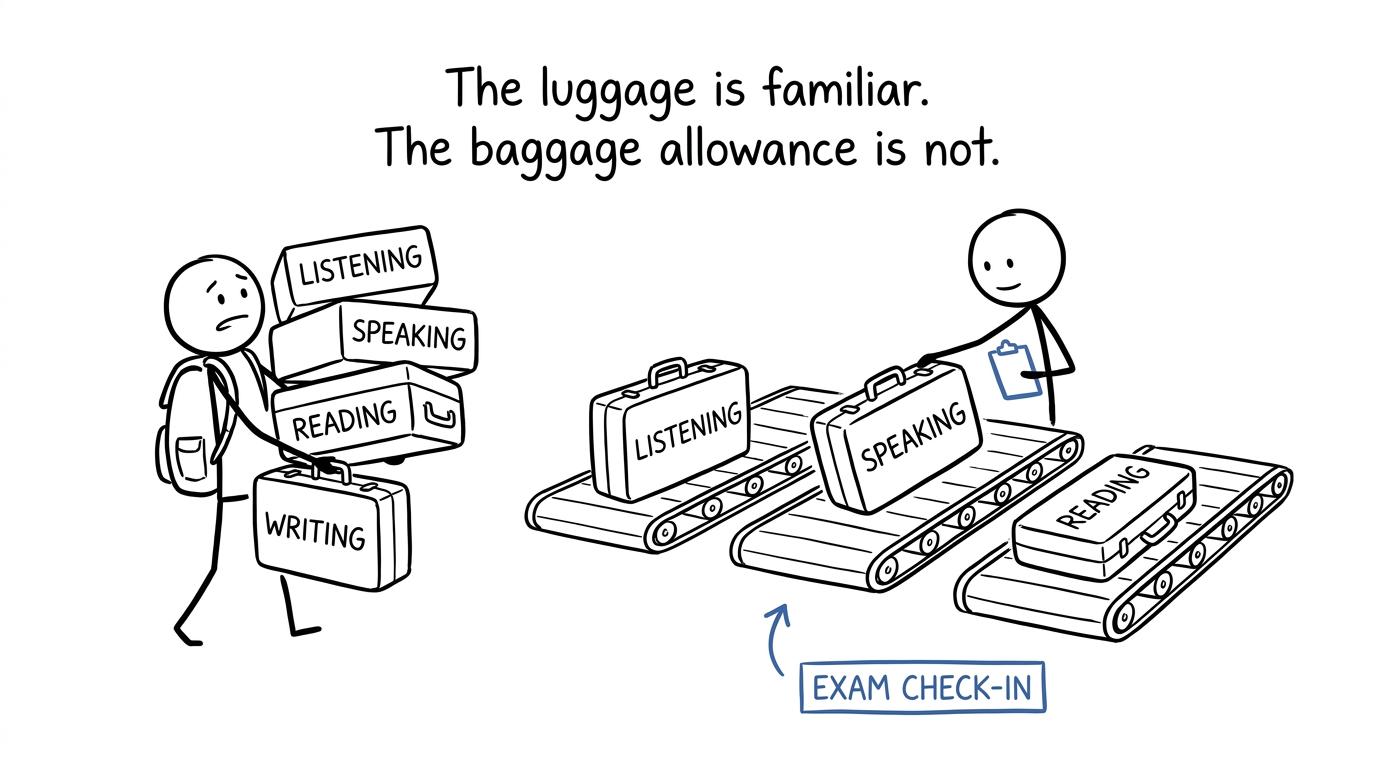 An examiner rearranges the same four language skills into different paper structures
Content overlaps, but the topic maps are not identical
Both courses develop practical communication across familiar areas such as home life, education, relationships, travel, work, health and the wider world. That overlap is why vocabulary from one course can often remain useful for another.
Yet the specifications organise this content differently. The Edexcel GCSE studied for the current qualification groups material into themes including identity and culture, local area and travel, school, future aspirations and the international dimension.
Edexcel International GCSE Chinese uses five topic areas:
- home and abroad;
- education and employment;
- personal life and relationships;
- the world around us;
- social activities, fitness and health.
The labels are not merely decorative. They shape vocabulary planning, speaking preparation and the contexts used in assessments. A revision guide for another specification may omit a sub-topic, emphasise the wrong vocabulary or prepare you for a task that does not appear in your paper.
Start with the specification checklist, then build vocabulary and grammar around it. Specification-led revision is less exciting than collecting colourful resources, but it is far more dependable.
Does it matter which qualification you sit?
It matters for how you prepare, but the name alone should not cause alarm.
Pearson describes its International GCSE as comparable in demand and assessment standard to reformed UK GCSEs. Both Edexcel Chinese qualifications use the 999 to 111 scale and assess all four language skills. International GCSE Chinese is not part of the UK Regulated Qualifications Framework, whereas a GCSE is regulated by Ofqual. That is a regulatory distinction, not proof that the course is automatically easier or harder.
Schools normally select qualifications according to their curriculum, teaching experience and student population. Individual sixth forms, colleges and universities set their own entry requirements, so anyone with a specific future application should check that institution’s published rules rather than relying on a general claim about recognition.
For most Year 10 and Year 11 students, changing course simply because another paper appears more appealing is rarely realistic or helpful. Teaching, internal assessments and speaking preparation will have been built around the school’s chosen specification. Your best advantage is knowing that specification unusually well.
What this teaches you about maths revision
Chinese and maths seem far apart, but examination strategy obeys the same rule: relevance beats volume.
A student taking AQA maths should prioritise AQA GCSE maths resources, just as a student taking Edexcel International GCSE Chinese should prioritise papers carrying the correct specification code. Extra material can broaden practice later, but it should not replace exact-match preparation.
Use a repeatable cycle:
- confirm the board, specification and paper;
- complete a task under the correct conditions;
- mark it using the matching mark scheme;
- record why marks were lost;
- practise the weakest skill;
- return to a fresh assessment task.
MathsGenie’s guide to finding your weakest GCSE topics explains how to turn lost marks into focused revision. The same thinking works for language learning: distinguish missing vocabulary from misunderstood questions, weak grammar, poor timing and task-format mistakes.
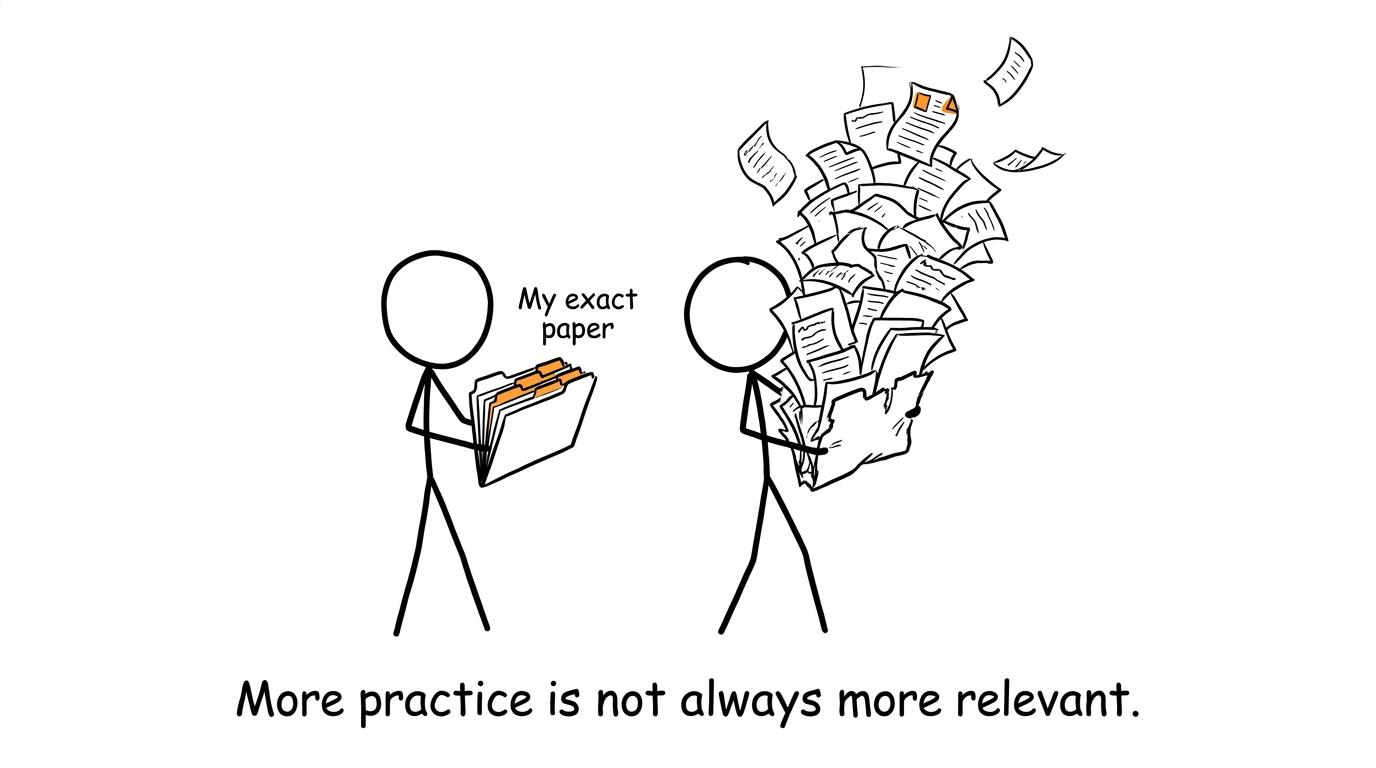 A precise revision folder looks calmly at a volcano of random practice papers
Common mistakes when comparing GCSE and iGCSE Chinese
Treating iGCSE as one universal specification
International GCSE qualifications come from different awarding organisations. Pearson Edexcel and Cambridge courses, for example, must be checked separately. Some boards also distinguish between Chinese as a foreign language and Chinese as a first language. Always compare exact qualification titles and codes.
Assuming one qualification is automatically easier
Paper structure, tiering and personal strengths influence how difficult an assessment feels. A single untiered paper is not inherently easier than foundation or higher tier, and fewer papers do not necessarily mean less content.
Revising from mismatched past papers
A paper can contain useful Chinese while still being poor preparation for your actual examination. Check the code, series, task types and mark scheme before using it as a mock.
Ignoring the speaking format
Fluent conversation helps, but examination performance also depends on following the required task. Practise picture work, role play or topic discussion according to your own specification.
Comparing raw marks without checking weightings
Raw totals from different qualifications are not directly comparable. Paper lengths, maximum marks and weightings differ. As the MathsGenie explanation of GCSE grade boundaries shows, meaningful comparisons require the correct board, specification and examination series.
Collecting resources instead of using them
Ten unopened papers create less progress than one carefully marked paper. The MathsGenie guide to starting past papers offers a useful progression from targeted practice to timed full papers, while the 20-minute GCSE revision routine helps when Chinese and maths are competing for space in the same week.
Choose the paper, then build the plan
The real GCSE vs iGCSE Chinese difference lies in assessment design. In the Edexcel comparison, GCSE has four tiered papers, while International GCSE has three untiered papers with reading and writing combined. Both assess listening, speaking, reading and writing, and both award grades from 999 to 111.
So begin with certainty. Ask for your full qualification title and specification code. Download the correct specification, use matching past papers and rehearse the exact speaking format. Once those details are settled, the label becomes less intimidating because your next action is clear.
Then give maths the same precision. Open MathsGenie’s free GCSE maths revision area, select your board and tier, and move through revision lessons, practice questions, mini tests, past papers, predicted papers, mark schemes and video solutions. The aim is not to do everything. It is to practise what your examination will actually ask, notice what goes wrong and return better prepared.