

GCSE vs iGCSE Biology: What Is Different?
GCSE vs iGCSE Biology explained: compare content, papers, practical work, grading and maths skills, then revise for the qualification you will sit.
There is a particular kind of uncertainty that appears when two qualifications have almost the same name. You recognise the subject. You recognise the age group. Yet one small letter makes you wonder whether everyone else is learning an easier course.
The short answer to GCSE vs iGCSE Biology is reassuring: both teach the central ideas of secondary-school biology, but their specifications, paper structures, practical assessment and grading systems can differ. The precise difference depends on the exam board. There is no single universal iGCSE Biology course.
What matters most is not which label sounds harder. It is whether your revision matches the exact specification and papers you will sit.
The difference at a glance
Before comparing details, check these five things:
- Qualification: GCSE Biology, International GCSE Biology or Biology within Combined Science
- Exam board: such as AQA, Pearson Edexcel, OCR, Eduqas or Cambridge International
- Specification code: the most reliable way to identify your course
- Tier or route: Foundation and Higher, Core and Extended, or an untiered paper structure
- Assessment format: the number of papers, their weighting and how practical skills are examined
GCSE Biology in England follows nationally regulated subject requirements. International GCSE courses are designed for use in a wider range of countries and are offered by different awarding organisations. Consequently, two iGCSE specifications may differ from one another just as clearly as an iGCSE differs from a domestic GCSE.
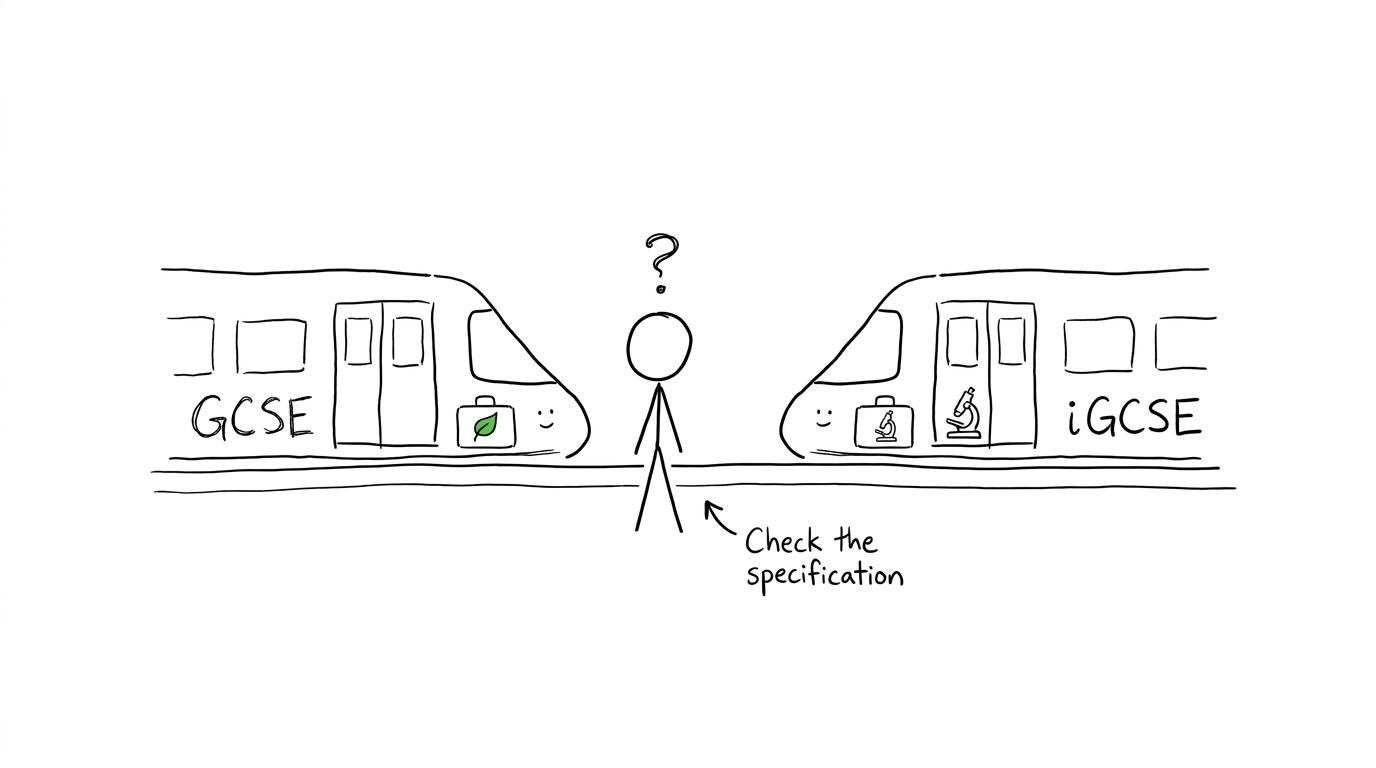 A student choosing between two similar Biology exam trains
GCSE Biology is not one identical course
Students sometimes speak about GCSE Biology as though every school receives the same textbook and exam. The national subject content creates substantial common ground, but boards organise and assess it differently.
For example, the current AQA GCSE Biology specification is linear. Students take two written papers at the end of the course, each lasting 111 hour 454545 minutes and contributing 50%50\%50% of the qualification. Foundation and Higher tiers are available.
Pearson Edexcel GCSE Biology also uses two externally examined papers, with Foundation and Higher entry. OCR offers different Biology suites, including Gateway Science and Twenty First Century Science, each with its own organisation of content and questions. Eduqas and WJEC arrangements must also be checked carefully because qualification structures can vary across England and Wales.
The biological foundations remain familiar: cells, organisation, transport, disease, bioenergetics, homeostasis, inheritance, evolution and ecology. The board determines how these ideas are divided between papers, how questions are phrased and which practical activities receive particular emphasis.
This is the first useful lesson: never revise from the word “GCSE” alone. Revise from your board, specification and tier.
iGCSE Biology can mean several different things
The lowercase “i” is often treated as if it identifies one standard course. It does not. Schools may use Pearson Edexcel International GCSE, Cambridge IGCSE, OxfordAQA International GCSE or another approved international qualification.
Their formats are not interchangeable.
Pearson Edexcel International GCSE Biology
Pearson’s linear International GCSE Biology specification uses two externally assessed papers. Paper 111 assesses the core specification content, while Paper 222 can assess all content, including material identified as additional content in the specification.
Pearson now also offers a modular International GCSE Biology route. Its first teaching began in September 202420242024, with first examinations in June 202520252025. A student taking this route must therefore use modular materials rather than assuming that every Pearson International GCSE paper follows the linear structure.
Cambridge IGCSE Biology
Cambridge IGCSE Biology has a notably different structure. Under the current 202620262026 to 202820282028 syllabus, candidates take three components.
Core candidates sit a multiple-choice paper, a theory paper and either a Practical Test or an Alternative to Practical paper. Extended candidates follow the same broad pattern using Extended theory papers. The practical component contributes 20%20\%20% of the qualification.
Cambridge currently reports this syllabus using grades from A* to G, whereas Pearson International GCSE Biology uses grades 999 to 111. That difference in labels does not mean one course is automatically more demanding. It means you must interpret results within the grading system of the qualification taken.
How much does the Biology content change?
There is considerable overlap. Both GCSE and International GCSE specifications commonly cover:
- cell structure and movement of substances
- enzymes and biological molecules
- photosynthesis and respiration
- transport in plants and animals
- coordination and homeostasis
- reproduction and inheritance
- variation, selection and evolution
- ecosystems and human effects on the environment
- experimental methods and data analysis
The differences often lie in depth, sequencing and emphasis. One specification may separate topics that another combines. Some may include a concept explicitly while another treats it through a broader theme. Terminology can also vary.
This makes specification checking more valuable than comparing the thickness of textbooks. A longer contents page does not necessarily represent a harder course. It may simply divide the same knowledge into smaller headings.
Students considering A Level Biology should build secure understanding rather than chase labels. Cells do not behave differently because the course title changes. However, your school or college may set particular entry grades, so check its published requirements directly.
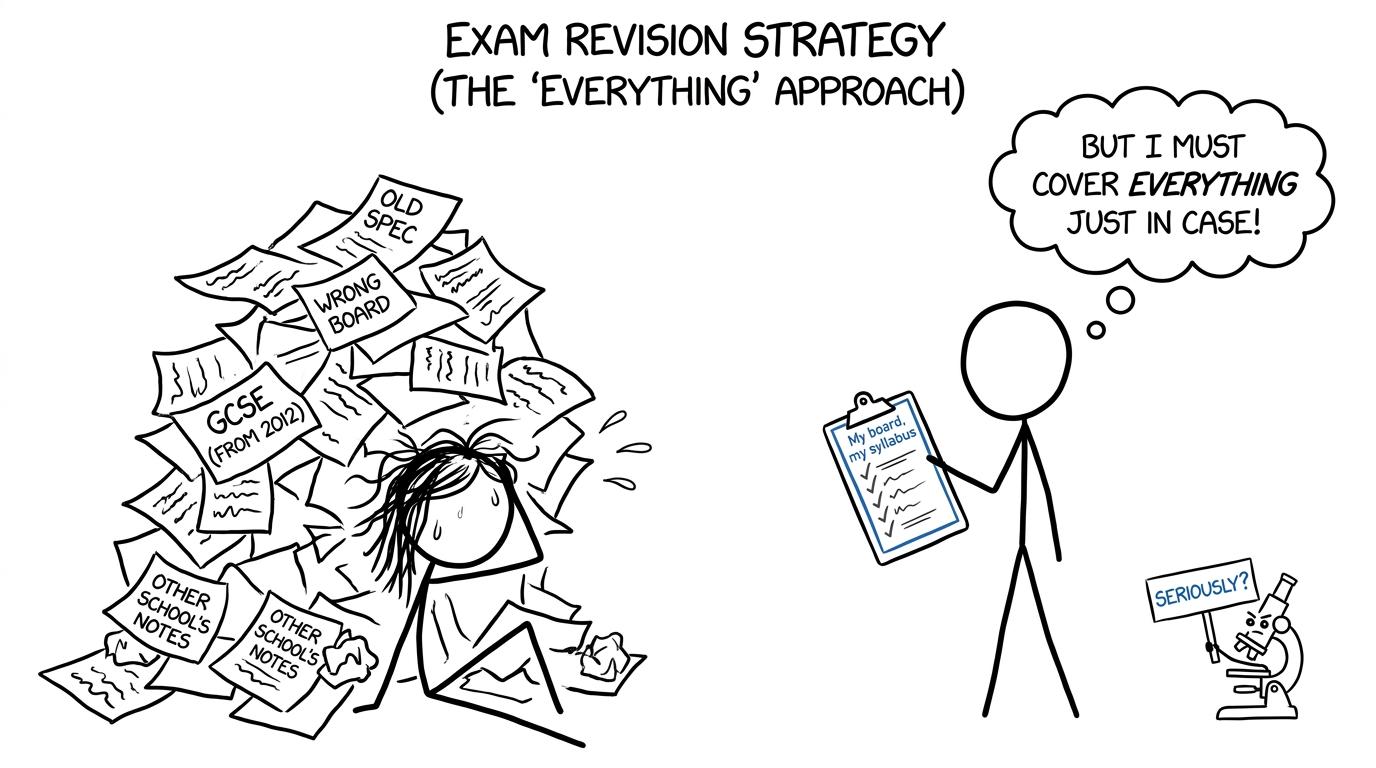 A calm student chooses one specification while another carries mismatched papers
Practical work is one of the clearest differences
Practical science is present in both routes, but it may be assessed differently.
In English GCSE Biology specifications, students complete required or specified practical activities during the course. Their understanding of methods, variables, results, risks and evaluation is then tested through written examinations. AQA, for example, states that practical-related questions account for at least 15%15\%15% of the marks across the qualification.
Cambridge IGCSE Biology gives practical assessment a distinct component. Depending on the school’s entry, this may be a laboratory Practical Test or a written Alternative to Practical paper. Both routes test experimental skills and contribute 20%20\%20%.
Pearson International GCSE Biology examines practical understanding through its written papers rather than requiring a separate practical examination for the linear qualification.
The revision consequence is important. Do not merely memorise a list of experiments. You should be able to identify variables, organise results, interpret graphs, evaluate reliability and suggest specific improvements. The format changes, but sound scientific reasoning remains valuable everywhere.
Does one course contain more maths?
Both GCSE and iGCSE Biology require numerical confidence. Depending on the specification, questions may involve:
- percentages and percentage change
- ratios and proportions
- averages and ranges
- rates
- probability in genetics
- graph scales and gradients
- unit conversions
- magnification
- standard form
A familiar percentage relationship is:
percentage=partwhole×100\text{percentage} = \frac{\text{part}}{\text{whole}} \times 100percentage=wholepart×100Magnification questions use the relationship:
magnification=image sizeactual size\text{magnification} = \frac{\text{image size}}{\text{actual size}}magnification=actual sizeimage sizeThe formula is rarely the real obstacle. Lost marks usually come from inconsistent units, misread graph scales or rounding too early.
MathsGenie students can strengthen these transferable skills through the GCSE Maths revision hub, the focused Standard Form revision lesson and the guide to GCSE Maths topics by board and tier. That work supports Biology while also preparing you for your maths exams.
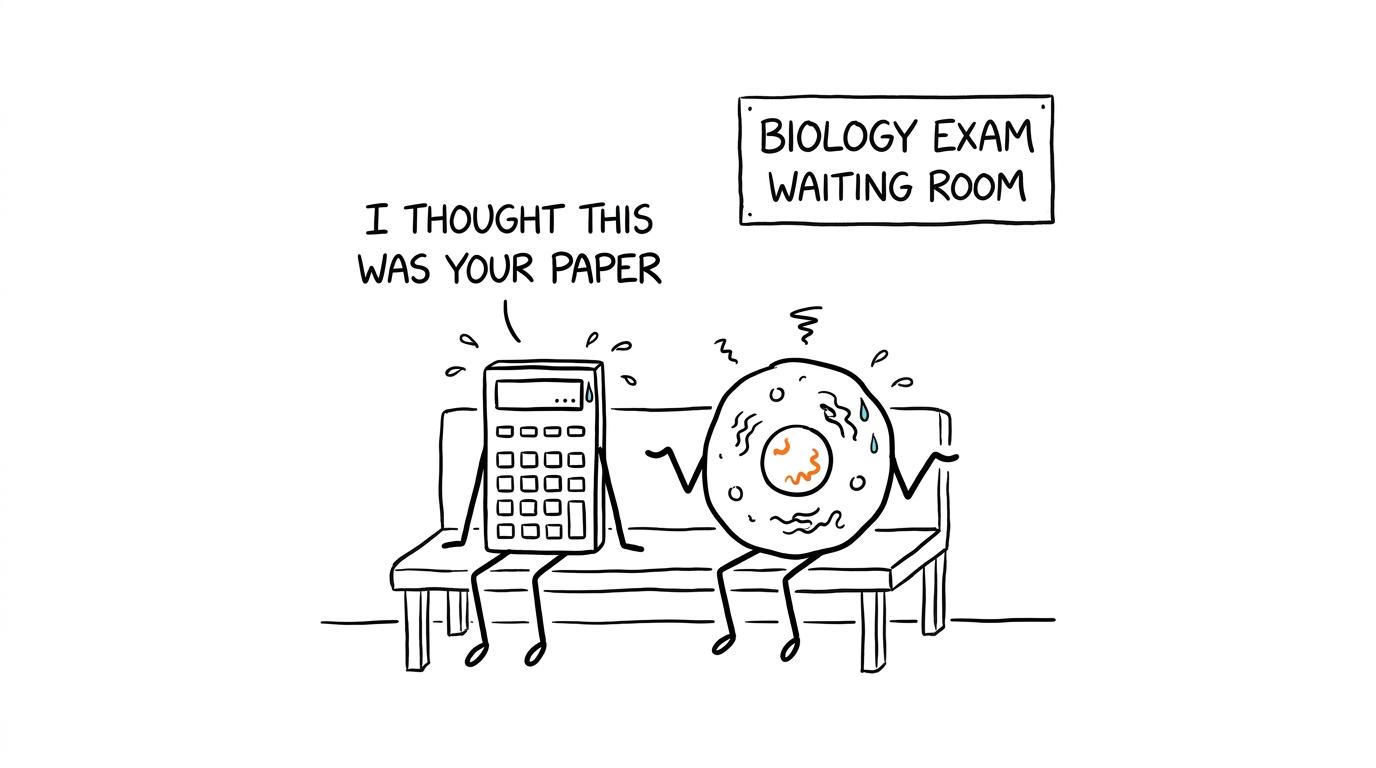 A calculator and a biology cell wait nervously for an exam
Is iGCSE Biology harder than GCSE Biology?
There is no reliable one-word answer.
Difficulty depends on the specification, your strengths and the assessment route. A student who likes concise multiple-choice questions may respond well to one Cambridge component but find its separate practical assessment demanding. Another student may prefer two longer written papers. A course can feel harder because of unfamiliar wording, broader recall or more independent data interpretation, even when much of its underlying content overlaps with another qualification.
Tiering complicates the comparison too. Many GCSE Biology courses use Foundation and Higher tiers. Cambridge uses Core and Extended routes. Pearson International GCSE Biology has its own paper structure. Comparing a Foundation GCSE paper with an Extended Cambridge paper would not be a balanced comparison.
Treat claims that one qualification is “always harder” with caution. The better question is: what does my specification expect me to know and demonstrate?
Does it matter which qualification you sit?
For most students, the decision is made by their school rather than chosen individually. Your task is to prepare for that route accurately.
Both qualifications can support progression, but individual sixth forms, colleges, universities and employers set their own entry requirements. If an application asks for a particular science grade or specifically names GCSE Biology, check whether your exact International GCSE qualification is accepted rather than relying on a general assumption.
Your result is shaped less by the name on the cover than by the quality of your preparation. Secure knowledge, careful calculations and familiarity with the correct question style matter more than rumours about prestige.
A revision method that works for either route
Begin with the specification and turn every statement into a checklist. Then use a simple cycle:
- retrieve a topic from memory
- answer questions from your own board
- mark them using the correct mark scheme
- record the precise reason for each lost mark
- revisit the weakness and test it again
For the mathematical side of Biology, use MathsGenie’s OCR Biology revision guidance alongside board-specific science materials from your school. Build exam discipline with GCSE past-paper advice, then apply the same mark, fix, retest cycle to Biology.
For maths itself, Edexcel GCSE Maths past papers provide papers, mark schemes and worked support. Shorter sessions can be built around GCSE revision planning guidance, while GCSE predicted papers offer fresh practice nearer the exams.
Predicted papers should complement, not replace, the specification and genuine past papers.
Common mistakes when comparing GCSE and iGCSE Biology
Assuming every iGCSE follows the same syllabus
Cambridge and Pearson qualifications have different papers, practical arrangements and grading structures. Always identify the awarding organisation and specification code.
Confusing separate Biology with Combined Science
This is a different comparison. A GCSE or International GCSE student may study Biology as a separate qualification or within a combined science award. Check what appears on your exam entry.
Revising from the wrong paper set
Questions from another board can provide extra practice, but they should not define your revision. Topic coverage, command words and paper structure may not match your assessment.
Believing practical revision means memorising methods
Examiners can change the context. Learn why controls are needed, how variables are measured and how evidence supports a conclusion.
Neglecting maths because the subject is Biology
Percentages, rates, graphs and units are part of scientific reasoning. Keep those skills active through regular maths practice rather than trying to repair them in the final week.
Choose the paper, then prepare for it
The difference between GCSE and iGCSE Biology is real, but it is not a verdict on your ability or future. The courses share a large biological core. Their most important differences concern specification detail, tiering, paper structure, grading and practical assessment.
Find your exact course. Read its specification. Practise its questions. Then stop spending energy wondering whether somebody else received the easier label.
MathsGenie can keep the numerical side of that preparation secure. Use the free revision lessons and practice questions to repair individual skills, mini tests to check progress, past papers and mark schemes to build exam judgement, and video solutions when a method is unclear. Nearer your maths exams, add predicted papers and a structured revision plan. Good revision is rarely mysterious; it is simply specific, checked and repeated.










