GCSE to A-Level English Literature Jump Explained
GCSE to A-level English Literature jump explained: compare reading, essays and independence, then learn how to prepare while revising GCSE maths.
The difficult thing about choosing an A level is that you must decide before you have experienced it. English Literature can look familiar from GCSE: more novels, more poems and more essays. Yet the GCSE to A-level English Literature jump is not simply an increase in workload. The real change is intellectual. You are expected to read more independently, sustain more complex arguments and consider interpretations that may challenge your own.
So, how much harder is it? Noticeably harder, but manageable if you enjoy close reading and prepare for the change. For students currently balancing English with GCSE maths exams, the most useful approach is to understand exactly what changes and build habits that protect time for both subjects.
The jump at a glance
Here is the short version:
- A-level English Literature covers a broader and deeper body of reading.
- Essays require sustained, conceptual arguments rather than a sequence of observations.
- Context must inform interpretation instead of appearing as a detached fact.
- Different critical readings become more important.
- Comparison is more sophisticated and may span genres or periods.
- Independent reading, accurate quotation and organised notes matter more.
- Assessment details vary between Edexcel, AQA, OCR and Eduqas, so you must check the specification used by your sixth form.
The jump is therefore less about learning a completely new subject and more about performing familiar skills at a more independent level.
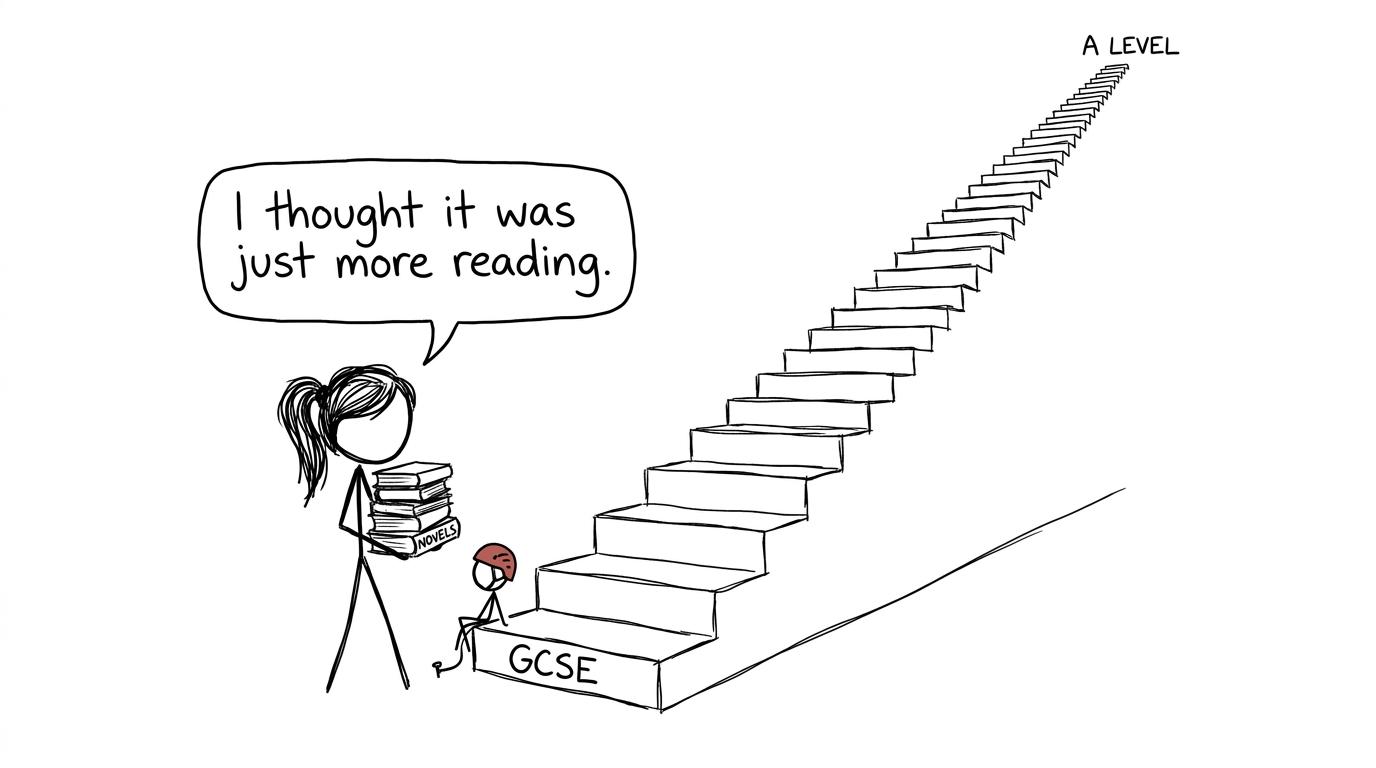 A student facing the staircase from GCSE to A level English Literature
How GCSE and A-level English Literature differ
For qualifications regulated in England, GCSE English Literature requires substantial whole-text study across Shakespeare, a nineteenth-century novel, poetry since 1789 and British fiction or drama from 1914 onwards. Students also respond to unseen material.
The national A-level subject content explicitly builds on GCSE but extends literary study in breadth and depth. It requires poetry, prose and drama, with a minimum of eight texts across the complete A level. These must include at least three texts published before 1900, at least one Shakespeare play and at least one work first published or performed after 2000. Students must also encounter an unseen text.
That difference in scope matters, but text quantity is only part of the story.
| At GCSE | At A level |
|---|---|
| Detailed knowledge of set texts | Detailed knowledge across a wider body of literature |
| Clear response supported by references | Independent, sustained argument supported by precise evidence |
| Analysis of language, form and structure | More integrated analysis of how meanings are shaped |
| Relevant contextual understanding | Evaluation of how contexts affect writing and reception |
| Some comparison and unseen analysis | More sustained connections between texts and traditions |
| A personal interpretation | A personal interpretation tested against other readings |
Exam boards organise these requirements differently. One course might be structured around historical periods, another around genres or themes. Non-exam assessment may also give students some choice over texts and comparisons. Before enrolling, ask the sixth form for its current specification, set-text list and assessment structure rather than assuming every course is identical.
Why A-level essays feel much harder
At GCSE, a well-selected quotation followed by thoughtful language analysis can earn valuable marks. At A level, that remains useful, but it is no longer enough by itself. The examiner wants to see an argument developing across the essay.
A paragraph cannot merely say that a writer uses an image and then explain its effect. It needs to connect that detail to a larger interpretation of the work. You may also need to consider whether another reader could understand the passage differently, how its form shapes meaning, or how the interpretation changes when placed within a literary or historical context.
This creates three important changes.
You must think beyond individual quotations
Quotations become evidence within an argument, not the argument itself. Secure A-level responses often move between close textual detail and the text as a whole. Structure, genre, narrative perspective and recurring patterns matter alongside individual words.
There may not be one safe interpretation
A-level study gives greater attention to how texts have been interpreted by different readers, including across time. You do not have to agree with every critical position. You do need to engage with alternatives thoughtfully and use evidence to justify your judgement.
Context must become part of the reading
Context should illuminate a text, not sit beside it. A remembered historical fact earns little if it does not help explain the writer's choices, the text's reception or the assumptions a reader might bring to it.
This is why the jump can initially feel strange. More knowledge is required, but the larger challenge is deciding how that knowledge changes your interpretation.
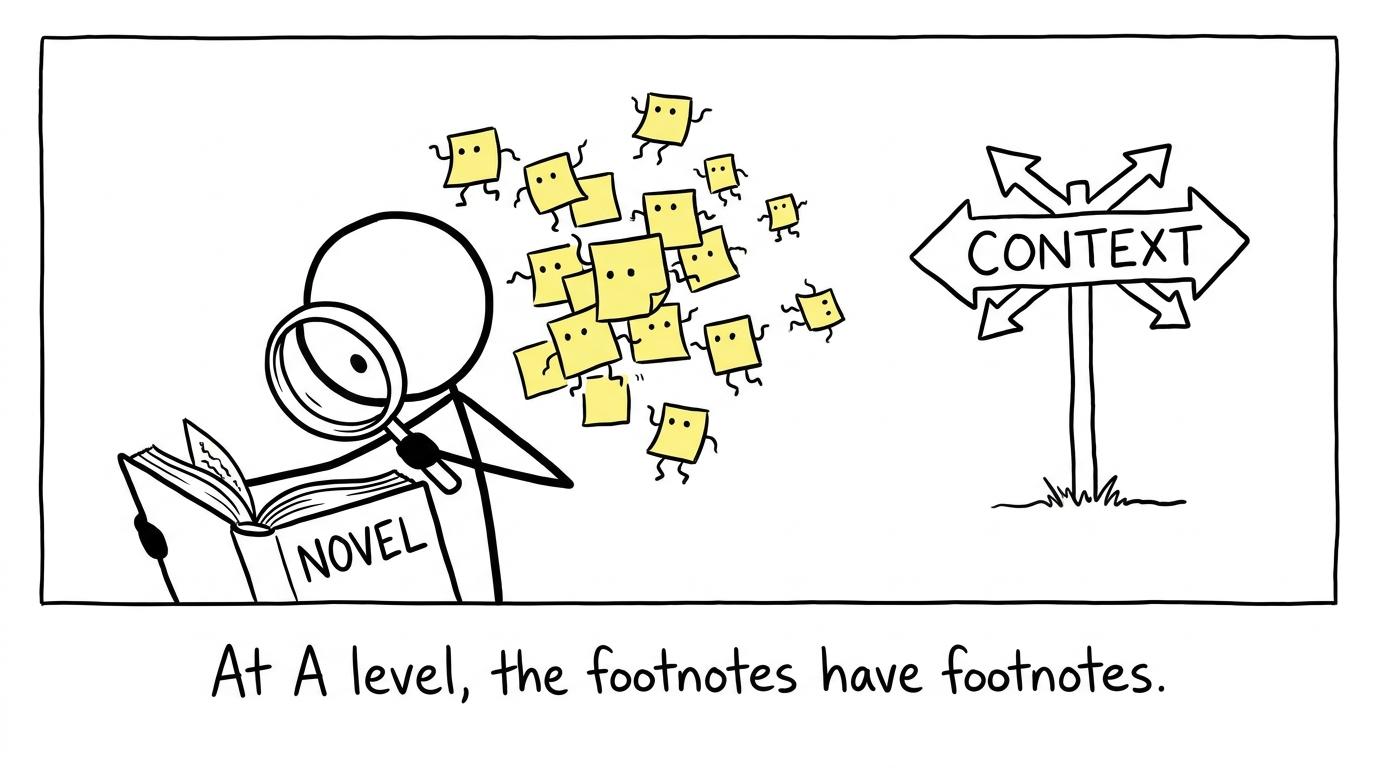 A literary detective discovers that the footnotes have footnotes
How hard is the GCSE to A-level English Literature jump?
There is no honest numerical answer. Difficulty depends on your reading habits, writing fluency, course texts and willingness to work independently. A strong GCSE grade is helpful, but it does not remove the adjustment.
The jump is likely to feel substantial if you rely heavily on memorised paragraph structures or teacher-provided interpretations. Those supports can help at GCSE, but A-level English Literature increasingly asks you to make choices: which evidence matters, which interpretation is convincing and how the parts of an essay fit together.
You may find the transition more manageable if you already enjoy rereading passages, discussing ambiguity and writing arguments that develop rather than repeat. Reading speed helps, but patient reading is more valuable. A short passage read closely can reveal more than a chapter rushed for completion.
The useful comparison is not “easy versus impossible”. It is “guided analysis versus increasingly independent literary study”.
How to prepare before starting A-level English Literature
You do not need to teach yourself the entire course during Year 11. Your immediate priority is completing GCSEs well. Preparation should be light, purposeful and sustainable.
Strengthen your GCSE foundations
Keep improving the skills that transfer directly:
- answer the precise question set;
- form a clear interpretation;
- choose concise textual evidence;
- analyse language, form and structure;
- connect context to meaning;
- compare ideas rather than merely spotting similarities;
- write accurately and coherently under time pressure.
These foundations matter more than learning advanced terminology for its own sake.
Read beyond your set texts
Read across poetry, prose and drama without trying to annotate every page. A mixture of modern and older writing will help you become comfortable with different voices and structures.
After reading, record a few brief thoughts: what changed, what remained unresolved and which feature of the writing shaped your response? The purpose is to practise independent judgement, not manufacture a school essay about everything you read.
Practise building arguments
When discussing a text, replace “What technique is used?” with better questions:
- What is my central interpretation?
- Which detail most strongly supports it?
- What could challenge this reading?
- How does the text's form affect the idea?
- Why might readers respond differently?
This is the mental shift A-level essays demand.
Learn to manage notes
A large folder of disconnected quotations quickly becomes unhelpful. Organise notes by themes, characters, structural patterns, contexts and interpretations. Keep quotation selections short enough to retrieve and flexible enough to use in more than one argument.
Balancing English preparation with GCSE maths revision
A-level planning should not quietly consume the time needed for current exams. If maths is one of your immediate pressure points, organise it first.
Start with the GCSE Maths revision hub, choose your exam board and identify the topics that are actually costing you marks. A GCSE revision timetable you can realistically follow is more useful than an ambitious plan that collapses after three days.
Short sessions can keep both subjects moving. The 20-minute GCSE revision routine offers a simple structure for crowded school days. For maths, a focused lesson followed by practice questions and immediate marking creates a clear feedback loop. For English, the equivalent might be reading a passage, planning one argument and checking whether each idea answers the question.
Use Edexcel GCSE Maths mini tests when you need a short diagnostic task. When you have time for longer practice, follow MathsGenie's guide to using GCSE maths past papers properly. Students taking another board should always prioritise papers that match their own specification and tier.
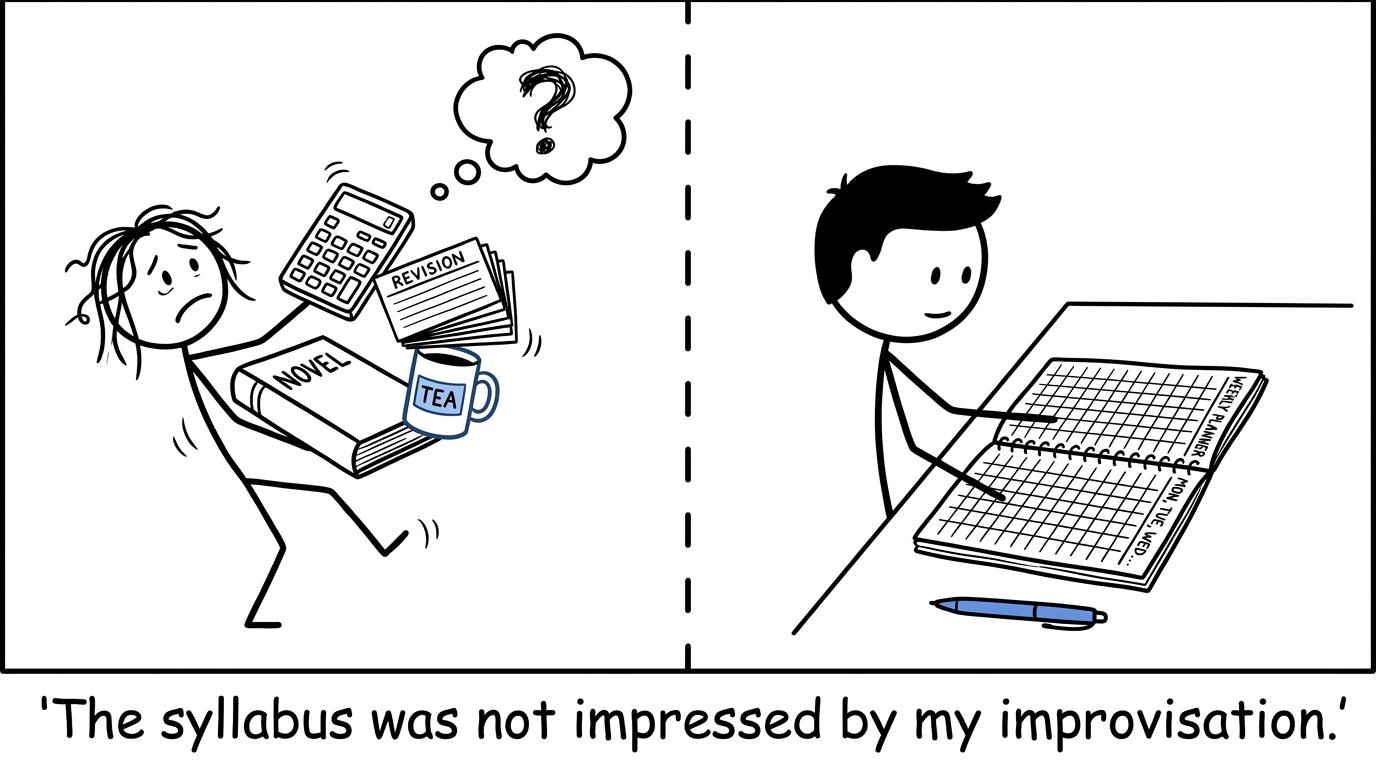 A student tries improvisation while a calmer student uses a weekly revision plan
The principle is simple: future preparation should not weaken present performance. A little wider reading each week is enough while GCSE exams remain the priority.
Common mistakes when preparing for the step up
Trying to sound complicated
Long words and dense sentences do not automatically create sophisticated analysis. A-level writing should be precise. Complexity should come from the thought, not from making a straightforward idea difficult to understand.
Collecting quotations without interpreting them
A quotation bank is useful only when you understand what each quotation could reveal and how its significance might change in different arguments.
Treating context as a fact-recall exercise
Biographical and historical information must contribute to interpretation. Avoid attaching a memorised context sentence to a paragraph without explaining its relevance.
Assuming there is one correct reading
Literary study welcomes disagreement when it is supported by the text. Prepare to test interpretations rather than search for the one answer your teacher supposedly wants.
Neglecting current GCSE revision
Reading next year's novels can feel productive because it is new. It is still less urgent than repairing weaknesses in the exams directly ahead. Use Edexcel predicted papers as realistic additional maths practice, not as a guarantee of what will appear, and continue to prioritise past papers and specification coverage.
Choosing the subject for the wrong reason
Enjoying one GCSE text does not necessarily mean you will enjoy sustained literary study. Look at the actual set texts, assessment model and reading expectations. Equally, do not reject the subject merely because the jump sounds large. Interest and consistent preparation make demanding courses manageable.
The jump is real, but it has a shape
The GCSE to A-level English Literature jump is significant because the course expects broader reading, greater independence and more sustained interpretation. It is not simply GCSE with longer books. You will be asked to make connections, consider competing readings and build arguments that remain coherent across an entire essay.
But a clearly defined challenge is easier to prepare for than a vague one. Strengthen your GCSE analysis, read beyond the set list occasionally and practise explaining why an interpretation is convincing. Then return your attention to the exams in front of you.
MathsGenie can keep the maths side of that plan organised. Use free revision lessons and practice questions to repair individual topics, mini tests to check progress, and past papers with mark schemes and video solutions to develop exam technique. If you are taking Edexcel, the guide to using Edexcel past papers effectively provides a practical starting routine. If you later choose A Level Maths alongside English Literature, Edexcel A Level Maths past papers are ready when that stage arrives.
Make the next step small: choose one weak GCSE maths topic, complete one focused practice set and plan one piece of wider reading for the week. Progress usually looks less dramatic than the staircase ahead. It is simply the next deliberate step.