

GCSE to A-Level Biology Jump: How Big Is It?
GCSE to A-level biology jump explained: compare depth, maths, practical work and exam demands, then build a realistic plan to step up confidently.

Moving from GCSE Biology to A-level Biology can feel less like turning a page and more like discovering that the next chapter has its own language. The GCSE to A-level biology jump is significant: there is more content, greater depth, harder data analysis and much more emphasis on applying knowledge. Yet it is manageable. Strong GCSE foundations, secure maths skills and consistent practice can make the step up far less intimidating.
The short answer is that A-level Biology is not simply GCSE with extra facts. You must connect ideas, interpret unfamiliar evidence, evaluate practical work and communicate with greater precision. The students who adapt best are not necessarily those who memorise fastest. They are the ones who change how they revise.
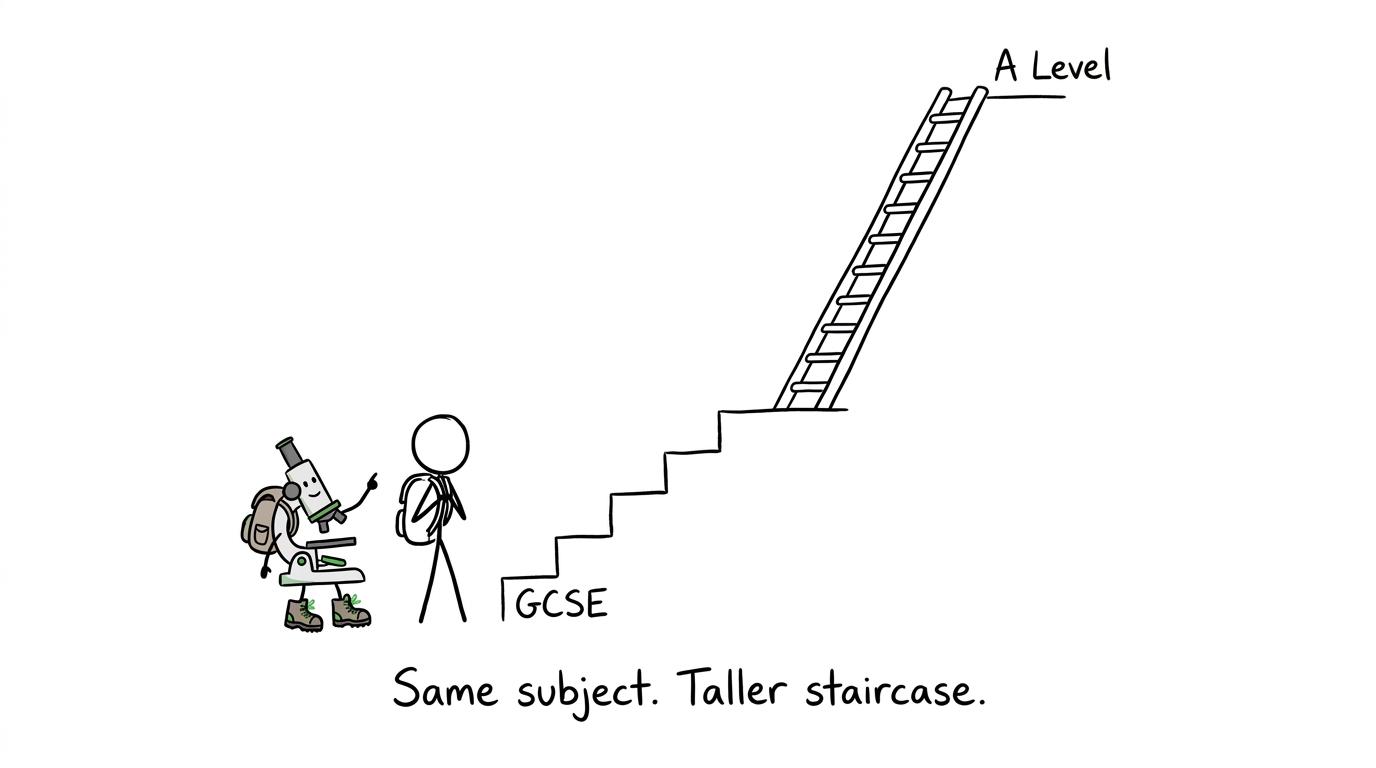 A student facing the unexpectedly tall staircase from GCSE to A Level
The GCSE to A-level biology jump at a glance
Before exploring the differences, use this checklist to understand what changes:
- Content becomes deeper, particularly in biochemistry, genetics, cells, physiology and ecology.
- Questions become less predictable, requiring knowledge to be applied in unfamiliar contexts.
- Mathematical skills remain important, but the calculations and data interpretation demand more independence.
- Practical work becomes more analytical, with greater attention to uncertainty, experimental design and evaluation.
- Scientific vocabulary must be precise, because vague explanations often miss marking points.
- Independent revision matters more, as lessons cannot provide enough repetition on their own.
There is no reliable multiplier that proves A-level Biology is “twice as hard” as GCSE. Difficulty depends on your GCSE course, exam board, confidence with maths and revision habits. The clearest conclusion is that the increase in depth and application is substantial, but preparation can reduce the shock.
How much harder is A-level Biology than GCSE?
You move from describing to explaining
At GCSE, you may receive marks for identifying a process and describing its main stages. At A Level, you are more likely to be asked why the process happens, how its stages are connected and what would happen if one variable changed.
This distinction matters. Recall remains essential, but it becomes the starting point rather than the finish line. Questions may combine knowledge from different specification areas or place a familiar idea inside an unfamiliar investigation.
Across AQA, Pearson Edexcel, OCR and Eduqas, precise requirements and paper structures vary. However, the broad direction is similar: A-level students must apply biological knowledge, interpret qualitative and quantitative information, and analyse or evaluate scientific evidence. Always check the specification used by your sixth form or college rather than assuming every board organises the course identically.
The volume of technical language increases
Biology already has a reputation for vocabulary at GCSE. A Level adds more terms, but the real challenge is distinguishing between ideas that sound similar.
A definition is not secure merely because it looks familiar in your notes. You need to retrieve it without prompts, use it in context and connect it to related processes. This is why short, repeated recall sessions tend to be more useful than rereading an entire chapter.
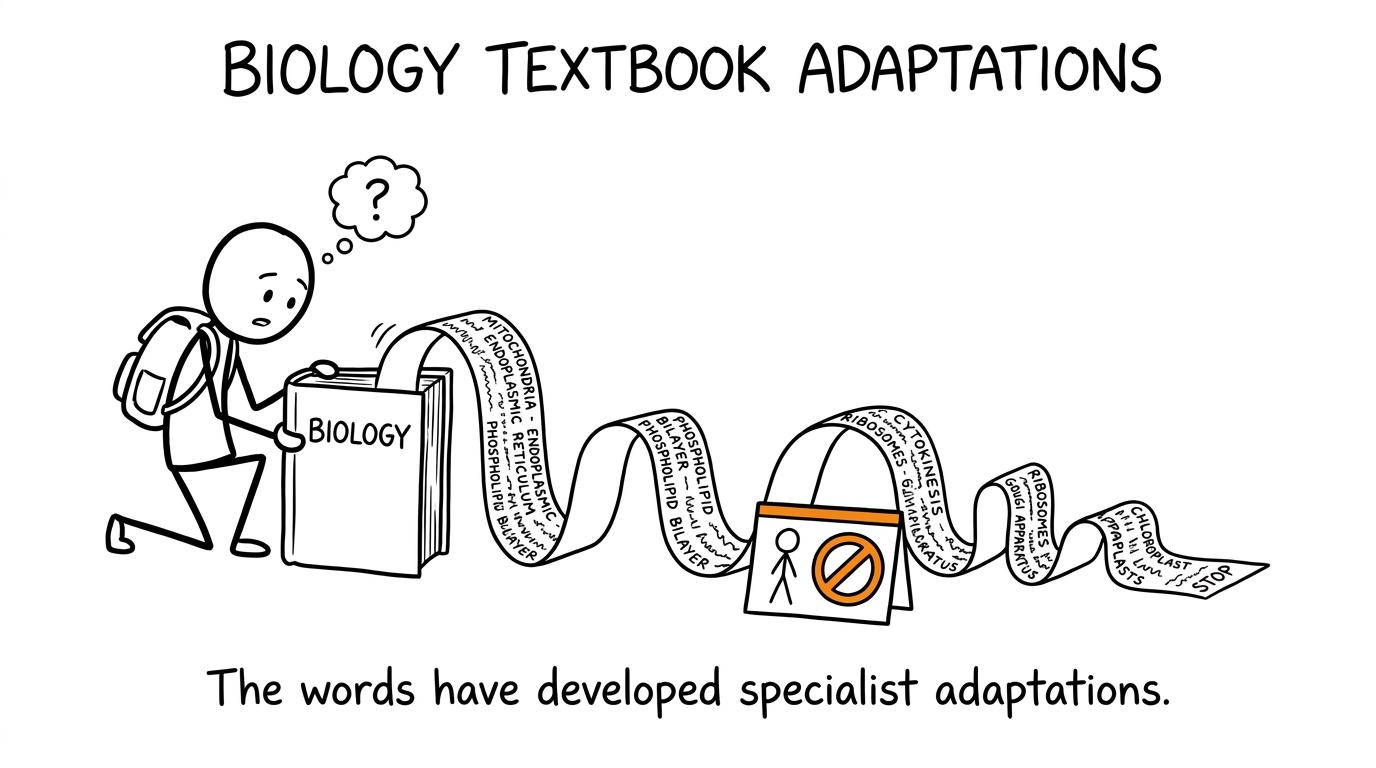 A biology textbook releasing an unexpectedly long ribbon of vocabulary
Application carries more weight
An A-level question may introduce an organism, molecule or experiment you have never seen before. That does not necessarily mean the required biology is new. The question is testing whether you can recognise the underlying principle beneath unfamiliar wording.
This is one of the biggest reasons capable GCSE students initially find A Level difficult. Familiar notes can create a feeling of confidence, while unfamiliar exam questions reveal whether the knowledge is genuinely usable.
A better revision sequence is:
- retrieve the idea without notes;
- explain it in precise scientific language;
- answer an application question;
- compare the response with the mark scheme;
- record the missing link, not merely the missing word.
That same evidence-led method works for maths. MathsGenie's guide to finding your weakest GCSE topics shows how an error log can turn lost marks into specific revision tasks.
How much maths is in A-level Biology?
The percentage alone can be misleading. Ofqual's GCSE requirements mean that at least 10%10\%10% of marks in separate Biology qualifications assess mathematical skills. In A-level Biology, at least 10%10\%10% of the assessment must involve mathematical skills at Level 2 or above, applied in a biological context. AQA describes this as at least the standard of higher-tier GCSE Maths.
The proportion therefore does not suddenly become enormous. The independence and context become harder.
At GCSE, a calculation may clearly indicate the values and operation required. At A Level, you may need to choose relevant data, convert units, select or rearrange an equation, interpret a graph and decide how many significant figures are appropriate.
Useful mathematical foundations include:
- ratios, fractions and percentages;
- percentage change;
- standard form and orders of magnitude;
- unit conversion;
- means, ranges and measures of dispersion;
- probability in genetic contexts;
- graph scales, gradients and intercepts;
- surface area and volume;
- equation rearrangement;
- uncertainty and percentage error.
For example, percentage change uses the relationship
percentage change=new value−original valueoriginal value×100.\text{percentage change}=\frac{\text{new value}-\text{original value}}{\text{original value}}\times 100.percentage change=original valuenew value−original value×100.Magnification connects image size and actual size through
magnification=image sizeactual size.\text{magnification}=\frac{\text{image size}}{\text{actual size}}.magnification=actual sizeimage size.The formulae are often not the hardest part. Marks disappear through inconsistent units, premature rounding or choosing the wrong values from a table.
If these foundations are uncertain, use MathsGenie's free lessons and questions on standard form, ratio and averages. The main GCSE Maths revision hub also lets you choose resources for your exam board.
Practical work becomes part of your reasoning
At GCSE, practical questions already assess variables, methods, graphs, conclusions and evaluation. A Level develops these skills further.
For A-level specifications in England, practical skills are assessed in written examinations and through a separately reported Practical Endorsement. Official subject requirements state that at least 15%15\%15% of A-level Biology assessment should relate to practical work. The exact programme depends on the board: for example, AQA uses required practical activities, while OCR organises work through Practical Activity Groups. Eduqas and other specifications should be checked individually.
You may need to:
- identify limitations in an investigation;
- distinguish random and systematic error;
- consider accuracy, precision and uncertainty;
- choose suitable controls;
- explain why repeats improve confidence;
- process results mathematically;
- decide whether evidence supports a conclusion.
A method should not be memorised as a paragraph without understanding its purpose. Ask what each step controls, measures or makes more reliable. That turns practical recall into practical reasoning.
How to prepare before starting A-level Biology
Secure the GCSE foundations that keep returning
Do not try to pre-learn the entire A-level specification. A more valuable bridge is to strengthen the GCSE ideas on which later work depends:
- cell structure and microscopy;
- enzymes and biological molecules;
- diffusion, osmosis and active transport;
- photosynthesis and respiration;
- inheritance and variation;
- homeostasis;
- ecology and sampling;
- required or core practical methods.
If you studied Combined Science, you can still succeed at A Level. You may simply need to identify content that separate Biology students covered in greater detail and close those gaps early.
Build mathematical fluency now
A-level Biology is a poor place to discover that unit conversion or standard form still feels uncertain. These are small skills, but they appear inside larger questions where biological reasoning already consumes attention.
Use the Edexcel GCSE Maths topic worksheets for focused practice, even if your science board is different. The underlying maths transfers across subjects. Work until you can complete the skill accurately without needing to rediscover the method each time.
Learn to revise through questions
Notes can organise knowledge, but questions reveal whether it is usable. A productive weekly routine contains four elements:
- one short retrieval session;
- one focused content review;
- one set of application or data questions;
- one correction session using a mark scheme.
Maths students already know this rhythm. A lesson introduces the method, practice questions expose weaknesses, and a mark scheme shows what earns credit. You can develop that discipline through MathsGenie's guide to efficient GCSE Maths revision.
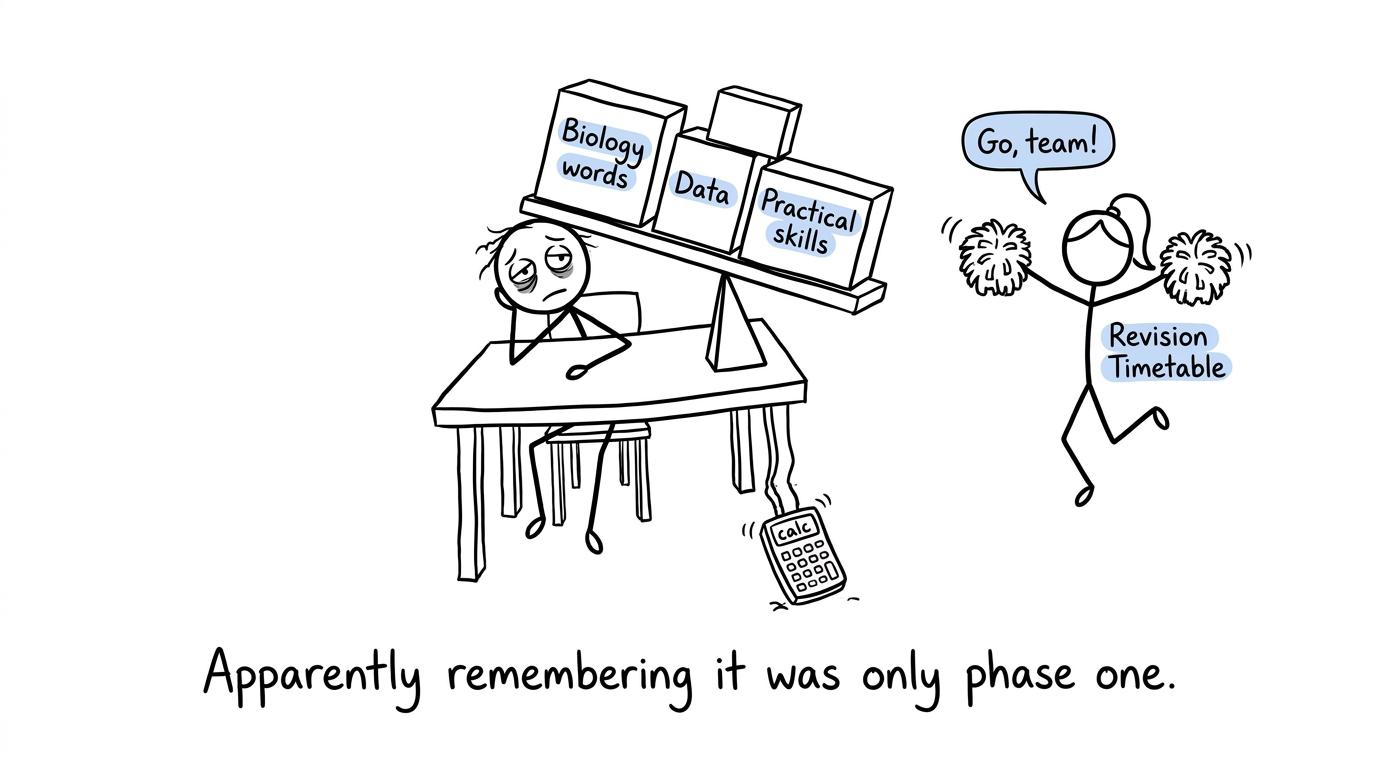 A student balancing biology knowledge, data and practical skills
Practise explaining links between ideas
After revising a process, ask yourself:
- What starts it?
- What changes during it?
- What limits its rate?
- How could it be measured?
- What graph might represent it?
- How is it connected to another topic?
These prompts move revision beyond isolated facts. They also prepare you for extended responses and synoptic questions that draw together different parts of the course.
Common mistakes when preparing for the jump
Assuming a high GCSE grade guarantees an easy transition
A strong grade is an excellent foundation, not a guarantee. GCSE success may have depended heavily on recall, while A Level requires sustained application and analysis. Expect to adjust your method rather than interpreting early difficulty as failure.
Ignoring maths because Biology is a science of words
Biology contains extensive written explanation, but quantitative skills are embedded throughout the specification. Avoiding graphs, percentages and uncertainty leaves a predictable gap in exam performance.
Making beautiful notes without testing recall
Neat notes can feel productive because they create visible progress. The more important question is whether you can reproduce and apply the idea with the page closed.
Memorising mark schemes word for word
Mark schemes reveal required precision, but copying phrases without understanding makes knowledge fragile. Learn why a phrase earns the mark and when it applies.
Using full papers too early or too often
Whole papers are useful for timing and diagnosis, but they are inefficient when several topics remain insecure. Repair foundations first, then use papers to test whether those repairs survive mixed conditions. MathsGenie's advice on redoing past papers effectively explains this learn, practise, mark and retest cycle.
The jump is large, but it is trainable
A-level Biology is harder than GCSE Biology in ways that matter: deeper content, more precise vocabulary, unfamiliar applications, stronger practical reasoning and more independent mathematical decisions. But none of those demands arrives as a single impossible leap. Each is a skill that can be practised.
Start with the foundations already in front of you. Make percentages, graphs, ratio and standard form dependable. Retrieve Biology knowledge rather than merely rereading it. Use questions and mark schemes to discover where your explanations lose precision.
MathsGenie can be your free base for the mathematical side of that preparation. Use the revision lessons and practice questions to repair individual skills, mini tests to check retention, and GCSE predicted papers alongside past papers, mark schemes and video solutions to build calm exam technique. The step up becomes less mysterious once your next action is clear.











