GCSE Subjects to Pair with Food and Nutrition
GCSE subjects to pair with Food and Nutrition: discover strong combinations, avoid workload clashes, and choose options that suit your goals and strengths.
Choosing GCSE options can feel like planning a meal when you do not yet know who is coming to dinner. Every subject sounds useful. Teachers describe exciting lessons. Then the timetable arrives, and all those individually sensible choices must somehow fit together.
The best GCSE subjects to pair with Food and Nutrition are usually biology or separate sciences, geography, PE, business and design and technology. Each connects naturally with nutrition, food science, health, sustainability, product development or costs. But the best combination for you also depends on your strengths, future plans and tolerance for practical or coursework-style deadlines.
There is no single perfect set. A balanced timetable is better than a collection of impressive subjects that leaves no room to revise properly.
A quick subject-pairing checklist
Before comparing individual options, ask five questions:
- Does the subject deepen my understanding of food, health or production?
- Does it develop a different skill, rather than repeating the same type of work?
- How much non-exam assessment or practical preparation is involved?
- Do I enjoy the subject enough to sustain it for two years?
- Does it support a sixth-form, college or career route I may want later?
Your school controls which qualifications and combinations are available, so check its options booklet carefully. Food courses may also have slightly different titles. In England, the GCSE is commonly called Food Preparation and Nutrition, while schools elsewhere in the UK may offer related qualifications under different specifications.
 A student choosing GCSE options from a subject buffet
Why Food and Nutrition connects with more subjects than expected
Food Preparation and Nutrition is not simply a practical cookery course. Official subject content includes nutrition, food science, food safety, food choice, provenance, preparation and cooking. Students may need to explain scientific processes, calculate nutritional or energy values, plan dishes and evaluate results.
Assessment arrangements depend on the qualification and exam board. As one current example, AQA divides its GCSE equally between a written examination and non-exam assessment. That matters when choosing other subjects: Food and Nutrition brings practical work, investigation, planning and written evaluation alongside revision for a final paper.
Maths also runs quietly through the course. Recipes involve ratio and proportion; nutritional information uses percentages and data; practical work requires accurate units, timing and measurement. These relationships can be expressed generally as:
scaled quantity=original quantity×scale factor\text{scaled quantity}=\text{original quantity}\times\text{scale factor}scaled quantity=original quantity×scale factorand
percentage contribution=partwhole×100\text{percentage contribution}=\frac{\text{part}}{\text{whole}}\times 100percentage contribution=wholepart×100That is why strengthening ratio skills for GCSE Maths, proportion and ingredients questions and units and conversions can support both subjects.
The strongest GCSE subjects to pair with Food and Nutrition
Biology or separate sciences
Biology is perhaps the most direct academic partner. Digestion, health, enzymes, microorganisms and the requirements of the human body all provide useful scientific context for nutrition.
Chemistry also connects strongly with the functional and chemical properties of ingredients. Food courses consider processes such as protein denaturation, coagulation, gelatinisation and the action of raising agents. Chemistry can make that language feel less unfamiliar.
Most students already take combined science as part of their core curriculum. Choosing separate sciences can deepen the connection, but it also means more content and usually more examination papers. It makes sense when you genuinely enjoy science or may pursue medicine, dietetics, food science, sports science or another science-based route. It is not automatically the best choice merely because it sounds prestigious.
Best for: students who enjoy explanations, investigations and evidence-based conclusions.
Possible pressure point: a large volume of scientific content alongside Food and Nutrition research and practical deadlines.
Geography
Geography connects particularly well with food provenance, sustainability, global supply chains, climate, resources and food security. It helps answer questions that sit behind every ingredient: where did it come from, why is it produced there, and what environmental or economic pressures shape its availability?
The subjects complement one another without being identical. Food and Nutrition brings practical application; geography adds wider human and environmental context.
Best for: students interested in sustainability, global development and the journey from producer to plate.
Possible pressure point: substantial case-study knowledge and extended written answers.
Physical Education
PE is a logical partner if you are interested in performance, health or sports nutrition. Energy requirements, hydration and balanced diets all have clear links with physical activity.
However, GCSE PE is not simply playing sport. Specifications normally include theoretical content and assessed practical performance, with exact arrangements varying by exam board. Choose it because you value both sides of the course, not because it appears to offer a break from classroom work.
Best for: students considering sport, coaching, fitness or health-related pathways.
Possible pressure point: practical assessment, theory revision and sporting commitments can compete for time.
Business
Business adds the commercial side of food. Pricing, revenue, costs, customer needs, marketing and operations are relevant to restaurants, catering businesses and food manufacturers.
It also gives repeated opportunities to use percentages, interpret data and reason about financial decisions. The underlying calculation for percentage change is:
percentage change=changeoriginal amount×100\text{percentage change}=\frac{\text{change}}{\text{original amount}}\times 100percentage change=original amountchange×100If data interpretation is a weak spot, MathsGenie's GCSE averages revision can help build the numerical confidence used across maths, business and food-related investigations.
Best for: students interested in catering, hospitality, entrepreneurship or food marketing.
Possible pressure point: choosing business only because it appears easy. It still requires precise terminology, application and written analysis.
Design and technology
Design and technology shares an interest in materials, testing, design decisions and evaluation. It can be valuable for students curious about food product development, packaging or manufacturing.
The overlap is useful, but the workload deserves serious thought. Both subjects can involve sustained project work, careful documentation and deadlines that arrive well before the final examinations.
Best for: organised students who enjoy designing, making, testing and improving products.
Possible pressure point: two project-led subjects can create deadline congestion.
A creative or humanities subject
Art, drama, music, history, languages and religious studies may not have an obvious nutritional connection, but GCSE choices do not need to resemble a narrow career training programme. A contrasting subject can create balance and preserve interests outside food and science.
History strengthens argument and evidence. Languages can support hospitality, travel and international cuisine. Art develops visual judgement and presentation. The important question is not whether the connection fits neatly on a careers poster. It is whether the overall combination keeps you curious and manageable.
Students considering the English Baccalaureate should also remember that it is a subject combination rather than a separate qualification. In England, its areas are English, maths, science, geography or history, and a language. Food Preparation and Nutrition can sit alongside those subjects, but it does not itself fill an EBacc area.
Which combinations can create unnecessary stress?
No subject combination is inherently wrong. Stress usually comes from the way several assessment patterns collide.
Too many practical or project-heavy options
Food and Nutrition alongside art and design, design and technology, drama or music can be rewarding. It can also mean several portfolios, rehearsals, practical assessments or extended projects running at once.
The problem is not difficulty alone. It is timing. A final food practical cannot always be moved simply because an art portfolio also needs attention.
Separate sciences without a genuine reason
Separate sciences pair well academically with food, but taking them from fear of “closing doors” can create unnecessary pressure. First check the entry requirements for sixth-form or college courses that genuinely interest you. Combined science already covers biology, chemistry and physics and is accepted for many routes, although individual providers set their own requirements.
Choosing every subject for career relevance
A student interested in nutrition might be tempted by separate sciences, PE, business and design and technology. The links are real, but the resulting timetable could contain heavy theory, practical assessment and project work with little contrast.
Career relevance is useful. Enjoyment and manageability are useful too.
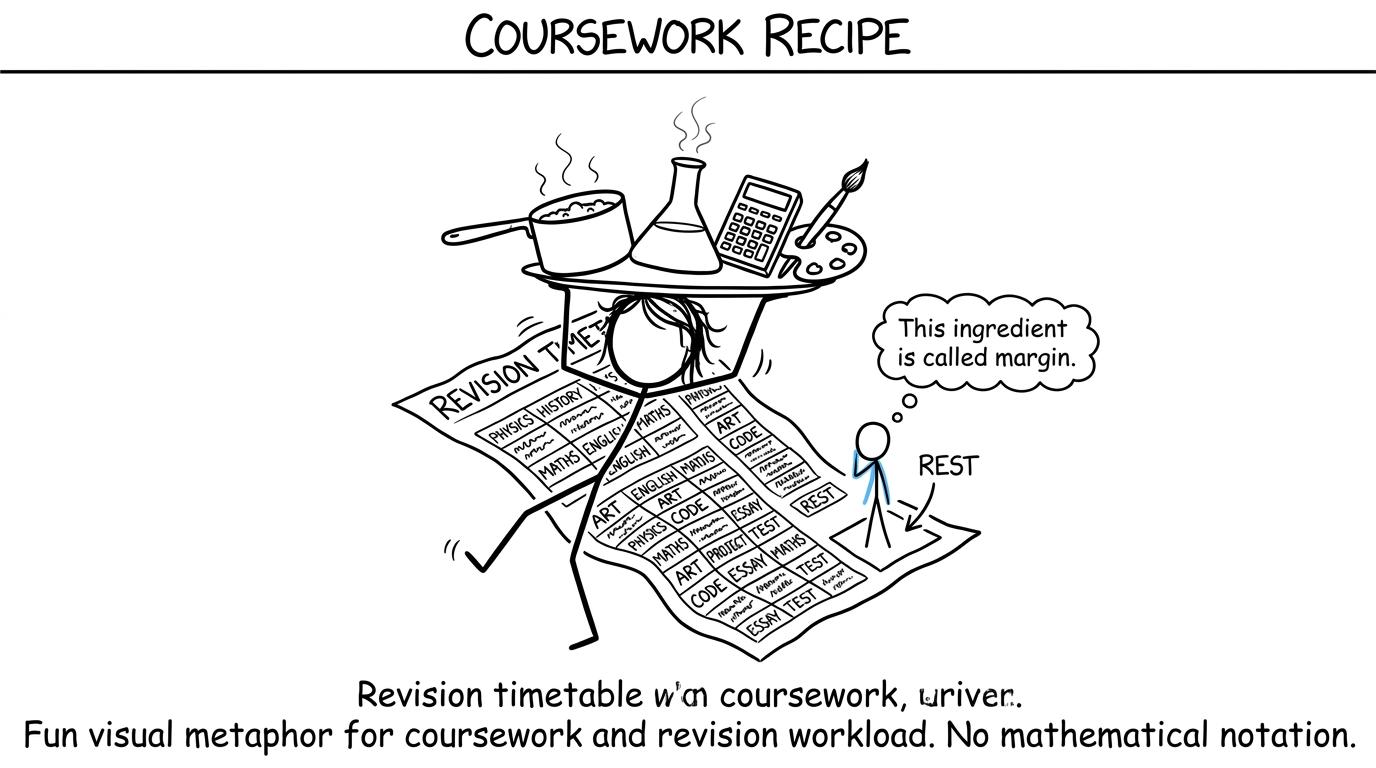 A student balancing an overloaded timetable
How to build a balanced GCSE combination
Think in terms of assessment types rather than subject names. For every possible option, note:
- the amount of content to remember;
- the balance between examinations and non-exam assessment;
- whether practical performance is assessed;
- how much extended writing is required;
- when major deadlines are likely to fall.
Then look across the whole timetable. A combination containing one practical subject, one essay-based subject and one analytical subject may feel more manageable than three subjects demanding long projects at the same time.
Your current working habits matter as well. If planning is difficult, do not assume motivation will magically appear in Year 11. A simple GCSE maths revision timetable can help you see how regular topic practice fits around practical work and other subjects.
Keep maths strong alongside Food and Nutrition
Maths is compulsory, but it is also one of the most useful supporting subjects for Food and Nutrition. You may need to:
- scale ingredient quantities using proportion;
- compare nutritional values and prices;
- interpret tables, graphs and averages;
- convert between units;
- calculate percentages;
- estimate and check whether an answer is reasonable.
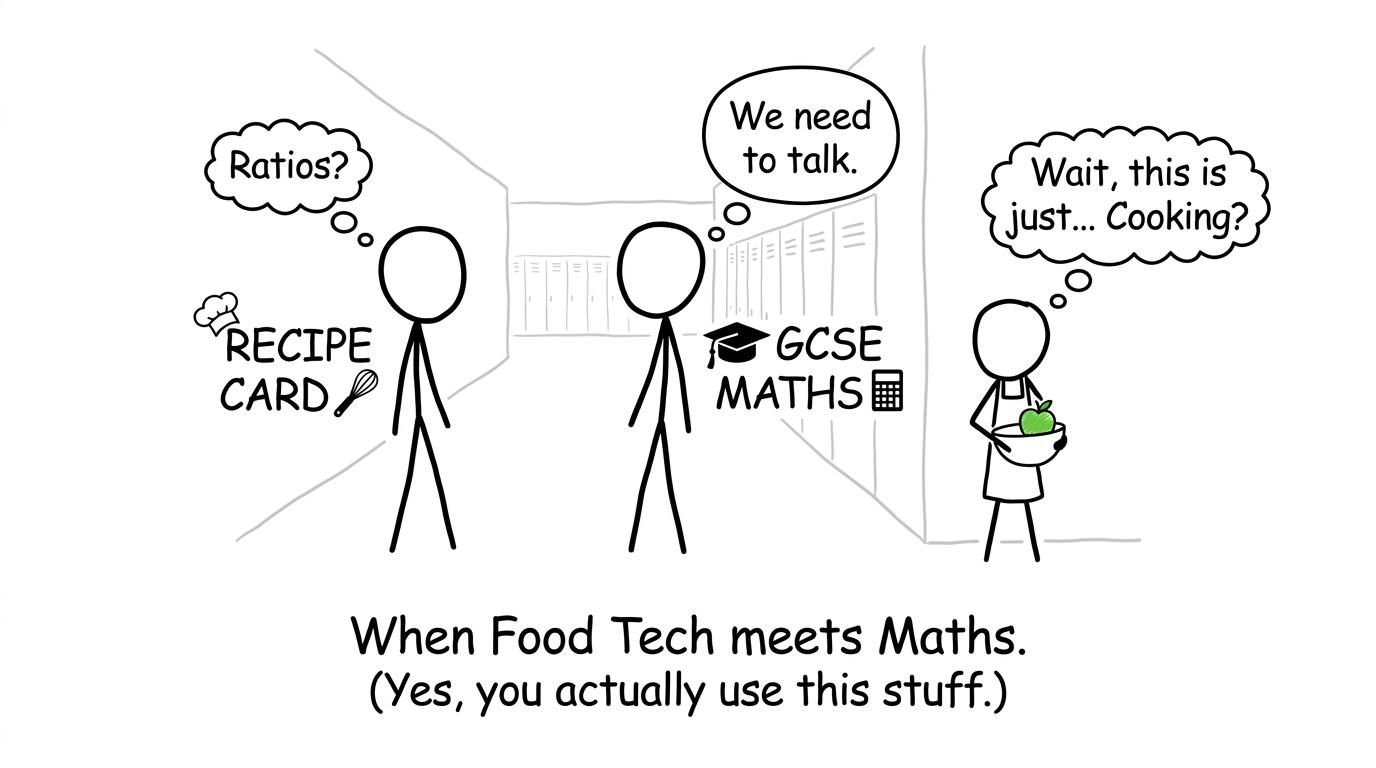 A recipe card meets a GCSE maths paper
Do not wait until a maths mock exposes every weakness at once. Follow a sensible order for learning GCSE maths topics, beginning with number fluency before moving through ratio, percentages, algebra, geometry and statistics.
As examinations approach, add timed practice. MathsGenie predicted papers can provide fresh exam-style questions, while the guide to using GCSE past papers effectively explains when to introduce full-paper practice. Always match resources to your exam board and tier.
Common mistakes when choosing GCSE options
Assuming a strong connection guarantees an easy subject. Biology supports nutrition, but that does not remove the need to learn detailed scientific content.
Ignoring non-exam assessment. Practical and portfolio work can reduce pressure during the final examination period, yet it creates earlier deadlines that require consistent organisation.
Following friends. Shared lessons may feel reassuring in September, but your interests and post-16 plans may differ.
Choosing from reputation rather than evidence. Labels such as “easy”, “academic” or “creative” tell you little about how a subject is assessed or whether it suits you.
Forgetting compulsory subjects. Your options sit alongside English, maths and science. Judge the workload of the complete timetable, not only the subjects you select.
Treating predicted papers as predictions of everything that will appear. They are practice resources, not guarantees. Use them alongside topic revision, official past papers and mark schemes.
Make the choice you can sustain
The best GCSE combination is not the one with the most obvious links. It is the one that gives you useful knowledge, keeps future routes reasonably open and leaves enough time to perform well across every subject.
Biology, geography, PE, business and design and technology can all pair meaningfully with Food and Nutrition. A creative subject or language can be equally sensible when it adds balance. What usually creates unnecessary stress is not one particular option, but too many subjects with overlapping deadlines or a timetable chosen to impress other people.
Once your options are settled, let MathsGenie make the compulsory maths part simpler. Use the free revision lessons and practice questions to repair individual topics, mini tests to check progress, and past papers, predicted papers, mark schemes and video solutions to build exam confidence. Choose calmly, then practise consistently. That combination travels well.