GCSE Statistics Grade Boundaries Explained
GCSE statistics grade boundaries explained: learn why raw marks change by year, how exam boards set thresholds, and how to plan revision with confidence.
A mark can feel permanent. You earned it, wrote it on your revision tracker and perhaps converted it into a percentage. Yet the grade attached to that mark may be different in another exam series.
That is the central idea behind GCSE statistics grade boundaries explained clearly: your raw mark is fixed, but its meaning depends on the grade boundaries set for that particular paper, tier, exam board and series. Boundaries are finalised after marking because exam boards must account for differences in paper difficulty while maintaining a consistent standard between years.
This does not make your result arbitrary. It is designed to stop a slightly harder paper from unfairly lowering everyone’s grades.
The essential grade-boundary checklist
Before using any boundary table, check:
- the qualification: GCSE Statistics or GCSE Maths;
- the exam board, such as AQA or Edexcel;
- the exam series and year;
- your Foundation or Higher tier entry;
- whether the table shows individual-paper or overall qualification boundaries;
- the maximum available mark;
- whether any paper-level boundaries are described as notional.
The safest starting point is the GCSE Statistics revision hub, where you can select your board and find relevant papers, questions and revision materials.
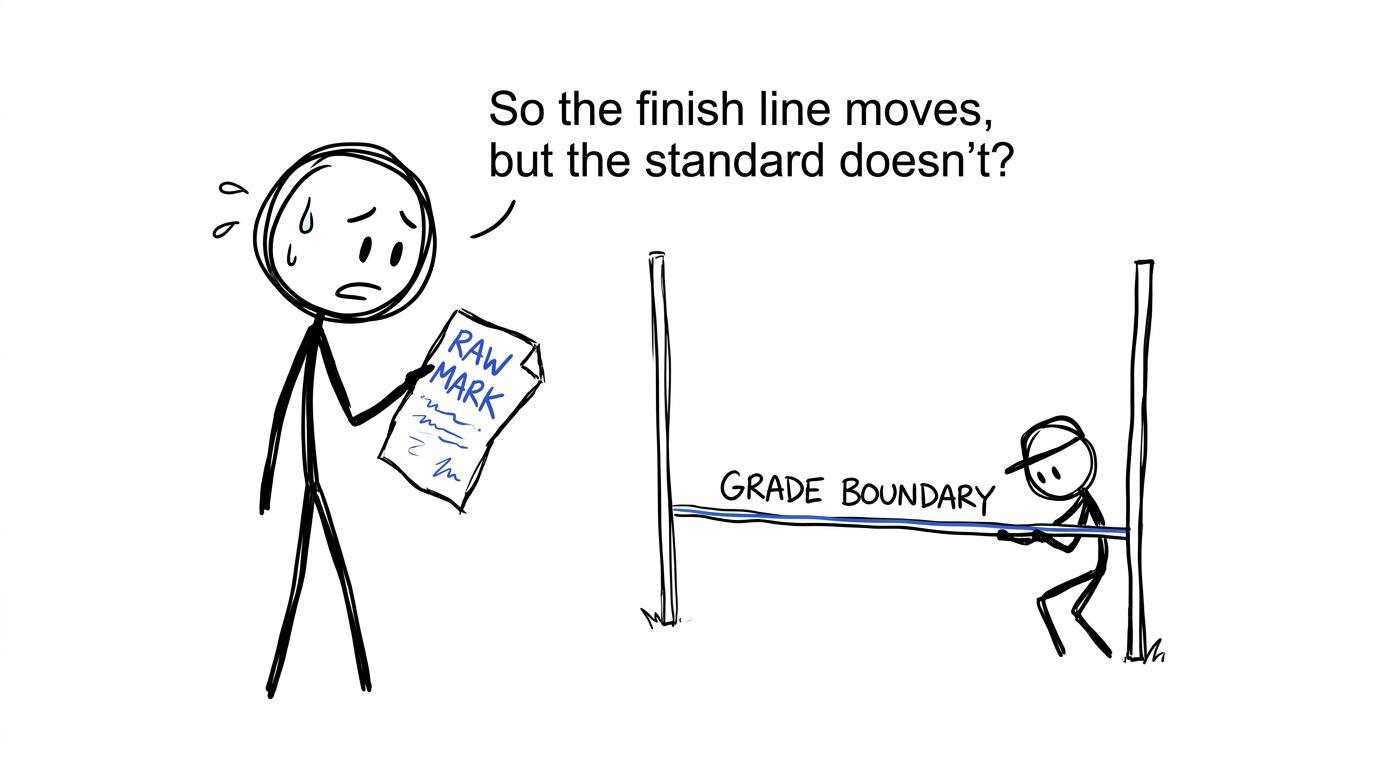 A student discovers that a grade boundary can move while the assessed standard remains steady
What is a GCSE Statistics grade boundary?
A grade boundary is the minimum overall mark required for a particular grade in one exam series. If a boundary is set at a given mark, reaching that mark earns the grade; finishing one mark below places the result in the grade beneath it, subject to the awarding rules for that tier.
Your raw mark is the number of marks awarded by examiners for your responses. For a linear qualification, the marks from the relevant papers are normally combined before the overall qualification boundary is applied. If components have different weightings, the exam board may scale them first.
A percentage is simply another way to express a score:
Percentage score=raw markmaximum mark×100\text{Percentage score}=\frac{\text{raw mark}}{\text{maximum mark}}\times 100Percentage score=maximum markraw mark×100That calculation describes how much of the available mark you earned. It does not independently decide your grade. There is no universal rule saying that the same percentage must always produce the same GCSE Statistics grade.
Why the same raw mark can produce a different grade
No two exam papers are perfectly equal in difficulty. One series may contain an unusually demanding interpretation question. Another may have more accessible calculations or familiar contexts. Exam boards design and review papers carefully, but small differences are unavoidable.
If boundaries were permanently fixed, students sitting a harder paper could be disadvantaged. Instead, boundaries can move:
- a paper found to be more demanding may have lower boundaries;
- a more accessible paper may have higher boundaries;
- the intended standard for each grade should remain broadly comparable.
This is why historical boundaries are useful evidence but unreliable predictions. The GCSE Statistics grade-boundary history shows that thresholds have changed between series. It should help you understand the pattern, not persuade you that next year’s figures are already known.
A recent illustration of the differences between tiers
Pearson’s published June 2025 Edexcel GCSE Statistics boundaries were based on a total maximum of 160160160 marks. Selected overall boundaries were:
| Tier | Grade | Minimum raw mark |
|---|---|---|
| Foundation | 555 | 878787 |
| Foundation | 444 | 686868 |
| Higher | 999 | 121121121 |
| Higher | 777 | 808080 |
| Higher | 444 | 242424 |
These figures belong only to that qualification, tier and exam series. They are not target percentages for a future paper, and comparing Foundation and Higher figures directly is misleading because the papers target different grade ranges and levels of demand.
For board-specific preparation, the Edexcel GCSE Statistics revision page brings together topic resources and exam practice for both tiers.
How GCSE Statistics grade boundaries get set
Grade boundaries are not normally decided before students sit the papers. Once marking is complete, exam boards use several forms of evidence to identify where each threshold should sit.
Statistical evidence
Awarding teams examine how the cohort performed and compare the evidence with previous series. Prior-attainment information can help indicate whether the group taking the qualification is broadly similar to earlier cohorts.
This does not mean grades are handed out according to a simple quota. GCSE awarding is not merely a competition in which a predetermined percentage of students must fail. Statistical evidence informs the process, but it is not the only evidence considered.
Examiner judgement
Senior examiners review samples of students’ work around possible boundaries. They consider whether the knowledge, reasoning and statistical understanding shown are appropriate for the grade.
The final decision combines evidence about paper difficulty, cohort performance and the quality of work at key thresholds. Ofqual regulates awarding in England, while exam boards are responsible for setting and publishing their boundaries.
Boundaries are specific to the exam series
AQA and Edexcel use their own papers and specifications. Their raw boundaries therefore need not match. A boundary from one board cannot be transferred to another simply because both qualifications are called GCSE Statistics.
Confirmed boundaries are published with results information after the awarding process. Any number circulated before then is an estimate, even if it is based on previous years.
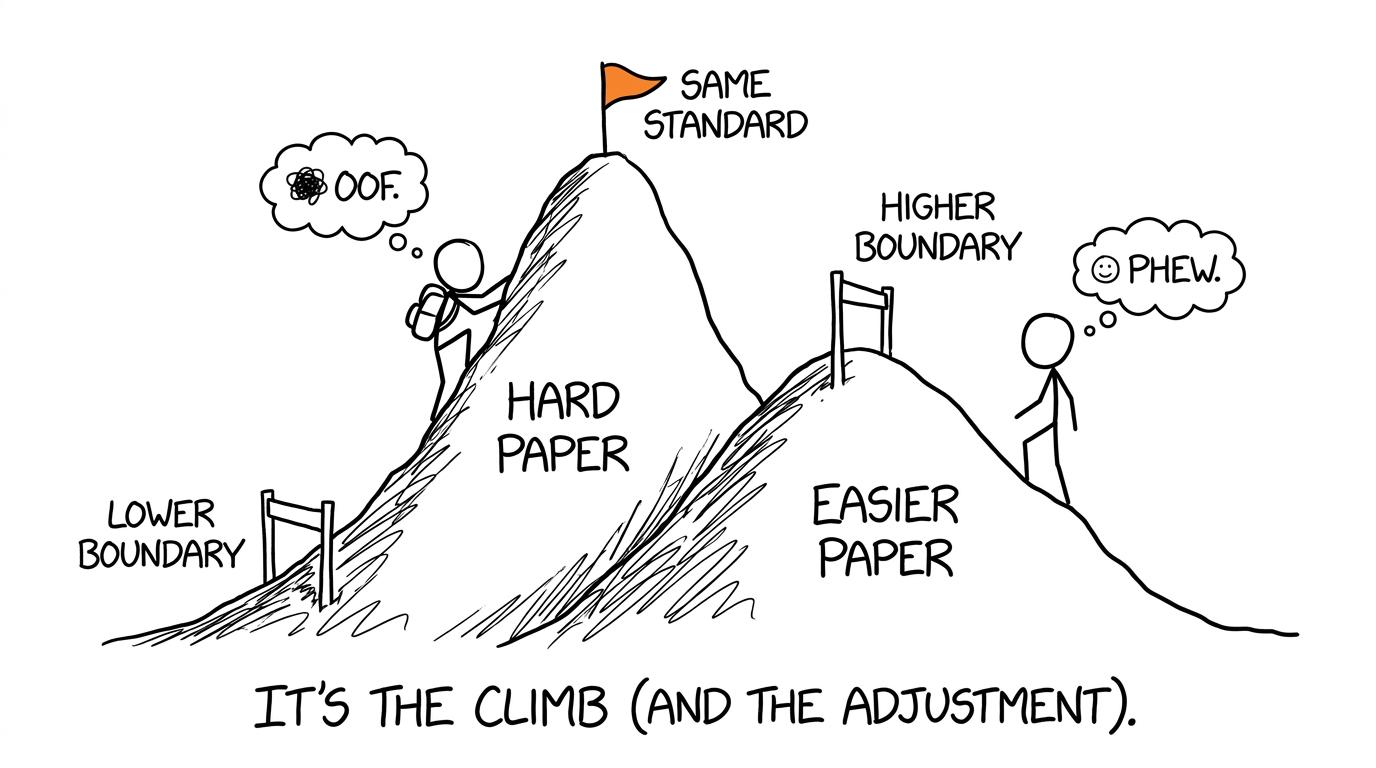 Two students cross different exam-paper hills to reach the same assessed standard
GCSE Statistics is not the same as statistics in GCSE Maths
This distinction prevents a great deal of confusion.
GCSE Statistics is a separate qualification with its own specification, papers and final grade. By contrast, statistics questions within GCSE Maths contribute marks towards your overall Maths result. You do not receive a separate statistics grade for one section of a Maths paper.
If you are preparing for GCSE Maths rather than the standalone Statistics qualification, use the GCSE Maths topics by board and tier to check how statistics, probability and the other content areas fit into your course.
The practical lesson is simple: always read the title and specification code on a boundary document. A GCSE Maths boundary cannot tell you the grade for GCSE Statistics, and a paper-level threshold cannot automatically tell you the final qualification grade.
How to use boundaries without letting them control revision
Grade boundaries matter on results day. During revision, however, they are less useful than the mistakes hidden inside your raw mark.
A score alone cannot tell you whether marks disappeared through weak knowledge, poor interpretation, calculator errors, incomplete comparisons or lost time. Your next action should come from the marked script.
Track marks, but target improvement
Record the raw mark for each complete paper and keep the maximum mark beside it. Then classify lost marks under headings such as:
- knowledge or formula recall;
- incorrect statistical method;
- interpretation in context;
- inaccurate calculation;
- incomplete explanation;
- timing or unanswered questions.
This turns a disappointing score into a revision plan. MathsGenie’s GCSE Statistics resit and results-day plan uses the same principle: diagnose first, repair individual topics and then return to timed papers.
Compare like with like
When you refer to a historical boundary, match the board, tier, specification and series. Comparing your Higher paper with a Foundation boundary produces no useful conclusion.
Even a correct historical boundary remains only a rough benchmark for an unseen future examination. Build a margin above the grade you want rather than aiming for the lowest mark that happened to work once.
Use papers as diagnostic tools
Complete papers under realistic conditions, mark them strictly and revisit every lost mark. The guide to starting GCSE past papers explains how to move from short sections to full timed practice.
Predicted papers can provide fresh questions, but they cannot predict an exact future boundary. Their value is practice. A calm revision routine matters more than guessing whether a threshold will rise or fall.
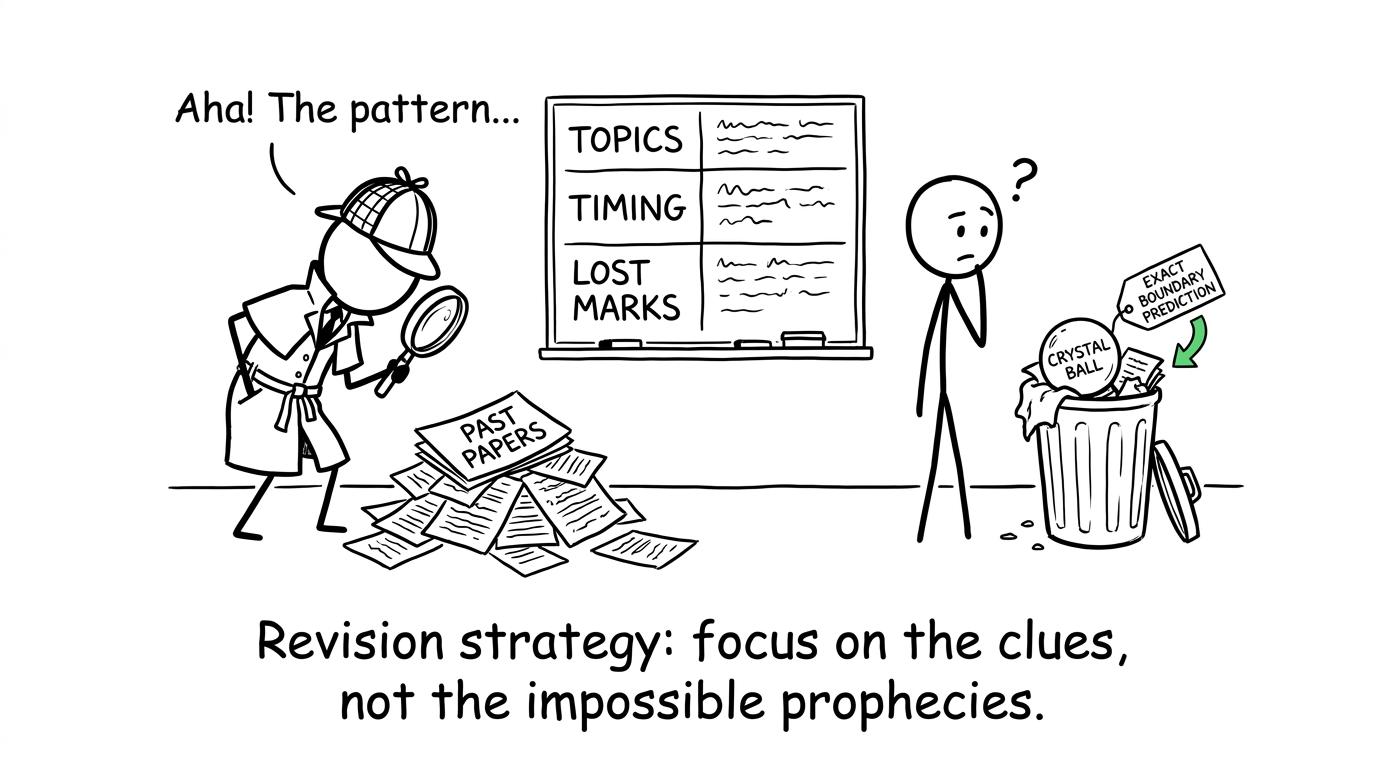 A revision detective investigates lost marks while ignoring a crystal ball for boundary predictions
Common mistakes when reading grade boundaries
Treating a boundary as a fixed percentage
A familiar percentage may feel like a permanent pass mark, but GCSE boundaries are expressed using marks for a particular series. Always consult the correct official table once it is published.
Adding paper grades together
Individual-paper boundaries may be described as notional. They indicate what performance on one component might resemble, but your qualification grade is normally determined from the combined subject mark. Two imagined paper grades should not be averaged to manufacture a final result.
Using last year’s boundary as a prediction
Past boundaries provide context, not certainty. The future paper and the evidence from the new cohort will be different.
Ignoring tier and exam board
Foundation and Higher papers target different ranges of performance. AQA and Edexcel also use different papers. Check every label before drawing a conclusion.
Revising only until you reach last year’s threshold
This creates a fragile target. Normal variation in paper difficulty, question style and your own performance can erase a small margin. Aim to improve understanding and consistency instead.
A structured GCSE Maths revision timetable can help you balance topic repair, mixed questions and timed papers without allowing one estimated grade to dominate every session.
The boundary moves, but your next step stays clear
Grade boundaries exist because exam papers vary. Your raw mark records what you earned; the boundary translates that mark into a grade while preserving standards as fairly as possible across different series.
So track marks, but look beneath them. Find the question types that repeatedly cost you marks. Learn the method, practise it, check the mark scheme and retest it later.
Start with MathsGenie’s free GCSE Statistics revision resources. Use revision lessons and practice questions to strengthen individual topics, mini tests to check recall, and past papers or predicted papers to build timing. Mark schemes and video solutions then show you where the next recoverable mark is waiting.
You cannot control next summer’s boundary. You can control how prepared you are when you meet it.